
Last Updated: March 2026 | Reading Time: 9 minutes | ~2,000 words
Anxiety disorders are the most common mental health conditions in the world — and India is no exception. An estimated 45–50 million Indians live with an anxiety disorder, yet fewer than 1 in 10 receives any treatment. While fear and worry are normal human experiences, anxiety disorders are characterised by excessive, persistent, and disproportionate anxiety that significantly impairs daily functioning — work, relationships, and physical health. Anxiety disorders are not “overthinking” or “weak nerves.” They are well-defined medical conditions with validated diagnostic criteria, clear neurobiological mechanisms, and highly effective treatments — often curable without lifelong medication. The key is recognition — because in India, anxiety most commonly presents as physical symptoms (palpitations, breathlessness, dizziness, chest pain) that lead to countless cardiology, gastroenterology, and general medicine consultations without the underlying anxiety ever being identified.
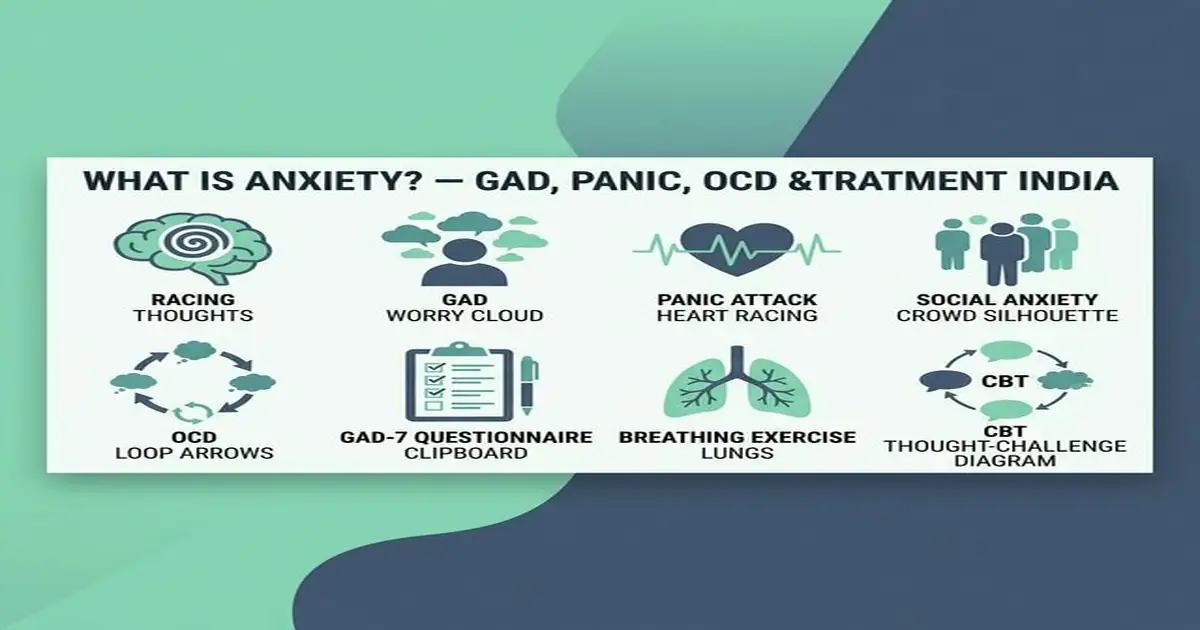
Types of Anxiety Disorders — Complete Guide
| Type | Core Feature | Physical Symptoms | India Relevance |
|---|---|---|---|
| Generalised Anxiety Disorder (GAD) | Excessive, uncontrollable worry about multiple everyday topics (family, finances, health, future) for 6+ months | Muscle tension, headache, insomnia, fatigue, irritability, GI upset | Most common anxiety disorder in India; financial insecurity and family pressure are dominant triggers; often dismissed as “tension” or “stress” |
| Panic Disorder | Recurrent, unexpected panic attacks — sudden surges of intense fear peaking in minutes; persistent worry about future attacks (anticipatory anxiety); avoidance behaviour | Heart pounding, chest pain, breathlessness, dizziness, sweating, trembling, fear of dying or “going mad” — classic cardiac mimicry | Extremely common in urban India; massive cardiology workup before psychiatric referral; ECG, stress test, echocardiogram — all normal — then anxiety diagnosed |
| Social Anxiety Disorder (Social Phobia) | Intense fear of social situations where scrutiny or humiliation is possible; avoidance of public speaking, eating in public, meeting new people | Blushing, sweating, trembling, nausea, voice shaking in social situations | Career-limiting condition in India — fear of interviews, presentations, office meetings; often misread as “shyness” or “introversion” |
| OCD (Obsessive-Compulsive Disorder) | Intrusive unwanted thoughts (obsessions) + repetitive behaviours/mental rituals (compulsions) to neutralise obsession anxiety; typically ego-dystonic (person recognises irrationality) | Not primarily physical; but exhaustive compulsions consume hours daily (hand washing, checking, counting, arranging) | India has high OCD prevalence with contamination obsessions (germ/purity themes) and religious obsessions (paap, blasphemous thoughts) — unique Indian subtypes |
| Health Anxiety (Illness Anxiety / Hypochondriasis) | Preoccupation with having or developing serious disease despite medical reassurance; excessively health-monitoring; avoidance of medical information or compulsive checking | Amplified awareness of normal body sensations (heartbeats, GI gurgling); drives excessive investigations | Extremely common in post-COVID India; frequent cancer fear; excessive testing; drives significant healthcare expenditure |
| Post-Traumatic Stress Disorder (PTSD) | Following trauma exposure — flashbacks, nightmares, hypervigilance, emotional numbing, avoidance of trauma reminders; lasting >1 month | Startle response, sleep disturbance, palpitations with trauma reminders | Domestic violence survivors, disaster survivors, combat veterans, road accident victims — significantly undertreated in India |
GAD-7 — Screening for Anxiety (Self-Assessment)
The GAD-7 is the validated 7-item anxiety screening tool. Over the past 2 weeks, how often have you been bothered by the following? (Score: 0=Not at all, 1=Several days, 2=More than half the days, 3=Nearly every day)
| # | Question |
|---|---|
| 1 | Feeling nervous, anxious, or on edge |
| 2 | Not being able to stop or control worrying |
| 3 | Worrying too much about different things |
| 4 | Trouble relaxing |
| 5 | Being so restless that it is hard to sit still |
| 6 | Becoming easily annoyed or irritable |
| 7 | Feeling afraid as if something awful might happen |
Scoring: 0–4 = Minimal anxiety; 5–9 = Mild anxiety; 10–14 = Moderate anxiety; 15–21 = Severe anxiety. Score ≥10 warrants clinical evaluation by a psychologist or psychiatrist.
Treatment of Anxiety Disorders in India
| Treatment | Evidence | Best For | India Cost |
|---|---|---|---|
| CBT (Cognitive Behavioural Therapy) | Gold standard first-line for all anxiety disorders; evidence superior to medication for long-term outcomes; teaches thought challenging + exposure techniques | GAD, panic disorder, social anxiety, health anxiety, OCD (ERP-CBT) | Private therapist ₹800–3,000/session; iCall ₹200–500; government hospitals free; 12–16 sessions typical |
| Exposure and Response Prevention (ERP) | Specific gold standard for OCD — systematic exposure to obsessional triggers with prevention of compulsive response; 60–80% response rate | OCD specifically; also panic with avoidance | Specialist OCD therapist needed; limited availability in India — increasing via teletherapy |
| SSRIs (Sertraline, Escitalopram, Fluvoxamine for OCD) | Effective for GAD, panic disorder, social anxiety, OCD; higher doses often needed for OCD (fluvoxamine/fluoxetine at OCD doses) | All anxiety disorders; OCD requires higher doses and longer duration (12–24 months) | Generic sertraline ₹2–5/tablet; fluvoxamine ₹5–10/tablet; widely available |
| SNRIs (Venlafaxine, Duloxetine) | Effective for GAD, panic; good for comorbid depression + anxiety | GAD with physical symptoms; comorbid pain + anxiety | ₹5–15/tablet; available generically |
| Buspirone | Specifically for GAD; non-sedating, non-habit-forming; takes 2–4 weeks to work; minimal side effects | Pure GAD; long-term use safe | ₹3–8/tablet; underused in India |
| Breathing and relaxation techniques | 4-7-8 breathing (inhale 4s, hold 7s, exhale 8s) activates parasympathetic system; reduces panic attack intensity; diaphragmatic breathing reduces GAD baseline anxiety | Panic attacks (immediate management); GAD (daily practice) | Free; can be self-taught; significantly effective as adjunct |
| Mindfulness-Based CBT (MBCT) | Particularly effective for stress- and ruminative-type anxiety; reduces relapse | GAD; recurrent depression-anxiety | Apps: Headspace, BetterMe (Indian app); group programmes at some centres |
What NOT to Use for Anxiety in India
⚠️ Benzodiazepines (Alprazolam/Xanax, Clonazepam/Clonotril, Diazepam/Valium) — widely overprescribed in India for anxiety — are NOT appropriate long-term treatment. They provide rapid relief but cause physical dependence within 4–6 weeks, cognitive impairment, rebound anxiety on stopping, and do not address the underlying anxiety disorder. They are appropriate only for short-term (2–4 weeks maximum) acute anxiety management while waiting for SSRIs/CBT to take effect. India has a significant benzodiazepine dependence epidemic — millions of Indians take alprazolam daily for years, prescribed by general practitioners, without receiving evidence-based treatment.
Frequently Asked Questions
Is anxiety a mental weakness or can anyone get it?
Anxiety disorders can affect anyone — regardless of intelligence, social status, professional success, or personal strength. Some of the world’s most accomplished people — CEOs, Olympic athletes, renowned scientists, political leaders — have publicly disclosed living with anxiety disorders. The neurobiological reality: anxiety disorders involve measurable changes in brain structure and function — amygdala hyperactivity (the brain’s fear centre), reduced prefrontal cortical control over the amygdala, altered GABA and serotonin signalling, and dysregulated HPA axis (stress hormone system). These are not character traits — they are brain circuit patterns that develop from a combination of genetic predisposition (anxiety disorders have 30–40% heritability) and life experiences (trauma, chronic stress, childhood adversity, perfectionist environments). The person most likely to develop GAD in India is often highly responsible, conscientious, and deeply invested in outcomes for people they love — not someone who is “weak” or “lacking discipline.” Cultural and life-stage factors also matter enormously: competitive academic pressure (JEE, NEET, UPSC) creates anxiety disorders in millions of Indian students; financial insecurity drives chronic hypervigilance; patriarchal family structures create role-based chronic stress in women. Anxiety is not a reflection of the person — it is a reflection of the circumstances and neurobiological vulnerabilities they were born with and lived through.
What is a panic attack — is it dangerous?
A panic attack is a sudden, intense episode of overwhelming fear that reaches peak intensity within minutes and typically resolves within 20–30 minutes. The physical experience is terrifying and often catastrophically misinterpreted: pounding heart (palpitations 140–160 bpm), chest tightness or pain, breathlessness, dizziness or light-headedness, tingling or numbness (especially hands and around mouth — from hyperventilation-induced hypocapnia), sweating, trembling, nausea, hot or cold flushes, and a profound sense of impending doom — “I am dying” or “I am going mad.” Are panic attacks dangerous? No — a pure panic attack, despite its terrifying experience, is not medically dangerous. The physiology is sympathetic activation (adrenaline release) — identical to the fear response from a genuine external threat, but triggered without one. No cardiac arrest, cardiac arrhythmia, stroke, or “going mad” occurs during a pure panic attack. However, a critical caveat: not every sudden chest pain with palpitations IS a panic attack — the first episode must be medically evaluated (ECG, cardiac enzymes) to rule out actual cardiac event, especially in patients over 40, diabetics, hypertensives, and heavy smokers. Once cardiac, respiratory, thyroid, and other medical causes are excluded, recurrent identical episodes are panic disorder. What to do during a panic attack: Do not run away — this reinforces avoidance and worsens future attacks. Instead: breathe slowly (4-second inhale, 6-second exhale); keep feet flat on ground (grounding); name 5 things you can see, 4 you can touch, 3 you can hear (sensory grounding technique); remind yourself “This is anxiety. It is not dangerous. It will pass in 20 minutes.” Alprazolam taken at the onset of every attack creates dependence and prevents the natural habituation process that CBT exploits for cure.
Can OCD be treated without medication?
Yes — for mild to moderate OCD, ERP (Exposure and Response Prevention) — a specialised form of CBT — is highly effective without medication and produces more durable results than medication alone. ERP works by systematically and gradually exposing the person to obsessional triggers while preventing the compulsive response, allowing the obsessional anxiety to rise, peak, and naturally habituate — breaking the obsession-compulsion cycle at its neurological core. Example: for contamination OCD with handwashing compulsions — ERP might involve touching a “contaminated” surface and then waiting progressively longer before any washing, experiencing the anxiety without engaging the compulsion, until the anxiety habituates. This sounds simple but requires skilled therapist guidance. The challenge in India: very few therapists are specifically trained in OCD-ERP — it is different from standard CBT and requires specialist training. For moderate to severe OCD, or when ERP alone is insufficient, SSRIs (particularly fluvoxamine, fluoxetine, sertraline at OCD doses — higher than depression doses) are added. For OCD: medication alone without ERP rarely produces full remission; ERP + SSRI combination is the gold standard for moderate-severe OCD. Duration: OCD is treated for 12–24 months minimum; many patients require long-term management. ICHOCD India is a patient support organisation providing OCD resources in Indian context.
Does anxiety cause physical illness?
Yes — chronic, untreated anxiety has measurable physical health consequences: Cardiovascular: Chronic sympathetic activation from GAD and panic disorder increases heart rate variability reduction, raises baseline cortisol and adrenaline → leads to hypertension, increased cardiac events (anxiety is an independent risk factor for heart disease comparable to smoking), and arrhythmias (anxiety-related atrial fibrillation). Gastrointestinal: The gut-brain axis is profoundly bidirectional — anxiety directly drives IBS (irritable bowel syndrome), functional dyspepsia, chronic nausea, and acid reflux through altered gut motility and visceral sensitivity. Many Indian patients diagnosed with “IBS” or “gastric problems” have primary anxiety disorder driving the gut symptoms. Immune function: Chronic anxiety impairs immune function through cortisol-mediated immunosuppression — increasing susceptibility to infections, impairing wound healing, and potentially modifying cancer surveillance (though the causal relationship here is complex). Musculoskeletal: Chronic muscle tension from GAD causes tension headaches, neck and shoulder pain, TMJ pain, and lower back pain. Sleep: Anxiety is the most common cause of insomnia — hyperarousal prevents sleep onset and maintenance; chronic sleep deprivation then worsens anxiety in a vicious cycle. Hormonal: Chronic cortisol elevation from anxiety disrupts menstrual cycles, reduces fertility, causes weight gain (central adiposity), and impairs thyroid function. Treating the anxiety often resolves multiple seemingly unrelated physical complaints simultaneously — this is why many patients report feeling “completely different physically” after successful anxiety treatment.
Yoga and meditation for anxiety — do they actually work?
Yes — and this is one area where India’s traditional knowledge aligns well with evidence-based medicine. Multiple high-quality randomised controlled trials and meta-analyses confirm: Yoga (particularly Hatha and Kundalini yoga): Reduces GAD symptoms significantly compared to waitlist control — reduces cortisol, activates parasympathetic tone, and improves GABA levels (the brain’s natural anxiety dampener). A 2021 JAMA Psychiatry RCT found Kundalini yoga equivalent to CBT for GAD at 12 weeks. Most effective when practiced 3–5 times/week for 45–60 minutes. Mindfulness meditation: MBSR (Mindfulness-Based Stress Reduction — 8-week programme) is as effective as SSRIs for GAD and social anxiety in multiple head-to-head trials. The mechanism: mindfulness practice strengthens prefrontal cortex regulation over the amygdala (the anxiety fear centre) — structurally measurable on MRI after 8 weeks. Pranayama (breathing techniques): Specifically, alternate nostril breathing (Nadi Shodhana) and extended exhale breathing (parasympathetic activating) reduce acute anxiety — evidence-based, not just traditional. Important caveat: Yoga and meditation are excellent adjuncts and preventive practices — but for clinical anxiety disorders (panic disorder, OCD, moderate-severe GAD), they are adjuncts to, not replacements for, CBT and medication when indicated. A person with OCD cannot yoga their way out of established OCD without ERP. Yoga prevents and reduces; ERP + SSRI treats.
What to Read Next
- Depression — Anxiety and Depression are the Most Common Mental Health Co-morbidity
- Thyroid — Hyperthyroidism Causes Symptoms Identical to Anxiety and Panic Attacks
- Vitamin B12 — B12 Deficiency Causes Anxiety and Palpitations
- Anemia — Iron Deficiency Causes Palpitations and Anxiety-Like Symptoms
- Diabetes — Hypoglycaemia Mimics Panic Attacks; Anxiety Worsens Blood Sugar Control
Anxiety is your brain running the same emergency programme in the absence of an emergency. The alarm is working too well. With CBT, you learn the skill to turn off the false alarm — not to suppress the fear response, but to retrain the brain’s threat-detection calibration. This is a skill. Like any skill, it takes practice. And it works.
About This Guide: Written by the StudyHub Health Editorial Team (studyhub.net.in) based on NICE (UK), APA, and Indian clinical practice guidelines for anxiety disorders. Last updated: March 2026.
Crisis Support: KIRAN Mental Health Helpline 1800-599-0019 (free, 24/7, all Indian languages) | iCall: 9152987821
Authoritative Sources: NIMHANS India | NICE — Anxiety Guidelines | ADAA — Anxiety and Depression Association | WHO Mental Health
⚕️ Medical Disclaimer: This article is for general informational and educational purposes only. Anxiety disorder diagnosis requires clinical evaluation. Benzodiazepines should only be used as short-term bridge therapy and only under medical supervision. Never self-taper or stop psychiatric medications abruptly.