
Last Updated: March 2026 | Reading Time: 9 minutes | ~2,000 words
Cervical cancer is one of India’s most devastating — and most preventable — cancers. India accounts for approximately 25% of the world’s cervical cancer deaths — the single largest national burden globally. An estimated 1,25,000 new cervical cancer cases and 77,000 deaths occur annually in India, making it the second most common cancer in Indian women (after breast cancer). The extraordinary reality: cervical cancer is almost entirely caused by human papillomavirus (HPV) — a common sexually transmitted infection — and is uniquely preventable through HPV vaccination, and detectable at pre-cancerous stage through Pap smear and VIA (Visual Inspection with Acetic Acid) screening. India’s challenge: despite having safe, affordable HPV vaccines (now manufactured domestically by Serum Institute — CERVAVAC, ₹200/dose under government programme) and a simple VIA test available at PHC level, cervical cancer screening coverage remains below 5–10% nationally. Nearly 70% of Indian women with cervical cancer are diagnosed at Stage III–IV — when survival drops below 30% — solely due to lack of screening.
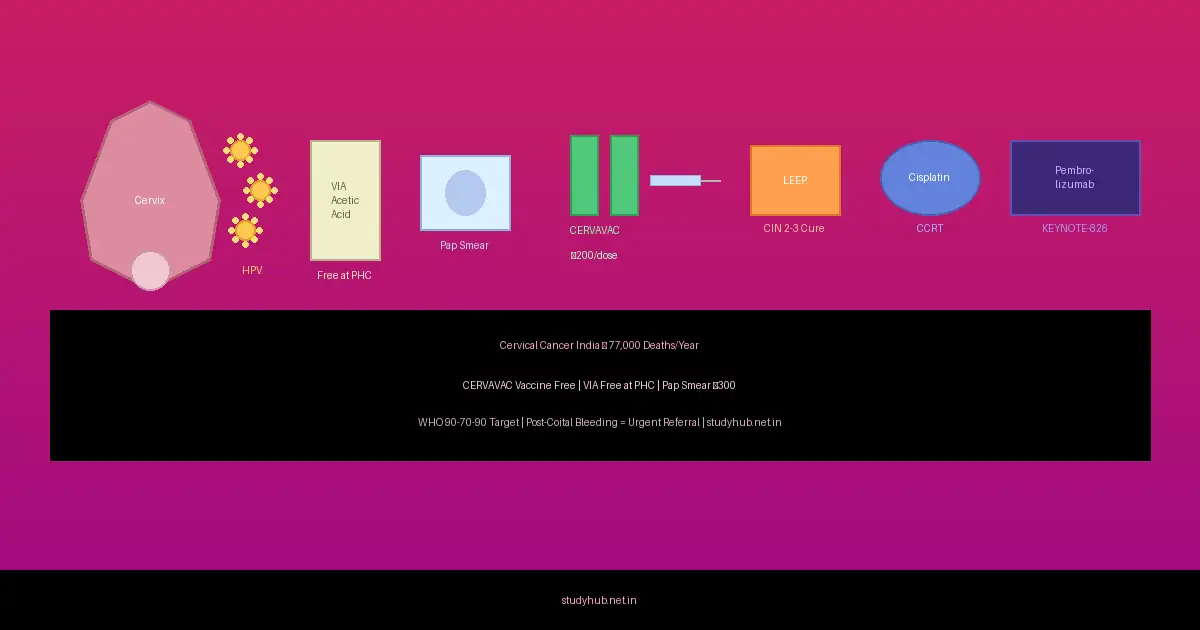
HPV Screening Methods — India Context
| Screening Method | How It Works | Sensitivity / Specificity | India Availability & Cost | Recommendation |
|---|---|---|---|---|
| VIA (Visual Inspection with Acetic Acid) | 3–5% acetic acid (dilute vinegar) applied to cervix; cervical intraepithelial neoplasia (CIN) and early cancer turn white (“acetowhite”) — visible to naked eye; simple, requires no lab, no electricity, results immediate; nurse or trained health worker can perform | Sensitivity 60–80%; specificity 60–80%; lower than Pap or HPV test but fits India’s healthcare infrastructure perfectly | Available at all PHCs under National Cancer Control Programme; can be performed by ASHA/ANM with training; essentially zero cost at government centres; ideal for rural and remote India; WHO recommends VIA for low-resource settings | ✅ Primary screening method for rural/remote India; screen-and-treat approach (VIA positive → cryotherapy at same visit = effective); WHO recommends once in lifetime between 30–49 years; ideally 2–3 times in lifetime |
| Cervical cytology (Pap smear / LBC) | Cells collected from cervix with brush → smeared on glass slide (conventional Pap) or liquid-based cytology (LBC — ThinPrep, SurePath) → examined by cytologist for abnormal cells; reports as NILM (normal), ASCUS, LSIL, HSIL, or malignant | Pap smear: sensitivity 55–70% (single test); specificity 90–95%; LBC slightly higher sensitivity; requires laboratory, cytologist, colposcopy referral infrastructure; sensitivity improves with 3-yearly screening | Government hospitals: ₹100–300; Private labs: ₹400–1,500 (LBC); requires trained cytologist for interpretation; available in cities and towns; limited at PHC level; referral infrastructure for abnormal results needed | ✅ Standard screening in urban/semi-urban India with laboratory access; every 3 years from age 21–65 (or 25–65), or every 5 years with co-testing (Pap + HPV DNA) |
| HPV DNA testing | Molecular detection of high-risk HPV types (HPV 16, 18 — cause 70% of cervical cancers; HPV 31, 33, 45, 52, 58 — next most common); identifies women at risk of CIN2+ even before cytological abnormality visible; can be self-sampled (patient self-collects vaginal swab — increases uptake dramatically) | Sensitivity 90–95% for CIN2+; specificity 85–90%; highest sensitivity of all screening tests; negative HPV test → low risk for next 5 years (5-yearly screening interval) | Private reference labs (Thyrocare, SRL, Metropolis): ₹1,500–4,000; available at AIIMS, tertiary government hospitals; self-sampling kits emerging; under NTCP (National Tobacco Control Programme / Cancer Control): expanding HPV testing | ✅ Preferred primary screening test where available; negative result = 5-year interval; positive HPV 16/18 → direct colposcopy; positive other high-risk HPV → Pap reflex testing; WHO recommends HPV DNA as preferred primary test |
| Colposcopy and biopsy | Magnified examination of cervix after acetic acid application; directed biopsies of acetowhite/abnormal areas → histological confirmation of CIN grade; required when screening test abnormal | Gold standard for diagnosis; guides treatment decision (CIN1 → observe; CIN2–3 → treat) | Available at district hospitals and tertiary centres; cost ₹1,500–5,000; PMJAY covers colposcopy; requires trained colposcopist | Indicated when: positive VIA; ASCUS with positive HPV; LSIL+; HSIL; any abnormal Pap on repeat |
Cervical Cancer Staging and Treatment
| FIGO Stage | Description | 5-Year Survival | Standard Treatment |
|---|---|---|---|
| Stage I (IA1 → IB3) | Confined to cervix; IA1: microscopic invasion <3mm; IB1: <2cm; IB2: 2–4cm; IB3: >4cm | IB1–IB2: 85–90%; IB3: 70–80% | IA1: LEEP or cone biopsy (fertility-sparing); IB1–IB2: radical hysterectomy + pelvic lymph node dissection OR concurrent chemoradiation (equally effective); IB3: concurrent chemoradiation preferred |
| Stage II (IIA–IIB) | IIA: beyond cervix into upper 2/3 vagina; IIB: parametrial invasion (sidewall not reached) | IIA: 70–80%; IIB: 60–70% | Concurrent chemoradiation (CCRT): external beam radiotherapy (EBRT) + cisplatin-based chemotherapy (weekly cisplatin 40mg/m²) → brachytherapy boost; NCCN Category 1 recommendation |
| Stage III (IIIA–IIIC) | IIIA: lower 1/3 vagina; IIIB: pelvic sidewall or hydronephrosis; IIIC: pelvic/para-aortic lymph node metastases | 40–60% | Concurrent chemoradiation; for IIIC2 (para-aortic nodes): extended field radiation; adding pembrolizumab to CCRT: KEYNOTE-A18 trial (2024) showed significantly improved PFS and OS — changing practice for Stage III–IVA |
| Stage IVA | Adjacent pelvic organ invasion (bladder or rectum mucosa) | 20–30% | Concurrent chemoradiation; pelvic exenteration (radical surgery) for very selected cases; pembrolizumab + CCRT (KEYNOTE-A18) |
| Stage IVB / Recurrent / Metastatic | Distant metastases (lung, liver, bone, distant nodes) | <15% | Pemrolizumab + chemotherapy (paclitaxel/cisplatin/bevacizumab — KEYNOTE-826 trial 2021: significant OS benefit for PD-L1+ tumours); bevacizumab (GOG-240 trial); best supportive care; clinical trials |
Frequently Asked Questions
Should my daughter get the HPV vaccine in India?
HPV vaccination is one of the most impactful public health interventions in human history — and India’s CERVAVAC (manufactured by Serum Institute of India, Pune) has made it accessible at revolutionary price points: The HPV vaccine — how it works: Prophylactic (preventive) vaccine; uses virus-like particles (VLPs) — non-infectious shells of HPV protein — to generate immune response without containing live virus; prevents infection by high-risk HPV types (vaccine does NOT treat existing HPV infection — it must be given BEFORE exposure); high efficacy: 98–100% protection against HPV 16 and 18 (causing 70% of cervical cancer) in HPV-naïve individuals. India HPV vaccine options 2026: CERVAVAC (Serum Institute): quadrivalent vaccine targeting HPV 6, 11, 16, 18; first Indian-manufactured HPV vaccine; government programme: free for girls 9–14 years (school-based programme in multiple states — UP, Andhra Pradesh, Tamil Nadu, others); private market: ₹2,000–3,500/dose × 2 doses (9–14 years) or 3 doses (15+ years); dramatically cheaper than Gardasil (₹3,000–4,000/dose, imported). Gardasil 4 (Merck): quadrivalent (HPV 6,11,16,18); widely available private sector India. Gardasil 9 (Merck): nonavalent — covers HPV 6,11,16,18,31,33,45,52,58 (protecting against 90% of cervical cancer strains); premium pricing ₹4,000–5,000/dose. Cervarix (GSK): bivalent (HPV 16, 18); available India. Dosing schedule: Age 9–14 years: 2-dose schedule (0 and 6 months); Age 15+ years: 3-dose schedule (0, 2, 6 months); maximal immunogenicity in younger age group (pre-sexual debut, HPV-naïve, superior immune response); vaccine still beneficial up to age 45 in women (FDA approval); men can also be vaccinated (protects against genital warts, anal cancer, oropharyngeal cancer — HPV 16 is the most common cause of oropharyngeal cancer in men). Safety — addressing vaccine hesitancy India: HPV vaccines are among the most extensively studied vaccines globally; over 400 million doses administered worldwide; serious adverse events: extremely rare; common reactions: injection site pain/swelling, mild fever (same as any other vaccine); fainting (vasovagal — administer seated, observe 15 min post-injection); the vaccine cannot cause HPV infection (no live virus); cannot cause infertility (no biological mechanism; no evidence from any study); India’s HPV controversies (2009–2012 PATH project controversy) involved protocol violations — not vaccine safety; Lancet-published review clearing the HPV vaccine of safety concerns (2015). School-based programme India: Class VI girls (approximately 11 years) are the target group; teacher and parent education critical to achieving high coverage; states with school-based HPV vaccination programmes: Karnataka (pilot 2023), Tamil Nadu, Delhi; National Cancer Grid target: 90% HPV vaccination coverage by 2030.
What are the symptoms of cervical cancer — when to see a doctor urgently?
One of the most important facts about cervical cancer: pre-cancerous cervical changes (CIN — cervical intraepithelial neoplasia) and very early cervical cancer cause NO symptoms — this is precisely why screening exists. By the time symptoms appear, the disease is usually at least Stage IB or more advanced: Symptoms that require urgent gynaecological assessment (within 2 weeks): Post-coital bleeding: bleeding after sexual intercourse — the most specific early symptom of cervical cancer; any woman with post-coital bleeding requires speculum examination and Pap smear or colposcopy; NEVER attribute post-coital bleeding to “cervicitis” or “erosion” without excluding CIN/cancer. Inter-menstrual bleeding: abnormal bleeding between menstrual periods (not related to contraception or identifiable hormonal cause). Post-menopausal bleeding: any vaginal bleeding after menopause requires gynaecological assessment — cervical and endometrial cancer must both be excluded. Foul-smelling vaginal discharge: persistent malodorous, blood-stained or purulent discharge may indicate cervical cancer or infection; do not self-treat with antifungals — medical assessment required. Pelvic pain: lower abdominal or pelvic pain — may indicate parametrial disease (Stage IIB+) or pelvic inflammatory disease complicating cervical infection. Urinary or rectal symptoms: haematuria (blood in urine), frequent urination, rectal bleeding — may indicate advanced disease invading adjacent organs (Stage IVA). India-specific awareness gap: Post-coital bleeding is one of the most taboo symptoms in India — the majority of Indian women experiencing this symptom do not report it to doctors for months or years due to embarrassment, cultural norms around discussing sexual activity, and fear; women in rural settings may have no access to a female gynaecologist; ASHA workers and ANM nurses play a critical role in normalising VIA screening and symptom discussion; community awareness campaigns specifically about post-coital bleeding as a warning sign are among the highest-impact cervical cancer interventions possible.
What treatment does cervical cancer receive in India?
Treatment of cervical cancer in India is provided across a spectrum of centres — from district hospital level to Tata Memorial Hospital (Mumbai), AIIMS Delhi, and a network of Regional Cancer Centres (RCCs): Pre-invasive disease (CIN 2–3) — curative outpatient treatment: Cryotherapy: freeze-thaw technique destroys abnormal cervical cells; effective for CIN2–3 if lesion <75% of cervix, ectocervical, not extending into endocervical canal; performed at PHC/district hospital level; free under NCCP government programme; simple, safe. LEEP (Loop Electrosurgical Excision Procedure) / LLETZ: loop wire heated by electrical current excises transformation zone including CIN lesion; provides tissue for histology (unlike cryotherapy); gold standard for CIN2–3; performed under local anaesthetic; available at tertiary hospitals; cost ₹3,000–8,000 private. Cone biopsy: larger excision for adenocarcinoma in situ or CIN extending into endocervical canal; under general anaesthesia. Early stage (I–IIA) — surgery or radiation equally effective: Radical hysterectomy (Wertheim’s hysterectomy): removes uterus, cervix, upper vagina, parametrial tissue, and pelvic lymph nodes; Stage IB1–IB2: equivalent survival to radiation; preserves ovarian function (can retain ovaries — prevents surgical menopause) — advantage in young women; disadvantage: major surgery with bladder/rectal dysfunction complications in 5–15%; available at tertiary centres across India. Concurrent chemoradiation (CCRT): standard for IIB and above; RT + weekly cisplatin 40mg/m² × 5–6 cycles during radiation; cisplatin access: widely available India, generic ₹500–2,000/dose; external beam radiotherapy (EBRT) 45 Gy to pelvis → brachytherapy boost (intrauterine or vaginal applicator — delivers high dose directly to cervix); brachytherapy is essential (without it, local control dramatically falls) — available at most Regional Cancer Centres. India access to radiotherapy: India has significant radiotherapy capacity shortfall: approximately 600 functional teletherapy units for 1.3 billion population (WHO recommends 1 unit per 250,000 population — India has capacity for approximately 1 per 2 million); long waiting times (2–12 weeks) at government centres; this is a critical bottleneck for cervical cancer treatment in India; AIIMS-Delhi, Tata Memorial Mumbai, RCC Thiruvananthapuram, MCC Chennai are premier centres. Recurrent/metastatic cervical cancer — KEYNOTE-826: Pembrolizumab (PD-1 inhibitor checkpoint immunotherapy) + chemotherapy (carboplatin/paclitaxel ± bevacizumab): KEYNOTE-826 trial (2021 NEJM, 2022 update): pembrolizumab addition significantly improved OS (24.4 months vs 16.5 months control) for PD-L1 CPS ≥1 group (90% of cervical cancers); FDA-approved 2021; NPPA (India pricing authority): pembrolizumab: ₹80,000–1,20,000/dose (21-day cycle) — accessible at tertiary centres; some states (Tamil Nadu, Rajasthan) providing limited coverage through CMCHIS/RGHS schemes.
Why does India have the highest cervical cancer burden despite a vaccine existing?
This is one of the most important public health questions in India — because the solution is known, affordable, and available, yet the burden persists: The four layers of the India cervical cancer crisis: 1. HPV vaccination gap: India launched its national HPV vaccination programme only in 2023 (Pradhan Mantri Jan Arogya Yojana / UIP inclusion) — delayed by decades of political controversy, vaccine safety concerns (mostly misinformation), and implementation challenges; coverage remains low outside programme states; the generation of women now dying of cervical cancer (aged 40–60) were never vaccinated — the benefit of current vaccination will be seen in 20–30 years. 2. Screening gap: screening coverage nationally <10%; compared to UK (80%), USA (80%), Japan (60%); women who have never undergone any cervical screening (Pap/VIA) constitute the majority of Indian women; lack of awareness, cultural barriers (male doctors in rural areas), no reminder system, no organised recall programme; ASHA/ANM outreach has improved VIA coverage in targeted areas but national coverage remains critically low. 3. Health system delay: even women who attend with symptoms (post-coital bleeding) often receive empirical treatment for “erosion/cervicitis” without colposcopy — delaying diagnosis by 6–18 months (progressing from Stage I to Stage II–III); lack of female gynaecologists in many district hospitals; lack of colposcopy services. 4. Treatment gap: 50–60% of women diagnosed with cervical cancer in India receive no or incomplete treatment — due to financial barriers, distance to radiotherapy centre, family resistance to major surgery, transportation difficulties, lack of awareness that cancer is treatable. What each Indian woman should know and do: Get the HPV vaccine (CERVAVAC) for daughters at 9–14 years — under government programme (free) or ₹2,000–3,500 private; Get a Pap smear or VIA test — at any government PHC/district hospital (free) or private gynaecology clinic (₹300–1,500); recommended: starting age 21 or 25, every 3 years until 65; Report post-coital bleeding immediately to a gynaecologist; Support other women in community to access screening — community mobilisation is the most effective last-mile delivery mechanism. WHO’s 90-70-90 target by 2030: 90% of girls fully vaccinated by age 15; 70% of women screened by age 35 and 45; 90% of women with cervical disease receive treatment — achieving these targets in India would prevent over 70,000 deaths/year within a decade.
What to Read Next
- Cancer Awareness India — Breast, Cervical & Oral Cancer: India’s Three Most Important Preventable Cancers
- PCOS & Women’s Health — Abnormal Uterine Bleeding in Women: When it Needs Urgent Gynaecological Evaluation
- High-Risk Pregnancy — Cervical Cancer Screening in Pregnancy (Pap smear safe in pregnancy); HPV Vaccine Deferred Until Postpartum
- IVF & Infertility — LEEP/Cone Biopsy for CIN May Affect Cervical Competence; Fertility-Sparing Approach in Young Women
- Depression — Cervical Cancer Diagnosis in Young Married Women: Significant Psychological Impact; Psycho-oncology Support Essential
77,000 Indian women die of cervical cancer every year. Every single one of those deaths was potentially preventable. A cheap vinegar test (VIA) at the local PHC. A ₹200 vaccine for 9-year-old daughters. A Pap smear every 3 years. These are not high-technology solutions requiring billion-dollar infrastructure. They require political will, community mobilisation, and the dismantling of cultural silence around women’s reproductive health. The women dying of advanced cervical cancer in India’s tertiary hospitals today will be replaced by their daughters — unless India achieves the 90-70-90 target. The biology allows elimination. The rest is policy and culture.
About This Guide: Written by the StudyHub Health Editorial Team (studyhub.net.in) based on WHO Cervical Cancer Elimination Strategy 2030, FIGO Staging 2018, NCCN Cervical Cancer Guidelines 2024, Indian Council of Medical Research (ICMR) Cancer Statistics, and Tata Memorial Hospital treatment protocols. Last updated: March 2026.
💉 HPV Vaccine — India’s CERVAVAC: India now manufactures its own HPV vaccine (CERVAVAC by Serum Institute) — free for girls 9–14 years under government school programme. If your daughter has not been vaccinated, contact your nearest PHC or paediatrician today. This single intervention prevents 70% of cervical cancer. No other vaccine prevents a cancer so directly or completely.
🩸 Post-Coital Bleeding is a Red Flag: Bleeding after sexual intercourse is NOT normal and is NOT always due to “erosion” or “infection.” Any woman with post-coital bleeding should see a gynaecologist within 2 weeks for speculum examination, Pap smear, and colposcopy if indicated. Do not accept reassurance without investigation.
⚕️ Medical Disclaimer: This article provides general educational information about cervical cancer. HPV vaccination, cervical screening, colposcopy, and cancer treatment decisions must be made by qualified gynaecologists and oncologists after individual assessment. Post-coital bleeding requires prompt medical evaluation.