
Last Updated: March 2026 | Reading Time: 9 minutes | ~2,000 words
India carries the world’s largest childhood malnutrition burden. Despite decades of economic growth and government nutrition programmes, the National Family Health Survey (NFHS-5, 2019–21) reveals that 35.5% of Indian children under 5 are stunted (too short for age), 19.3% are wasted (too thin for height), and 32.1% are underweight. These numbers represent tens of millions of children whose physical growth, brain development, immunity, and adult economic productivity are permanently compromised. Simultaneously, India faces a paradoxical double burden: while undernutrition persists in rural and tribal populations, childhood overweight and obesity is rising rapidly in urban centres — creating a nutritional split that requires different policy responses. Understanding the definitions, causes, detection methods, and treatments of childhood malnutrition is essential knowledge for every Indian parent, healthcare worker, Anganwadi supervisor, and policymaker.
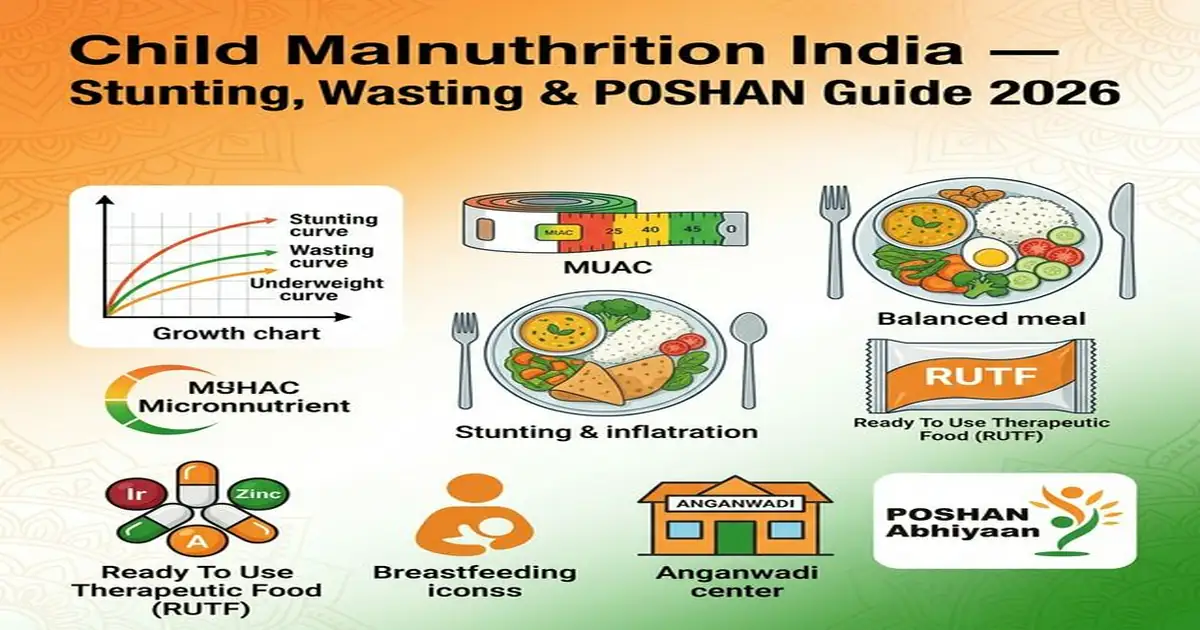
The Four Forms of Malnutrition — Definitions
| Type | Definition | Measurement | India NFHS-5 Prevalence | Long-Term Impact |
|---|---|---|---|---|
| Stunting (chronic undernutrition) | Height-for-age Z-score (HAZ) <–2 SD below WHO median; reflects prolonged/cumulative nutritional deficit since conception, especially in first 1,000 days | Height measured by stadiometer/infantometer; plotted on WHO growth charts; <–2 SD = stunted | 35.5% under-5 children; worst states: Bihar (42.9%), UP (39.7%), Jharkhand (39.4%); best: Kerala (23.4%) | Irreversible after age 2–3 (window of opportunity closes); reduced adult height, brain development, IQ, cognitive test performance; 10–17% lifetime earnings reduction; generational cycle |
| Wasting (acute undernutrition) | Weight-for-height Z-score (WHZ) <–2 SD; reflects recent, acute nutritional deficit; may occur even in non-stunted child; fluctuates with food availability and illness | Weight + height plotted on WHO weight-for-height charts; MUAC (mid-upper arm circumference) <12.5 cm = moderate wasting; <11.5 cm = SAM (severe acute malnutrition) | 19.3% under-5; India has 25% of world’s wasted children; higher in Maharashtra (25.6%), Gujarat (25.1%) | Acute risk: 5–10× higher mortality risk; 9× higher mortality in SAM; immediate medical emergency in severe wasting with complications |
| Underweight | Weight-for-age Z-score (WAZ) <–2 SD; composite indicator (can reflect stunting, wasting, or both); most commonly tracked in Indian health system (Mamta cards) | Weight plotted on WHO weight-for-age growth chart; tracked at monthly Anganwadi weighing | 32.1% under-5; improvements from NFHS-4 (35.8%) showing POSHAN Abhiyaan progress | Serves as overall malnutrition screening tool; cannot distinguish stunting vs wasting — both WHZ and HAZ needed for complete classification |
| Overweight/Obesity (double burden) | Weight-for-height Z-score (WHZ) >+2 SD or BMI-for-age >+2 SD; rising rapidly in urban India across all socioeconomic groups | BMI-for-age Z-score; weight-for-height for under-5; waist circumference increasingly added | 3.4% under-5 nationwide; urban rates significantly higher (7–10% in metro cities); Karnataka (6.1%), Goa (5.2%) highest nationally | Childhood obesity tracks strongly into adult obesity; T2DM, metabolic syndrome, cardiovascular disease risk rises proportionally; visceral fat in Indian children physiologically more metabolically harmful than absolute weight suggests |
The 1,000-Day Window — Why It Matters
The period from conception to the child’s second birthday — approximately 1,000 days — is the single most important nutritional window in human life. The evidence basis: Brain development: 90% of brain growth occurs before age 5, with peak velocity in the first 2 years. Adequate protein, iron, zinc, DHA (omega-3), iodine, and calories drive neuronal proliferation, myelination, and synaptic development. Nutritional deficiency during this window → fewer neurons, reduced synaptic density, impaired myelination → permanent cognitive deficits detectable into adulthood. Stunting determinism: Linear growth (height) is most sensitive to nutritional insult in this window. After age 2–3, catch-up in height is biological limited — the growth plate timeline is fixed. Nutritional rehabilitation after age 3 improves weight and health but cannot fully reverse stunting. Micronutrient critical periods: Iron deficiency during months 6–24 → impaired hippocampal development → long-term memory and learning deficits (demonstrated to persist to school age and beyond even after iron repletion). Iodine deficiency in pregnancy → cretinism, subclinical cognitive impairment (India’s iodine fortified salt programme prevents many cases but coverage gaps persist). Vitamin A deficiency → blindness (xerophthalmia), immune suppression. Zinc deficiency → impaired immune function, delayed growth, increased pneumonia and diarrhoea severity. Breastfeeding within the 1,000 days: Exclusive breastfeeding for 6 months provides complete nutrition, passive immunity (IgA, lactoferrin), gut health foundation (human milk oligosaccharides — HMOs — selectively grow protective Bifidobacterium in infant gut), and epigenetic programming. India’s exclusive breastfeeding rate from birth to 6 months is 63.7% (NFHS-5) — improved from 54.9% but still leaving 36% of infants without optimal early nutrition. Colostrum (first milk — thick, yellow milk for days 1–3): Rich in IgA, growth factors, and micronutrients — crucial for mucosal immunity; cultural practices of discarding colostrum (“dirty milk”) in some communities directly contributes to infant mortality and morbidity.
Detection — MUAC and Growth Monitoring
| Tool | How Used | Thresholds | India Setting |
|---|---|---|---|
| MUAC Tape (Mid-Upper Arm Circumference) | Colour-coded tape around left mid-upper arm (between shoulder and elbow) of child 6 months–5 years; single measurement replaces weight+height combination for screening in field settings | Green (>12.5 cm): Normal; Yellow (11.5–12.5 cm): MAM (Moderate Acute Malnutrition); Red (<11.5 cm): SAM (Severe Acute Malnutrition) | Deployed at ASHA/Anganwadi level; requires no electricity, no scales, no literacy for colour reading; WHO-endorsed for community screening; MUAC <11.5 cm = refer to NRC (Nutrition Rehabilitation Centre) immediately |
| Weight-for-age (Mamta card growth chart) | Monthly weighing at Anganwadi; weight plotted on WHO growth chart by Anganwadi worker; trajectory matters as much as absolute value — faltering growth (weight gain slower than expected) is as important as underweight classification | Normal (+2 to –2 SD); underweight (–2 to –3 SD = moderate); severe underweight (<–3 SD = SAM); “Road to Health” concept — consistent upward trend expected | Universal in India through ICDS; practical limitation: scales often inaccurate; weighing suspended during COVID had lasting impact on detection gap |
| Height-for-age (stunting assessment) | Recumbent length (<2 years): infantometer; standing height (2+ years): stadiometer; plotted on WHO growth charts; assessed at immunisation visits, Anganwadi sessions, and school health camps | <–2 SD = stunted; <–3 SD = severely stunted | Less commonly performed at field level than weight (requires infantometer/stadiometer); identified nationally through NFHS surveys rather than routine tracking; gap in individual child stunting detection and intervention |
| Bilateral Pitting Oedema | Press dorsum of foot firmly for 3 seconds; release; if pit persists = oedema; bilateral = SAM (kwashiorkor type); unilateral = other cause | Any bilateral pitting oedema in child under 5 = automatic SAM classification regardless of weight or MUAC | Identified at any level; indicator of severe protein deficiency; must be referred to NRC; kwashiorkor (oedematous SAM) has different metabolic profile and higher mortality than marasmus (wasting without oedema) |
Frequently Asked Questions
What is SAM and how is it treated in India?
Severe Acute Malnutrition (SAM) is the most life-threatening form of childhood malnutrition — and India has approximately 7.5 million children with SAM, the highest number globally: SAM definition: MUAC <11.5 cm, OR weight-for-height Z-score <–3 SD, OR bilateral pitting oedema. Mortality risk: Untreated SAM carries 30–50% mortality in young children; even with treatment, mortality is 5–10% in complicated SAM managed at NRC level — the goal is to identify and treat before complications develop. The two pathways: Community-Based Management of Acute Malnutrition (CMAM) — for SAM without medical complications (child is alert, has appetite, no oedema, no respiratory distress, no dehydration): Treated at home with Ready-to-Use Therapeutic Food (RUTF). RUTF is a paste made of peanuts, milk powder, sugar, vegetable oil, and micronutrients; requires no water preparation (reducing infection risk); provides 500 kcal/sachet in 3 sachets/day protocol; child gains weight at home without hospitalisation; revolutionary for scale (India-manufactured RUTF: Plumpy’Nut equivalent, NutriRice — increasingly procured through UNICEF/NHM); weekly or biweekly community follow-up by ASHA. This approach treats 80% of SAM cases effectively at community level — dramatically cheaper than hospitalisation. NRC (Nutrition Rehabilitation Centre) — for SAM with complications: Medical complications include severe oedema, anorexia (failing appetite test), hypothermia, hypoglycaemia (<3 mmol/L glucose → give oral dextrose immediately), infections (pneumonia, sepsis, gastroenteritis), anaemia requiring transfusion. Hospital-based management: Phase 1 (Stabilisation — 1–7 days): F75 milk formula (75 kcal/100mL — lower energy initially to prevent refeeding syndrome); antibiotics (amoxicillin ± gentamicin); treatment of complications; strict feeding every 2 hours. Phase 2 (Rehabilitation — 2–6 weeks): F100 formula (100 kcal/100mL) or RUTF transitioning to home foods; weight gain 10–15g/kg/day target; systematic micronutrient supplementation. Discharge criteria: MUAC ≥12.5 cm for 2 consecutive weeks; weight gain satisfactory; medically stable; mother/caregiver educated. India NRC status: As of 2024, ~1,100 NRCs across India — still far below the estimated need for 7.5 million SAM children; occupancy often <50% due to poor community referral and maternal hesitation to stay hospitalised with child. POSHAN Abhiyaan aims to expand NRC coverage and improve SAM detection-to-treatment pipeline.
What are the best foods to prevent malnutrition in Indian children?
The most evidence-based dietary approach to preventing malnutrition in Indian children combines complementary feeding principles with affordable, locally available Indian foods: The “IYCF” approach (Infant and Young Child Feeding): 0–6 months: Exclusive breastfeeding — no water, no other fluids or solids; breast milk alone is sufficient even in Indian summer heat. 6 months: Begin complementary feeding while continuing breastfeeding to 2 years and beyond. Complementary foods should be: Timely (at exactly 6 months — not before 4, not delayed past 7); Adequate (calorie-dense enough for small stomach); Safe (hygienically prepared); Responsive (fed patiently, not forcefully). Energy density problem in Indian complementary foods: The traditional first Indian baby food is dilute rice kanji (very low calorie density) — not adequate for growth. A 6–12 month child needs approximately 200–300 kcal from complementary foods rising to 550 kcal by 12–24 months. Kanji at 20 kcal/100mL is nutritionally inadequate as primary complementary food. Better first foods: Thick dal khichdi (rice + dal) with ghee/oil added (fat increases energy density); mashed potato with ghee; suji (semolina) kheer with milk; egg yolk mashed (from 6 months — egg introduction early prevents egg allergy); banana mashed; ragi (finger millet) porridge with milk or dal water — ragi has 344mg calcium per 100g and excellent nutrient profile. The “minimum dietary diversity” target: Children 6–23 months should eat from at least 4 of 8 food groups daily: Grains/roots/tubers; Legumes/nuts; Dairy products; Flesh foods; Eggs; Vitamin A rich fruits and vegetables; Other fruits & vegetables; Breast milk. India NFHS-5: Only 25% of children 6–23 months received minimum dietary diversity — an enormous gap indicating most Indian children in this critical age group eat primarily rice/roti without adequate protein, fat, or micronutrient diversity. Priority micronutrient foods: Iron: Chicken liver (most bioavailable source — 9.9mg/100g); ragi; dark green leafy vegetables (palak, methi) with lemon juice (vitamin C increases iron absorption by 3×); jaggery (shakkar) as sweetener (3.5mg Fe/100g) over sugar. Zinc: Dal, rajma, chickpeas, pumpkin seeds, sesame. Vitamin A: Sweet potato (deep orange — 1 serving covers daily requirement), carrot, papaya, egg yolk, liver. Iodine: Iodised salt (for family cooking — not added separately to baby food until after 12 months).
What is the POSHAN Abhiyaan and is it working?
POSHAN Abhiyaan (PM’s Overarching Scheme for Holistic Nourishment) — launched 2018 — is India’s flagship nutrition mission with an ambitious target of reducing stunting, underweight and anaemia by 2% per year and wasting by 1% per year: Major components of POSHAN Abhiyaan: Convergence mission: Links nutrition with health (vaccination, ORS, deworming), WASH (safe water/sanitation — key undernutrition driver), early childhood education, and social protection. Technology — POSHAN Tracker: Real-time digital tracking of Anganwadi beneficiaries (pregnant women, lactating mothers, children under 6); 13 crore+ individuals tracked; helps identify drop-outs and growth-faltering children faster than paper records. Social and Behavior Change Communication (SBCC): Monthly Jan Andolan (community mobilisation events); nutrition rallies; Anganwadi-based counseling on first 1,000 days, breastfeeding, IYCF. ICDS expansion: Supplementary nutrition (SNP) for all children 6 months–6 years and pregnant/lactating mothers through Anganwadi centres. Pradhan Mantri SUPOSHAN Yojana (PM-SUPOSHAN): Targeted intensive intervention for severely malnourished children. Evidence of progress: NFHS-5 (2019–21) vs NFHS-4 (2015–16): Stunting: 38.4% → 35.5% (improvement of 2.9% over 4 years — slightly below POSHAN target of 2%/year but significant absolute numbers given population size). Wasting: 21.0% → 19.3% (improved). Underweight: 35.8% → 32.1% (improved). Exclusive breastfeeding 0–6 months: 54.9% → 63.7% (strong improvement driven by POSHAN SBCC). Remaining challenges: POSHAN Tracker implementation gaps — Anganwadi worker smartphone ownership and connectivity; data quality; Anganwadi vacancies (estimated 20–25% position vacancies nationally); COVID-19 disruption (March 2020–mid 2021) caused significant retrogression in malnutrition surveillance and supplementary nutrition delivery; quality of SNP — in many states, SNP is provided as uncooked dry rations rather than hot cooked meals (less adherent to nutritional guidelines); district-level variation enormous — requires state and district-specific strategies.
How does child malnutrition relate to school performance and adult outcomes?
The consequences of early childhood malnutrition extend far beyond physical health — they shape intellectual development, educational achievement, and economic productivity across the lifespan: The cognitive impact: Iron deficiency anaemia — affecting 67% of Indian children under 5 (NFHS-5) — directly impairs myelination of the corpus callosum and prefrontal cortex during the critical windows of development. Controlled longitudinal studies show iron-deficient children at age 2 demonstrate: 8–12 point lower IQ scores by school age even after iron repletion; slower processing speed and executive function; specific deficits in attention, working memory, and language acquisition. Zinc deficiency (present in approximately 60% of Indian under-2 children by dietary inadequacy) impairs hippocampal NMDA receptor function → reduced spatial memory and learning capacity. Stunted children perform significantly worse on school readiness tests at age 5–6, regardless of socioeconomic status — the nutritional pathway to school failure is independent of poverty’s other mechanisms. The school performance evidence: In India specifically, ASER (Annual Status of Education Report) data correlates with district-level stunting rates — districts with higher stunting show higher primary school dropout rates, lower literacy at grade 3, and more children requiring grade repetition — consistent with global findings. Mid-Day Meal programme (PMPOSHAN scheme): Government of India’s school feeding programme — provides nutritious hot cooked meal to 12 crore+ primary school children; significantly reduces school absenteeism (especially in girls); improves hemoglobin levels over time; increases school enrolment and retention; represents convergence of nutrition and education policy. Adult economic consequences: The Lancet series on malnutrition estimates: Elimination of child malnutrition in India would add 4–11% to GDP. A stunted child’s adult earnings are 10–17% lower on average than a well-nourished peer. Child malnutrition costs India approximately USD 10 billion/year in lost economic productivity. This positions child nutrition investment not as humanitarian expense but as highest-ROI economic policy — every rupee invested in the first 1,000 days yields approximately ₹350 in economic return through improved adult productivity.
Does the Mid-Day Meal scheme actually work?
The Pradhan Mantri Poshan Shakti Nirman (PM POSHAN) scheme — the successor to the Mid-Day Meal Scheme — provides nutritious meals in government schools grades 1–8 across India to over 12 crore children daily. The evidence base: What the evidence shows works: Enrolment increases: Studies across multiple states show 14–20% increase in primary school enrolment after MDM introduction — hunger is a powerful attendance deterrent, and a guaranteed meal brings children to school. Attendance improvement: 2–5% attendance increase per child in RCT-quality evaluations from Gujarat and Karnataka (lower absenteeism, particularly in drought years when food insecurity peaks at home). Nutritional benefit: Regular egg provision (states like AP, Telangana, Karnataka provide eggs 3–5 days/week in MDM) → measurable improvement in child weight gain and haemoglobin. Girl enrolment: Disproportionately benefits girl child enrolment (particularly secondary school attendance) as families perceive a concrete value in schooling — reduces dropout in education-resistant households. Teacher workload: Where properly implemented with cooks, does not burden teachers; where cooks are inadequate, teachers are pulled from teaching. Quality and implementation challenges: Calorie and micronutrient adequacy: National guidelines specify 300 kcal, 8–12g protein and specific micronutrient content per meal; audit studies show significant shortfalls in calorie adequacy (especially in UP, Bihar, Rajasthan where budget allocation is lower per child). Egg controversy: Several states face religious and political resistance to eggs in MDM despite strong nutritional evidence; vegetarian-only MDM in many states is nutritionally inferior (eggs are the cheapest, most complete protein source available in India at ₹8–12 per egg). Food safety: Multiple poisoning incidents (2013 Saran, Bihar incident — 23 children died) from contaminated or pesticide-adulterated food highlight implementation quality concerns; strengthened FSSAI compliance and social audit mechanisms are essential. Bottom line: MDM works where it is properly funded, properly cooked, includes protein (egg/dal/soy), and has community oversight. It is one of India’s most successful public health nutrition programmes — which is why strengthening it (Budget 2024: PM POSHAN allocation increased to ₹12,467 crores) matters far more than replacing it with cash transfers.
What to Read Next
- Iron Deficiency Anaemia — 67% of Indian Children Under 5 Have Iron Deficiency Anaemia
- Vitamin D — Critical for Bone Growth and Immune Function in Malnourished Children
- Childhood Asthma — Malnutrition Increases Asthma Severity and Infection Susceptibility
- Childhood Obesity — India’s Double Burden: Undernutrition in Rural, Overnutrition in Urban
- Diabetes — Early Childhood Malnutrition Increases Adult Type 2 Diabetes Risk (Barker Hypothesis)
A MUAC tape costs ₹10. It identifies a child with severe acute malnutrition in 30 seconds. RUTF costs ₹400 per month and cures SAM at home without hospitalisation. The cost of not doing this — in lifetime cognitive impairment, reduced school completion, and lowered adult earnings — is immeasurable. India does not have a poverty problem that creates malnutrition. It has a detection and treatment access problem that creates preventable poverty.
About This Guide: Written by the StudyHub Health Editorial Team (studyhub.net.in) based on NFHS-5 (2019–21), WHO IMCI guidelines, UNICEF CMAM protocol, and NIN (National Institute of Nutrition, Hyderabad) nutrition guidelines. Last updated: March 2026.
Authoritative Sources: NHM India — POSHAN Abhiyaan | UNICEF India | NIN Hyderabad | WHO IMCI Protocol
⚕️ Medical Disclaimer: This article is for general information. If your child has MUAC <11.5 cm, bilateral pitting oedema, or has lost weight consistently over 3 months, seek evaluation at the nearest NHM health facility or NRC immediately. Severe acute malnutrition is a medical emergency with a 30–50% untreated mortality rate.