
Last Updated: March 2026 | Reading Time: 9 minutes | ~2,000 words
Epilepsy is one of the world’s most common serious neurological conditions — and India carries the largest epilepsy burden of any country, with an estimated 12–14 million people with epilepsy. Despite being a highly treatable condition (70–80% of people achieve seizure freedom with medication), India has a massive treatment gap: only 25–30% of Indian epilepsy patients receive appropriate treatment. The barriers are profound: rural inaccessibility to neurologists, deep stigma (epilepsy is associated with supernatural causes in many communities), antiepileptic drug (AED) supply discontinuity, and the myth that epilepsy is untreatable or requires lifelong dependency. These barriers cause unnecessary seizures, injuries, lost livelihoods, and preventable deaths — from drowning, burns (cooking fires), and sudden unexpected death in epilepsy (SUDEP).
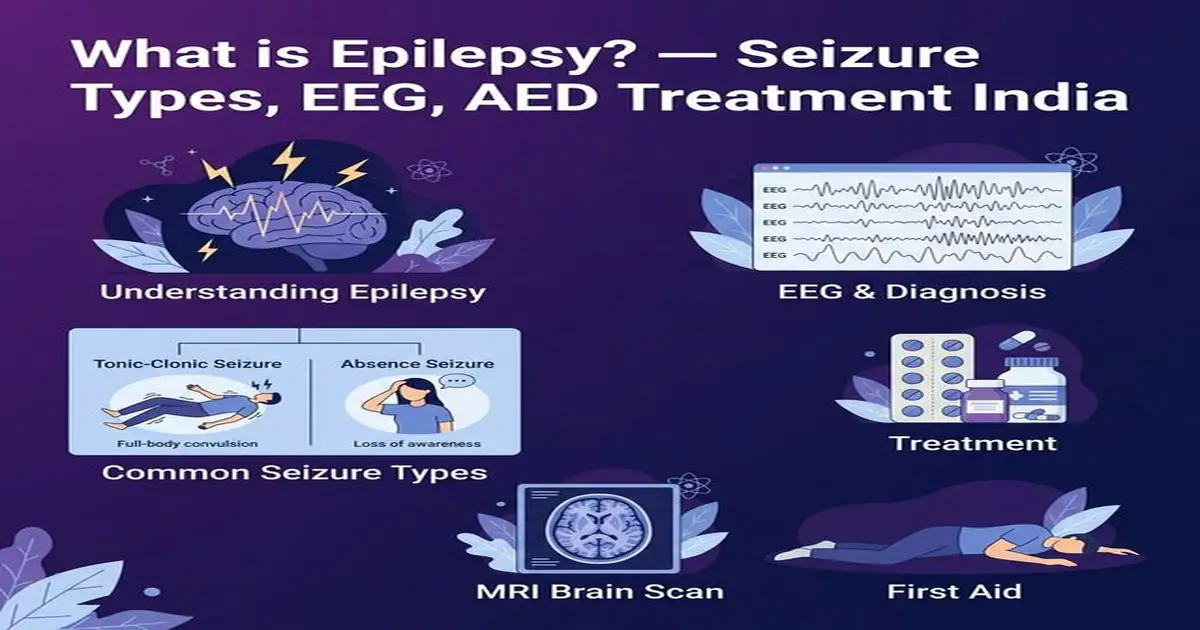
What is Epilepsy? — Definition and Criteria
Epilepsy is defined by the International League Against Epilepsy (ILAE) as: (1) at least two unprovoked seizures more than 24 hours apart; OR (2) one unprovoked seizure with a high (>60%) probability of recurrence; OR (3) diagnosis of an epilepsy syndrome. A seizure is a transient episode of abnormal, excessive, and synchronous neuronal firing in the brain, producing clinical manifestations that depend on which brain area is involved — from a few seconds of blank staring to vigorous convulsions. Critically: not every seizure is epilepsy — a single seizure after sleep deprivation, fever (febrile convulsion in children), hypoglycaemia, or alcohol withdrawal is a “provoked seizure” and does not constitute epilepsy. The distinction matters because provoked seizures require treating the cause, not necessarily long-term AEDs.
Types of Seizures and Epilepsy
| Classification | Type | Clinical Features | EEG Finding |
|---|---|---|---|
| Focal (Partial) Seizures | Focal aware (simple partial) | Consciousness preserved; limb jerking, tingling, unusual smell/taste, déjà vu — confined to one brain area | Focal epileptiform discharge |
| Focal impaired awareness (complex partial) | Consciousness impaired; automatisms (lip smacking, fumbling, chewing); post-ictal confusion | Temporal or frontal focus with spread | |
| Focal to bilateral tonic-clonic | Focal onset evolving to generalised convulsions; historically called “secondary generalised” | Focal onset with generalisation | |
| Generalised Seizures | Tonic-clonic (GTCS — “grand mal”) | Sudden loss of consciousness; tonic phase (stiffening, fall, cry); clonic phase (rhythmic jerking); post-ictal drowsiness 5–30 min; tongue bite, incontinence | Generalised spike-wave |
| Absence (“petit mal”) | Brief (5–30 seconds) blank staring; immediate recovery; no post-ictal phase; child stops mid-sentence and resumes; 100s/day possible | 3Hz spike-wave; activated by hyperventilation | |
| Myoclonic | Brief, sudden jerks — often in morning after waking; coffee mug dropped; predominantly upper limbs | Polyspike-wave | |
| Tonic/Atonic | Tonic: sudden stiffening and fall; Atonic: “drop attacks” — sudden loss of muscle tone; both cause falls and injury | Variable; seen in Lennox-Gastaut |
Diagnosis — EEG and MRI in Epilepsy
- 🧠 EEG (Electroencephalogram): Records brain electrical activity — the primary diagnostic test for epilepsy. Interictal (between seizures) epileptiform discharges (spikes, sharp waves, spike-wave complexes) confirm epilepsy diagnosis. A normal EEG does NOT exclude epilepsy (interictal EEG normal in 40–50% of epilepsy patients); repeat EEG after sleep deprivation or prolonged video-EEG increases yield. Cost: ₹500–2,000 at government/private labs. Essential for syndrome classification (absence epilepsy vs juvenile myoclonic epilepsy vs Lennox-Gastaut — each has different AED preferences).
- 🔬 MRI Brain (structural epilepsy protocol): 3T MRI with epilepsy-specific protocol detects structural causes — hippocampal sclerosis (most common cause of temporal lobe epilepsy and drug-resistant epilepsy), cortical dysplasia, tumour, cavernoma, post-traumatic gliosis. Essential for all new-onset epilepsy except clearly idiopathic generalised syndromes. CT brain is NOT adequate for epilepsy workup (misses small cortical lesions). Cost: MRI ₹3,000–8,000; government facilities at reduced cost.
- 🩸 Blood tests: Glucose, electrolytes, calcium (to exclude metabolic causes); serum AED levels (to check compliance and toxicity); LFT, CBC before valproate; renal function before levetiracetam dose adjustment in CKD.
- 🎥 Video-EEG monitoring: Gold standard for characterising seizure semiology, lateralising focus for surgery, and confirming functional (non-epileptic) events; available at NIMHANS and major tertiary centres.
Antiepileptic Drug (AED) Treatment in India
| Drug | Use | Key Side Effects | India Cost/Month |
|---|---|---|---|
| Valproic acid (Valparin, Encorate) | Broad-spectrum: generalised seizures (GTCS, absence, myoclonic); juvenile myoclonic epilepsy first-line | Weight gain, tremor, hair thinning; TERATOGENIC (spina bifida) — avoid in women of childbearing age if possible; hepatotoxicity (rare) | ₹200–500; widely available |
| Carbamazepine (Tegretol, Mazetol) | Focal epilepsy; trigeminal neuralgia | Dizziness, diplopia, rash; SJS (Stevens-Johnson Syndrome) — screen for HLA-B*1502 (common in South and Southeast Asians including Indians — risk gene); hyponatraemia | ₹100–300; widely available |
| Levetiracetam (Keppra, Levera) | Broad-spectrum; focal and generalised; safe in pregnancy (relative); no drug interactions | Behavioural side effects (irritability, aggression — “Keppra rage”); usually dose-dependent and reversible | ₹500–1,500 (generic available); can be high-cost at brand rates |
| Phenytoin (Eptoin) | Focal and generalised; IV for status epilepticus | Gum hyperplasia, hirsutism, ataxia, cognitive effects; narrow therapeutic index; many drug interactions; NOT recommended as new initiation — older drug | ₹50–150; very cheap; still widely used in India |
| Lamotrigine (Lamitor, Lametec) | Focal epilepsy; Lennox-Gastaut; safer in pregnancy for women; mood stabiliser in bipolar | Rash (must titrate slowly to avoid SJS); risk of worsening myoclonic epilepsy in JME | ₹300–800 |
| Sodium valproate + Lamotrigine / Levetiracetam | Combination for drug-resistant epilepsy — most common in India | Combination monitoring essential | ₹500–2,000 |
First Aid During a Seizure — What to Do and What NOT to Do
| ✅ DO | ❌ DO NOT |
|---|---|
| Stay calm and stay with the person | Do NOT restrain the person’s movements |
| Note the time — seizures lasting >5 minutes = status epilepticus (emergency) | Do NOT put anything in the person’s mouth (including fingers, spoons, keys) — tongue cannot be swallowed; teeth can break tools; fingers will be bitten |
| Cushion the head — place something soft under their head | Do NOT try to hold the tongue down |
| Remove glasses; loosen tight clothing around neck | Do NOT give water until fully conscious |
| After convulsions stop — turn person on side (recovery position) to prevent aspiration | Do NOT leave person alone during or immediately after seizure |
| Call 108 if: first seizure ever; seizure >5 minutes; no recovery; injury occurred; pregnant woman | Do NOT pour water on face during seizure |
Frequently Asked Questions
Can epilepsy be cured?
Epilepsy outcomes exist on a wide spectrum — from complete seizure freedom (which can be maintained indefinitely) to drug-resistant epilepsy requiring surgical intervention: “Outgrown” epilepsy: Many childhood epilepsy syndromes (childhood absence epilepsy, benign rolandic epilepsy — the most common childhood epilepsy syndrome) remit spontaneously by adolescence — AEDs can be withdrawn after 2–3 years of seizure freedom. Juvenile myoclonic epilepsy (JME), while highly treatment-responsive, tends to relapse if medication is stopped — usually lifelong valproate/levetiracetam needed. Medication-achieved sustained remission: 70–80% of epilepsy patients become seizure-free on AEDs. After 2+ years of complete seizure freedom on medication, withdrawal can be attempted with gradual tapering — 60–70% of these patients remain seizure-free off medication (effectively “cured”). Factors predicting successful withdrawal: idiopathic generalised epilepsy (where structural cause exists is less likely to allow withdrawal), normal EEG at time of withdrawal attempt, child onset, single drug control. Surgery — the most underutilised cure: For drug-resistant epilepsy (failure of 2+ adequate AED trials), epilepsy surgery results in seizure freedom in 60–80% of carefully selected patients (temporal lobe resection for hippocampal sclerosis is the most common — 70–80% seizure freedom). India has world-class epilepsy surgery centres — NIMHANS Bangalore, SCTIMST Thiruvananthapuram, AIIMS Delhi, Christian Medical College Vellore — yet the average wait from first seizure to surgery in India is 18–20 years (vs 5–7 years in Western countries), due to delayed referral. A person with drug-resistant temporal lobe epilepsy has a better chance of seizure freedom from surgery than from trying a 3rd, 4th, or 5th medication — yet referral for surgical evaluation is routinely delayed. The honest answer: “Epilepsy” is not one disease — it is many. Some types are fully curable with surgery; some remit spontaneously in childhood; some require lifelong medication but allow normal life. A person’s individual prognosis is best discussed with a neurologist after syndrome classification and adequate trial of appropriate AEDs.
Can people with epilepsy drive, work, and have children?
Epilepsy significantly impacts quality of life through social and legal restrictions — but the picture is far more nuanced than blanket disability: Driving in India: Under the Motor Vehicles Act, a person with epilepsy is legally prohibited from holding a driving licence unless seizure-free for 5 years on or off medication (as per amended guidelines). This is a significant hardship for employment and mobility in India. With sustained seizure freedom, licence reinstatement is possible — documentation from a neurologist required. Employment: Most jobs are accessible to people with epilepsy under the Rights of Persons with Disabilities Act 2016 (epilepsy qualifies). Contraindicated occupations: working at heights (construction, ladders), heavy machinery operation without supervision, fire hazard environments, commercial aviation/shipping. Most office, academic, and service work is fully accessible. The National Trust for the Welfare of Persons with Autism, Cerebral Palsy, Mental Retardation and Multiple Disabilities Act provides legal protection and employment support. Pregnancy and epilepsy: All AEDs cross the placenta — teratogenicity risk varies significantly: Valproate: highest risk (spina bifida, fetal valproate syndrome, cognitive effects); AVOID if possible in women of childbearing age. Carbamazepine: moderate risk (neural tube defects); folic acid 5mg/day mandatory. Lamotrigine: currently preferred in women seeking pregnancy — lowest teratogenicity among effective AEDs. Levetiracetam: growing evidence of relative safety in pregnancy. KEY MESSAGE: stopping AEDs in pregnancy without medical guidance is DANGEROUS — status epilepticus during pregnancy can harm or kill both mother and foetus. Pre-conception counselling with a neurologist is essential for all women with epilepsy planning pregnancy. Social life: Alcohol lowers seizure threshold and interacts with AEDs — minimise or avoid. Sleep deprivation is a powerful seizure trigger — sleep discipline is therapeutic. With seizure control, most social and sporting activities are accessible.
What triggers seizures — and can they be avoided?
Understanding and avoiding personal seizure triggers is a key component of epilepsy self-management, particularly for people with breakthrough seizures despite medication compliance. Common triggers: Sleep deprivation — the most potent trigger for generalised epilepsies (particularly juvenile myoclonic epilepsy); missing even one night’s sleep dramatically increases next-day seizure risk in susceptible individuals; sleep hygiene is therapeutic. Alcohol — lowers seizure threshold directly and through sleep disruption and dehydration; withdrawal seizures also occur with heavy use followed by abrupt cessation. Flashing lights (photosensitivity) — present in ~5% of epilepsy patients (higher in generalised epilepsies); disco lights, video games, sunlight flickering through trees at speed — relevant but often overestimated as trigger. Missed medication — the most important avoidable trigger; medication non-compliance is the primary cause of breakthrough seizures in controlled patients; 30-day pill organisers, medication reminder apps, and dispensing at PHC level all help. Fever and acute illness — metabolic stress lowers seizure threshold; fever management important during illness in epilepsy patients. Hormonal changes — catamenial epilepsy (seizures clustering around menstruation) in 20–35% of women with epilepsy; hormonal changes at ovulation and the pre-menstrual drop in progesterone are key triggers; manages with clobazam PRN or cycle-adjusted AED dosing. Stress — chronic psychological stress and acute stressors are significant triggers; addressing depression and anxiety in epilepsy patients is essential. The trigger diary — keeping a seizure diary with trigger notation — is one of the most useful and free self-management tools that neurologists should routinely recommend.
Is valproate safe for women?
This is one of the most critical medication safety questions in Indian epilepsy care — and the answer is nuanced. Valproic acid (sodium valproate) is an exceptionally effective broad-spectrum AED, particularly for idiopathic generalised epilepsies (JME, childhood absence epilepsy, absence epilepsy). However, it has the highest teratogenic risk of all commonly used AEDs: Neural tube defects (spina bifida) — 1–2% risk vs 0.03% in general population. Fetal valproate syndrome — craniofacial abnormalities, cardiac defects, limb defects. Neurodevelopmental effects — children exposed to valproate in utero have lower IQ (average 9 points lower), higher rates of autism spectrum disorder (3×), and higher rates of ADHD than children exposed to lamotrigine or carbamazepine. Despite this, valproate remains on the WHO Essential Medicines List and continues to be used in women in India because: it is the only drug that effectively controls some epilepsy syndromes (JME — lamotrigine alone may worsen myoclonic jerks); it is extremely affordable (₹200–500/month vs lamotrigine’s ₹500–800); regulatory awareness programmes are inadequate in India. Current guidance for Indian women: Avoid valproate in girls and women of childbearing potential if ANY effective alternative exists; if valproate is the only effective option, informed consent essential, highest effective dose avoided, folic acid 5mg/day mandatory, regular monitoring; add contraception if no pregnancy planned. European Medicines Agency (2018) mandated valproate in a Pregnancy Prevention Programme — India is implementing equivalent guidance through updated prescribing guidelines. Any Indian woman on valproate who is planning pregnancy MUST consult her neurologist — do not stop medication unilaterally.
What is status epilepticus — and is it dangerous?
Status epilepticus (SE) is a neurological emergency defined as a seizure lasting >5 minutes OR a series of seizures without recovery of consciousness between them. It is life-threatening — mortality in convulsive status epilepticus is 3–35% depending on cause and speed of treatment. Why 5 minutes? Seizures self-terminate through inhibitory mechanisms; if a seizure has not stopped by 5 minutes, these mechanisms have failed and the seizure is unlikely to stop without intervention. Every minute of continued SE causes progressive neuronal injury, metabolic derangement (hypoxia, hyperthermia, lactic acidosis), and increasing drug-resistance. Treatment in India: Phase 1 (0–5 minutes after seizure onset): IV lorazepam (4mg) or rectal/IM diazepam (10mg) if IV access unavailable; buccal midazolam is the preferred first-line for community treatment (squirted between gum and cheek, effective within 5 minutes — better than rectal diazepam, no IV needed). Caregivers of known high-risk epilepsy patients in India should be trained by their neurologist in buccal midazolam administration and equipped with it. Phase 2 (benzodiazepine failed/refractory at 20–30 minutes): IV levetiracetam (first choice in India due to safety profile), IV valproate, or IV phenytoin. Phase 3 (refractory SE — 45–60 minutes): ICU intubation + IV anaesthesia (propofol, midazolam, thiopentone). In India, recognition of SE and immediate 108 activation is the critical message. Any seizure not stopping at 5 minutes = call 108 immediately = medical emergency.
What to Read Next
- Stroke — Both Stroke and Epilepsy Involve Sudden Focal Brain Events
- Depression — 30–40% of Epilepsy Patients Have Comorbid Depression
- Vitamin B12 — Severe B12 Deficiency Can Lower Seizure Threshold
- Vitamin D — AEDs (Phenytoin, Carbamazepine) Deplete Vitamin D; Supplement Routinely
- Hypertension — Hypertensive Emergency Can Cause Seizures (PRES)
12 million Indians live with epilepsy. Most of them are treatable. Most of them are not being treated. The barrier is not science — medicine has the answer. The barrier is stigma, ignorance, and access. An Indian with epilepsy deserves the same chance at seizure freedom, employment, marriage, parenthood, and full life as anyone else. The first step is knowledge — and the person reading this may now hold that key for someone they love.
About This Guide: Written by the StudyHub Health Editorial Team (studyhub.net.in) based on ILAE (International League Against Epilepsy) guidelines, Indian Epilepsy Society guidelines, and NIMHANS clinical protocols. Last updated: March 2026.
Authoritative Sources: ILAE — International League Against Epilepsy | NIMHANS India | Indian Epilepsy Society | WHO — Epilepsy
🚨 Status Epilepticus Emergency: Any seizure not stopping at 5 minutes = call 108 immediately. Do not wait. Do not restrain. Note the time the seizure started. Turn person on side after convulsions end.
⚕️ Medical Disclaimer: This article is for general informational and educational purposes only. Epilepsy diagnosis requires clinical evaluation and EEG. Never start, stop, or change AED dosing without neurologist supervision. Women on valproate must consult their neurologist before pregnancy.