
Last Updated: March 2026 | Reading Time: 9 minutes | ~2,000 words
Gastro-oesophageal reflux disease (GERD) — colloquially known as “acid reflux” or “acidity” — is one of the most prevalent digestive conditions in India, affecting an estimated 20–25% of urban Indians and 7–10% of rural Indians. The terminology used in India adds complexity: patients and physicians use “acidity” to cover a spectrum including GERD, dyspepsia, peptic ulcer, and functional heartburn. India’s dietary patterns — spicy food, large meals, late evening eating, tea/chai dependency, betel nut (supari) use, tobacco, and rapid urbanisation — make it uniquely predisposed to GERD. Despite high prevalence, GERD is frequently mismanaged: overuse of antacids as a symptom suppressor without addressing lifestyle causes; chronic PPI use without reassessment; underdiagnosis of Barrett’s oesophagus (the pre-cancerous complication); and confusion between GERD, H. pylori gastritis, and peptic ulcer disease.
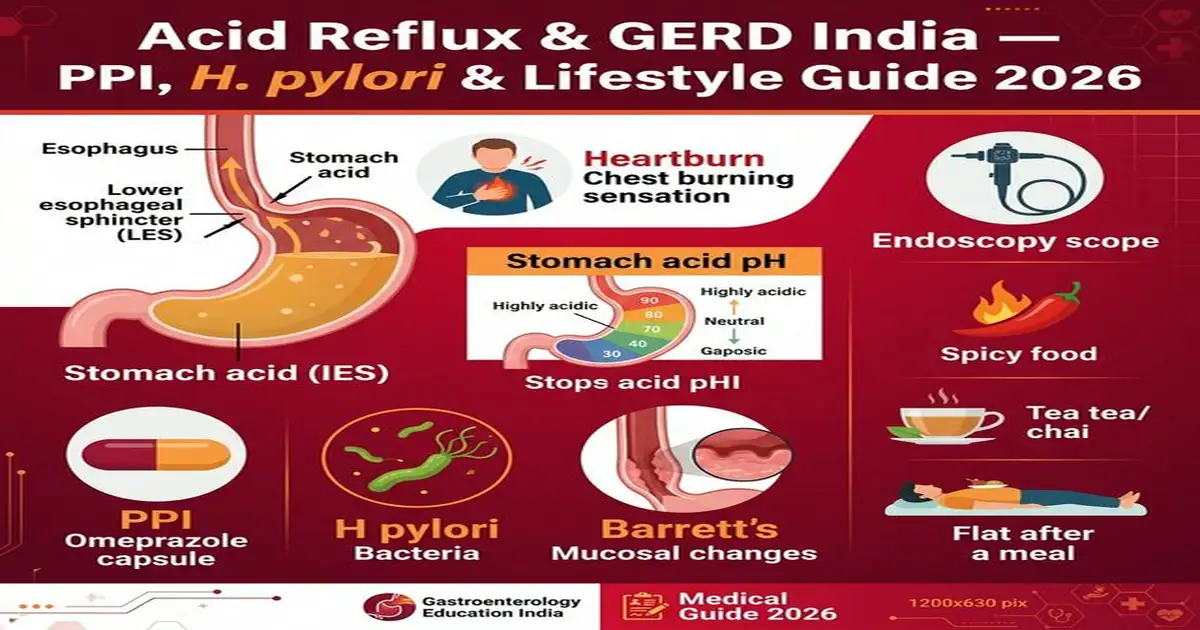
GERD vs Dyspepsia vs Peptic Ulcer — Key Differences
| Condition | Key Symptoms | Cause | Treatment | India Context |
|---|---|---|---|---|
| GERD (Gastro-Oesophageal Reflux Disease) | Heartburn (burning sensation rising from stomach to chest/throat); regurgitation (sour/bitter taste in mouth); worse after meals, bending forward, lying down; nocturnal symptoms; dysphagia (swallowing difficulty in severe cases — red flag for Barrett’s/stricture) | Lower oesophageal sphincter (LES) dysfunction → stomach acid escapes into oesophagus → irritation and inflammation of oesophageal mucosa; contributing factors: hiatus hernia, obesity, pregnancy, large meals, tight clothing, lying down after meals | Lifestyle modification + PPI (proton pump inhibitor) — omeprazole, pantoprazole, rabeprazole; H2 blockers (famotidine, ranitidine — ranitidine withdrawn due to NDMA contamination); antacids for symptomatic relief; surgical fundoplication for severe GERD failing PPI | Spicy Indian diet; lying down on bed after lunch (common in rural India); chai intake (caffeine relaxes LES); obesity; pregnancy in young women; supari (betel nut) use — all major GERD drivers in India |
| Functional Dyspepsia | Upper abdominal pain or discomfort, fullness, early satiety, bloating WITHOUT structural cause; heartburn may or may not be present; no GERD on endoscopy; Rome IV criteria; often worse with stress and meals | Multifactorial: H. pylori in a subgroup; gut-brain axis dysfunction; visceral hypersensitivity; delayed gastric emptying; post-infectious; psychological (anxiety, depression strongly associated) | Test-and-treat H. pylori first (if positive); PPI for postprandial distress syndrome (PDS) subtype; prokinetics (domperidone, metoclopramide) for early satiety and fullness; low-dose amitriptyline for refractory cases; psychological treatment (CBT) evidence-based | One of the most common GI presentations at Indian PHC level; large overlap with GERD; significant under-recognition of functional vs structural cause; prokinetics (domperidone) widely and often appropriately used in India |
| Peptic Ulcer Disease (PUD) | Epigastric (upper central abdomen) pain — burning or gnawing; gastric ulcer: pain WORSENED by eating; duodenal ulcer: pain RELIEVED by eating (food neutralises acid temporarily) → returns 2–3 hours later; nocturnal pain waking at 2–3am typical of DU; complications: haematemesis (bleeding — vomiting blood/coffee-grounds); melaena (black tarry stool = upper GI bleeding) | H. pylori infection in 70–80% of Indian peptic ulcers; NSAID use (second most common cause — India’s widespread diclofenac use contributes significantly); Zollinger-Ellison syndrome (rare) | H. pylori eradication (triple therapy: PPI + clarithromycin + amoxicillin × 14 days; or bismuth quadruple therapy for clarithromycin-resistant areas — India has high clarithromycin resistance in southern states); stop NSAIDs; PPI × 4–8 weeks; confirm eradication with urea breath test or stool antigen | India has one of the world’s highest H. pylori prevalence rates (60–70% in adults, rising to 80–90% in lower socioeconomic groups — faecal-oral transmission in settings with poor sanitation); NSAID overuse for musculoskeletal pain creates large India peptic ulcer burden; generic PPI triple therapy affordable (<₹500 for full course) |
Lifestyle Modifications — The Foundation of GERD Treatment
| Lifestyle Factor | GERD Impact | India-Specific Recommendation |
|---|---|---|
| Meal timing and lying down | Eating and then immediately lying down → gravity no longer prevents reflux → acid pools at LES → symptoms worsen; nocturnal GERD is the most damaging to oesophageal mucosa (prolonged acid exposure at night without swallowing to clear it) | Do not lie down for at least 2–3 hours after last meal; avoid eating after 8pm; avoid large dinner (India’s largest meal is often dinner — this should be reversed to reduce nocturnal GERD); elevate head of bed 15–20cm with a wedge pillow or bed blocks (NOT just extra pillows which bend the neck) |
| Weight reduction | Obesity increases intra-abdominal pressure → pushes stomach contents upward across LES; strongest modifiable risk factor for GERD and Barrett’s oesophagus; even 5% weight loss reduces GERD symptom frequency significantly | India’s obesity epidemic (central obesity particularly — common in urban Indians — creates typical upper abdominal pressure pattern); saree/dhoti/tightly worn waistbands additionally increase intra-abdominal pressure — loose comfortable waistbands recommended |
| Dietary triggers | Caffeine (chai/coffee: relaxes LES smooth muscle); alcohol (relaxes LES + directly irritates mucosa); chocolate (fat + methylxanthines relax LES); mint (peppermint relaxes LES — paradoxically worsens GERD despite perceived “cooling”); spicy food (capsaicin directly irritates oesophageal mucosa); fatty meals (delay gastric emptying → prolonged LES exposure); citrus and tomatoes (direct acid aggravation) | India-specific triggers: Chai (tea with milk — 3–4 cups/day = significant caffeine + heat irritation); Biryani and heavy curries at dinner; Pickle (achaar — highly acidic, spicy); Pan masala and supari (betel nut use — directly impairs LES); Carbonated soft drinks (CO2 increases gastric pressure → belching → reflux); patients should keep a 2-week food-symptom diary to identify personal triggers |
| Smoking | Nicotine impairs LES function; reduces salivary bicarbonate (which normally neutralises refluxed acid); delays oesophageal clearance; smoking cessation reduces GERD symptoms in 70% of smokers with GERD | Bidi/cigarette smoking extremely common in rural and lower-income Indian men; tobacco cessation counselling must be incorporated into GERD management; nicotine replacement therapy (NRT) patches available Jan Aushadhi at low cost |
| Sleeping position | Left-lateral decubitus position (sleeping on left side) reduces nocturnal acid reflux by 60–70% vs right lateral or supine positions; anatomical reason: stomach anatomy places the gastro-oesophageal junction above the gastric pool when lying on left → gravity carries acid away from LES | Simple, free, zero side effects; left-lateral sleeping position is the most under-utilised GERD intervention; teach every GERD patient — “sleep on your left side, acid goes down”; right-side sleeping makes GERD significantly worse |
Frequently Asked Questions
Which PPI should I take and for how long?
Proton pump inhibitors (PPIs) are the most effective pharmacological treatment for GERD and peptic ulcer disease — but their long-term use without reassessment in India has created a significant PPI overuse problem: How PPIs work: PPIs (omeprazole, lansoprazole, pantoprazole, rabeprazole, esomeprazole) irreversibly block the H+/K+-ATPase proton pump in stomach parietal cells — the final common pathway for acid secretion → reduces gastric acid by 90–95% → allows oesophageal and gastric mucosa healing; PPIs require activation by gastric acid — MUST be taken 30 minutes before first meal (not with or after food — a common India prescription error that significantly reduces efficacy). Which PPI in India: All PPIs are approximately equivalent in efficacy at standard doses; cost differences are dramatic: Omeprazole 20mg (generic/Jan Aushadhi): ₹5–10/capsule; Pantoprazole 40mg (widely prescribed, Pantop brand): ₹15–40/tablet; Esomeprazole 40mg (Nexium/Raciper): ₹30–80/tablet; Rabeprazole 20mg (Razo): ₹20–50/tablet; Generic omeprazole or pantoprazole is clinically equivalent to expensive branded PPIs for most indications; the ₹5 omeprazole is the same drug mechanism as the ₹80 esomeprazole — choose generic unless specific indication for enantiomer preparation. Duration guidance: Acute erosive GERD or oesophagitis: 8 weeks PPI; then step down or stop with lifestyle modification. Non-erosive GERD: 4–8 weeks; trial stopping with lifestyle measures. Peptic ulcer disease: 4–6 weeks after H. pylori eradication. Barrett’s oesophagus: indefinite PPI (reduces cancer risk). The PPI overuse crisis in India: Multiple surveys show 40–60% of Indian patients on long-term PPI have no clear ongoing indication; prescribed at discharge, continued indefinitely by habit; PPI overuse causes: hypomagnesaemia; hyponatraemia; increased fracture risk (reduced calcium absorption); C. difficile diarrhoea; community-acquired pneumonia (slightly increased risk); rebound acid hypersecretion on stopping (causes patients to restart PPI). How to stop PPI safely: Do not stop abruptly after long-term use (rebound hypersecretion causes worse heartburn than before — often misinterpreted as “I need the PPI”); step-down strategy: full dose PPI → alternate day PPI → H2 blocker (famotidine 20mg) → as-needed antacid → stop; takes 4–8 weeks; lifestyle modification must be maintained throughout.
What is H. pylori and do I need to treat it?
Helicobacter pylori is one of the most important human pathogens — a gram-negative spiral bacterium that colonises the gastric mucosa and is responsible for the majority of peptic ulcers and a significant proportion of gastric cancer worldwide. India’s H. pylori burden is among the world’s heaviest: India H. pylori epidemiology: Prevalence: 60–70% in general adult Indian population; 80–90% in lower socioeconomic groups; 40–50% in urban middle-class (improving with sanitation); children infected early in India — most acquire H. pylori before age 10 (faecal-oral transmission, shared food, contaminated water, overcrowded housing). Who needs H. pylori testing and treatment (Maastricht VI 2022 guidance): Everyone with peptic ulcer disease (gastric or duodenal) — test and treat regardless; Uninvestigated dyspepsia in populations with high prevalence (>20%) — India qualifies completely — test first before endoscopy; Functional dyspepsia — eradication improves symptoms in ~10% more than placebo; Early gastric cancer (resected) — treat to reduce recurrence risk; First-degree family member of gastric cancer patient; Long-term NSAID use — test and treat H. pylori before starting NSAIDs; Iron deficiency anaemia (unexplained — H. pylori impairs iron absorption); Idiopathic thrombocytopenic purpura (ITP). Testing options in India: Urea Breath Test (UBT) — gold standard non-invasive test: patient swallows 13C-labelled urea → if H. pylori present, urease enzyme cleaves urea → labelled CO2 exhaled → detected by spectrometer; highly accurate (sensitivity/specificity >95%); cost approximately ₹1,500–3,000; available at most tertiary hospitals and reference labs (Thyrocare, Metropolis). Stool Antigen Test (SAT) — alternative non-invasive; sensitivity ~94%; cost ₹800–1,500; requires fresh stool sample; monoclonal antibody assay preferred. Serology (blood IgG antibody) — NOT recommended for active infection diagnosis (remains positive years after eradication — cannot distinguish active from past infection); still widely ordered in India inappropriately. Rapid urease test (CLO test) — biopsy-based; done during endoscopy; results in 1 hour. Standard eradication regimens India 2024: First-line (clarithromycin-sensitive areas): PPI + amoxicillin 1g + clarithromycin 500mg twice daily × 14 days; Note: clarithromycin resistance is rising in India (southern states 20–30% resistance rate) — consider bismuth quadruple therapy in areas with high resistance. Bismuth quadruple therapy (preferred for clarithromycin resistance): PPI BD + bismuth subcitrate 120mg QID + metronidazole 400mg TDS + tetracycline 500mg QID × 14 days; confirm eradication with UBT or stool antigen 4–8 weeks after completing antibiotics (NOT serology).
What is Barrett’s oesophagus and should I be worried?
Barrett’s oesophagus (BO) is the pre-cancerous complication of chronic GERD — the most important indication for endoscopic surveillance in GERD patients — and deeply under-diagnosed in India: What Barrett’s oesophagus is: Prolonged acid exposure causes the normal squamous lining of the lower oesophagus to undergo metaplastic change to columnar (intestinal-type) epithelium — “intestinal metaplasia”; Barrett’s oesophagus is not cancer and does not cause symptoms beyond GERD; Barrett’s progression to oesophageal adenocarcinoma (OAC): risk per year approximately 0.3–0.4% of Barrett’s patients → more than 30× general population risk for OAC; OAC is one of the fastest-growing cancers globally — linked to obesity + GERD; India historically had predominantly squamous oesophageal cancer (SCC — linked to tobacco and hot beverages) but adenocarcinoma rates are rising with urbanisation/obesity epidemic. Who should have endoscopy for GERD screening: GERD symptoms ≥5 years + any 3 of: Male sex; Age ≥50; Obesity (BMI ≥30); Smoking; White/European ethnicity (Barrett’s predominantly a Western condition — lower but increasing prevalence in India); Family history of Barrett’s or OAC. If Barrett’s is diagnosed — surveillance: Non-dysplastic Barrett’s: endoscopy every 3–5 years; Low-grade dysplasia: 6-monthly endoscopy or endoscopic eradication therapy; High-grade dysplasia: endoscopic mucosal resection (EMR) or radiofrequency ablation (RFA) — available at tertiary centres in India (AIIMS, CMC Vellore, Apollo, Fortis); Oesophageal adenocarcinoma: surgical resection + chemotherapy. PPI for Barrett’s oesophagus: PPIs are recommended indefinitely in confirmed Barrett’s oesophagus — reduce progression risk and control symptoms; aspirin (low-dose) has emerging evidence for reducing BO cancer risk; chemoprevention trials ongoing.
When do heartburn symptoms require endoscopy urgently?
Most heartburn does not require endoscopy — but certain features indicate urgent investigation to exclude serious pathology: Alarm symptoms requiring prompt upper GI endoscopy (within 2 weeks): Dysphagia — difficulty swallowing, especially progressive (food sticking) → may indicate oesophageal cancer, benign stricture, achalasia; Odynophagia — painful swallowing → oesophagitis, candidal oesophagitis (HIV/immunosuppressed patients); Haematemesis — vomiting blood or coffee-ground material → bleeding peptic ulcer, Mallory-Weiss tear, oesophageal varices (portal hypertension from liver cirrhosis — common in India given HBV/HCV/alcohol burden); Melaena — black tarry stool → upper GI bleeding (requires urgent same-day endoscopy if haemodynamically compromised); Unexplained iron deficiency anaemia → possible occult GI blood loss; Significant unexplained weight loss with GI symptoms → malignancy until excluded; Palpable epigastric mass; New dyspepsia in patients over 55; Persistent vomiting. Endoscopy access in India: Upper GI endoscopy (OGD): available at all district hospitals and above; government hospitals: ₹0–500; private: ₹3,000–8,000; increasingly available in tier-2 cities; most government medical colleges have OGD services. The “alarm symptom” awareness gap in India: Many Indian patients with dysphagia attributed to “food getting stuck” normalise this for months-years before seeking evaluation; oesophageal cancer (predominantly SCC in India — associated with hot tea, tobacco, alcohol) has one of the worst prognoses in part because of delayed presentation; rural patients often attribute progressive dysphagia to a “throat problem” and try home remedies; community awareness of dysphagia as a red flag requiring timely endoscopy is a critical unmet health education need.
Are antacids and home remedies safe for long-term use?
Antacids are among the most commonly self-purchased medicines in India — and several home remedies are deeply embedded in Indian culture for “acidity” management. Understanding what is safe, what is effective, and what is harmful is important: Aluminium/magnesium antacids (Digene, Gelusil, Eno, Pudin Hara): Mechanism: neutralise gastric acid on contact → immediate symptom relief (15–30 minutes); Duration: short-lived (1–2 hours → acid returns); Safety: generally safe short-term; Aluminium antacids can cause constipation; Magnesium antacids cause diarrhoea; combinations balance this. AVOID long-term high-dose aluminium antacid use: aluminium toxicity risk (neurological effects); accumulation in renal failure. Sodium bicarbonate (Eno effervescent, baking soda): rapid relief; high sodium content → avoid in hypertension, heart failure, kidney disease, pregnancy (contraindicated). Calcium carbonate (Tums, Cremaffin): effective antacid; excess calcium from chronic high-dose use → hypercalcaemia, milk-alkali syndrome (metabolic alkalosis + hypercalcaemia + renal impairment) — a real risk with excessive antacid self-medication in India. Traditional Indian home remedies: Jeera (cumin) water: some evidence for dyspepsia (carminative — reduces gas); reasonable to use; no major risks. Ajwain (carom seeds): carminative; used in Indian home medicine for “gas and acidity”; reasonable; no evidence for GERD but generally well-tolerated. Ginger (adrak): moderate evidence as anti-nausea, anti-dyspeptic; limited direct GERD evidence; reasonable addition. Tulsi (holy basil): used traditionally; no significant evidence; harmless. Baking soda water: short-term occasional use fine; harmful for daily chronic use in hypertensives — high sodium; rebound acid secretion with chronic use. Cow’s milk: a deeply entrenched Indian acidity home remedy — “drink a glass of milk for acidity”; milk INITIALLY neutralises acid (the protein and fat buffer); however, fat and protein then STIMULATE more acid secretion over 30–60 minutes → rebound increase in acid; milk is NOT an effective GERD treatment and may worsen nocturnal symptoms if consumed before bed. Coconut water: alkaline pH, soothing; modest benefit; safe and reasonable for mild symptoms. What NOT to do: Never use antacids as a substitute for investigating alarm symptoms; do not use antacids chronically without PPI if oesophagitis or peptic ulcer is present (antacids provide symptomatic relief but no mucosal healing); do not use bicarbonate antacids if on heart medication or have hypertension.
What to Read Next
- Liver Cirrhosis — H. pylori + Liver Disease: Peptic Ulcers Extremely Common in Cirrhosis; PPI Important
- Obesity — Obesity is the Strongest Modifiable Risk Factor for GERD and Barrett’s Oesophagus
- Cancer — Oesophageal Cancer (SCC and Adenocarcinoma): Early Detection via Endoscopy When Alarm Symptoms Present
- Arthritis — NSAID Use for Joint Pain: Always Co-prescribe PPI to Prevent Peptic Ulcer in Any NSAID User
- Hypertension — Calcium Channel Blockers (amlodipine, nifedipine) Relax LES → May Worsen GERD in Hypertensive Patients
India’s evening routine: large spicy dinner at 9pm, watch TV lying on bed by 10pm, wake at 2am with burning throat. This is textbook GERD. The solution: dinner at 7pm, mild preparation, walk for 20 minutes, sleep on left side, head elevated. Zero cost. Zero drugs. Maximum impact. The same routine that drives evening acid reflux for 150 million Indians has a simple, free, evidence-based solution. The PPI is for when lifestyle changes aren’t enough — not as a substitute for making them.
About This Guide: Written by the StudyHub Health Editorial Team (studyhub.net.in) based on ACG GERD Guidelines 2022, Maastricht VI H. pylori Consensus 2022, and Indian Society of Gastroenterology (ISG) recommendations. Last updated: March 2026.
🔴 Alarm Symptoms — Endoscopy Urgently: Difficulty swallowing + weight loss, or vomiting blood, or black tarry stool = do not self-treat with antacids. See a doctor for urgent upper GI endoscopy within 2 weeks. These are NOT normal “acidity” symptoms.
✅ Free GERD Fix: Sleep on your LEFT side. Eat dinner by 7pm. Don’t lie down for 2–3 hours after meals. Elevate head of bed 15cm. Lose 5kg. These interventions reduce GERD symptoms by 50–70% in most patients — without a single tablet.
⚕️ Medical Disclaimer: This article provides general educational information about GERD and related digestive conditions. Alarm symptoms require urgent medical evaluation. H. pylori testing and PPI prescribing must be supervised by a qualified doctor. Do not self-diagnose or self-treat persistent GI symptoms.