
Last Updated: March 2026 | Reading Time: 8 minutes | ~1,900 words
Gout — the most common inflammatory arthritis in adults worldwide — is a condition where excess uric acid in the blood (hyperuricaemia) causes deposition of monosodium urate (MSU) crystals in joints and soft tissues, triggering intensely painful acute attacks. In India, gout is significantly underdiagnosed and undertreated, with an estimated prevalence of 0.12–0.5% of the adult population — likely an underestimate given poor detection. The classical picture: a middle-aged or elderly man awoken at 2 AM with excruciating, hot, swollen, red pain in the big toe (podagra) — possibly triggered by a celebratory meal of red meat, seafood, and alcohol. India has unique gout risk factors: rising red meat consumption, beer consumption in urban men, dietary shift to purine-rich foods, and high rates of metabolic syndrome (obesity + diabetes + hypertension) — all of which elevate uric acid. The key teaching point of gout management: most gout is treated inadequately because uric acid-lowering therapy (ULT — typically allopurinol) is not started during acute attacks (causes flare worsening) and is often abandoned when patients feel better, allowing progressive joint damage and tophi formation.
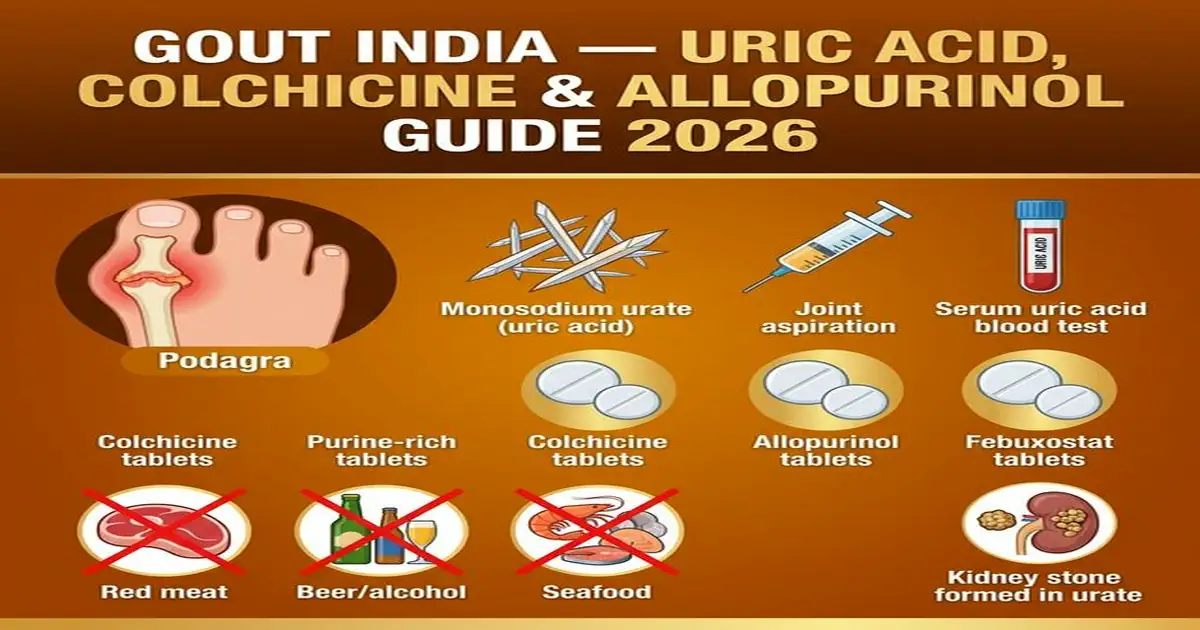
Gout Management — Acute Attack vs Long-Term Urate Lowering
| Phase | Treatment | Dose | Key Points | India Cost |
|---|---|---|---|---|
| Acute gout attack — first-line | Colchicine | 1mg stat then 0.5mg 1 hour later (low-dose colchicine — AGREE trial); maximum 1.5mg/day for 5–7 days; no maximum dose of old “until diarrhoea or vomiting” — this high-dose protocol is OUTDATED and dangerous | Most effective if started within 24 hours of attack onset; anti-inflammatory via microtubule inhibition (blocks NLRP3 inflammasome — the core mediator of gout inflammation); diarrhoea commonest side effect (dose-dependent — reduced by low-dose protocol); renal dose adjustment: eGFR <30 contraindicated; avoid with strong CYP3A4 inhibitors (clarithromycin, verapamil — increases colchicine toxicity → myopathy, neuropathy) | Generic colchicine: ₹5–10/tablet; very affordable; widely available India |
| Acute gout attack — alternative | NSAIDs (Naproxen preferred; Indomethacin; Diclofenac) | Naproxen 500mg twice daily; Indomethacin 50mg three times daily × 5–7 days; use with PPI (omeprazole) for GI protection | Equally effective to colchicine for acute attack; avoid in: CKD (nephrotoxic), peptic ulcer, cardiovascular disease, elderly; avoid aspirin (low-dose aspirin raises uric acid — use other NSAID); widely used India as first-line due to familiarity | Generic naproxen: ₹10–20/tablet; indomethacin: ₹5–15/tablet |
| Acute gout attack — if colchicine/NSAIDs contraindicated | Prednisolone (oral corticosteroid) | Prednisolone 30–35mg/day × 5–7 days then taper; or intra-articular triamcinolone injection for monoarticular attack | Effective; useful in CKD where colchicine/NSAIDs both risky; monitor blood glucose in diabetics (steroids cause transient hyperglycaemia); IL-1β antagonists (anakinra, canakinumab) — for refractory, frequent gout attacks unresponsive to all others; very expensive; rarely needed India | Generic prednisolone: ₹2–5/tablet; triamcinolone injection: ₹100–300 |
| Long-term urate-lowering therapy (ULT) — first-line | Allopurinol (xanthine oxidase inhibitor) | Start at 50–100mg/day after acute attack resolves (wait ≥2 weeks after attack); titrate monthly → target serum uric acid (SUA) <6 mg/dL (or <5 mg/dL for tophaceous gout); maximum dose 600–900mg/day (higher doses often needed — most undertreatment is due to inadequate dose escalation) | Cover with colchicine prophylaxis 0.5mg once/twice daily for minimum 3–6 months when starting allopurinol (prevents mobilisation flares); HLA-B*5801 testing before allopurinol in Han Chinese and Thai patients (severe hypersensitivity — Stevens-Johnson syndrome risk); India: low HLA-B*5801 prevalence in general Indian population but significant in some ethnic communities — test if available; allopurinol hypersensitivity syndrome (AHS): rare but potentially fatal (rash + fever + liver/kidney failure) — stop immediately if rash develops | Generic allopurinol: ₹5–15/tablet (extremely affordable); 300mg/day = ₹150–450/month |
| Long-term ULT — second-line | Febuxostat (non-purine xanthine oxidase inhibitor) | 40–80mg once daily; more potent than allopurinol at equivalent doses; does not require renal dose adjustment (useful in mild-moderate CKD — metabolised by liver) | CONFIRMS trial: febuxostat (80mg) superior to allopurinol 300mg (commonly under-dosed) at achieving SUA <6; cardiovascular warning (CARES trial): increased cardiovascular mortality vs allopurinol in patients with established CVD — avoid if recent MI/stroke; prefer allopurinol in high-cardiovascular-risk patients; useful in allopurinol intolerance or inadequate response | Febuxostat brand (Febutaz, Zurig): ₹15–30/tablet; generic: ₹10–20/tablet; 80mg/day = ₹300–600/month |
Frequently Asked Questions
What causes high uric acid in India — and which foods to avoid?
Hyperuricaemia (high serum uric acid — SUA >7 mg/dL in men, >6 mg/dL in women) is the biochemical prerequisite for gout, but most people with hyperuricaemia never develop gout — the prevalence of hyperuricaemia is much higher than clinical gout: Purine metabolism — why uric acid rises: Purines (adenine, guanine) found in DNA/RNA → metabolised → hypoxanthine → xanthine → uric acid (by xanthine oxidase enzyme); uric acid excreted 70% by kidneys, 30% by gut; either overproduction of uric acid (less common — 10%) or under-excretion by kidneys (90% of primary gout) → hyperuricaemia; uric acid saturates plasma at 6.8 mg/dL → above this concentration → crystallises as monosodium urate → deposits in cooler peripheral joints (big toe, ankle, knee — lower temperature promotes crystal formation). India-specific dietary triggers — foods to avoid with gout: High-purine foods (significantly raise uric acid): Red meat: mutton, beef, pork — high in purines (especially organ meats: liver, kidney, brain — mutton brain/liver are very high purine, common in Indian non-vegetarian cuisine); avoid or strictly limit; Seafood: prawns, crab, lobster, sardines, anchovies — high purines; shellfish particularly high; Alcohol: beer is worst (both purines + inhibits uric acid excretion); spirits (whisky/rum) less so but all alcohol impairs renal uric acid excretion; moderate-purine foods (limit but don’t eliminate): chicken (white meat — lower purines than red meat), daal (lentils — despite purine content, vegetarian purines don’t raise uric acid as much as animal purines — epidemiological evidence that vegetarians have lower gout risk), mushrooms, spinach (mild effect in high amounts); Fructose/sugar: surprisingly important — fructose (from sugary drinks, fruit juice, corn syrup) raises uric acid by increasing purine nucleotide degradation; regular cola/lemonade/fruit juice consumption doubles gout risk; this is mechanistically distinct from dietary purines; India context: rising cold drink/juice consumption contributes to hyperuricaemia in younger urban Indians; Protective foods (lower uric acid): Dairy: low-fat dairy (milk, yoghurt/dahi) significantly lowers uric acid — dairy proteins increase uric acid excretion; DASH diet associated with lower SUA; Cherry/cherry extract: anthocyanins reduce inflammation and uric acid; 30–40% reduced gout attack frequency in observational studies; tart cherry juice (widely available India); Vitamin C: 500–1,000mg/day supplementation modestly lowers SUA (-0.5 mg/dL); Water: adequate hydration 2–3L/day promotes uric acid excretion; alkaline water/sodium bicarbonate alkalinises urine → increases urate solubility and excretion. Non-dietary causes of hyperuricaemia India: Diuretics: thiazides and loop diuretics (furosemide) used for hypertension/heart failure — impair uric acid excretion; very common cause of new gout in cardiac/hypertensive patients on diuretics; alternative anti-hypertensive: losartan (ARB with mild uricosuric effect — mild SUA lowering — preferred in hypertensive gout patients); Low-dose aspirin: paradoxically raises uric acid at low doses (<2g/day); Cyclosporine: post-transplant gout — common in transplant patients on cyclosporine; use tacrolimus-based immunosuppression instead where possible; CKD: reduced renal excretion → hyperuricaemia — a chicken-and-egg problem (hyperuricaemia may accelerate CKD); Lead exposure (saturnine gout): historically from lead-contaminated spirits; now from occupational lead exposure (battery workers, painters); test blood lead if atypical gout presentation.
When should allopurinol be started and what mistakes to avoid?
Urate-lowering therapy (ULT) is indicated for most patients with recurrent gout — but there are critical timing, dosing, and monitoring rules that are frequently violated in Indian clinical practice, leading to treatment failure: Indications to start ULT (allopurinol or febuxostat): ≥2 gout attacks/year; 1 attack + CKD stage ≥3 (SUA lowering slows CKD — KDIGO recommends treating hyperuricaemia in CKD); 1 attack + tophi (visible urate deposits); 1 attack + urolithiasis (uric acid kidney stones constitute 10% of all kidney stones in India); SUA >9 mg/dL even if never had attack (very high risk of first attack). The golden rule — NEVER start allopurinol during an acute attack: Starting ULT during an acute gout attack causes mobilisation of urate crystals from existing deposits → triggers new flares or worsens current attack; wait until acute inflammation has completely resolved (minimum 2 weeks after attack resolution) before initiating allopurinol; the most common India mistake: starting allopurinol the moment serum uric acid result comes back (during or immediately after attack) → patient immediately has another flare → blames allopurinol → stops it → never restarts → progressive tophaceous gout develops over years. Start low, go slow — dose escalation: Start allopurinol at low dose (50–100mg/day) regardless of renal function; this reduces risk of allopurinol hypersensitivity syndrome (AHS); increase by 50–100mg every 2–4 weeks; measure SUA every 2–4 weeks during titration; target SUA <6 mg/dL (serum); many patients need 300–600mg/day to reach target (standard 300mg is often inadequate — under-dosing is the most common cause of treatment failure); maximum effective dose: 600mg (900mg in some guidelines); in CKD, dose allopurinol according to eGFR (lower doses in CKD G3+ — risk of AHS higher in CKD). Colchicine prophylaxis during ULT initiation: Add colchicine 0.5mg once or twice daily prophylactically for the first 3–6 months of allopurinol (or until SUA reaches target AND no attacks for 3 months); rationale: lowering SUA mobilises urate from tissue deposits → triggers flares; colchicine prevents these; many Indian prescribers start allopurinol without prophylactic colchicine → patient gets repeat flares → stops allopurinol → failure to achieve long-term control. Duration of ULT: Allopurinol should be continued indefinitely in most gout patients — gout is a chronic disease; stopping allopurinol after 1–2 years (once SUA normalised and attacks stop) universally leads to SUA rebounding and recurrent attacks within 1–2 years; the goal of ULT is “cure” of the underlying hyperuricaemia — not merely treatment of individual attacks.
Can gout be confused with other conditions in India?
Gout is frequently misdiagnosed in India — confused with septic arthritis (joint infection), pseudogout, rheumatoid arthritis, cellulitis, and other conditions. The gold standard for diagnosis is joint aspiration and crystal identification: Differential diagnosis of acute hot joint (monoarthritis) — always consider: Septic arthritis (MUST NOT MISS): bacterial joint infection — staph/strep/gram-negatives; fever, warm/swollen/tender joint; joint aspiration shows turbid fluid with WBC >50,000/µL and bacteria on Gram stain/culture; if suspected, joint aspiration is mandatory and antibiotics started immediately (waiting for uric acid or other results = dangerous delay); gout and septic arthritis CAN coexist; Gout: MSU crystals on polarised microscopy — negatively birefringent, needle-shaped; typically lower WBC than septic arthritis (10,000–60,000/µL); Pseudogout (CPPD disease): calcium pyrophosphate deposition — positively birefringent, rhomboid-shaped crystals; affects larger joints (knee > wrist) in elderly; radiograph shows chondrocalcinosis (calcium within cartilage); Reactive arthritis: post-infectious arthritis (Chlamydia, Yersinia, Salmonella, Campylobacter) — asymmetric oligoarthritis; HLA-B27 associated; may have urethritis/conjunctivitis (Reiter’s triad); Rheumatoid arthritis: polyarthritis; symmetric small joint involvement; rheumatoid factor + anti-CCP antibodies; gout and RA can coexist; Cellulitis: skin infection — may mimic gout; no joint swelling on aspiration; responds to antibiotics not colchicine. When to do joint aspiration in India: Any first monoarthritis episode (exclude septic arthritis — culture); diagnostic uncertainty; suspected tophi aspiration (whitish chalky deposits — confirms gout); not always available at PHC level — referral to secondary/tertiary centre with rheumatology access needed. Serum uric acid in acute attack: Crucially: serum uric acid can be NORMAL or LOW during an acute gout attack (acute phase response lowers SUA transiently); a normal SUA during an acute attack does NOT exclude gout; measure SUA ≥2 weeks after attack resolution for accurate baseline.
What to Read Next
- Kidney Stones — Uric Acid Stones: 10% of All Kidney Stones; Allopurinol + Urinary Alkalinisation (Sodium Bicarbonate) Dissolves Urate Stones
- CKD — Gout and CKD Are Bidirectional: Hyperuricaemia Accelerates CKD; CKD Impairs Uric Acid Excretion; Avoid NSAIDs
- Arthritis — Gout vs RA vs OA: Three Very Different Arthritis Types with Different Treatment; Don’t Confuse Them
- Hypertension — Thiazide Diuretics Raise Uric Acid; Switch to Losartan (ARB) if Gout + Hypertension
- Diabetes — Metabolic Syndrome: Obesity + Hypertension + Diabetes + High Uric Acid Often Cluster Together in India
Gout is 100% controllable with cheap generic medication that costs ₹150–500 per month. Allopurinol has been available since 1966. Colchicine has been used for centuries. The science of gout management is settled. And yet patients across India continue to have monthly acute attacks, develop progressive tophi, and destroy their joint function — because their SUA target is never checked, their allopurinol dose is never escalated adequately, and their colchicine prophylaxis is never prescribed during ULT initiation. Undertreated gout is not a pharmacological failure. It is a monitoring and prescribing failure.
About This Guide: Written by the StudyHub Health Editorial Team (studyhub.net.in) based on ACR Gout Management Guidelines 2020, BSR/EULAR Gout Guidelines 2022, and Indian Rheumatology Association recommendations. Last updated: March 2026.
💊 The Two Rules of Gout: (1) NEVER start allopurinol during an acute attack — wait 2 weeks after full resolution. (2) ALWAYS add colchicine 0.5mg once/twice daily prophylactically for the first 3–6 months of allopurinol. Violating either rule causes repeat flares, patient abandonment of allopurinol, and progressive joint damage.
🎯 SUA Target: <6 mg/dL: Check serum uric acid every 2–4 weeks during allopurinol titration. Target is SUA <6 mg/dL (not just “normal range” — lab normal is up to 7, but gout target is <6). Most Indians need 300–600mg allopurinol/day to reach this target. Do not stop at the first “normal” SUA result — ensure sustained control.
⚕️ Medical Disclaimer: This article provides general educational information about gout and hyperuricaemia. Diagnosis, acute attack treatment, and urate-lowering therapy decisions require qualified physician or rheumatologist assessment. Joint aspiration to exclude septic arthritis is required for any first-time acute monoarthritis.