
Last Updated: March 2026 | Reading Time: 9 minutes | ~2,000 words
India’s maternal mortality ratio (MMR) — 97 per 100,000 live births (SRS 2018–20) — while dramatically improved from 254 in 2004, remains far above the SDG target of <70 per 100,000 and masks enormous state-level variation: Kerala achieves 19; Assam and Uttar Pradesh exceed 200. The leading causes of maternal death in India are haemorrhage (25%), hypertensive disorders including preeclampsia/eclampsia (20%), sepsis (15%), and anaemia (13%) — virtually all preventable with timely recognition and correct management. A “high-risk pregnancy” is one where pre-existing conditions or complications developing during pregnancy significantly increase the risk of adverse outcomes for mother, baby, or both. Recognising risk factors, understanding warning signs, and ensuring appropriate referral to a facility equipped to manage complications is the difference between a live mother with a healthy infant and a preventable tragedy. This guide provides the evidence-based framework every Indian woman, family, and frontline health worker needs.
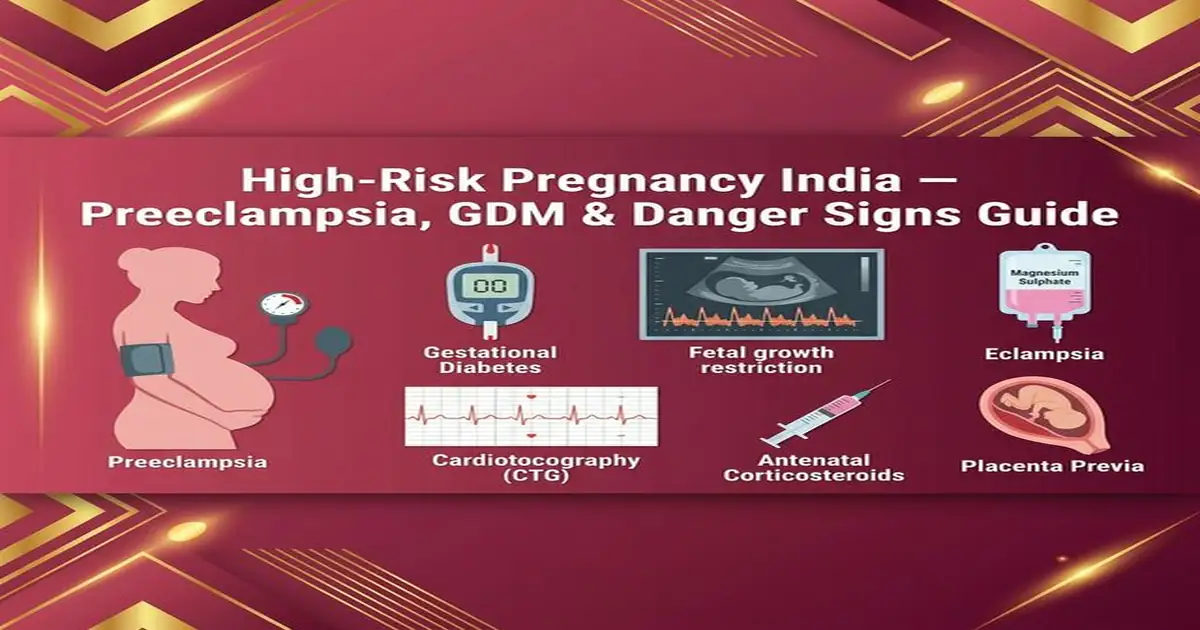
Major High-Risk Conditions — Classification & Management
| Condition | Definition | India Prevalence | Key Risk | Management |
|---|---|---|---|---|
| Preeclampsia | Hypertension (BP ≥140/90) + proteinuria or end-organ dysfunction after 20 weeks gestation; “pure” hypertension before 20 weeks = chronic hypertension, not preeclampsia | 5–8% pregnancies; leading cause of maternal death; more prevalent in primigravidae, obesity, diabetes, multiple pregnancy, CKD, previous preeclampsia | Eclampsia (seizures); HELLP syndrome; placental abruption; FGR; preterm delivery; maternal acute kidney injury, stroke, pulmonary oedema | Antihypertensives (labetalol, nifedipine, methyldopa); if severe features → magnesium sulphate for seizure prevention + delivery is definitive treatment; low-dose aspirin 75–150mg from 12 weeks in high-risk women reduces preeclampsia by 20–30% |
| Gestational Diabetes Mellitus (GDM) | Glucose intolerance first detected in pregnancy (2-hour 75g OGTT: fasting ≥92 mg/dL, 1hr ≥180, 2hr ≥153 mg/dL — IADPSG/WHO 2013 criteria); India uses modified Dipsi criteria in some settings | 16–17% of Indian pregnancies — highest rate globally; India’s T2DM predisposition expressed under metabolic stress of pregnancy; underdiagnosis significant in low-resource settings | Macrosomia (large baby → shoulder dystocia → birth trauma); neonatal hypoglycaemia; preterm delivery; polyhydramnios; C-section; increased future T2DM risk (50% within 5 years for GDM mother); offspring at higher T2DM risk | Medical nutrition therapy (MNT) + self-monitoring blood glucose; if targets not met in 1–2 weeks: insulin (preferred in pregnancy over oral agents); metformin used in some low-resource settings; target: fasting <95, post-meal <120 mg/dL |
| Placenta Praevia | Placenta implanted over or near the internal cervical os; grades: complete (os fully covered), partial, marginal; diagnosed on ultrasound; most placenta praevia found at 20 weeks scan resolve by 36 weeks (placental migration) | 0.5% pregnancies; risk factor: previous C-section scar (placenta accreta spectrum — PAS — increasingly common with India’s rising C-section rates; PAS has 7% maternal mortality if unprepared) | Painless antepartum haemorrhage (PPH before delivery); catastrophic haemorrhage at delivery; PAS (accreta/increta/percreta) → uncontrollable bleeding if uterus cut | NEVER do vaginal examination in undiagnosed APH (can precipitate fatal haemorrhage from praevia). Delivery by planned C-section at 36–37 weeks for complete praevia; PAS requires tertiary centre with blood bank + interventional radiology + experienced surgeon |
| Fetal Growth Restriction (FGR) | Estimated fetal weight <10th percentile or abdominal circumference <10th percentile on serial growth scans; classified early (<32 weeks, placental vascular disease) or late (>34 weeks); important to distinguish constitutionally small from pathologically small | 10–15% pregnancies in India (higher due to maternal malnutrition, anaemia, hypertension, infections including malaria); often under-detected in rural settings without ultrasound access | Stillbirth; perinatal asphyxia; neonatal hypoglycaemia; hypothermia; infection; long-term: higher risk of metabolic syndrome and cardiovascular disease | Serial growth scans every 2 weeks; Doppler studies (umbilical artery, ductus venosus — absent/reversed end-diastolic flow = emergency); correct maternal anaemia, hypertension; deliver at 37 weeks (late FGR) or earlier with adverse Doppler (early FGR) |
| Preterm Labour | Labour before 37 completed weeks of gestation; spontaneous or indicated (maternal/fetal compromise requiring early delivery); very preterm <32 weeks; extremely preterm <28 weeks | 10–13% deliveries in India; leading cause of neonatal death; most very preterm infants in India lack NICU access — survival at 28 weeks >95% in tertiary NICU vs <50% without NICU | Neonatal respiratory distress syndrome (RDS); intraventricular haemorrhage; necrotising enterocolitis; sepsis; death; long-term: cerebral palsy, developmental delay | Antenatal corticosteroids (ACS: betamethasone 12mg IM × 2 doses 24 hr apart) 24–34 weeks → reduces RDS and neonatal mortality by 30–40%; magnesium sulphate for neuroprotection <32 weeks; tocolysis to buy 48 hours for ACS; refer to centre with NICU |
Danger Signs in Pregnancy — When to Go to Hospital Immediately
| Danger Sign | What It May Indicate | Action |
|---|---|---|
| Severe headache + visual disturbance (blurred vision, flashing lights, “stars”) + upper abdominal pain (epigastric/right upper quadrant) | Severe preeclampsia / HELLP syndrome (Haemolysis, Elevated Liver enzymes, Low Platelets) — imminent eclampsia; hepatic capsule distension | 🔴 EMERGENCY — go to hospital immediately; do not wait for next ANC appointment; these are premonitory signs before eclamptic convulsion |
| Convulsion / fit in a pregnant woman after 20 weeks | Eclampsia — obstetric emergency; can occur antepartum, intrapartum, or up to 4 weeks postpartum | 🔴 Call 108; place in left lateral position (prevents aspiration, improves uterine blood flow); give IV/IM magnesium sulphate loading dose if available (protocol: 4g IV slow over 20 min + 5g deep IM each buttock); airway management; urgent delivery after stabilisation |
| Vaginal bleeding at any stage of pregnancy | First trimester: threatened miscarriage; ectopic pregnancy; Second trimester: cervical incompetence, placental abruption; Third trimester: placenta praevia (painless); placental abruption (painful + tender uterus) | Any vaginal bleeding in pregnancy = go to hospital; NEVER assume it is normal spotting without assessment; never do vaginal examination in third trimester bleeding before ultrasound excludes praevia |
| Reduced/absent fetal movements | Fetal distress; placental insufficiency; fetal compromise; stillbirth prevention window | Apply “Count to 10” method (from 9am — count 10 movements; if 10 movements achieved, normal); if 10 movements not felt by 5pm → go to hospital for CTG (cardiotocography); fetal movement reduction is one of the most reliable early warning signs of fetal compromise |
| Severe breathlessness / chest pain | Pulmonary oedema (complication of preeclampsia, fluid overload); pulmonary embolism (pregnancy increases VTE risk 4–5×); peripartum cardiomyopathy; severe anaemia with cardiac decompensation | 🔴 Emergency — call 108; sit upright; do not lie flat; history of leg swelling + sudden breathlessness = high suspicion PE; pregnancy is a hypercoagulable state |
| High fever (>38°C) with rigors, dysuria, loin pain | Pyelonephritis (UTI ascending to kidneys — common in pregnancy due to physiological urinary stasis from uterine compression + progesterone urinary tract relaxation); chorioamnionitis (infection of membranes — obstetric emergency if present); septic abortion | All fever in pregnancy needs urgent evaluation; UTI/pyelonephritis in pregnancy causes preterm labour; untreated → sepsis; chorioamnionitis → immediate antibiotic treatment + delivery |
Frequently Asked Questions
What is magnesium sulphate and why is it critical for eclampsia in India?
Magnesium sulphate (MgSO₄) is one of the most important life-saving drugs in obstetrics — and its availability and correct use at the first referral level is a primary determinant of eclampsia survival in India: What it does: Magnesium sulphate prevents and treats eclamptic seizures — it is NOT an antihypertensive (blood pressure requires separate treatment with labetalol, nifedipine, or hydralazine). The mechanism: Mg²⁺ blocks NMDA receptors in cerebral cortex → prevents the abnormal electrical discharge causing eclamptic seizures; also protects blood-brain barrier. Evidence: The Magpie Trial (2002) — 10,000 women in 33 countries including India — showed magnesium sulphate reduces eclampsia by 58% compared to placebo; reduces maternal death by 45%. It is unambiguously superior to diazepam (Valium) and phenytoin for eclampsia — both still used in some Indian settings inappropriately. FIGO and WHO explicitly state: magnesium sulphate is the only recommended anticonvulsant for eclampsia in pregnancy. The Pritchard regimen (standard for low-resource India settings): Loading dose: 4g IV slow over 20 minutes (given carefully — too fast = cardiotoxicity) + 5g deep IM each buttock (10g total loading). Maintenance: 5g deep IM every 4 hours for 24 hours after last seizure. Monitoring for toxicity (before each maintenance dose): Respiratory rate ≥16/min (respiratory depression = first sign of toxicity); deep tendon reflexes present (loss of reflexes precedes respiratory arrest); urine output ≥25mL/hour (Mg²⁺ renally excreted). Antidote: Calcium gluconate 10mL of 10% solution IV over 3 minutes — reverses magnesium toxicity immediately; must be at the bedside whenever MgSO₄ is being infused. India availability: Magnesium sulphate injection (1g/mL and 500mg/mL vials) is an Essential Medicine listed in India’s National Essential Medicines List; must be available at every first referral unit (FRU) and community health centre (CHC) managing deliveries. The Janani Suraksha Yojana (JSY) institutional delivery programme cannot be considered truly safe without MgSO₄ availability at every delivery point — gaps in peripheral facilities remain a major preventable eclampsia death cause.
How should GDM be screened and managed in India?
India has the highest GDM prevalence globally — 16–17% — driven by the combination of genetic insulin resistance, South Asian fat distribution (visceral fat even at normal BMI), and rapid urbanisation with dietary transition. Yet screening practices remain inconsistent: Screening approach: FOGSI (Federation of Obstetric and Gynaecological Societies of India) recommends universal screening (ALL pregnant women, not just high-risk) because India’s background risk is so high that risk-factor-based screening misses too many cases. 75g OGTT at 24–28 weeks (standard window). Many obstetricians screen at the FIRST antenatal visit (8–12 weeks) using a early screening OGTT to detect pre-existing undiagnosed diabetes — important because 10–15% of women diagnosed with “GDM” in India actually have pre-existing T2DM. DIPSI (Diabetes in Pregnancy Study Group India) criteria: A simplified, resource-appropriate approach widely used in India: 75g glucose load given regardless of fasting status (non-fasting) → 2-hour plasma glucose ≥140 mg/dL = GDM. Less sensitive than full fasting + 2-hour IADPSG criteria but practical for PHC level use. Postpartum follow-up — critically neglected: EVERY GDM mother must have a 75g OGTT at 6–12 weeks postpartum (not just a random glucose) — because 50% will develop T2DM within 5–10 years. GDM is the most powerful individual-level predictor of future T2DM. Lifestyle modification postpartum (weight loss to pre-pregnancy BMI, regular exercise, dietary change) reduces T2DM progression by 50%. This postpartum testing and counselling is largely absent in Indian obstetric practice — a massive missed opportunity for T2DM prevention at population scale. For the baby: All GDM babies need blood glucose checked at 1–2 hours of birth (neonatal hypoglycaemia risk); if well and feeding: breastfeed immediately; if hypoglycaemic: IV dextrose. GDM baby requires paediatric assessment; mother education on future T2DM risk for both mother and child.
What are antenatal steroids and who needs them?
Antenatal corticosteroids (ACS) — specifically betamethasone or dexamethasone given to the mother before preterm delivery — are one of the most cost-effective interventions in all of medicine, reducing neonatal death from prematurity dramatically. Yet their use in India remains inconsistent: What ACS does: Betamethasone (or dexamethasone) crosses the placenta → stimulates fetal lung maturation → accelerates surfactant production → reduces the risk of respiratory distress syndrome (RDS) — the principal cause of death in preterm infants. Effect on outcomes at 28–34 weeks (highest impact window): Reduces RDS by 35–40%; reduces neonatal mortality by 30%; reduces intraventricular haemorrhage (brain bleed) by 40%; reduces necrotising enterocolitis by 50%; overall: for every 5 preterm infants treated, one death prevented. This is an extraordinary benefit from a 48-hour, two-injection treatment costing less than ₹200. Protocol: Betamethasone 12mg IM × 2 doses, 24 hours apart; OR Dexamethasone 6mg IM × 4 doses, 12 hours apart. Must be given when preterm delivery is anticipated within 7 days, at 24–34 weeks of gestation. A “rescue” course can be considered if the first course was given >14 days ago and the patient remains at risk of preterm delivery. Administration at first point of contact: A critical principle: if a woman presents in preterm labour at a primary health centre before transport to a higher facility — give the FIRST dose of ACS (betamethasone 12mg IM) immediately before transport. Even partial benefit (one dose) significantly helps fetal lung maturity. Do not wait to arrive at the referral centre to start ACS — transport time may be 4–6 hours in rural India, during which fetal lung benefit is accruing. India-specific barriers: ACS availability at PHC/CHC level for preterm deliveries is still inconsistent. Betamethasone ampoules must be stocked, refrigerated correctly, and staff trained in administration. Under NHM, ACS availability at block-level facilities is being expanded but rural gaps persist.
How can postpartum haemorrhage (PPH) be prevented?
Postpartum haemorrhage (PPH) — blood loss >500mL after vaginal delivery or >1,000mL after C-section — is the leading direct cause of maternal death globally and in India, accounting for approximately 25% of maternal deaths: The most important prevention — Active Management of the Third Stage of Labour (AMTSL): This package must be given to EVERY woman after delivery — not just high-risk. Components: Uterotonic (oxytocin 10 IU IM immediately after baby is born — before placenta is delivered) → uterine contraction → reduces PPH risk by 50%. Controlled cord traction (clamp umbilical cord, apply traction while supporting uterus — Brandt-Andrews technique) → aids placenta delivery. Uterine massage after placenta delivery — until uterus is firm. The oxytocin supply challenge: Oxytocin requires cold chain storage (2–8°C) — unavailable in many rural delivery points. Alternatives for peripheral use: Misoprostol 600mcg sublingual or oral — heat-stable, given by ASHA/ANM at home delivery or in PHC without cold chain; reduces PPH by 40% vs no uterotonics. Carbetocin (heat-stable oxytocin analogue) — used in selected settings. Tranexamic acid 1g IV — given within 3 hours of PPH onset, reduces PPH death by 30% (WOMAN trial); now in India’s national PPH protocol; available at all government facilities. The “three-delays” model and PPH deaths: Most PPH deaths in India occur because of three delays: Delay 1: Delay in decision to seek care (woman/family doesn’t recognise severity of bleeding); Delay 2: Delay in reaching facility (distance, transport); Delay 3: Delay in receiving treatment at facility (drugs not available, staff not trained). Iron/folate supplementation throughout pregnancy reduces anaemia → even modest PPH is better tolerated. Specific PPH causes (the “4 Ts”): Tone (uterine atony — 70% of PPH): oxytocin → carboprost → B-Lynch suture; Trauma (lacerations): Inspection + suture; Tissue (retained placenta): Manual removal; Thrombin (coagulopathy): FFP, cryoprecipitate, tranexamic acid.