
Last Updated: March 2026 | Reading Time: 9 minutes | ~2,000 words
Irritable Bowel Syndrome (IBS) is the most common gastrointestinal disorder worldwide — and in India, it represents an enormous but under-recognised burden. Population studies estimate 10–15% of Indians have IBS, with surveys in some urban populations reporting rates as high as 20%. IBS significantly impairs quality of life, productivity, and mental health — yet carries no increased mortality risk and has no structural abnormality on investigation. The fundamental challenge in India: IBS is a diagnosis of inclusion (in high-prevalence countries) and exclusion (where structural causes like IBD, coeliac disease, and infection must be excluded); it is chronically mismanaged through repeated investigations (costly colonoscopies finding nothing), inappropriate antibiotic courses (worsening the gut microbiome), and dismissal as “stress” without constructive therapeutic management. This guide applies the evidence-based framework — including the gut-brain axis, low-FODMAP diet, and India-specific triggers — to IBS diagnosis and management.
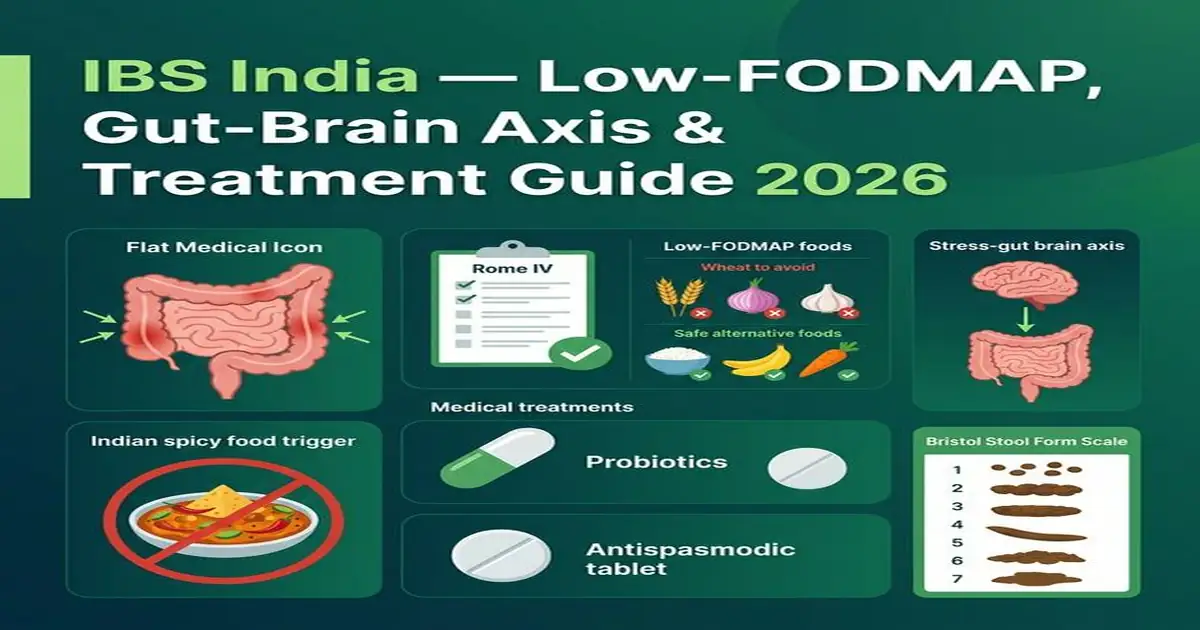
Rome IV Diagnostic Criteria & IBS Subtypes
| IBS Subtype | Stool Pattern | Predominant Symptoms | Treatment Focus | India Prevalence |
|---|---|---|---|---|
| IBS-C (Constipation-predominant) | Bristol Stool Form ≤2 (lumpy/hard pellets) in >25% bowel movements; Bristol ≥6 in <25% | Bloating, abdominal distension, infrequent hard stools, straining, incomplete evacuation; rarely urgency; pain relieved by bowel movement | Soluble fibre (ispaghula/psyllium husk — Isabgol — most used India); linaclotide (Linzess); prucalopride; osmotic laxatives (macrogol/lactulose); low-FODMAP; peppermint oil capsules; avoid insoluble fibre (wheat bran) worsening bloating in IBS | Common in older Indian women; wheat-heavy Indian diet and low fluid intake exacerbate constipation; widespread use of Isabgol (psyllium husk) as self-medication — appropriate and evidence-based when used with adequate water (>300ml per dose) |
| IBS-D (Diarrhoea-predominant) | Bristol Stool Form ≥6 (loose/watery) in >25% bowel movements; Bristol ≤2 in <25% | Frequent loose stools; urgency (can’t delay defecation — socially disabling); morning rush (most intense symptoms first 1–2 hours after waking); post-prandial urgency after meals; pain; incontinence risk in severe cases; anxiety from fear of accidents | Low-FODMAP diet (most evidence for IBS-D); loperamide (Imodium) for urgency and diarrhoea control (not for abdominal pain); antispasmodics — mebeverine, dicyclomine, hyoscine; tricyclic antidepressants (amitriptyline low-dose) for pain and slowing motility; rifaximin (poorly absorbed antibiotic) for post-infectious IBS-D | Most common IBS subtype in India; strongly linked to prior gastroenteritis (“post-infectious IBS” — after typhoid, amoebiasis, food poisoning); morning rush pattern extremely prevalent among working-age Indian professionals; causes significant occupational and social avoidance behaviour |
| IBS-M (Mixed) | Alternating constipation and diarrhoea; Bristol ≥6 AND ≤2 each in >25% of bowel movements | Alternating loose and hard stools with no clear predominant pattern; bloating; cramping; often unpredictable — very distressing to patients; morning diarrhoea alternating with constipated days | Combined approach: low-FODMAP diet; antispasmodics for cramping; soluble fibre for constipation days; loperamide for diarrhoea days; psychotherapy (gut-directed hypnotherapy, CBT) often most effective for IBS-M due to gut-brain axis dysregulation | Very common and often misdiagnosed; alternating patterns sometimes attributed by Indian patients to “hot/cold” foods or “digestive weakness”; frequently treated with repeated courses of metronidazole and rifaximin without diagnosis — worsening microbiome |
| IBS-U (Unsubtyped) | Neither sufficient constipation nor sufficient diarrhoea to qualify above; some loose, some normal stools | Abdominal pain + altered bowel habit not meeting other subtypes | Symptom-directed; antispasmodics for pain; lifestyle and stress management | Least common subtype; often a transitional category |
Rome IV Diagnostic Criteria (essential for diagnosis): Recurrent abdominal pain at least 1 day/week for the last 3 months, associated with 2+ of: A) Related to defecation; B) Associated with change in stool frequency; C) Associated with change in stool form/appearance. Onset ≥6 months ago. NO alarm features (see below). IBS is a POSITIVE diagnosis based on symptoms — not a “diagnosis of exclusion” requiring exhaustive investigation in every case in a low-risk young patient.
The Low-FODMAP Diet — India Adaptation
| FODMAP Category | Avoid (High FODMAP) | Safe Alternatives (Low FODMAP) | India Context |
|---|---|---|---|
| F — Fermentable Oligosaccharides (Fructans + GOS) | Wheat (roti, bread, pasta, naan — all wheat-based); onion; garlic; leek; spring onion (white part only); rye; barley; most pulses/legumes (dal, chana, rajma, moong, urad) in large quantities | Rice (completely safe — excellent IBS staple); rice noodles; rice-based poha, idli, dosa (all fermented rice dishes — safe); sourdough wheat (lower fructan); oats (limit to 52g). Low-FODMAP pulses: canned chickpeas (rinsed, 42g limit); firm tofu; tempeh | Wheat roti (chapati) is the fundamental Indian staple — the MOST IMPORTANT dietary change for Indian IBS patients is reducing wheat roti intake and replacing with rice; dal tadka with garlic and onion is the second most important trigger meal to modify; garlic and onion-free tadka (asafoetida / hing is low-FODMAP and can replace |
| O — Oligosaccharides (subset) | Included above | Included above | Already covered |
| D — Disaccharides (Lactose) | Milk (cow, buffalo — high lactose); soft paneer; cream; ice cream; yoghurt in large quantities (30% of Indians have lactose intolerance, rising to 60% in some southern states) | Hard aged cheese (minimal lactose); lactose-free milk; small amounts of curd/dahi (fermentation reduces lactose significantly); ghee (pure fat, minimal lactose) — good cooking oil substitute for IBS patients | India’s dependence on milk and dairy (chai, paneer, curd) makes this a significant trigger; curd/dahi up to 125ml is low-FODMAP (lactobacillus fermentation reduces lactose); full glass of milk is high-FODMAP; ghee is safe and traditional |
| M — Monosaccharides (Excess Fructose) | Mango (large quantities — India’s summer staple); watermelon; apple; pear; honey; high-fructose corn syrup; asparagus; sugar snap peas | Banana (ripe — very safe; unripe gives resistant starch but less fructose issue); papaya (excellent for IBS — natural digestive enzymes + low-FODMAP); grapes (small serving); orange; strawberry; kiwi; pineapple | Mango season (May-July) is a classic IBS flare trigger in India; large mango consumption causes bloating and diarrhoea in IBS-D patients; papaya is the ideal Indian IBS-friendly fruit (widely available, affordable, low-FODMAP, digestive enzyme papain) |
| P — Polyols (Sorbitol + Mannitol) | Stone fruits: peach, apricot, plum, cherry; avocado (mannitol); mushrooms (high mannitol — very common IBS trigger); cauliflower; sugar-free products with sorbitol/xylitol/mannitol | Carrot; tomato (serve <65g); cucumber; potato; sweet potato; pumpkin; capsicum; courgette/zucchini; beans (French beans — not lentils) | Mushrooms are a highly underestimated India IBS trigger — used commonly in sabzi/stir-fry; cauliflower (phool gobhi) is a significant trigger; carrot, potato, and tomato are safe and form staples of an India-adapted low-FODMAP plan |
Frequently Asked Questions
What is the gut-brain axis and why does stress worsen IBS?
The gut-brain axis is one of the most fascinating and clinically important concepts in modern gastroenterology — and understanding it transforms how IBS is perceived and managed by both patients and physicians: The science: The enteric nervous system (ENS) — often called the “second brain” — contains over 500 million neurons lining the gastrointestinal tract; the ENS communicates bidirectionally with the central nervous system (CNS) via the vagus nerve, spinal sensory pathways, and the hypothalamic–pituitary–adrenal (HPA) axis. In IBS, this bidirectional communication is dysregulated: psychological stress activates the HPA axis → cortisol release → alters gut motility (speeds or slows transit depending on individual), increases intestinal permeability (“leaky gut”), and sensitises pain receptors within the gut wall → abdominal pain and altered bowel habit even without any structural abnormality. Simultaneously, gut signals (from the microbiome, inflammation, or motility disturbance) are sent to the brain → alter mood, anxiety, and even cognition. This explains: Why IBS patients have higher rates of anxiety and depression (40–50% comorbidity) — not because IBS is “psychosomatic” but because the gut-brain axis creates genuine bidirectional comorbidity; Why exam stress, work pressure from deadlines, relationship conflict, bereavement reliably trigger IBS flares; Why treating the psychological component is as medically legitimate as treating the gut. India-specific gut-brain context: Academic and career pressure (board exams, competitive entrance exams, job insecurity) are triggers for IBS onset and flare in millions of young Indians; IBS-D is commonly the most severe during morning exam/work commute periods (peak cortisol time + motility peak + anxiety peak → “exam morning diarrhoea” is physiologically driven, not simply anxiety); Post-traumatic stress (survivors of violence, disaster, or severe adverse life events) have significantly higher IBS rates — a fact unreported in India’s trauma care. Evidence-based psychological therapies for IBS: Gut-directed hypnotherapy: Grade A evidence (Manchester Protocol RCT); 12 weekly sessions; achieved 70% long-term responder rate; now recommended by NICE as a first-line treatment for refractory IBS; available via trained hypnotherapists and validated digital programmes (Nerva app — evidence-based); growing availability in India metros. CBT (Cognitive Behavioural Therapy): multiple high-quality RCTs; addresses catastrophising, symptom amplification, avoidance behaviour; reduces IBS symptom severity scores significantly; 8–12 sessions. Mindfulness-based stress reduction (MBSR): growing RCT evidence; particularly useful in mixed-subtype IBS with anxiety comorbidity.
Do I have IBS or inflammatory bowel disease (IBD)?
This is the most important distinction in gastroenterology for a patient with chronic GI symptoms — and both conditions are increasing in India: IBD (Inflammatory Bowel Disease) = Crohn’s disease + Ulcerative Colitis: IBD involves genuine inflammation and structural damage to the gut mucosa; it progresses, causes complications (bleeding, strictures, fistulae), requires immunosuppressive treatment, and needs endoscopic monitoring. India’s IBD prevalence is rising sharply — urbanisation, Westernisation of diet, improved hygiene hypothesis (reduced early microbial exposure), and genetic susceptibility are all contributing. Key distinguishing features:
| Feature | IBS | IBD (UC/Crohn’s) |
|---|---|---|
| Blood in stool | NEVER (blood in stool = red flag, not IBS) | Common in UC; possible in Crohn’s |
| Nocturnal symptoms | Very rare — IBS is almost always daytime; waking from sleep with diarrhoea = NOT IBS | Common — waking at night with diarrhoea/urgency/blood |
| Fever | Never | Common in active disease flare |
| Weight loss | Uncommon (if significant = alarm feature) | Common — malabsorption and inflammation |
| CRP/ESR | Normal (IBS is not an inflammatory disease) | Elevated in active IBD |
| Faecal calprotectin | Normal (<50 μg/g) | Elevated (typically >150–200 μg/g in active IBD) |
| Colonoscopy | Normal mucosa | Active inflammation, ulcers, granulomas (Crohn’s) |
| Age of onset | Any age; often 20–40 years | UC bimodal 20–40 and 50–70; Crohn’s typically younger |
Faecal calprotectin — the key triage test: A stool test that detects neutrophil protein released by intestinal inflammation; normal calprotectin (<50 μg/g) makes IBD very unlikely (high negative predictive value — if normal, colonoscopy usually not necessary for typical IBS symptoms); elevated calprotectin → colonoscopy needed to exclude IBD. Cost in India: ₹1,500–3,000 at reference labs (Metropolis, SRL, Thyrocare); enormously valuable in avoiding unnecessary colonoscopy (₹5,000–12,000) in low-risk IBS patients. Alarm features requiring colonoscopy regardless: blood in stool; nocturnal diarrhoea; fever; weight loss; new symptoms over age 45; family history of colon cancer or IBD; iron deficiency anaemia.
Which medications work for IBS?
IBS management is personalised to subtype — the same treatment does not work across all subtypes and can even worsen symptoms (e.g., laxatives in IBS-D, loperamide in IBS-C): For ALL IBS subtypes (universal): Antispasmodics: Mebeverine (Colofac) 135–200mg TDS; dicyclomine (Cyclopam) — widely used India; hyoscine butylbromide (Buscopan); peppermint oil enteric-coated capsules (natural antispasmodic — relaxes intestinal smooth muscle; Grade B evidence; well-tolerated; available India — IBgard brand or similar); take 30–60 minutes before meals. Soluble fibre (ispaghula/psyllium — Isabgol): benefits IBS by normalising stool consistency in both C and D subtypes; start low and increase slowly (too fast = bloating); essential: ALWAYS take with ≥250ml water. Probiotics: Evidence is moderate (Cochrane review 2018: probiotics reduce global IBS symptoms vs placebo; NNT ≈8); specific evidence: Lactobacillus rhamnosus GG (Culturelle — available India); VSL#3 (multi-strain; strong evidence especially IBS-D and post-infectious IBS); Saccharomyces boulardii (Enterogermina forte — evidence for IBS-D); effect seen over 4–8 weeks; choose multi-strain formulations over single strain. IBS-D specific: Loperamide (Imodium) 2mg before planned activity/travel — reduces urgency and stool frequency; does NOT help abdominal pain (does not address visceral hypersensitivity); do not use for daily ongoing symptoms long-term. Low-dose amitriptyline 10–25mg at night: most evidence of any medication for IBS-D (NICE first-line recommendation for refractory IBS); reduces gut motility (anticholinergic effect); reduces visceral pain (central sensitisation effect); helps comorbid anxiety/depression; Indian availability: widely available generic amitriptyline ₹5–15/tablet. Rifaximin 1600mg/day × 14 days: poorly absorbed antibiotic; evidence for IBS-D (especially post-infectious); alters gut microbiome for 10+ weeks; available India branded (Rifagut) ₹400–800/course; expensive but effective for selected cases. IBS-C specific: Linaclotide (Linzess) 145–290mcg daily: secretagogue — stimulates intestinal fluid secretion and transit; evidence grade A for IBS-C; available India; ₹80–120/capsule (expensive). Lubiprostone: similar mechanism; less available India. Osmotic laxatives (macrogol/PEG — Miralax; lactulose — widely available India; sorbitol): use carefully — some osmotic agents are high-FODMAP and worsen bloating. SSRIs for IBS: SSRIs (sertraline, escitalopram) — modest evidence for global IBS improvement (citalopram has best evidence); help comorbid anxiety/depression (which if treated, reduces IBS burden independently); SSRIs accelerate gut transit (may help IBS-C, worsen IBS-D).
Is post-infectious IBS common in India?
Post-infectious IBS (PI-IBS) is one of the most clinically significant and under-recognised subtypes of IBS — and India, with its high rates of enteric infectious disease, has an enormous PI-IBS burden: What is PI-IBS: PI-IBS develops in 10–20% of people following an acute episode of infectious gastroenteritis (bacterial: Salmonella typhi [typhoid], Campylobacter, Shigella, E. coli; viral: norovirus; protozoal: Giardia, Entamoeba histolytica). The infectious episode causes low-grade persistent inflammation, changes to the gut microbiome, increased intestinal permeability, and sensitisation of mucosal nerve endings → IBS symptoms persist for months-years after the acute infection has resolved. India PI-IBS context: India has some of the world’s highest rates of: Typhoid (Salmonella typhi — 10–15 million cases annually); Giardiasis (endemic in areas with poor water quality); Amoebiasis (Entamoeba histolytica — extremely common India); Norovirus, E. coli gastroenteritis during monsoon season (contaminated water and food); All are potent PI-IBS triggers. Each monsoon season creates a new wave of post-infectious IBS cases in India — the diarrhoea, stomach cramps, and altered bowel habits persisting into October-November after the acute gastroenteritis episode of July-September. Risk factors for developing PI-IBS after enteric infection: Female sex; Younger age; Prolonged acute infection; Severity of acute illness; Pre-existing anxiety or depression; Prior history of IBS symptoms; Antibiotic treatment during acute infection (paradoxically increases PI-IBS risk via microbiome disruption — particularly a concern with inappropriate antibiotic courses given for viral gastroenteritis in India). Treatment of PI-IBS: Rifaximin (poorly absorbed antibiotic) shows specific evidence for PI-IBS; Probiotics (VSL#3, Saccharomyces boulardii) support microbiome restoration; Low-FODMAP diet (IBS-D subtype most common after infection); Time — most PI-IBS improves over 12–24 months as gut inflammation resolves and microbiome normalises; Post-typhoid IBS: a specific Indian variant — typhoid survivors (particularly without appropriate antibiotic completion) have high rates of IBS-type symptoms lasting years.
What to Read Next
- Acid Reflux & GERD — Upper GI Symptoms Often Coexist with IBS (Functional GI Disorders); H. pylori Assessment Important
- Depression — 40–50% of IBS Patients Have Comorbid Depression; SSRIs Treat Both; Gut-Brain Axis Bidirectional
- Anxiety — GAD and IBS Are Strongly Comorbid; Anxiety Amplifies Gut Pain Signals via Gut-Brain Axis
- Fatty Liver — SIBO (Small Intestinal Bacterial Overgrowth) Links NAFLD and IBS in Many Patients
- Vitamin B12 — Metformin Depletes B12; B12 Deficiency Can Cause GI Symptoms Mimicking IBS
Every monsoon, millions of Indians recover from the “stomach bug” — the diarrhoea, the cramping, the food avoidance. Most recover fully. But 10–15% go on to have IBS symptoms for years without knowing why. They are told their investigations are normal. They are given repeated antibiotic courses. They are told it is “stress.” All of these responses are partial truths. The full truth: the monsoon gastroenteritis changed your gut, your microbiome, and your gut-brain axis; the right approach is low-FODMAP, probiotics, stress management, and time — not another colonoscopy or another course of metronidazole.
About This Guide: Written by the StudyHub Health Editorial Team (studyhub.net.in) based on Rome IV Diagnostic Criteria, NICE IBS Guideline 2017, Monash University FODMAP research, and Indian Society of Gastroenterology practice guidelines. Last updated: March 2026.
🌾 India IBS Diet Swap: Replace wheat roti with rice. Replace garlic+onion tadka with asafoetida (hing) tadka. Replace mango with papaya. Replace milk with small curd. Replace mushroom sabzi with carrot/potato. These 5 swaps alone can dramatically reduce IBS symptoms in most Indian patients on a low-FODMAP trial.
🩸 Blood in Stool is NEVER IBS: Blood in stool, nocturnal diarrhoea waking you from sleep, fever with bowel symptoms, or unexplained weight loss = these are NOT IBS. These are alarm features requiring urgent colonoscopy to exclude IBD, cancer, or infection.
⚕️ Medical Disclaimer: This article provides general educational information about IBS. IBS diagnosis requires clinical assessment by a qualified gastroenterologist or general physician to exclude alarm features and structural causes. All dietary and pharmacological management should be supervised by a qualified healthcare provider.