
Last Updated: March 2026 | Reading Time: 9 minutes | ~2,000 words
Infertility — defined as failure to conceive after 12 months of regular unprotected intercourse (or 6 months if the woman is over 35) — affects an estimated 27.5 million couples in India, representing one of the largest infertility burdens globally. Despite this scale, infertility in India carries profound social stigma — particularly for women, who disproportionately bear both the biological investigation burden and the psychological and societal consequences of childlessness. The last decade has transformed Indian fertility medicine: over 2,500 IVF clinics now operate nationally; success rates have improved dramatically; costs have fallen significantly; and the regulatory framework under the ART (Assisted Reproductive Technology) Act 2021 has brought legal structure to a previously unregulated sector. Understanding the causes, investigation pathway, treatment options, and realistic success rates of infertility treatment empowers couples to make informed decisions rather than relying on costly, unproven, or exploitative interventions.
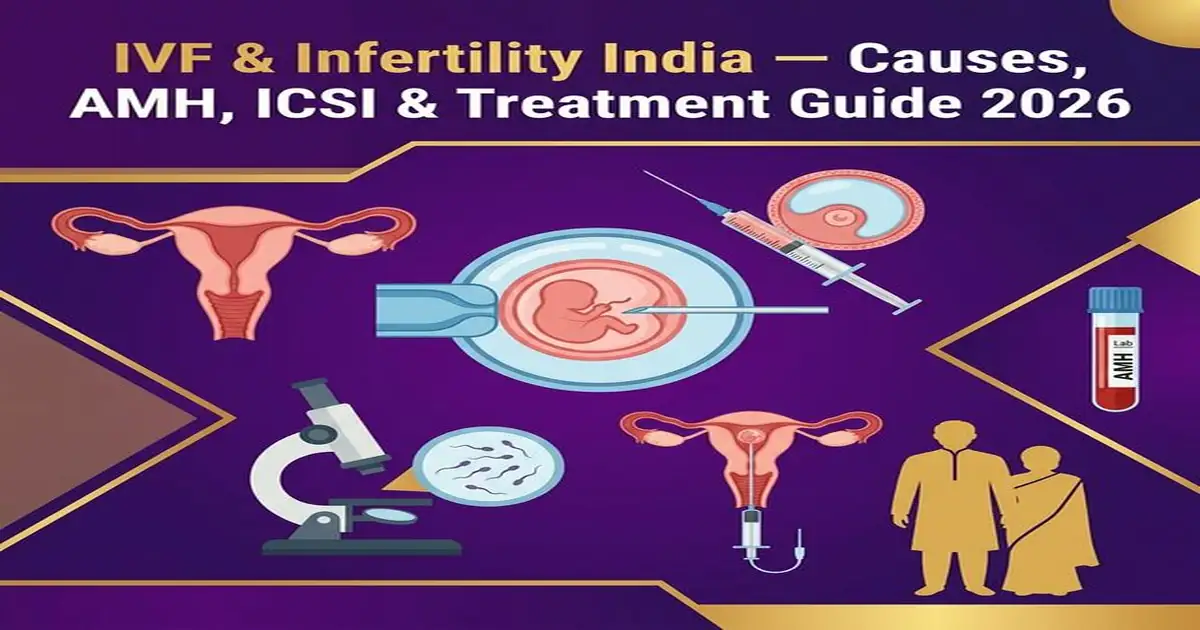
Causes of Infertility — Equal Burden on Both Sexes
A critical and frequently misunderstood fact: infertility is equally attributable to male and female factors. The global distribution — and India’s distribution — is approximately: Female factor alone: 35–40%; Male factor alone: 30–35%; Combined male + female: 20%; Unexplained: 10–15%. This equal distribution makes the male partner’s investigation (semen analysis) the first and most essential test — it is non-invasive, inexpensive (₹300–800), and provides immediate information on 40–50% of infertility causes. The cultural norm of investigating the woman first while delaying or avoiding semen analysis causes significant diagnostic delays in Indian couples.
| Category | Cause | India Prevalence | Investigation | Treatment |
|---|---|---|---|---|
| Female — Ovulatory | PCOS (most common — 70–80% of anovulatory infertility); hypothalamic amenorrhoea (stress, low weight, excessive exercise); premature ovarian insufficiency; thyroid dysfunction (hypo/hyperthyroid); hyperprolactinaemia | PCOS affects 15–20% Indian reproductive-age women; thyroid dysfunction India-endemic — check TSH in all infertile women | Day 2 FSH + LH + E2; AMH (ovarian reserve); thyroid function; prolactin; Day 21 progesterone (confirms ovulation); transvaginal ultrasound (antral follicle count) | Letrozole (first-line induction — superior to clomiphene for PCOS); clomiphene citrate; FSH injections for resistant cases; metformin adjunct for PCOS; correct thyroid/prolactin before induction |
| Female — Tubal | Tubal block from PID (pelvic inflammatory disease — Chlamydia, gonorrhoea, post-TB); previous ectopic pregnancy; previous pelvic surgery adhesions; endometriosis-related tubal damage | TB-induced tubal infertility is a specific India problem — genital TB (GUTB) causes bilateral tubal block in 40–50% of cases and is often missed; must be considered in all tubal factor infertility India | Hysterosalpingography (HSG — dye test) initial; laparoscopy for definitive diagnosis and treatment; TB evaluation (Mantoux, CBNAAT, hysteroscopy + endometrial biopsy) | Laparoscopic salpingostomy for distal block; IVF for severe/bilateral tubal damage; anti-TB treatment (6–9 months) for GUTB — IVF after completing ATT |
| Female — Uterine | Submucosal fibroids; endometrial polyps; intrauterine adhesions (Asherman’s syndrome — post-curettage); uterine septum (congenital); adenomyosis | Adenomyosis under-diagnosed in India — treated as fibroids; Asherman’s syndrome common post-D&C for incomplete abortion; uterine septum common congenital anomaly causing recurrent miscarriage | Transvaginal ultrasound; saline infusion sonography (SIS); hysteroscopy (gold standard for intracavitary pathology) | Hysteroscopic polypectomy, myomectomy, adhesiolysis, septum resection — all correctable before IVF improves outcomes significantly |
| Male Factor | Oligospermia (low count <16M/mL); asthenospermia (poor motility <42%); teratospermia (abnormal morphology >96% abnormal Kruger strict criteria); azoospermia (no sperm — obstructive or non-obstructive); varicocele (most common surgically correctable male infertility) | Male factor 30–50% of India infertility; sperm quality declining in Indian men (heat exposure, sedentary lifestyle, obesity, laptop/heat scrotum, smoking); azoospermia 1% men | Semen analysis (WHO 2021 reference values: volume ≥1.4mL; count ≥16M/mL; motility ≥42% progressive; morphology ≥4% Kruger normal); hormonal evaluation (FSH, LH, testosterone) for azoospermia; scrotal ultrasound for varicocele; karyotype for non-obstructive azoospermia | Varicocele repair (if grade 2–3): improves sperm parameters in 60%; IUI for mild oligospermia; IVF+ICSI for severe; TESA/PESA/micro-TESE for azoospermia (retrieves sperm from testis) |
The Investigation Pathway — A Step-by-Step Guide
| Step | Investigation | When Done | What It Shows | Cost India |
|---|---|---|---|---|
| 1. Semen analysis (FIRST) | WHO 2021 semen analysis; 2–5 day abstinence; fresh sample analysed within 1 hour | Immediately — first test in any infertile couple | Sperm count, motility, morphology, volume; identifies male factor in 40–50% | ₹300–800 |
| 2. Ovulation confirmation | Day 21 serum progesterone (>16 nmol/L = ovulation confirmed); LH urine kit (LH surge = ovulation in 24–36 hours); Day 2 FSH + AMH (ovarian reserve) | Woman’s menstrual cycle Day 2 (hormones) and Day 21 (progesterone) | Whether ovulation is occurring; ovarian reserve (AMH predicts response to stimulation); hypothalamo-pituitary cause if FSH elevated | AMH: ₹800–1,500; progesterone: ₹300–600 |
| 3. Pelvic ultrasound | Transvaginal ultrasound Day 2–4: antral follicle count (AFC), ovarian volume, uterine morphology, fibroids, polyps | Menstrual cycle Day 2–4 | Antral follicle count quantifies ovarian reserve (AFC <5 = poor reserve; >15 = risk of OHSS); PCOS morphology (12+ follicles each ovary, “necklace” pattern); fibroids/polyps | ₹500–1,500 |
| 4. Tubal assessment (HSG) | Hysterosalpingography — radio-opaque dye injected via cervix; X-ray shows dye spillage (patency) or block; done Day 7–10 of cycle | After semen analysis normal (no point testing tubes if male factor severe); or simultaneously to save time | Tubal patency (unilateral or bilateral block); uterine cavity shape (septum, adhesions, fibroids); therapeutic effect — HSG can flush partial block and improve conception rate for 3 months post-procedure | ₹2,000–5,000 |
| 5. Additional if indicated | Hysteroscopy (intracavitary pathology); laparoscopy (endometriosis, tubal adhesions); karyotype (recurrent miscarriage, azoospermia); thrombophilia screen (recurrent miscarriage >3) | When basic investigations abnormal or after 2+ IUI failures or recurrent miscarriage | Endometrial pathology; pelvic adhesions; chromosomal anomalies; clotting disorders causing pregnancy loss | Hysteroscopy ₹8,000–25,000; laparoscopy ₹20,000–60,000 |
Frequently Asked Questions
What is the realistic success rate of IVF in India?
Understanding IVF success rates is critical — because the fertility industry globally, and in India specifically, has commercial incentives to quote optimistic figures that don’t reflect a particular patient’s realistic chances: The correct metric — Live Birth Rate per transfer: Success rate means Live Birth Rate (LBR) per embryo transfer — NOT clinical pregnancy rate (which includes pregnancies that miscarry), NOT biochemical pregnancy rate (hCG detected but no heartbeat), NOT cumulative success after multiple cycles. Many Indian IVF clinics quote “success rates” of 50–60% — which often refers to clinical pregnancy rates, not live births. Realistic India IVF live birth rates (2024 ICMR data and international benchmarks): Women under 35: 35–45% live birth rate per fresh transfer; 40–50% cumulative over frozen + fresh transfers from one stimulation cycle. Women 35–37: 25–35% live birth rate per transfer. Women 38–40: 15–25% per transfer. Women 41–42: 10–15% per transfer. Women over 42 (own eggs): 5–8% per transfer; success drops sharply — donor eggs recommended at this age. Factors that significantly reduce success: Poor ovarian reserve (AMH <1.0 ng/mL — fewer eggs retrieved, fewer good embryos); Raised BMI (obesity significantly reduces IVF success — 30% lower LBR at BMI >30; weight loss before IVF is strongly recommended); Untreated uterine pathology (fibroids distorting cavity, polyps, adhesions — hysteroscopy first); Poor semen quality (ICSI used for severe male factor to fertilise eggs directly with single sperm); Smoking (reduces ovarian response, implantation, and increases miscarriage rate); Multiple failed cycles without investigation change (failed IVF isn’t “bad luck” — it’s a signal to re-evaluate protocol, genetics, or diagnosis). What increases success: Optimal age (under 35 whenever possible); PGT-A (preimplantation genetic testing for aneuploidy) — reduces miscarriage, improves LBR per transfer in women 37+ by selecting chromosomally normal embryos; blastocyst transfer (day 5 vs day 3) — self-selection means only the most viable embryos reach blastocyst; frozen embryo transfer in a prepared cycle — allows uterine recovery from stimulation; choosing an experienced centre with documented, unselected success rates.
What is AMH and what does it mean for fertility?
Anti-Müllerian Hormone (AMH) is now the most important single blood test in female fertility assessment — and is increasingly over-interpreted, causing unnecessary panic when low and false reassurance when normal: What AMH measures: AMH is produced by granulosa cells of small antral and preantral follicles. It reflects the quantity of remaining eggs (ovarian reserve). It is the best available blood marker for ovarian reserve — more stable than Day 2 FSH (can be tested any day of the cycle), and correlates well with antral follicle count on ultrasound. AMH reference ranges (approximate): Very high (PCOS risk for OHSS): >5 ng/mL; Optimal: 2.0–5.0 ng/mL; Normal: 1.0–2.0 ng/mL; Low normal: 0.5–1.0 ng/mL; Low: 0.2–0.5 ng/mL; Very low: <0.2 ng/mL. What AMH actually predicts and does NOT predict: AMH DOES predict: Ovarian response to stimulation (how many eggs IVF will retrieve); Risk of OHSS (high AMH = PCOS = higher OHSS risk); Time to menopause (lower AMH = sooner expected menopause). AMH does NOT predict: Natural fertility or ability to conceive naturally (women with AMH 0.8 ng/mL conceive naturally; AMH predicts IVF response, not spontaneous conception reliable well). Egg quality (AMH reflects quantity, not quality — a 38-year-old with AMH 2.5 has poorer quality eggs than a 28-year-old with AMH 0.8, despite higher quantity). Pregnancy success in IVF (a woman with AMH 0.7 produces fewer eggs but if she produces 2 good blastocysts, her success rate is similar to a woman who produced 12 eggs). Low AMH in India — what to do: AMH below 1.0 ng/mL in a woman planning fertility: Begin trying naturally immediately — don’t delay; Discuss IVF with freeze-all approach sooner rather than later; Do NOT take DHEA/testosterone supplements without specialist supervision; Lifestyle factors (good sleep, nutrient-dense diet, weight normalisation) support egg quality indirectly; Avoid delaying investigation by trying repeated “natural” months when AMH is very low. High AMH (PCOS) — implications for IVF: Women with PCOS + high AMH require modified stimulation protocols (lower FSH doses, GnRH antagonist protocol) to prevent OHSS; in-vitro maturation (IVM) of immature eggs is an emerging option for severe OHSS risk.
What is the difference between IUI, IVF, and ICSI?
These three treatment options are frequently confused by couples, leading to either premature escalation to expensive IVF or delayed escalation when simpler treatments have already failed: IUI (Intrauterine Insemination) — the “simple” option: Sperm (washed and concentrated husband’s or donor’s) is injected directly into uterine cavity at time of ovulation; bypasses cervical mucus; increases sperm density at fallopian tube; most effective if: tubes are patent, mild male factor, cervical factor, or unexplained infertility with female age under 37. Success rate: 10–20% per cycle in optimal candidates; cumulative: 40–50% after 3–4 cycles. Recommended: Maximum 3–4 cycles of IUI before moving to IVF — repeating IUI more than 4 times without success is not evidence-based. Cost: ₹5,000–15,000 per cycle (including monitoring and sperm preparation). NOT appropriate for: Bilateral tubal block; severe male factor (count <5M/mL); advanced female age (>38 — lower success rates, time-wasted); poor ovarian reserve. IVF (In Vitro Fertilisation): Ovarian stimulation (FSH injections 8–12 days) → egg collection under light anaesthesia (transvaginal ultrasound-guided aspiration of follicles) → eggs + sperm mixed in laboratory (conventional IVF) or ICSI → embryo culture 3–5 days → embryo transfer (fresh or frozen). Success rate: 35–45% per cycle in women under 35. Cost: ₹1.5–3.5 lakh per cycle in India (significant variation; PMJAY does NOT currently cover IVF; some state schemes provide partial support). Indications: Tubal block; severe PCOS; IUI failures; unexplained infertility >3 years; moderate male factor. ICSI (Intracytoplasmic Sperm Injection): Single sperm injected directly into each egg using micromanipulator; eliminates fertilisation failure from poor sperm; now performed in virtually all IVF cycles in India regardless of sperm quality — because it ensures fertilisation; additional cost (₹15,000–30,000) added to IVF. Specific indications: Severe oligospermia, teratospermia; azoospermia (sperm retrieved by TESA/PESA/micro-TESE); previous fertilisation failure; antisperm antibodies. Compared to conventional IVF: ICSI does not improve live birth rates when sperm count and motility are normal — there is modest over-utilisation of ICSI in India. Summary — escalation ladder: Try naturally (12 months age under 35; 6 months age 35+) → Investigate both partners → IUI × 3 cycles (if appropriate) → IVF ± ICSI → Donor eggs/sperm if own gametes exhausted. Don’t skip steps without medical reason; don’t repeat steps indefinitely — evaluate and escalate appropriately.
Is IVF legal and regulated in India?
The ART (Assisted Reproductive Technology) (Regulation) Act, 2021 — India’s first comprehensive legislation governing fertility treatment — was a landmark development in formalising a sector that had operated largely unregulated for decades: Key provisions of the ART Act 2021: Registration: All ART clinics and ART banks (sperm and egg donor banks) must register with the National Registry of ART Clinics under the ART Regulation Board. Operating without registration is illegal. Age limits: ART services available to women aged 21–50 years; legal spouse or partner involvement (with consent); donor sperm and eggs allowed within regulatory framework. Embryo donation and surrogacy: Commercial surrogacy is banned under the Surrogacy (Regulation) Act 2021 (enacted simultaneously); altruistic surrogacy (close relative as surrogate) is allowed with Commission approval; this significantly restricts the international surrogacy tourism that India was previously known for. Donor regulations: Anonymous donation allowed but regulated; donors cannot donate more than once; clinics must maintain registers; donors must be between 21–35 years (egg donors) and 21–45 years (sperm donors). Number of embryos: Regulation discourages multiple embryo transfer (to reduce multiple gestations) — single embryo transfer (SET) recommended where possible. What this means for patients: Always check an IVF clinic’s ART Registration Certificate before treatment. Ask for their published, unselected, age-stratified success rates — all registered clinics are expected to report outcomes to the national registry. Avoid clinics quoting success rates without specification of age group, number of cycles, and whether it’s clinical pregnancy or live birth rate. Cost transparency: ART Act requires itemised billing — ask for written treatment plan with complete cost breakdown before committing. Common additional costs to ask about: Stimulation medications (₹30,000–70,000/cycle), anaesthesia, ICSI, embryo freezing (₹15,000–25,000), frozen embryo transfer cycle (₹40,000–80,000 additional). Grievance redressal: The ART Act establishes disciplinary mechanisms for misconduct, misrepresentation of success rates, and unethical practices — patients have legal recourse they did not have before 2021.
What lifestyle changes actually improve fertility?
Lifestyle modification for fertility is both genuinely impactful and vastly over-commercialised — separating evidence-based advice from wellness industry mythology is essential for Indian couples spending money on supplements and regimens without proven benefit: Evidence-based changes that DO improve fertility: Weight normalisation — most impactful lifestyle intervention: Both obesity (BMI >30) and underweight (BMI <18.5) impair fertility significantly. Obesity → hyperinsulinaemia → elevated androgens → PCOS → anovulation; obesity → reduced IVF success rates by 30%; Every 5 BMI point gain above 29 reduces IVF live birth rate by ~5–8%; In men, obesity → lower testosterone, higher oestrogen (aromatisation in adipose), higher scrotal temperature from thigh fat → impaired sperm production; 10% weight loss in an obese woman with PCOS can restore ovulation without any medication. Smoking cessation: Smoking → accelerated ovarian ageing (AMH lower in smokers by 20% vs non-smokers at same age); increases miscarriage rate; reduces IVF success: 15–30% lower LBR in smokers vs non-smokers per cycle; men smoking reduces sperm motility and DNA fragmentation significantly. Alcohol reduction: Heavy alcohol (>14 units/week) reduces fertility in both sexes; modest alcohol at <5 units/week has minimal evidence of harm; complete abstinence advised once pregnant or in IVF cycle. Exercise: Moderate aerobic exercise 3–5 days/week improves insulin sensitivity (critical for PCOS fertility), improves BMI, and may improve sperm quality in men. Excessive high-intensity endurance exercise (marathon training) in women can suppress the hypothalamic-pituitary-ovarian axis → hypothalamic amenorrhoea → anovulation. Heat avoidance for men: Avoid prolonged laptop on lap, hot baths/saunas, tight underwear — scrotal temperature 2°C above body temperature impairs spermatogenesis; measurable (if modest) effect on sperm quality. Supplements with evidence: Folic acid 5mg/day (for women planning pregnancy — prevents neural tube defects; starts at least 3 months before conception); CoQ10 (300–600mg/day — may improve egg and sperm quality; modest evidence from RCTs; reasonable to recommend); Vitamin D if deficient (low vitamin D associated with lower IVF success; correction may improve outcomes); Omega-3 (DHA — sperm motility improvement; reasonable); Zinc and selenium for men (specific deficiency states). Supplements WITHOUT good evidence: DHEA (only for poor ovarian reserve under specialist guidance — not for general use; can cause androgenic side effects); “Fertility teas” and herbal supplements — no RCT evidence; Inositol for PCOS — myo-inositol has modest evidence for improving menstrual regularity and ovulation in PCOS (may use as adjunct but not replacement for letrozole); Expensive branded “fertility multivitamins” — often contain folic acid + vitamin D at reasonable doses but priced 10× above generic equivalents.
What to Read Next
- PCOS India — 70-80% of Anovulatory Infertility is PCOS; Letrozole First-Line Ovulation Induction
- Menopause & HRT — Premature Ovarian Insufficiency (POI): Menopause Before 40
- BPH & Prostate — Retrograde Ejaculation After TURP Can Cause Male Infertility
- Erectile Dysfunction — ED and Male Infertility Often Coexist; Both Need Evaluation
- Thyroid — Hypothyroidism Causes Anovulation and Recurrent Miscarriage; TSH Must Be <2.5 When TTC
27.5 million Indian couples want a child they cannot have. For most of them, the problem has a name, a test, and a treatment. A semen analysis costs ₹500. An AMH costs ₹1,000. A correct investigation sequence costs ₹10,000–15,000 total. The information in this article costs nothing. The couples who benefit most from fertility medicine are not those with the most money — they are those who ask the right questions in the right order.
About This Guide: Written by the StudyHub Health Editorial Team (studyhub.net.in) based on ICMR ART guidelines, ESHRE (European Society of Human Reproduction and Embryology) 2024 guidelines, and FOGSI (Federation of Obstetric and Gynaecological Societies of India) recommendations. Last updated: March 2026.
Authoritative Sources: ESHRE Guidelines | ICMR India | FOGSI India | ISAR — Indian Society of Assisted Reproduction
💜 Key Message: Infertility affects both partners equally. ALWAYS investigate both — start with semen analysis (₹500). AMH predicts IVF response, not natural fertility. IVF success drops sharply after 38. Seek help after 12 months trying (6 months if age 35+). Don’t delay for “natural treatment” if investigations show a clear cause.
⚕️ Medical Disclaimer: This article provides general information about infertility investigation and treatment. All fertility treatments including IVF/ICSI/IUI must be supervised by a qualified reproductive medicine specialist at a registered ART clinic. Individual success rates vary significantly based on age, diagnosis, and treatment history.