
Last Updated: March 2026 | Reading Time: 9 minutes | ~2,000 words
Knee osteoarthritis (OA) is the most common joint disease in India, affecting an estimated 15–20% of adults over 60 and 6% of adults over 30 — accounting for approximately 45 million Indians with clinically significant knee OA. India has a paradoxically high prevalence of knee OA compared to Western populations — driven by a combination of floor-sitting lifestyle (deep knee flexion), squatting habits, higher rates of obesity, and genetic predisposition. Knee OA is the leading cause of pain-related disability in Indian elderly, responsible for significantly reduced mobility, social withdrawal, depression, and increased fall risk. Despite this, management in India remains suboptimal: patients oscillate between undertreatment (dismissing knee pain as inevitable ageing) and overtreatment (premature surgery, inappropriate steroid injections, and unproven PRP/stem cell therapies marketed aggressively in the private sector). This guide provides the evidence-based framework for effective knee OA management at every stage.
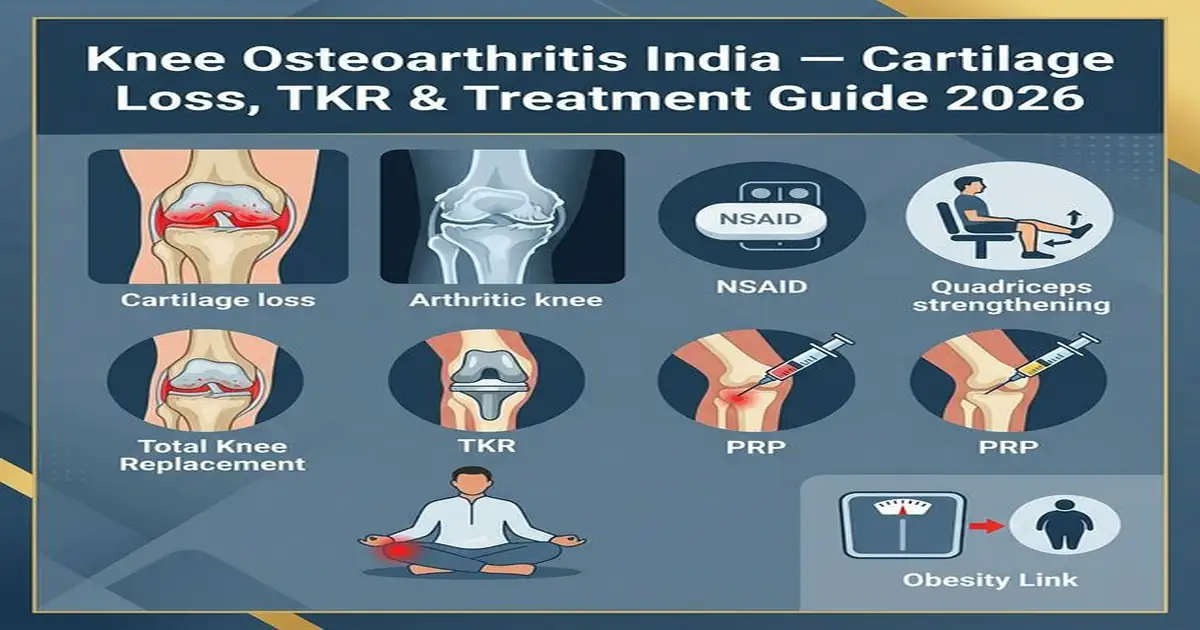
Grading Knee OA — Kellgren–Lawrence Classification
| Grade | X-ray Findings | Symptoms | Management Focus |
|---|---|---|---|
| Grade 0 — Normal | No OA features; normal joint space; no osteophytes | No OA symptoms; may have other knee pain causes (meniscal tear, ligament injury, patellofemoral pain in younger patients) | Exclude other diagnoses; education; prevention (weight, exercise, avoid repetitive high-impact activity) |
| Grade 1 — Doubtful | Possible osteophytes; normal joint space maintained | Mild intermittent pain after exertion; little or no functional limitation; often incidental finding | Lifestyle modification: weight management (most important single intervention); low-impact exercise (swimming, cycling); paracetamol/topical NSAID for flares |
| Grade 2 — Mild | Definite osteophytes; possible joint space narrowing; mild subchondral sclerosis | Moderate pain particularly on stairs, rising from floor; morning stiffness <30 minutes; crepitus (creaking noise); functional limitation beginning | Physiotherapy (quadriceps strengthening); weight loss; oral NSAIDs short course; topical diclofenac; consider intra-articular corticosteroid for acute flare; knee brace (medial OA pattern — lateral wedge insole) |
| Grade 3 — Moderate | Multiple osteophytes; definite joint space narrowing; moderate subchondral sclerosis; possible bone deformity | Significant pain limiting daily activities; difficulty walking >500m; knee swelling; varus deformity (bow-leg) common in medial compartment OA; night pain present | Optimised physiotherapy + analgesia; corticosteroid injections; hyaluronic acid injection (modest evidence); weight management intensive; assess for surgical candidacy; duloxetine for central sensitisation component of pain |
| Grade 4 — Severe | Large osteophytes; severe joint space narrowing or complete loss (bone-on-bone); severe subchondral sclerosis; definite bone deformity (varus/valgus) | Severe pain at rest and at night; severely limited mobility; significant varus/valgus deformity; patients often near housebound; high fall risk | Total knee replacement (TKR) — highly effective for Grade 4 OA with severe functional limitation; TKR provides sustained pain relief and functional restoration in 85-90% at 10 years; surgical threshold: severe pain + functional limitation + adequate trial of conservative management + patient fit enough for surgery |
Treatment Evidence — What Works and What Doesn’t
| Treatment | Evidence Level | India Context | Recommendation |
|---|---|---|---|
| Weight loss | Grade A — Every 1kg weight loss reduces knee joint load by 4kg; IDEA trial: losing >10% body weight reduces knee pain by 50%+ and significantly delays OA progression; the single most impactful modifiable intervention for knee OA | India’s overweight/obesity epidemic is the primary driver of premature knee OA in urban populations; Indian BMI cutoffs (overweight ≥23, obese ≥25) mean even moderately overweight Indians are putting abnormally high joint loads on their knees from a younger age | ✅ Strongly recommended — even 5–10% weight loss produces clinically meaningful pain reduction |
| Exercise therapy (physiotherapy) | Grade A — Multiple high-quality RCTs demonstrate exercise reduces knee OA pain and improves function comparably to NSAID medication; specifically: quadriceps strengthening (VMO — vastus medialis oblique is most important OA-relevant muscle); aquatic exercise; cycling | Physiotherapist access limited outside cities; many Indian patients with knee OA are told to “rest” and avoid exercise — this is wrong and harmful; deconditioning worsens OA; quadriceps wasting in knee OA patients requires specific strengthening; physiotherapy should continue long-term | ✅ Core treatment — ideally 3× weekly; swimming and cycling preferred over high-impact in severe OA; home exercise programme for long-term maintenance |
| Topical NSAIDs (diclofenac gel) | Grade A — Topical diclofenac gel (Voveran Emulgel, Diclomove) applied to knee 3–4× daily is as effective as oral NSAIDs for knee OA pain with minimal systemic effects; superior safety profile in elderly (no GI, cardiovascular, renal risks of oral NSAIDs) | Widely available India (₹120–200/tube, lasts 2–4 weeks); significantly under-used relative to oral NSAIDs; oral diclofenac over-prescribed in elderly Indian patients creating GI bleeding /renal/cardiac risks; topical should be first-line in elderly and anyone with GI concerns | ✅ First-line analgesia — use before oral NSAIDs in elderly |
| Intra-articular corticosteroid injection | Grade B for short-term (6–8 weeks) relief; no evidence of benefit beyond 3 months; repeated injections (>3–4/year) may accelerate cartilage loss | Widely performed in India (₹800–3,000 per injection including drug + specialist fee); best used for acute flare with effusion (swollen knee) to provide temporary relief enabling physiotherapy engagement; not a long-term management strategy; overused in India without physiotherapy partnership | ⚠️ Useful tool for acute flare — limit to 3–4 per year per joint; always pair with physiotherapy |
| PRP (Platelet-Rich Plasma) injection | Grade C — Conflicting evidence; some trials show modest benefit in mild-moderate OA; no benefit in severe OA (Grade 3–4); not recommended by NICE, OARSI, or ACR guidelines; high-quality RCT (RESTORE trial 2023 UK) showed PRP no better than saline placebo in knee OA | PRP is aggressively marketed in India’s private orthopaedic sector at ₹10,000–30,000 per injection (2–3 injection course often sold); marketed as “your own blood healing your knee” — compelling narrative masking absence of evidence; patients spend enormous sums with modest or no benefit | ❌ Not recommended by major guidelines; unproven; very expensive; use physiotherapy cost-effectively first |
| Glucosamine + chondroitin supplements | Grade C/D — Multiple large RCTs (GAIT trial, UK MAST) show glucosamine + chondroitin no better than placebo for pain reduction; cannot regenerate lost cartilage; classification as “nutraceuticals” means weaker regulatory oversight | One of the most widely self-prescribed supplements in India among elderly knee OA patients; ₹500–2,000/month; perceived as “natural and safe”; evidence does not support pain benefit; may have very modest structural benefit in a minority — insufficient to justify universal recommendation | ❌ Not recommended as standard treatment; money better spent on physiotherapy and weight management |
| Total Knee Replacement (TKR) | Grade A — One of the most cost-effective surgical interventions in medicine for end-stage OA; 85–90% patient satisfaction at 10 years; implant survival >95% at 15 years; dramatic functional improvement and pain relief | India performs ~350,000+ TKRs annually; cost: ₹1.5–3.5 lakh (private) to near-free (government hospitals under PMJAY Ayushman Bharat for eligible patients); India is now the world’s 3rd largest TKR market; concern: premature TKR in Grade 2–3 OA without adequate conservative management trial; bilateral simultaneous TKR controversy (higher complication rate vs sequential) | ✅ Highly effective for Grade 4 OA with severe functional limitation after failed conservative management; should not be offered without adequate physiotherapy, weight management trial, and analgesia optimisation |
Frequently Asked Questions
Does floor sitting and squatting cause knee OA in India?
This is one of the most epidemiologically fascinating questions in Indian orthopaedics — because India’s habit of floor sitting (cross-legged — “sukhasana”), squatting (Indian toilet use, prayer, traditional work), and deep knee flexion activities are simultaneously exercise for joint mobility AND potential contributors to knee loading: The evidence — complex picture: Epidemiological data consistently shows India has a higher prevalence of knee OA than European populations, particularly medial compartment OA and patellofemoral OA. Risk factors specifically identified in Indian population studies: habitual squatting at work (agricultural labourers, domestic workers squatting for prolonged periods → repetitive high knee-flexion loading → accelerated cartilage wear); walking long distances daily on hard surfaces without footwear; heavy physical labour. Floor sitting — protective vs harmful: Regular floor sitting (Indian style cross-legged) through childhood and middle age maintains excellent knee range of motion and tendon flexibility — this may be PROTECTIVE against OA by maintaining joint health; however, in established Grade 3–4 OA, floor sitting becomes increasingly painful and may exacerbate symptoms; patients with established OA should use chair seating and raised toilet seats (western toilet or toilet seat raiser). Indian toilet (squatting toilet) — the dilemma: Squatting requires maximum knee flexion (~130–150°) — in established OA, this is painful and potentially damaging to remaining cartilage; conversion to western toilet strongly recommended for OA patients Grade 2+; toilet seat raisers (₹500–2,000) are an inexpensive, practical adaptive device; stair-free or ramped bathroom access increasingly relevant. Occupational loading India: Agricultural workers (60%+ of Indian elderly patients with severe knee OA have agricultural occupation history); domestic workers (prolonged squatting for floor-level work); construction labourers (kneeling on hard surfaces); preventive advice for working-age adults: use long-handled tools; avoid prolonged squatting; rest-and-return patterns for high-knee-load tasks.
What is the best exercise for knee osteoarthritis?
Exercise is the most evidence-based, most cost-effective, and most sustainable treatment for knee OA at all grades — and the specific programme matters: Home exercise programme for knee OA (can be started immediately): 1. Straight leg raise: Lie on back; bend one knee; lift the other (straight) leg to the height of the bent knee; lower slowly; 3 × 15 repetitions each leg daily → strengthens VMO (inner quadriceps — most important OA muscle) without knee joint loading. 2. Wall slide (mini squat): Stand with back against wall; slowly bend knees to 30° (NOT deep squat — maximum 30–45°) → hold 10 seconds → return to standing; 3 × 10 repetitions daily → builds quadriceps without excessive joint loading. 3. Seated knee extension: Seated on chair; slowly extend knee to straight; hold 5 seconds; lower slowly; 3 × 15 each leg → VMO and rectus femoris. 4. Calf raises: Stand holding chair; rise onto toes; hold 2 seconds; lower; 3 × 15 → improves knee proprioception and ankle stability contributing to fall prevention. 5. Short arc quad: Lie with rolled towel under knee; lift foot to straighten knee; 3 × 15 → activates VMO in pain-free range. Aquatic/hydrotherapy — India’s underused resource: Exercising in waist-deep water reduces knee joint load by 50–75% (buoyancy eliminates most body weight forces) → allows exercise that would be painful on land without pain or cartilage damage; multiple RCTs show aquatic therapy reduces OA pain as effectively as land-based exercise; available at most municipal swimming pools and hospital rehabilitation centres; a doctor’s referral enables access to hospital hydrotherapy. Cycling — ideal OA exercise: Stationary or outdoor cycling: minimal knee joint impact; maintains range of motion; strengthens quadriceps; cardiovascular benefit; pedal resistance adjusted to comfort; 20–30 minutes daily for Grade 2–3 OA is evidence-based and tolerated by most patients. What to AVOID in knee OA: Running on hard surfaces (impacts joint 3–5× body weight); stair climbing as primary exercise (high patellofemoral load); deep squats (>90° flexion); heavy leg press in gym (axial loading); prolonged standing or walking on hard floors without cushioned footwear/insoles.
When should I consider total knee replacement?
TKR is one of the most effective orthopaedic procedures — but in India it is both under-performed in ideal candidates (patients suffering severe disability avoid surgery due to cost, fear of anaesthesia, lack of family support) and over-performed in premature candidates (Grade 2–3 OA without adequate conservative management trial): Appropriate criteria for TKR referral (based on NICE and OARSI guidelines): Severe OA (typically Grade 3–4 on X-ray); Pain at rest AND at night; Significantly limited walking ability (cannot walk to local market without severe pain); Failed adequate trial of conservative management: minimum 3–6 months including: weight management attempt, physiotherapy (quadriceps programme), NSAIDs/analgesia optimised, at least one intra-articular corticosteroid injection; Patient medically fit for surgery (cardiac, respiratory, renal assessment); Patient understanding of realistic outcomes and rehabilitation requirements. TKR outcomes — realistic India expectations: Pain relief: 85–90% of patients report significant pain reduction; 75–80% achieve excellent functional outcome; 10–15% have suboptimal pain relief or complications (this group is well-studied — factors predicting poor outcome: obesity Grade III, psychological distress pre-operatively, unrealistic expectations, severe pre-operative quadriceps weakness). Recovery timeline: Hospital stay: 3–5 days typically; Walking aids: 4–6 weeks; Driving: 6–8 weeks; Full recovery: 6–12 months; physiotherapy rehabilitation is essential for optimal outcome. TKR under PMJAY (Ayushman Bharat) in India: TKR is covered under AB-PMJAY for eligible low-income patients at empanelled government and private hospitals; cover typically ₹1.5–2 lakh per knee; enables many patients who could not otherwise afford surgery to access TKR; significant state variation in implementation quality; waiting lists at government centres can be 6–18 months. Bilateral TKR (both knees simultaneously): Performed as “bilateral simultaneous TKR” at some Indian centres; advantages: one anaesthetic, one rehabilitation period, faster return to mobility; risks: higher blood loss (2× blood loss), higher clot risk, higher cardiac stress; recommended at high-volume centres with proper transfusion protocols and ICU backup only; “staged bilateral TKR” (one knee, recover, then second knee 3–6 months later) is safer, especially for elderly or high-risk patients.
Are knee braces, insoles and walking aids useful?
Assistive devices and orthoses are underused but genuinely evidence-based additions to knee OA management: Knee braces: Valgus knee brace (off-loader brace): for medial compartment OA (varus/”bow-legged” deformity — the most common pattern in India) — the brace applies a valgus force that shifts load from the medial (damaged) compartment to the lateral compartment; reduces pain and improves function in medial OA; evidence Grade B; cost in India: ₹3,000–15,000 for hinged off-loader brace; available at orthopaedic appliance shops and online. Simple neoprene sleeve brace: provides warmth, proprioceptive feedback, mild support; useful for mild OA and after activities for comfort; minimal OA-specific evidence but widely tolerated; cost: ₹400–1,500. Patellar taping (McConnell technique): evidence-based for patellofemoral OA (front-of-knee pain, worse on stairs/squatting); taught by physiotherapist; cheap once patient learns technique. Footwear and insoles: Lateral wedge insoles: for medial compartment OA — a wedge placed under the lateral foot reduces the varus moment at the knee; modest evidence, good tolerability; cost: ₹300–800 from orthopaedic appliance shops; worth trying. Cushioned insoles: for general LBP and knee OA — reduces impact transmission through joints; useful for those walking on hard Indian stone/marble floors. Footwear: Shock-absorbing trainers/sports shoes significantly reduce joint impact compared to chappals and leather-soled shoes commonly worn by elderly Indians; a basic recommendation many Indian orthopaedic physicians omit. Walking aids: Walking sticks: single stick (opposite hand to affected knee — contralateral) reduces knee joint load by 20–25%; dramatically improves safety and gait efficiency in Grade 3–4 OA; stigma of “looking old” prevents many Indian elderly from using walking sticks earlier than necessary — education is required (a walking stick now may prevent a fall and TKR later); cost: ₹300–1,200; quad stick or walker for bilateral severe OA. Raised toilet seats: Inexpensive (₹800–2,000); dramatically reduces pain of toilet use in severe knee OA; prevents dangerous fall risk during toilet rising; one of the highest impact/lowest cost adaptive devices for Indian knee OA patients; often not prescribed or mentioned in orthopaedic consultations.
What to Read Next
- Low Back Pain — Lumbar OA Often Coexists with Knee OA in Indian Elderly
- Osteoporosis — Osteoporosis + Knee OA Common Comorbidity; Both Require Vitamin D
- Arthritis & Joints — Rheumatoid Arthritis vs Osteoarthritis: Key Differences in Inflammatory vs Mechanical Joint Disease
- Obesity — Every 1kg Lost = 4kg Less Knee Joint Load; Weight Loss Treats Knee OA Most Effectively
- Diabetes — Diabetic Patients Have Worse TKR Outcomes; Preoperative HbA1c Control Essential
45 million Indians living with significant knee osteoarthritis. Millions have been told PRP injections will “regenerate” their cartilage — for ₹25,000 a course. Millions more have been told glucosamine will “rebuild” their joint. Neither is true. What does work: losing 5kg (free), swimming 3× weekly (minimal cost), a walking stick (₹500), raised toilet seat (₹1,000), and a proper physiotherapy programme (₹200–500/session). The treatments that matter most are the ones least profitably marketed. Doctors and patients must make the evidence-based choices together.
About This Guide: Written by the StudyHub Health Editorial Team (studyhub.net.in) based on OARSI (Osteoarthritis Research Society International) 2019 Guidelines, ACR/EULAR recommendations, NICE OA Guideline 2022, and Indian Orthopaedic Association resources. Last updated: March 2026.
💡 Most Important OA Action: Every 1kg of weight loss reduces knee joint load by 4kg. Losing 10kg = 40kg less force on your knee with every step. No injection, supplement, or drug comes close to this benefit. Weight management is the most powerful knee OA treatment available.
❌ Save Your Money: PRP injections (₹20,000–30,000 per course) show no benefit over placebo in major RCTs for knee OA. Glucosamine supplements show no clinically meaningful pain benefit. Invest that money in a qualified physiotherapist, a good pair of cushioned shoes, and a swimming pool membership instead.
⚕️ Medical Disclaimer: This article provides general educational information about knee osteoarthritis. All treatment decisions including physiotherapy, injections, and total knee replacement must be made by qualified orthopaedic surgeons and physiotherapists after individual assessment and X-ray evaluation.