Last Updated: March 2026 | Reading Time: 9 minutes | ~2,100 words
Menopause — the permanent cessation of menstruation due to ovarian follicle depletion — is a universal physiological transition for women, typically occurring between ages 45–55 (median 51 years globally; 46–48 years in Indian women — approximately 2–4 years earlier than Western populations). India has approximately 65 million post-menopausal women — a number growing rapidly with an ageing population. Yet menopause remains profoundly under-discussed and under-treated in India: cultural silence around menstrual and reproductive health, lack of menopause specialist services, widespread misconceptions (menopause symptoms dismissed as “natural ageing,” hormone therapy feared as “cancer-causing”), and significant access inequity mean that the majority of Indian women endure severe menopausal symptoms without effective intervention. This guide covers the evidence-based management of menopause, with the confidence that modern menopause medicine has evolved dramatically since the flawed WHI study of 2002 — and that menopausal hormone therapy (MHT), when used appropriately, is safe and highly effective for the right patient.
Menopausal Symptoms — Classification and Management
| Symptom Domain | Symptoms | Mechanism | First-Line Treatment | India Notes |
|---|---|---|---|---|
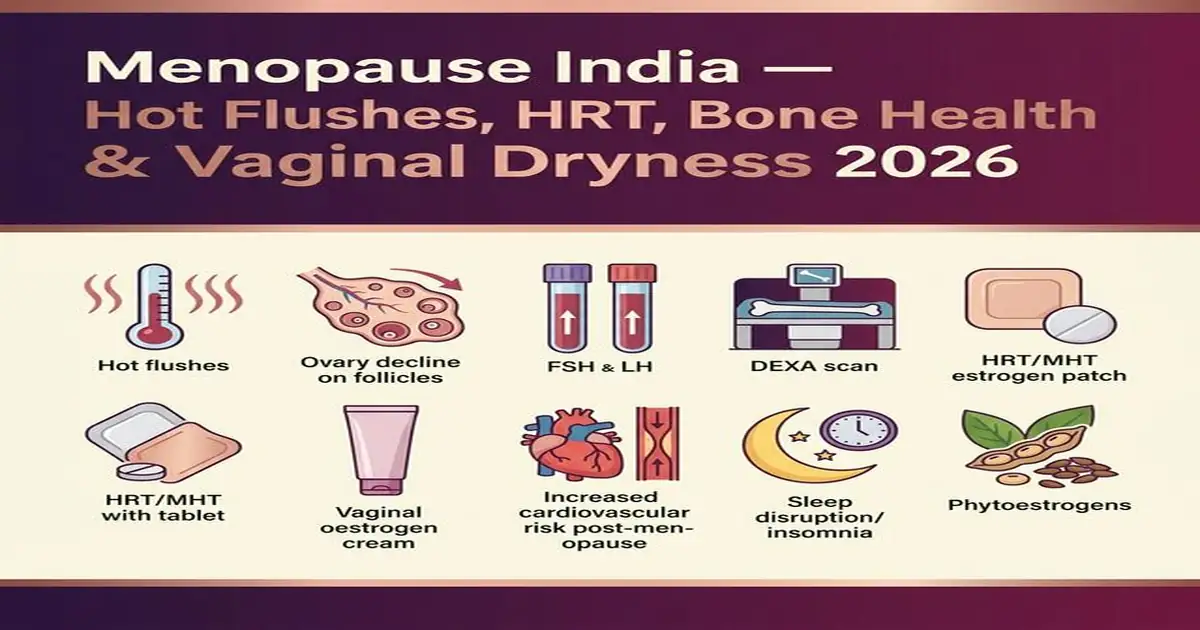
| Vasomotor symptoms (VMS) | Hot flushes (sudden intense heat — face/neck/chest/back — 30 sec to 5 min); night sweats (drenching → sleep disruption); palpitations during flush; flushing visible on skin | Declining oestrogen → thermoregulatory instability (narrowed thermoneutral zone — hypothalamic KNDy neurone dysregulation); NKB/NK3R pathway activation → GnRH pulsatility → LH surges → heat dissipation response | MHT (menopausal hormone therapy): most effective VMS treatment (75–90% reduction in frequency and severity); systemic oestrogen (oral/patch/gel) ± progestogen (if uterus intact); Non-hormonal: fezolinetant (NK3R antagonist — SKYLIGHT trials: 60% VMS reduction; FDA 2023 approved; India emerging); venlafaxine 37.5–75mg (SNRI — 60% VMS reduction; off-label); gabapentin 300mg nocte; CBT (cognitive behavioural therapy — MENOS trials); clonidine (less effective); isoflavones (soy/red clover phytoestrogens — modest benefit in some) | Indian women less likely to report VMS to doctor (cultural silence) but experience equally prevalent symptoms; night sweats in India’s hot climate particularly debilitating; air conditioning significantly helps; lightweight cotton nightwear; average Indian woman suffers VMS 7–10 years without treatment |
| Genitourinary syndrome of menopause (GSM) | Vaginal dryness; dyspareunia (painful sex — culturally very difficult to discuss India); vulval irritation/burning; urinary frequency, urgency, recurrent UTI; vaginal atrophy; not self-limiting (worsens with time unlike VMS) | Oestrogen receptors dense in vagina, bladder, urethra; oestrogen withdrawal → vaginal epithelium thins → pH rises (alkaline → susceptible to infection) → loss of normal lactobacilli flora → recurrent UTI | Local vaginal oestrogen (first-line for GSM without systemic VMS): vaginal oestradiol tablets (Vagifem) / estradiol cream / oestradiol ring; safe — minimal systemic absorption; can be used long-term; safe in most breast cancer survivors (discuss with oncologist); Ospemifene (SERM — oral): approved GSM; Prasterone (intravaginal DHEA) — India emerging; Systemic MHT: treats GSM systemically; Lubricants (non-hormonal — Replens, water-based gels): for dyspareunia when oestrogen contraindicated | GSM profoundly underreported India — vaginal dryness and painful sex carry deep social stigma; ASHA worker counselling for menopause health critical; recurrent UTI in menopausal women often treated with repeated antibiotics without addressing underlying GSM (vaginal oestrogen dramatically reduces UTI recurrence — should be used in recurrent post-menopausal UTI) |
| Sleep and psychological symptoms | Insomnia; fatigue; mood lability; low mood; irritability; anxiety; cognitive difficulty (“menopause brain fog”); memory impairment; loss of concentration | Night sweats → sleep fragmentation → fatigue cascade; direct oestrogen effect on limbic system and serotonin/dopamine neurotransmission; perimenopause (transition years) = high-risk period for first major depressive episode | MHT: treats sleep disruption (via VMS control) and directly improves mood in perimenopausal women; venlafaxine/SSRIs: for depressive symptoms; CBT-I (insomnia): stimulus control + sleep restriction; melatonin (short-term); assess and distinguish menopausal vs primary depression/anxiety (can coexist) | Perimenopause depression frequently misdiagnosed as pure psychiatric disorder in India; GPs rarely correlate menstrual irregularity + mood changes + sleep disruption = perimenopause; MHT dramatically improves mood in oestrogen-deficient perimenopausal depression (within 2–4 weeks) — more rapid than antidepressant |
| Bone (osteoporosis) | Accelerated bone density loss (oestrogen maintains osteoblast function — oestrogen withdrawal → 2–3% bone density loss/year for 5–7 years post-menopause); vertebral and hip fractures; dowager’s hump (kyphosis) | Oestrogen directly inhibits osteoclast activation; withdrawal → uncoupled bone remodelling → net bone loss; Indian women: already lower peak bone mass, dietary calcium gaps, vitamin D deficiency, minimal weight-bearing exercise — higher fracture risk | MHT: most effective bone protection started within 10 years of menopause or <60 years (reduces fracture risk 30–50%); stop MHT → bone loss resumes; bisphosphonates (alendronate, risedronate, zoledronate) if osteoporotic or MHT contraindicated; DEXA scan (baseline at menopause in high-risk; all women ≥65); Calcium 1,200mg/day + Vitamin D 2,000IU/day (dietary + supplement); weight-bearing exercise | Indian post-menopausal women often not offered DEXA; calcium supplement use low (“calcium causes kidney stones” — myth at correct doses); high fracture incidence in Indian women over 60; preventable with early MHT + DEXA + bisphosphonate when indicated |
| Cardiovascular risk | Post-menopausal women lose cardioprotective effect of oestrogen; CVD risk rises sharply after menopause; dyslipidaemia (LDL rises, HDL falls); hypertension; visceral adiposity; metabolic syndrome | Oestrogen: vasodilatory, anti-atherogenic, improves lipid profile, reduces insulin resistance; oestrogen withdrawal → accelerated cardiovascular ageing; Indian women already have high CVD risk (higher rates of metabolic syndrome, diabetes) | MHT started early (<60 years or within 10 years of menopause — “timing hypothesis” / “window of opportunity”): cardioprotective; MHT started late (>10 years post-menopause): no cardiovascular benefit, may increase risk; lifestyle: Mediterranean-pattern diet, exercise, quit smoking; manage BP, lipids, glucose aggressively | WHI study (2002) showing cardiovascular risk was in older women (mean age 63) started on MHT 10+ years post menopause — not applicable to women in early menopause; “menopause hormone therapy causes heart attacks” is outdated — timing matters enormously |
Frequently Asked Questions
Does HRT/MHT cause breast cancer — what is the real risk in India?
The fear of hormone therapy and breast cancer is the single greatest barrier to appropriate MHT use in India and globally — rooted in the misinterpretation of the 2002 WHI (Women’s Health Initiative) study. Here is the evidence-based reality: The WHI study (2002) — what it actually showed: WHI combined HRT arm (conjugated equine oestrogen + medroxyprogesterone acetate — oral) in women aged 50–79 (mean 63 — most already 10+ years post-menopause): modest increase in breast cancer risk — 8 additional breast cancers per 10,000 women per year; WHI oestrogen-only arm (no progestogen — hysterectomised women): actually REDUCED breast cancer risk; CRITICAL context: the WHI used older synthetic progestogen (medroxyprogesterone acetate — MPA), older women, oral delivery — all factors now known to affect risk. Modern MHT and breast cancer — updated evidence: Micronised progesterone (Utrogestan — body-identical, not synthetic MPA): evidence (E3N cohort, CAMS SWAN studies) shows significantly lower breast cancer risk than synthetic progestogens (MPA, norethisterone); transdermal oestradiol (patch/gel — not oral): does not increase breast cancer risk to same degree as oral (no first-pass liver metabolism); duration: risk increases after 5+ years combined MHT; returns to baseline within 5 years of stopping; type of progestogen is the critical determinant — body-identical micronised progesterone = lowest risk regimen available; India prescribing: most Indian gynaecologists still prescribe older synthetic progestogens (norethisterone, MPA) — updating to micronised progesterone reduces risk. Absolute risk context for Indian women: Background breast cancer risk in Indian women: lifetime risk approximately 1 in 28 (much lower than UK 1 in 7 or US 1 in 8); MHT 5-year combined exposure adds approximately 0.5–1 additional breast cancer per 1,000 women per year — comparable to: drinking 1–2 alcohol units/day; being overweight BMI >25; sedentary lifestyle; untreated severe menopause symptoms with resulting poor sleep, depression, and stress likely carry higher total health risk than appropriately selected MHT in most Indian women aged 45–60. MHT is contraindicated in: Current/recent breast cancer (within 5 years — discuss with oncologist for GSM — local vaginal oestrogen may be acceptable); undiagnosed abnormal uterine bleeding; active thromboembolic disease (VTE); active liver disease; pregnancy; uncontrolled hypertension; oestrogen-sensitive conditions.
What MHT is available in India — and what does it cost?
The landscape of MHT available in India is comprehensive — covering both older synthetic and newer body-identical preparations — but awareness among both prescribers and patients remains low: Systemic oestrogen preparations (India): Oral oestradiol valerate (Progynova — Bayer; 1mg, 2mg): ₹150–250/month; conjugated equine oestrogen (Premarin — Pfizer; 0.3mg, 0.625mg): ₹120–200/month; Transdermal oestradiol patch (Climara, Estradot — weekly patch): ₹300–600/month (available in India in larger cities); oestradiol gel (Oestrogel — pump gel applied to skin): ₹600–1,000/month (preferred in women with cardiovascular risk factors — transdermal avoids first-pass metabolism, no VTE risk increase unlike oral oestrogen). Progestogens for uterine protection (women with uterus — MUST have progestogen with systemic oestrogen): Body-identical micronised progesterone (Utrogestan 100mg, 200mg): ₹400–700/month (₹30–40/capsule; 12–14 days per month); norethisterone acetate (NETA — Primolut N): ₹100–200/month; dydrogesterone (Duphaston): ₹200–400/month; medroxyprogesterone acetate (MPA — Provera): cheapest but highest risk (avoid if possible — higher thrombosis and breast cancer risk vs micronised progesterone). Combined preparations (India): Femoston (oestradiol + dydrogesterone): ₹300–500/month; Cliane (oestradiol + NETA pellet — continuous combined); Angeliq (oestradiol + drospirenone); Gynokadin (gel). Local vaginal oestrogen India: Vagifem vaginal tablets (10µg oestradiol): ₹200–350/month; Dienoestrol cream (Dienocream): ₹150–250/month; estriol cream (Ovestin): ₹400–600 — safe, minimal systemic absorption, excellent for GSM. Who prescribes MHT in India: Gynaecologists: primary prescribers but variable training in menopause medicine; FOGSI (Federation of Obstetric and Gynaecological Societies of India) menopause committee developing guidelines; Indian Menopause Society (IMS) has growing membership but specialist shortfall; primary care (GPs): uncommonly prescribe MHT — confidence and training gap. PMJAY coverage: MHT is not currently listed under PMJAY standard drug package; oral oestradiol generics available at Jan Aushadhi (₹50–100/month); access remains primarily in urban private gynaecology — rural underserved.
What is premature ovarian insufficiency — and how is it different from normal menopause?
Premature ovarian insufficiency (POI) — previously called “premature menopause” — is the loss of normal ovarian function before age 40, occurring in approximately 1 in 100 Indian women under 40 and 1 in 1,000 under 30. POI is a distinct and more serious condition than natural menopause, requiring specific management: Definition and diagnosis: Oligomenorrhoea or amenorrhoea × ≥4 months + elevated FSH (>25 IU/L on two occasions ≥4 weeks apart) in women <40; NOT necessarily permanent — 5–10% may spontaneously recover ovarian function; 25% may ovulate intermittently; spontaneous pregnancy can occur (unlike natural menopause — contraception needed if not planning pregnancy). Causes of POI in Indian women: Idiopathic (most common — 70–90%); Genetic: Turner syndrome (45,X — short stature + POI); Fragile X premutation (FMR1 gene — commonest genetic cause; test all idiopathic POI); autoimmune (associated with hypothyroidism, Addison’s disease, T1DM — screen anti-TPO, anti-adrenal, fasting glucose); iatrogenic: chemotherapy (cyclophosphamide — high-risk; alkylating agents), pelvic radiation, bilateral oophorectomy (surgical menopause); infections (rare — mumps oophoritis). Health consequences of POI — why urgency matters: Cardiovascular: oestrogen deficiency from <40 years dramatically accelerates CVD risk — heart disease risk equivalent to 10–15 years older; Bone: osteoporosis risk very high — peak bone mass not fully exploited; fracture risk elevated from age 40–50 onwards; Neurological: increased dementia risk, cognitive effects; POI = 15+ years of hormone deficiency if untreated — far greater health impact than natural menopause. Management of POI — oestrogen replacement until natural menopause age: HRT (hormone replacement therapy) is MANDATORY for all women with POI who lack contraindications — not optional; replace physiological oestrogen until age 51 (natural menopause age) AT MINIMUM — do not apply MHT breast cancer risk framing to POI (replacement of physiological deficiency is fundamentally different from supraphysiological use in post-menopausal women); oestrogen dose higher than standard MHT (transdermal oestradiol 100µg patch or oral oestradiol 2mg — physiological replacement doses); progestogen protection of uterus; if fertility desired: specialist reproductive endocrinology; oocyte donation (most effective — 50–60% pregnancy rate per cycle); spontaneous conception may occur — do not assume infertile; Addison’s/thyroid: screen and treat; genetic counselling (FMR1 premutation — may affect daughters); psychological support (devastating diagnosis for young woman — peer support groups).
What to Read Next
- Osteoporosis — Menopause Accelerates Bone Loss 2-3%/Year; MHT + DEXA + Bisphosphonate if Osteoporotic; Calcium + Vitamin D Daily
- High-Risk Pregnancy — POI and Fertility; Oocyte Donation; Premature Menopause Diagnosis Before 40 Urgently Needs HRT
- Sleep — Menopausal Night Sweats Destroy Sleep Quality; MHT Most Effective Treatment for Night-Sweat-Driven Insomnia
- Depression — Perimenopause is High-Risk for First Major Depression; MHT More Effective Than Antidepressants for Oestrogen-Driven Low Mood
- Hair Loss — Post-Menopausal Hair Thinning: Oestrogen Decline Unmasks AGA; FPHL; Minoxidil + Oral Oestrogen/MHT Helps
A 48-year-old Indian woman experiences night sweats that soak her bedclothes three times a night, waking every hour. She has not had a full night’s sleep in 8 months. She has gained 6kg. She cries unpredictably. Her libido is gone. She has vaginal dryness that makes intimacy with her husband impossible and deeply shameful to discuss. Her doctor has prescribed antidepressants. She is not depressed. She is in perimenopause. She needs a 10-minute conversation about menopause and a prescription for oestrogen gel and micronised progesterone. This conversation happens in every clinic in every city in India — and it is almost always missed. Because we don’t talk about menopause. The silence is costing women a decade of their lives.
About This Guide: Written by the StudyHub Health Editorial Team (studyhub.net.in) based on NICE Menopause Guidelines 2015 (updated 2023), British Menopause Society (BMS) recommendations 2023, Indian Menopause Society (IMS) consensus statement 2022, and FOGSI guidelines. Last updated: March 2026.
💊 MHT is Safe for Most Women Under 60: The 2002 WHI study that scared a generation away from HRT used older synthetic hormones in women over 63. Modern body-identical MHT (oestradiol gel + micronised progesterone) started within 10 years of menopause in healthy women is safe, effective, and improves quality of life — and protects bone and heart. Don’t let 20-year-old misinterpreted data deny you effective treatment.
🚨 POI Before 40 Needs HRT Urgently: If you have had no periods for 4+ months before age 40 — get FSH checked immediately. Premature ovarian insufficiency (POI) needs hormone replacement until age 51 to protect your heart, bones, and brain. This is not optional. Do not be told it is “just stress” or “normal” at 35.
⚕️ Medical Disclaimer: This article provides general educational information about menopause and POI. MHT prescribing decisions require individual risk assessment by a qualified gynaecologist or menopause specialist. POI management requires specialist reproductive endocrinology input.