
Last Updated: March 2026 | Reading Time: 9 minutes | ~2,000 words
Migraine is not “just a bad headache.” It is the second most disabling neurological condition globally — surpassed only by stroke in terms of years lived with disability — affecting approximately 150 million Indians (WHO 2019 data), with the highest burden in women aged 20–50. Despite this enormous prevalence, migraine remains catastrophically under-diagnosed and under-treated in India: the majority of Indian migraine sufferers self-diagnose as “sinus headache,” receive inappropriate antibiotic and decongestant treatment, are not offered specific migraine-abort therapies, and are not assessed for preventive therapy. The revolution in migraine understanding — from serotonin to CGRP (Calcitonin Gene-Related Peptide) as the key neurotransmitter — has transformed management globally; much of this has not yet reached Indian practice. This guide bridges that gap.
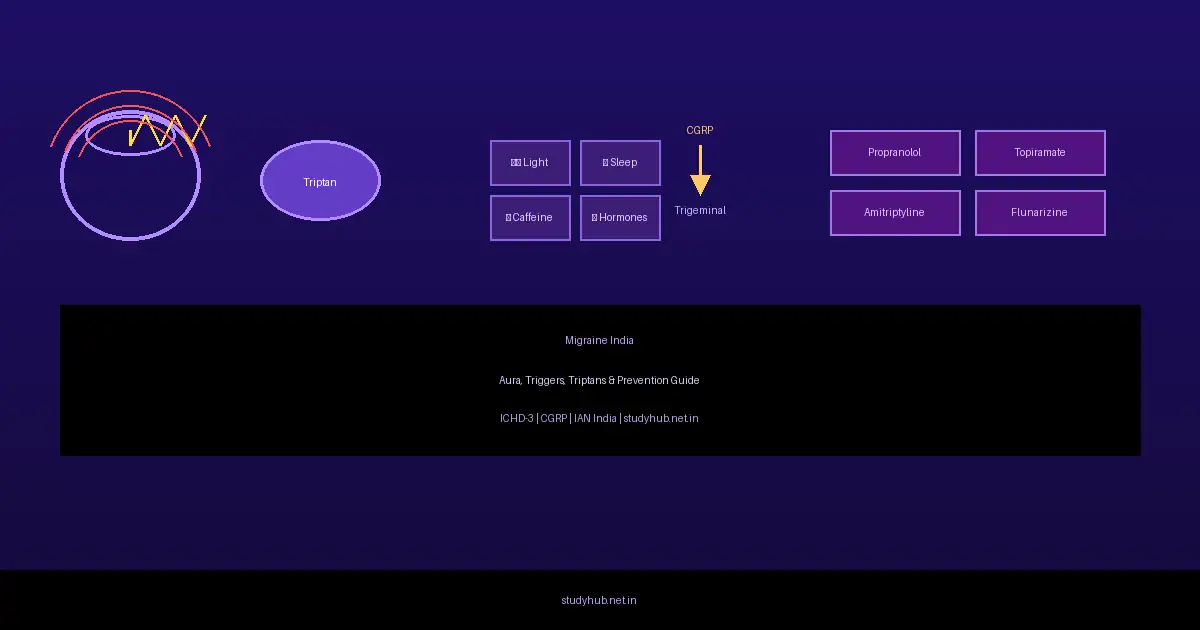
The 4 Phases of a Migraine Attack
| Phase | Timing | Symptoms | What to Do |
|---|---|---|---|
| Prodrome (“pre-headache warning”) | Hours to 2 days before headache | Yawning excessively; food cravings; neck stiffness; mood changes; fatigue; increased thirst; light/sound sensitivity beginning | Hydrate, avoid triggers; early triptan if reliable prodrome pattern |
| Aura (30% of migraine patients) | 20–60 minutes before headache | Visual aura: zigzag shimmering arcs (fortification spectrum), flashing lights, scotoma; Sensory: pins and needles spreading hand→arm→face; Speech aphasia; Hemiplegic migraine (rare — motor weakness) | Take triptan at early headache onset; dark quiet room; visual aura >60 min OR motor weakness = call doctor to exclude stroke |
| Headache | 4–72 hours | Unilateral throbbing (60%); moderate-severe; worsened by physical activity; nausea/vomiting; photophobia; phonophobia; osmophobia; allodynia (skin hypersensitivity) | Triptans (sumatriptan, rizatriptan); NSAIDs + domperidone; dark quiet room; cold/warm pack; avoid screens |
| Postdrome (“migraine hangover”) | Up to 24–48 hours post-headache | Fatigue; cognitive fog; muscle aching; mood low; lingering sensitivity | Rest; gentle hydration; avoid triggers; do not repeat triptans in postdrome |
Common Migraine Triggers — India Context
| Trigger | India Relevance | Management |
|---|---|---|
| Hormonal (oestrogen fluctuation) | Most powerful trigger in women — migraines worsen 2 days before and first 3 days of menstruation (menstrual migraine); COC pill with oestrogen can worsen migraine with aura | Menstrual migraine: frovatriptan or naratriptan from 2 days before menstruation × 5–6 days (mini-prophylaxis); avoid COC + migraine with aura (increased stroke risk) — use POP or mirena IUS instead |
| Sleep disturbance (too little OR too much) | Late-night social media → delayed sleep onset → morning migraine; “weekend headache” — sleeping late disrupts schedule → Sunday migraine; oversleeping during Indian festival holidays | Consistent sleep-wake schedule 7 days/week; no catch-up sleep weekends; treat sleep apnoea (strongly associated with chronic migraine) |
| Dehydration and meal-skipping | Intermittent fasting, Ramadan fasting, busy Indian schedules; summer heat dehydration; chai dependency (caffeine withdrawal triggers migraine) | Regular meals; 2–3L water/day; gradual caffeine reduction (not sudden withdrawal); discuss preventive strategy for religious fasting periods with neurologist |
| Sensory triggers (light, sound, smell) | Diwali firecrackers (noise + smoke + sulphur); Holi brightness; temple incense; office fluorescent flickering; AQI pollution days (PM2.5 triggers neuroinflammation) | FL-41 tinted migraine sunglasses (rose/amber filter specific trigger wavelengths); earplugs for noise events; AQI apps to avoid peak outdoor pollution; limit perfume/incense in confined spaces |
| Stress + “let-down” after stress | “Post-exam migraine” — attack comes in relaxation phase after stressor, not during; stress → cortisol → CGRP release → trigeminal sensitisation; common in high-stress Indian professional/academic environments | CBT and mindfulness (both shown to reduce frequency); regular aerobic exercise (independent preventive effect); biofeedback training (evidence-based non-pharmacological prevention) |
Treatment — Acute and Preventive
| Treatment | Agent | Dose | India Cost |
|---|---|---|---|
| Acute — mild-moderate (step 1) | Aspirin 900mg + metoclopramide 10mg; OR Naproxen 500mg + domperidone 10mg; OR Ibuprofen 400–600mg + domperidone 10mg; take at earliest warning sign | Single dose at onset; can repeat naproxen × 1 after 8 hours | Naproxen 500mg: ₹15–25; domperidone ₹5; most cost-effective option |
| Acute — moderate-severe; NSAID failure (step 2 — triptans) | Sumatriptan 50–100mg oral; Rizatriptan 10mg oral wafer (avoids swallowing with nausea); Zolmitriptan 2.5mg; Naratriptan 2.5mg; Frovatriptan 2.5mg (preferred for menstrual migraine mini-prophylaxis — longest half-life) | At headache onset; repeat once after 2 hours if partial response; max 2 doses/24hr; max 10 days/month (medication overuse headache risk) | Sumatriptan 50mg: ₹60–120 (Migranil, Suminat); Rizatriptan 10mg: ₹100–180; prescription required |
| Acute — anti-emetic adjunct | Domperidone 10–20mg; Metoclopramide 10mg; Ondansetron 4mg (severe vomiting); Prochlorperazine 3mg buccal tablet (bypasses vomiting) | Give 10 minutes before or with oral triptan/NSAID — improves absorption (antiemetics restore gastric motility slowed by migraine) | Domperidone ₹3–5; Metoclopramide ₹2–3; widely available OTC |
| Preventive — start when ≥4 migraine days/month or significant disability | Propranolol 40–120mg/day (most widely used India; avoid in asthma/diabetes); Topiramate 25–100mg/day (avoid if planning pregnancy — teratogenic); Amitriptyline 10–75mg at night (comorbid insomnia/depression); Flunarizine 5–10mg at night (widely used India; watch weight gain); Candesartan 8–16mg (good tolerability); CGRP monoclonal antibodies (erenumab, fremanezumab — ₹8,000–15,000/month; highly effective chronic migraine) | Start low, titrate monthly; minimum 3-month trial; assess with headache diary; taper gradually to discontinue | Propranolol 40mg: ₹2–5/tablet; Topiramate 25mg: ₹5–10/tablet; Flunarizine 5mg: ₹4–8/tablet; all available in India |
Frequently Asked Questions
How is migraine different from tension headache and “sinus headache”?
The most consequential misdiagnosis in Indian headache medicine is “sinus headache” — a diagnosis applied to nearly every bilateral facial-region headache, leading to years of inappropriate antibiotic and decongestant treatment: Reality: 90% of self-diagnosed “sinus headaches” are actually migraine or tension-type headache. True sinusitis headache requires: purulent nasal discharge (thick green/yellow mucus) + facial tenderness on pressing over sinuses + fever + acute onset with viral or bacterial URTI context. Facial pain without these features and with recurrent, episodic pattern = almost certainly NOT sinusitis. Distinguishing migraine, tension-type, and sinusitis: Migraine: Unilateral throbbing; moderate-severe intensity; worse with movement; nausea/photophobia; typically 4–72 hours; may have aura; episodic attacks with pain-free intervals. Tension-type headache: Bilateral; pressing/tightening (non-pulsating) quality; mild-moderate intensity; NOT aggravated by routine activity; no nausea; no aura; may be episodic or chronic daily. “Sinus headache” (true sinusitis): Facial pain over sinuses; purulent nasal discharge; fever; no throbbing; no nausea; no aura. The ICHD-3 (International Classification of Headache Disorders) diagnostic criteria for migraine: A) At least 5 attacks; B) Duration 4–72 hours; C) At least 2 of: unilateral; pulsating; moderate-severe; aggravated by routine activity; D) At least 1 of: nausea/vomiting; photophobia AND phonophobia. A patient meeting ICHD-3 criteria should be treated for migraine — not given another course of antibiotics for a “sinus infection” that does not exist. The “sinus headache” misdiagnosis cycle causes: years of delayed correct treatment; antibiotic exposure without indication (AMR contribution); unsuccessful treatment + worsening disability; secondary anxiety and depression from untreated chronic pain.
Why are triptans prescribed so rarely in India despite being highly effective?
Triptans — introduced in 1991 with sumatriptan — are the first migraine-specific medications ever developed, with dramatic efficacy in aborting acute migraine attacks. Despite being available in India for decades, they remain drastically under-prescribed: The access barriers in India: Specialist access: Triptans are primarily prescribed by neurologists — India has approximately 1,500 practising neurologists for 1.4 billion people (about 1 per 1 million populaton vs 5–6 per 100,000 in UK/USA); the vast majority of Indian migraine patients never see a neurologist. General practitioner awareness: Many Indian GPs are unfamiliar with triptan prescribing, contraindications, and monitoring — defaulting to paracetamol, analgesic combinations (which cause medication overuse headache), and “sinus treatment.” Cost: Sumatriptan 50mg (₹60–120/tablet) is affordable for urban middle-class patients but represents a significant per-attack cost for lower-income patients — though brand generics (Suminat, Migranil) make it accessible. Prescription perception: Some physicians are concerned about sumatriptan cardiovascular contraindications (avoid in ischaemic heart disease, uncontrolled hypertension, stroke history, basilar migraine) — leading to blanket under-prescribing in populations where these contraindications are uncommon. The medication overuse headache (MOH) trap: The most common consequence of triptan under-prescribing is overuse of analgesics as compensatory treatment — codeine/caffeine combination tablets (Saridon — widely used India), diclofenac, and aspirin/paracetamol combinations used more than 10 days/month → MOH (chronic daily headache from medication overuse) → disabling daily headache. MOH treatment requires supervised analgesic withdrawal — extremely difficult without support. Preventing MOH: Prescribe appropriate acute therapy (triptans for moderate-severe) + preventive therapy for frequent episodics → reduces reliance on non-specific analgesics. New options arriving in India: Gepants (ubrogepant, rimegepant) — CGRP receptor antagonists; no vasoconstriction risk (safe in cardiovascular disease); not yet widely available/affordable India. Ditans (lasmiditan) — serotonin 1F agonist; cardiovascular safe; not avaliable India 2024. CGRP monoclonal antibodies (erenumab — Aimovig; fremanezumab — Ajovy): Monthly injections for preventive treatment chronic migraine; available India privately, ₹8,000–15,000/dose; transformative for chronic migraine unresponsive to oral preventives.
Does migraine increase stroke risk?
This is one of the most important safety questions in migraine medicine — particularly for women on combined oral contraceptives: The evidence for migraine with aura + stroke risk: Multiple meta-analyses confirm: migraine with aura (MWA) increases ischaemic stroke risk by approximately 2× compared to no migraine. The absolute risk: Ischaemic stroke in women 20–45 without migraine: 3–4 per 100,000/year. With MWA: 6–8 per 100,000/year. With MWA + oral contraceptive pill (combined, containing oestrogen): 13–15 per 100,000/year. With MWA + COC + smoking: 34+ per 100,000/year. The critical Indian clinical implication: Women with migraine WITH aura should NOT take combined oral contraceptive pills (COC, containing oestrogen). This is a WHO Medical Eligibility Criteria Category 4 contraindication (absolute — do not use). Alternative contraception: progestogen-only pill (POP); Mirena IUS; copper coil; barrier methods — all safe in migraine with aura. Note: Migraine WITHOUT aura is a Category 2 concern for COC (use with caution, benefits generally outweigh risks) — the distinction between migraine with and without aura is therefore critically important for contraceptive counselling. The “thunderclap headache” — different emergency: A severe headache that reaches peak intensity within seconds to minutes (“the worst headache of my life,” “like a bolt out of the blue”) is a medical emergency until proved otherwise — do not assume migraine. Differential: Subarachnoid haemorrhage (ruptured aneurysm) — CT head + lumbar puncture urgently; Cerebral venous sinus thrombosis (CVST — especially in women on COC or in postpartum); Meningitis; Hypertensive crisis. Any sudden-onset severe headache = emergency assessment. Migraine, while severe, typically builds gradually over 30–60 minutes — it does not reach peak intensity in seconds.
When should I see a neurologist about my headaches?
While most migraine can be managed at the GP level with appropriate knowledge, certain features require neurological assessment: Red flags requiring urgent neurological assessment (same-day or next-day): “Thunderclap headache” — sudden severe headache = emergency (see stroke/SAH risk above). New headache in patient over 50 (may represent temporal arteritis, cerebral tumour, subdural haematoma). Headache with fever + neck stiffness + photophobia = meningitis until proved otherwise (emergency). Progressive worsening pattern: Headache that has never been better for months, progressively worsening, especially with early morning waking and vomiting (raised intracranial pressure pattern). Headache with focal neurological symptoms: weakness, speech disturbance, vision loss (other than typical migraine aura), gait disturbance. Headache in HIV+ or immunosuppressed patient (cryptococcal meningitis risk). Seizure with headache. New headache after head trauma. Routine neurological assessment recommended for: Headache occurring ≥4 days/month causing disability (preventive therapy appropriate — requires neurological assessment and headache diary evaluation). Failed trials of 2+ acute treatments. Medication overuse headache (codeine/analgesic dependency exceeding 10 days/month — requires supervised detoxification). Migraine with prolonged (>60 min) aura, hemiplegic aura, or brainstem aura (basilar migraine). Women with migraine with aura considering or currently on combined hormonal contraception. Chronic daily headache (headache >15 days/month). What neurologist assessment includes: ICHD-3 classification; headache diary review (headache frequency, severity, triggers); neurological examination; MRI brain (where indicated — not routinely required for typical migraine); preventive therapy prescription and monitoring; patient education on trigger management and medication overuse avoidance.
What is medication overuse headache and how is it treated?
Medication overuse headache (MOH) — previously “analgesic rebound headache” — is one of the most common and most disabling headache disorders in India, primarily affecting the lowest-income migraine patients who rely on cheap OTC analgesic combinations: Definition: Headache occurring ≥15 days/month for more than 3 months in a patient who uses acute headache medication on ≥10 days/month (triptans, ergots, analgesic combinations) or ≥15 days/month (simple analgesics alone); the headache worsens or does not resolve without medication; a “rebound” pattern where each dose wears off triggering another headache. The Indian MOH pattern: India’s most common MOH presentations: Saridon (propyphenazone + paracetamol + caffeine) overuse — the caffeine component creates physical dependency and withdrawal headache (cycle: morning headache → Saridon → relief → wears off → morning headache); Diclofenac injection overuse — patients request IV diclofenac daily from local pharmacies; Muscle relaxant + analgesic combination overuse (Flexon, Combiflam, Dolo-650 combinations). Treatment: Step 1 — Diagnosis: Identify MOH pattern; keep headache diary for 4 weeks. Step 2 — Abrupt or gradual withdrawal of the overused medication; abrupt withdrawal preferred for triptans and ergots; gradual for analgesics/caffeine if abrupt too difficult. Withdrawal period: typically 2–4 weeks of worsening headache before improvement; patient MUST be warned and supported. Step 3 — Start preventive medication during withdrawal (propranolol, topiramate, amitriptyline) to reduce rebound headache frequency. Step 4 — Education: Explain the paradox — taking more headache medication is causing more headaches; there is no effective shortcut. Step 5 — Follow up at 6 weeks: typically 50–70% improvement in headache frequency after successful withdrawal. MOH is not a character weakness or addiction — it is a pharmacological phenomenon occurring with any acute headache medication used too frequently. Prevention is far easier than treatment: limit acute medications to <10 days/month; treat the frequency with appropriate preventive therapy before MOH develops.
What to Read Next
- Epilepsy — Some Anti-Seizure Medicines (Topiramate, Valproate) Are Also Migraine Preventives
- Depression — Comorbid Depression in Chronic Migraine: Amitriptyline Treats Both
- Anxiety — GAD and Migraine Are Highly Comorbid; Anxiety Worsens Migraine Frequency
- High Blood Pressure — Propranolol and Candesartan Treat Both Hypertension and Migraine
- Sleep Disorders — Sleep Disturbance is the Most Consistent Migraine Trigger; Amitriptyline Treats Both
150 million Indians live with a condition that causes them to lose 4–72 hours of productivity, function, and wellbeing with every attack. The majority have been told they have “sinus problems.” They have been given antibiotics that do nothing for migraine. They have been denied triptans that could abort their attacks in 2 hours. They have been denied preventive therapy that could halve their attack frequency. None of this is acceptable when the tools are available, affordable, and evidence-based. A correct migraine diagnosis — followed by appropriate acute and preventive therapy — can transform a patient’s life within 3 months.
About This Guide: Written by the StudyHub Health Editorial Team (studyhub.net.in) based on ICHD-3 diagnostic criteria, IHF (International Headache Foundation) guidelines, and IAN (Indian Academy of Neurology) migraine guidelines. Last updated: March 2026.
Authoritative Sources: ICHD-3 Headache Classification | International Headache Society | IAN India Migraine Guidelines
💜 Key Message: If you have recurrent headaches with nausea or light sensitivity — it is almost certainly migraine, not sinus. Ask your doctor to classify your headache properly. Triptans abort migraine in 2 hours. Preventives halve attack frequency. Do NOT use analgesics more than 10 days/month.
🔴 Thunderclap Headache Emergency: Sudden severe headache reaching maximum intensity in seconds (“worst headache of my life”) = call 108 immediately. This is NOT migraine until a subarachnoid haemorrhage has been excluded by CT head.
⚕️ Medical Disclaimer: This article is for general educational purposes. All migraine diagnosis, triptan prescribing, and preventive therapy decisions must be made by a qualified healthcare provider. Women with migraine with aura must discuss contraceptive choices with their doctor due to stroke risk interaction with combined oral contraceptives.