
Last Updated: March 2026 | Reading Time: 10 minutes | ~2,100 words
India is facing a dual nutrition crisis — widespread undernutrition on one side and a rapidly escalating obesity epidemic on the other. NFHS-5 (2019–21) reveals that 24% of Indian women and 23% of Indian men are overweight or obese — figures that have nearly doubled in a decade. In urban India, prevalence crosses 40%. Obesity in India is not simply a cosmetic concern — it is a metabolic disease that dramatically increases risk of Type 2 diabetes (7× risk), hypertension (3× risk), heart disease, stroke, PCOS, sleep apnoea, NAFLD, certain cancers, and premature death. Critically, Indians develop these metabolic complications at lower BMI values than Caucasians — a thin-fat Indian with a “normal” Western BMI of 23 may already have dangerous visceral adiposity and insulin resistance. India’s obesity crisis requires India-specific definitions, solutions, and messages.
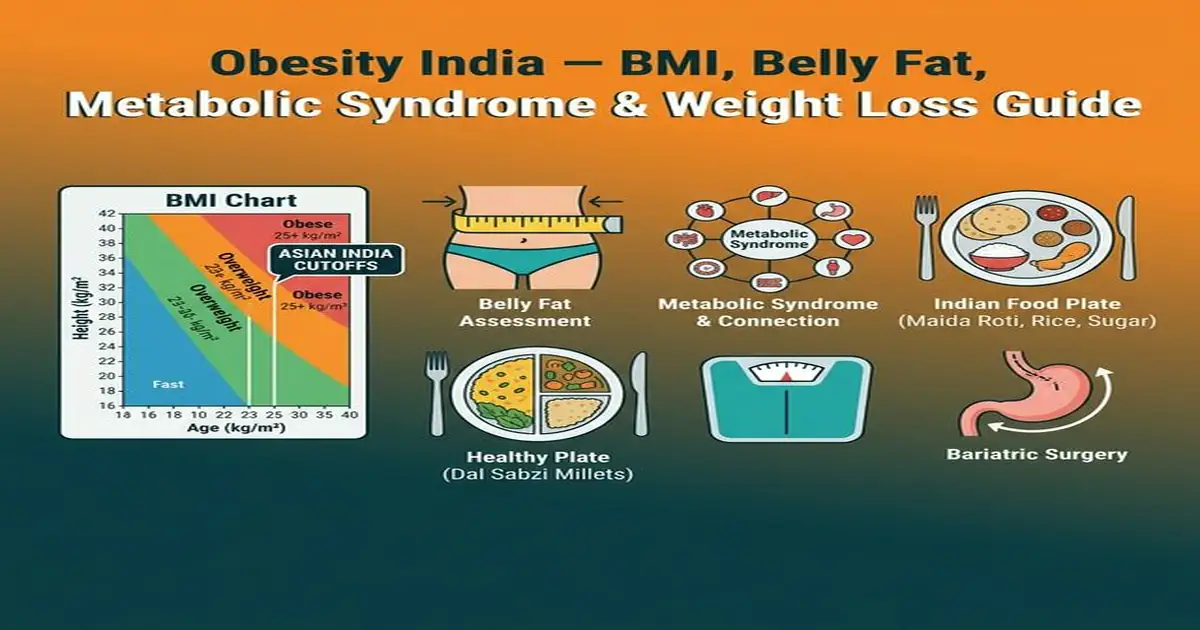
BMI — India-Specific Cutoffs (Asian Classification)
| BMI (kg/m²) | WHO Classification | Asian / India Classification | Risk Level |
|---|---|---|---|
| <18.5 | Underweight | Underweight | Malnutrition risk |
| 18.5–22.9 | Normal weight | Normal weight | Low risk |
| 23–24.9 | Normal (WHO) | ⚠️ Overweight — India threshold starts at 23 | Moderate risk — screen for metabolic syndrome |
| 25–27.4 | Overweight | Obesity Class I — India | High metabolic risk; lifestyle intervention mandatory |
| 27.5–32.4 | Obesity I (WHO) | Obesity Class II — India | Very high risk; medical management consider |
| ≥32.5 | Obesity II (WHO) | Obesity Class III — India | Severe; bariatric surgery eligibility starts at BMI ≥32.5 for Indians with comorbidities |
Why India-specific cutoffs? Indians have a “thin-fat” phenotype — high body fat percentage and visceral adiposity at lower BMI values than European populations. A South Asian with BMI 23 has equivalent cardiovascular risk to a European with BMI 28. The ICMR and Ministry of Health recommend BMI ≥23 as the overweight threshold for Indians.
Waist Circumference — The More Important Measure
Waist circumference (WC) is actually a better predictor of metabolic risk than BMI — because it measures visceral (abdominal) fat, which is metabolically active and directly drives insulin resistance, inflammation, and cardiovascular disease. India-specific cutoffs (WHO/ICMR recommendations): Men: ≥90 cm (35.4 inches) = high risk; Women: ≥80 cm (31.5 inches) = high risk. These are lower than Western cutoffs (102 cm men, 88 cm women) because Indians deposit more dangerous visceral fat for the same waist size. A person who appears slim with a “flat stomach” may still have dangerous visceral fat if WC is at or above these thresholds.
Metabolic Syndrome — India’s Central Threat
Metabolic syndrome is diagnosed when 3 or more of the following 5 criteria are met (IDF criteria with South Asian waist cutoffs): central obesity (WC ≥90 cm men / ≥80 cm women); triglycerides ≥150 mg/dL; HDL cholesterol <40 mg/dL (men) / <50 mg/dL (women); fasting blood glucose ≥100 mg/dL; blood pressure ≥130/85 mmHg. Metabolic syndrome affects an estimated 25–35% of urban Indians and 15–20% of rural Indians — dramatically increasing their risk of Type 2 diabetes (5× risk) and cardiovascular events (2–3× risk). The entire cluster is driven by insulin resistance — primarily caused by excess visceral fat + sedentary lifestyle + refined carbohydrate diet. Treating the root cause (visceral adiposity through weight loss + exercise) reverses all 5 components simultaneously.
India’s Obesity Drivers
| Driver | Mechanism | India-Specific Insight |
|---|---|---|
| Refined carbohydrates — maida & white rice | High glycaemic index → rapid glucose spike → insulin surge → fat storage + hunger cycle | Maida (refined wheat) products — white bread, biscuits, namkeen, puri, samosa — ubiquitous; white polished rice as 2× daily staple in South and East India; switch to whole wheat atta, millets (bajra, jowar, ragi) dramatically reduces GI load |
| Sugar and sweetened beverages | Liquid calories bypass satiety signals; fructose preferentially deposits as visceral fat; cola/fruit juice/chai with 3 tsp sugar = 30–50g sugar/cup | India’s tea consumption with 2–4 tsp sugar 3–5×/day adds 150–300 kcal/day of pure sugar; cold drinks marketed heavily; tender coconut water is a safe alternative to cold drinks |
| Sedentary lifestyle | Urbanisation = reduced walking; office jobs; car/auto commute; screen time 6–8 hours/day; reduced physical activity = reduced TDEE and muscle mass | India’s Physical Activity Report Card (2022): only 13% of Indian adults meet WHO recommended 150 min/week of moderate activity; urban office workers walk average 3,000–5,000 steps/day vs recommended 8,000–10,000 |
| Ultra-processed food accessibility | High calorie density, engineered palatability, cheap, long shelf life; displaces home-cooked meals | Biscuit, namkeen, chips, instant noodles — India’s fastest growing food categories; hyper-palatable = overconsumption |
| Sleep deprivation | Short sleep (<7 hours) elevates ghrelin (hunger hormone) + reduces leptin (satiety hormone); increases cortisol; drives carbohydrate craving; increases obesity risk by 23% per hour of sleep lost | India’s sleep average: 6.5–7 hours (National Sleep Foundation); night shift workers, students, and anxiety-ridden urban professionals particularly vulnerable |
| Thrifty gene hypothesis (genetic) | Indian populations carry genes that maximally store energy during abundance — adaptive in historical food scarcity; maladaptive with modern calorie surplus | Explains why Indians develop T2DM, PCOS, and CVD at lower BMIs than Caucasians — genes are the same; environment changed |
Evidence-Based Weight Loss Strategies for India
| Strategy | Evidence | India Application |
|---|---|---|
| Caloric deficit 500–750 kcal/day | Produces 0.5–1 kg/week weight loss — gold standard; sustainable and prevents muscle loss compared to crash dieting | Indian women average 1,800–2,000 kcal/day; target 1,200–1,500 kcal; men average 2,200–2,500 kcal; target 1,500–1,800 kcal with maintained protein |
| Protein priority (1.2–1.6g/kg body weight) | Protein increases satiety (highest satiety macronutrient), preserves muscle mass during caloric restriction, has highest thermic effect (25–30% of protein calories burned in digestion) | India’s major diet gap: protein intake 30–40% below requirement; dal at every meal + paneer/eggs/curd + seed mix as snacks; avoid protein supplements unless needed |
| Millet replacement for refined grains | Bajra, jowar, ragi — high fibre, low GI, high protein relative to rice/maida; reduces postprandial glucose by 20–30% vs white rice | PM POSHAN promoting millets; millets as roti, dosa, porridge (ragi kanji — popular South India postnatal food); cost-effective, culturally familiar |
| Intermittent fasting (16:8) | 16 hours fasting + 8-hour eating window — equivalent to caloric restriction for weight loss in most trials; improves insulin sensitivity; reduces visceral fat specifically; well-tolerated | Culturally familiar (Navratri, Ekadashi fasting traditional) but structured 16:8 is different; works well for Indians if dinner is last meal by 8pm and breakfast at 12pm (skipping breakfast feasible for most adults) |
| 150–300 min/week aerobic exercise | Minimum 150 min/week moderate intensity (brisk walk) for weight maintenance; 300 min/week for weight loss; resistance training 2–3×/week for metabolic benefits | Walking is the most accessible, free, and culturally acceptable exercise in India; add resistance (bodyweight squats, yoga with strength element) for muscle preservation; morning exercise pre-breakfast maximises fat burning |
| Medications (adjunct) | Orlistat (fat absorption blocker): 5–10% extra weight loss; GI side effects limit use. Semaglutide (Ozempic/Wegovy): 15–20% weight loss in trials; GLP-1 agonist; now approved in India for weight management (BMI ≥27 with comorbidity). Liraglutide (Saxenda): similar mechanism; available India | Semaglutide cost: ₹5,000–12,000/month in India; not covered under government programmes; reserved for significant obesity with comorbidities when lifestyle fails |
| Bariatric surgery | RYGB (Roux-en-Y Gastric Bypass) and sleeve gastrectomy: 25–35% total body weight loss; remission of T2DM in 70–80%, hypertension in 60–75%; durable at 10 years | India eligibility (lower than Western): BMI ≥32.5 with comorbidities (T2DM/HTN) or BMI ≥37.5 without; available at AIIMS, Medanta, Apollo at ₹2–4 lakhs; PM-JAY coverage limited but growing |
Frequently Asked Questions
Why does India have an obesity problem despite widespread poverty?
The coexistence of undernutrition and obesity in India is called the “double burden of malnutrition” — and it reflects the nature of modern Indian poverty, food systems, and urbanisation. Understanding this paradox is essential: Calorie-dense but nutrient-poor diets: Cheap, accessible calories in India disproportionately come from refined carbohydrates (white rice, maida, sugar) and cooking fats — cheap, satisfying in volume, but metabolically damaging. Ultra-processed foods (biscuits, namkeen, instant noodles) are cheaper per calorie than fruits, vegetables, and protein-rich foods. A poor urban Indian family spends the most on the foods (refined grains, oil, sugar) most likely to cause obesity. Nutritional transition: Rural-to-urban migration brings sedentary jobs (replacing agricultural labour), reduced home cooking (street food from mobile vendors), and increased ultra-processed food access — simultaneously. Obesity rates in urban slum populations have risen sharply — poverty no longer protects against obesity as it once did when starvation was the primary caloric threat. Cooking oil transition: India underwent a dramatic shift from traditional cooking fats (ghee, mustard oil, coconut oil — in limited quantities, as they were expensive) to cheap refined vegetable oils (palmolein, refined soybean oil) and vanaspati (partially hydrogenated — trans fat rich) after the 1960s. Cheap refined oil enables cooking of high-calorie fried food at much lower cost than before. Thin-fat phenotype and gestational programming: Indian babies born small (low birth weight — a product of maternal undernutrition) are programmed for metabolic thrift — they are particularly prone to insulin resistance and visceral adiposity when calorie surplus emerges in childhood or adulthood. The poorest Indians who survive undernutrition in childhood are paradoxically most vulnerable to obesity-associated metabolic disease as adults.
Is ghee making Indians fat?
Ghee has been demonised in modern Indian nutritional discourse — and the picture is more nuanced than the popular characterisation of ghee as a health food OR as the cause of India’s obesity epidemic. The scientific reality: Ghee is clarified butter — almost 100% fat, primarily saturated fat (60–65%) with butyrate, conjugated linoleic acid (CLA), and fat-soluble vitamins A, D, E, K. At moderate consumption (1–2 teaspoons per day), ghee does not significantly increase cardiovascular risk in most individuals — this is consistent with the evidence base on saturated fat, which is now more nuanced than the “all saturated fat is bad” messaging of the 1980s–2000s. Ghee is NOT the cause of India’s obesity epidemic — traditional Indian ghee consumption was always 1–2 teaspoons/day (an expensive food used sparingly). The obesity epidemic is driven by refined carbohydrates, sugar, ultra-processed foods, and sedentary lifestyles — not traditional ghee. The real concern with ghee: Portion size — many modern Indian households (particularly those that equate ghee with health and prosperity) add 2–4 tablespoons to each meal — 200–400 extra calories of pure fat per meal that can absolutely drive caloric surplus and weight gain at this quantity. One tablespoon ghee = 120 kcal. Used as a teaspoon on roti, ghee is fine. Poured liberally on dal twice daily, it becomes a significant caloric contributor. Practical guidance: 1–2 teaspoons (not tablespoons) of pure ghee or mustard oil in home cooking is traditional, acceptable, and not harmful. The replacement of ghee with cheap refined vegetable oils and palmolein in most Indian cooking is not an automatic health improvement. Vanaspati (partially hydrogenated vegetable fat) should be avoided completely — it contains trans fats with clear cardiovascular harm.
What is the best Indian diet for weight loss?
The best weight loss diet is one that creates a sustainable caloric deficit while maintaining nutrition adequacy and fitting cultural food preferences — which is why a specifically Indian approach is more effective than imported Western diets (keto, paleo) that require avoiding traditional Indian staples. A practical evidence-based Indian weight loss framework: Meal structure: For most Indian adults — high-protein breakfast (besan chilla with vegetables, moong dal chilla, eggs if non-vegetarian, paneer bhurji + roti of atta); medium lunch (2 small roti atta + dal + sabzi + small bowl rice optional); light dinner (2 atta roti + sabzi + soup; skip rice at dinner which is the most easily cut meal). Swap strategy (without eliminating culturally important foods): White rice → Brown rice or reduce portion by 30% + add 50% more dal/sabzi; Maida roti → Multi-grain or whole wheat atta roti; Biscuits + chai snack → Handful almonds/roasted chana + black coffee; Fruit juice → Whole fruit (fibre preserved, lower glycaemic impact); Fried poha/upma → Dry version with vegetables; Packaged namkeen → Makhana (fox nuts — 70 kcal/10g vs 450 kcal/100g for chips). Potions sizes — the India-specific issue: Indians habitually eat very large roti (usually 60–80g each vs the 30–40g appropriate portion), which doubles caloric intake per roti. Rolling smaller rotis and eating slower (allowing satiety signals to register) is a simple, culturally appropriate intervention. What to measure: Track portions of roti and rice (the two primary caloric vehicles in Indian diet) rather than counting every calorie — simplifies compliance. 2 medium rotis + 1 small bowl rice per meal = approximately 250–300 kcal of carbohydrate — the target for most adults at weight loss quantities.
Does rice make you fat?
Rice is one of the most emotionally charged foods in Indian nutritional discourse — millions of South and East Indians can barely imagine a meal without rice, yet it is routinely demonised as “fattening.” The scientific truth is nuanced: Rice itself is not uniquely fattening — it is a source of carbohydrates and calories, like any other carbohydrate. Japan and South Korea have some of the lowest obesity rates in the world, with white rice as a staple. The issue is not rice per se, but total caloric intake, portion size, the foods eaten with rice, and the physical activity pattern. Why Indians specifically have a problem with rice: Indian rice portions are large — a typical South Indian meal uses 200–300g cooked rice (60–90g dry) = 200–300 kcal from rice per meal. This is taken twice or three times daily. Accompanying preparations are often calorie-dense (sambar with oil, coconut chutney, fried pappad). The combination with very sedentary urban lifestyle means total calories exceed TDEE chronically. The glycaemic issue: Polished white rice has a high glycaemic index (70–80) — it causes rapid blood glucose elevation → insulin spike → fat storage signal and appetite return. Brown rice (GI 50–55) or rice + dal combination (dal protein slows starch digestion, reducing GI by 20–30%) significantly reduce this effect. Practical advice: You do not need to eliminate rice. Reduce portion from 2 cups cooked to 1 cup cooked (half the calories). Choose smaller diameter plate (studies show smaller plate reduces portions without hunger). Increase dal and sabzi portion — they provide protein and fibre that slow rice starch digestion and increase satiety. Eat rice earlier in the day (lunch) rather than at dinner when activity is lower.
When is bariatric surgery the right choice?
Bariatric surgery is one of the most evidence-based and durable treatments for severe obesity — with outcome data showing 65–80% of patients maintaining significant weight loss at 10 years (vs <10% long-term success for diet alone in severe obesity). In India, updated guidelines lower the eligibility threshold from Western standards: Eligibility (Indian guidelines — OSSI, IMA): BMI ≥32.5 kg/m² with obesity-related comorbidities (T2DM, hypertension, obstructive sleep apnoea, PCOS, NAFLD, joint disease); OR BMI ≥37.5 kg/m² without comorbidities; Minimum age 18 (adolescent bariatrics considered above 16 with specific criteria). Types available in India: Sleeve gastrectomy — most popular — removes 80% of stomach; produces 25–35% total body weight loss; safe and reversible endoscopically. Roux-en-Y Gastric Bypass (RYGB) — remission of T2DM in 80%+ (even before significant weight loss — through hormonal/gut mechanisms); 30–40% total body weight loss; gold standard for diabetic obesity. Mini-gastric bypass — gaining popularity in India; simpler technically; comparable results. What bariatric surgery is NOT: It is not a cosmetic procedure — it is a metabolic intervention. It is not a permanent solution without dietary and lifestyle commitment — patients can regain weight if the underlying relationship with food is not addressed. Nutritional supplementation is lifelong post-bariatric (B12, iron, calcium, Vitamin D). Psychological evaluation is mandatory pre-surgery. Cost: Private hospitals ₹2–4 lakhs; some government empanelled hospitals ₹1.5–2 lakhs; PM-JAY coverage limited but improving for bariatric at empanelled centres for qualifying patients. The cost must be weighed against the lifetime cost of diabetes medications, cardiovascular interventions, joint replacements — all of which bariatric surgery significantly reduces need for.
What to Read Next
- Diabetes — Obesity is the Number One Modifiable Cause of Type 2 Diabetes in India
- Fatty Liver (NAFLD) — Obesity Directly Causes Fatty Liver and Its Progression to Cirrhosis
- PCOS — Obesity Worsens PCOS; 5% Weight Loss Restores Ovulation in Obese PCOS
- Hypertension — Obesity Drives 30–65% of Primary Hypertension in India
- Arthritis — Every 1 kg Weight Adds 4 kg Force to the Knee; Obesity Drives Knee OA
India does not have a rice problem or a ghee problem or a roti problem. India has a portion problem, a movement problem, a sugar problem, and an ultra-processed food problem. The solutions are not complicated — but they are cultural and systemic. The first step is understanding that obesity is not a failure of willpower. It is the biological response of a 50,000-year genetic programme to a food environment it was never designed to navigate.
About This Guide: Written by the StudyHub Health Editorial Team (studyhub.net.in) based on ICMR dietary guidelines, NFHS-5, WHO/IDF metabolic syndrome criteria, and Obesity Surgery Society of India (OSSI) bariatric guidelines. Last updated: March 2026.
Authoritative Sources: ICMR Dietary Guidelines | WHO — Obesity | NFHS-5 India | IDF Metabolic Syndrome
⚕️ Medical Disclaimer: This article is for general informational and educational purposes only. Bariatric surgery requires specialist evaluation. Any weight loss medication should be taken only under medical supervision. Consult a registered dietitian for personalised dietary plans, particularly if you have diabetes or kidney disease.