
Last Updated: March 2026 | Reading Time: 9 minutes | ~2,000 words
Sleep is not a passive luxury — it is an active biological necessity equivalent to food and water. India is in the middle of a silent sleep crisis: a 2022 survey found that India ranks among the most sleep-deprived nations globally, with 93% of Indians reporting poor sleep quality and average sleep duration of 6.5–7 hours — below the 7–9 hours required for adult health. Chronic sleep deprivation drives obesity, diabetes, hypertension, depression, reduced immunity, cognitive impairment, and increased accident risk. Obstructive Sleep Apnoea (OSA) — the condition where breathing stops repeatedly during sleep — affects an estimated 6–13% of Indian adults and is significantly underdiagnosed. This guide covers insomnia, OSA, and the spectrum of sleep disorders that are harming Indian health in silence.
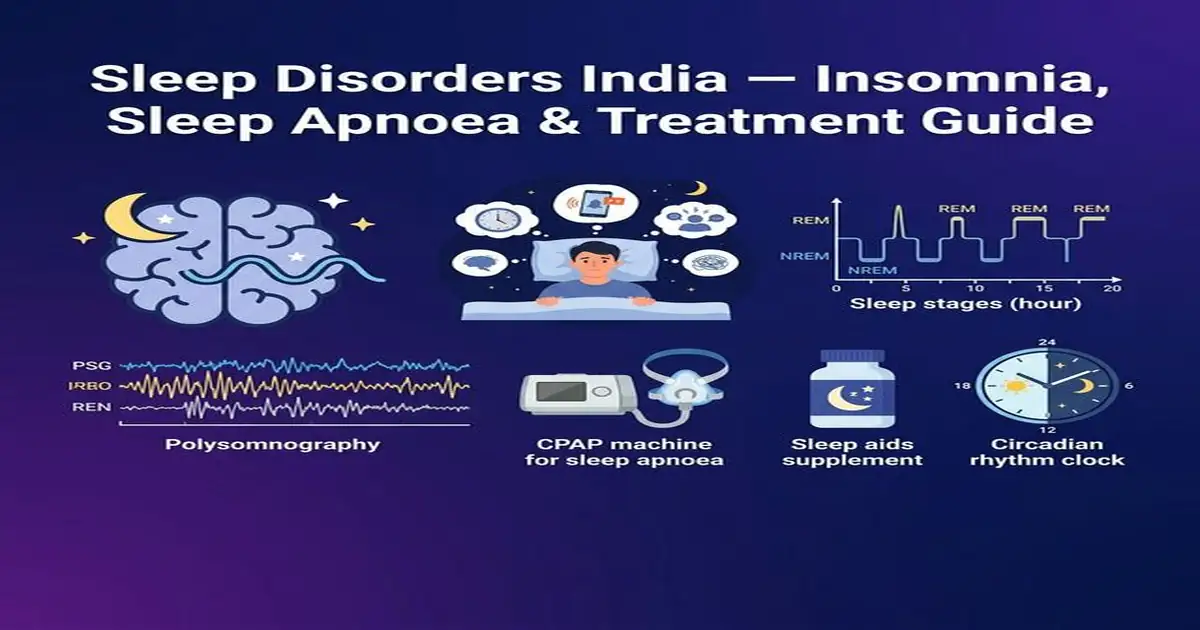
Sleep Architecture — Why Quality Matters As Much As Quantity
| Sleep Stage | Duration | Function | Disrupted By |
|---|---|---|---|
| NREM Stage 1 (Light sleep) | 5–10 min per cycle | Transition from wake to sleep; easily awakened; hypnic jerks common | Noise, light, smartphone vibrations |
| NREM Stage 2 | 20–30 min per cycle | Body temperature drops; heart rate slows; memory consolidation begins; K-complexes and sleep spindles | Alcohol (fragments Stage 2); caffeine after 2pm |
| NREM Stage 3 (Deep/Slow Wave) | 20–40 min (mostly first half of night) | Physical restoration; growth hormone release; immune function; tissue repair; most restorative stage | Alcohol (suppresses SWS); OSA (fragments); aging (SWS reduces) |
| REM Sleep | 10–60 min per cycle; increases toward morning | Emotional processing; memory consolidation; creativity; dreaming; brain restoration | Alcohol (suppresses REM); sleeping pills (many); antidepressants (some); sleep deprivation (REM rebounds) |
| Full cycle (90 min) | 4–6 cycles per night | Complete sleep architecture requires 7–9 hours — short sleepers sacrifice REM and SWS disproportionately | All sleep disorders; social jet lag; shift work |
Common Sleep Disorders in India
| Disorder | Key Features | India Prevalence | Treatment |
|---|---|---|---|
| Insomnia (acute and chronic) | Difficulty falling asleep (>30 min sleep onset latency), maintaining sleep (multiple awakenings), or early morning awakening; non-restorative sleep; daytime impairment; chronic = 3+ nights/week for 3+ months | 30–40% short-term; 10–15% chronic insomnia; rising with smartphone use, work stress, and anxiety | CBT-I (gold standard — better than sleep pills long-term); sleep restriction; stimulus control; sleep hygiene; short-term melatonin or low-dose antidepressants |
| Obstructive Sleep Apnoea (OSA) | Repetitive partial/complete collapse of upper airway during sleep → 10–30 second breathing pauses (apnoeas) → arousal → fragmented sleep; snoring + witnessed apnoea + excessive daytime sleepiness (Epworth >10) = classic triad | 6–13% of Indian adults; higher in obese, middle-aged men, post-menopausal women; extremely underdiagnosed | CPAP (gold standard); weight loss (10% weight loss reduces AHI by 30%); positional therapy; mandibular advancement device; surgery for anatomical causes |
| Restless Legs Syndrome (RLS) | Uncomfortable urge to move legs (typically evenings/night); relieved by movement; worsens at rest; disrupts sleep onset; often caused/worsened by iron deficiency | 2–5%; iron deficiency, pregnancy, renal failure are key triggers in India | Iron supplementation (if ferritin <50); dopaminergic drugs (pramipexole); pregabalin; lifestyle (avoid caffeine, alcohol) |
| Circadian Rhythm Disorders | Delayed Sleep Phase Syndrome (DSPS — “night owl” — cannot sleep before 2–4am); shift work disorder; social jet lag (weekend schedule shift) | Very common in Indian urban youth and IT/BPO night shift workers — India’s night shift economy is among the world’s largest | Light therapy (10,000 lux morning light for DSPS); melatonin 0.5mg at target bedtime; gradual schedule adjustment; shift work management protocols |
| Narcolepsy | Excessive daytime sleepiness despite adequate night sleep; cataplexy (sudden muscle weakness with emotion — pathognomonic); sleep paralysis; hypnagogic hallucinations; autoimmune loss of orexin neurons | Rare (0.02–0.05%); significantly underdiagnosed in India — often dismissed as “laziness” | Modafinil (wakefulness-promoting); sodium oxybate; lifestyle scheduling; avoid driving/heights until controlled |
Obstructive Sleep Apnoea (OSA) — India’s Most Underdiagnosed Condition
OSA is diagnosed when the Apnoea-Hypopnoea Index (AHI — number of breathing pauses per hour of sleep) is ≥5 with symptoms, or ≥15 regardless of symptoms. Severity: Mild: AHI 5–14; Moderate: AHI 15–29; Severe: AHI ≥30. OSA consequences beyond poor sleep: Cardiovascular: OSA doubles the risk of hypertension (resistant to treatment until OSA is treated); 2–3× increased risk of atrial fibrillation; significant independent risk factor for myocardial infarction and stroke. Metabolic: Intermittent hypoxia (oxygen drops during apnoeas) drives insulin resistance, worsens T2DM control, increases visceral adiposity through cortisol/sympathetic activation. Neurological: Fragmented sleep → excessive daytime sleepiness (EDS) → 7× increased road traffic accident risk (driving while sleepy is equivalent to driving drunk). Diagnosis: Home Sleep Test (HST) — affordable portable oximetry and airflow monitoring available at ₹3,000–8,000; Gold standard: in-laboratory Polysomnography (PSG) at sleep centres — ₹8,000–20,000 at government/private hospitals. Screening tool: STOP-BANG questionnaire (Snoring, Tired, Observed apnoea, Pressure/hypertension, BMI >30/27 India, Age >50, Neck >40cm, Gender male) — score ≥3 = high risk. CPAP therapy: mask worn during sleep delivers continuous positive air pressure keeping airway open; 70%+ patients report dramatic improvement in daytime energy; available in India at ₹8,000–25,000 for device.
Sleep Hygiene — Evidence-Based Behavioural Rules
| Rule | Evidence-Based Rationale |
|---|---|
| Fixed wake time regardless of bedtime or weekend | The single most effective sleep hygiene change — anchors circadian clock; consistency builds sleep pressure (adenosine) at correct time |
| Blue light avoidance 1 hour before bed | Blue light (580–700nm) from smartphones/LED suppresses melatonin secretion by 50%; use night mode/f.lux; avoid phone in bedroom |
| Cool bedroom temperature 18–20°C | Core body temperature must drop 1–2°C for sleep onset; cooler room (fan/AC) facilitates this; hot Indian summers with no cooling is a significant insomnia driver |
| No caffeine after 2pm | Caffeine half-life 5–7 hours; a 3pm chai/coffee still has 50% pharmacological activity at 8pm; blocks adenosine receptors → delays sleep onset |
| Bed only for sleep and sex | Stimulus control — working/watching/scrolling in bed creates conditioned arousal to bed surface; brain must associate bed = sleep not stimulation |
| Wind-down routine (30–60 min) | Reading (physical book), warm shower (body temp drop post-shower facilitates sleep), light stretching, breathing exercises — activates parasympathetic; no work email/news |
| Exercise (but not within 2–3 hours of bedtime) | Regular aerobic exercise improves sleep quality — increases SWS by 20–30%; reduces sleep onset latency; morning exercise most beneficial |
Frequently Asked Questions
Are sleeping pills safe for insomnia?
Sleeping pills are among the most prescribed medications in India — and among the most misused. The honest answer about their safety requires distinguishing between types: Benzodiazepines (nitrazepam, clonazepam, diazepam — widely prescribed in India): Effective for short-term insomnia (1–2 weeks); rapidly cause tolerance (drug loses effectiveness) and physical dependence within 4–6 weeks. Chronic use causes cognitive impairment (particularly in elderly — doubled dementia risk with long-term use), next-day sedation, fall risk (critical in elderly Indians leading to hip fracture), rebound insomnia on stopping, and psychological dependence. India has a significant benzodiazepine dependence problem — many patients take these nightly for years without review, prescribed repeatedly by GPs. Z-drugs (zolpidem/Ambien — increasingly used in India): Slightly better tolerated than benzodiazepines but similar dependence and rebound profile; associated with sleepwalking, sleep driving, and complex behaviours. Melatonin: Physiological dose (0.5–1 mg) at bedtime is safe for short-term use; particularly effective for jet lag and circadian rhythm disorders; available OTC in India; not a hypnotic (does not knock you out) — it shifts and promotes natural sleep onset; minimal side effects; not habit-forming. Low-dose antidepressants (mirtazapine, doxepin, trazodone): Used for comorbid insomnia-depression or refractory insomnia; sedating at low doses; not habit-forming; reasonable option under psychiatrist guidance. CBT-I (Cognitive Behavioural Therapy for Insomnia): The gold standard — not a drug — outperforms sleeping pills in RCTs at 6–12 months and has no side effects. Components: sleep restriction (counterintuitively restricting time in bed initially to build sleep drive), stimulus control, sleep hygiene, cognitive restructuring (challenging catastrophic beliefs about sleep). Available through psychologists trained in CBT-I; digital CBT-I (Sleepio app) has RCT evidence; increasingly available in India. The meta-message: any sleeping pill is appropriate only as short-term bridge while addressing the underlying cause of insomnia (anxiety, depression, OSA, pain, medication side effects). Chronic nightly use is harmful and delivers progressively less benefit as tolerance develops.
Does India’s smartphone use explain its sleep crisis?
Significantly yes — and the evidence is compelling. India has 700+ million smartphone users with average screen time of 4–6 hours/day, with a substantial proportion of this after 9pm. The mechanisms by which smartphones disrupt sleep: Blue light and melatonin suppression: Smartphone screens emit blue-range (440–490nm) light directly stimulating intrinsically photosensitive retinal ganglion cells (ipRGCs) → suppresses suprachiasmatic nucleus → delays melatonin release → delays sleep onset by 45–90 minutes. This is essentially free-choice circadian rhythm disruption happening in billions of Indians nightly. Psychological arousal: Social media, news, messaging — all stimulate the brain’s reward and threat circuits (dopamine + amygdala activation), making it neurologically difficult to transition to sleep. Seeing a WhatsApp message requiring response at 11pm activates cortical arousal incompatible with sleep onset. Conditioned alertness: The brain learns that bedtime = phone time = stimulation → bed no longer triggers sleep response. This is stimulus control failure at scale. India-specific pattern: The post-dinner phone scroll in bed is culturally universal across Indian urban households — a pattern that has entirely replaced the previously sleep-promoting activities (reading, conversation, early darkness). Night-time “reels” consumption on Instagram/YouTube Shorts provides unpredictable partial reinforcement (variable reward) — the most powerful conditioning schedule known to behavioural psychology, making phone use compulsive even when the user wants to stop. Solutions beyond willpower: Phone charger outside bedroom (remove temptation entirely — “out of sight, out of mind” — most powerful intervention). App usage limits set on device (Screen Time/Digital Wellbeing). Blue-light blocking glasses from 9pm (partial but real effect). Fixed “phone off” time — 30 minutes before sleep target.
My partner snores loudly — should I be worried?
Loud snoring is never “just snoring” — it is a symptom that requires evaluation to distinguish benign primary snoring from obstructive sleep apnoea (OSA), which carries serious health consequences. Primary (benign) snoring: Vibration of upper airway soft tissue (soft palate, uvula, tongue base) during sleep; no breathing pauses; no oxygen desaturation; no daytime sleepiness. Still disruptive to the bed partner’s sleep but not medically dangerous to the snorer. OSA snoring pattern: Loud crescendo snoring → abrupt silence (the apnoea — breathing has stopped) → gasping, choking, or snorting as the person arouses to resume breathing → brief silence → snoring resumes. The witnessed apnoeas (partner sees the breathing stop) are the most important symptom. Other symptoms suggesting OSA rather than simple snoring: unrefreshing sleep despite 8 hours in bed; excessive daytime sleepiness (falling asleep at meetings, while driving — critically dangerous); morning headache (CO₂ retention from apnoeas); nocturia (night-time urination — negative intrathoracic pressure from apnoeas causes release of natriuretic peptide → kidney responds by producing urine); irritability, mood changes, poor concentration. When to insist on evaluation: Any witnessed apnoea is sufficient indication for sleep study referral. Epworth Sleepiness Scale score ≥10 (validated tool — ask your partner to score their daytime sleepiness) combined with snoring = high OSA probability. Untreated severe OSA (AHI ≥30) significantly increases 10-year cardiovascular mortality. The person with OSA often doesn’t know they have it — the partner does. Getting this person evaluated and on CPAP could add years to their life.
Is melatonin safe and effective in India?
Melatonin is available over-the-counter in India (unlike many countries where it requires a prescription) — making its appropriate use and misuse both more accessible. What melatonin does: Melatonin is a hormone produced by the pineal gland in dim light (~9pm) that signals to the brain and body that it is biologically night. It does not knock you to sleep — it shifts the timing of the circadian clock and lowers the threshold for sleep onset. It is most effective for: jet lag (take at target bedtime in new timezone starting day of travel); delayed sleep phase syndrome (DSPS — inability to sleep before 1–2am — take 0.5mg 5–6 hours before current sleep time to gradually advance the phase); shift work (help re-anchor circadian clock on days off); short-term insomnia with delayed sleep onset. Dose: The key insight from pharmacology research: more is NOT better with melatonin. The effective dose is 0.3–1 mg — the physiological range. Most Indian products sell 3–10 mg — pharmacological doses that saturate receptors, provide no additional benefit, and cause morning grogginess. Use the lowest effective dose (0.5–1 mg). Safety: Melatonin is very safe at physiological doses with no evidence of dependence, tolerance, or significant side effects. Long-term data beyond 12 months is limited. Not recommended in pregnant women or children without medical guidance. What melatonin does NOT do: It does not treat chronic insomnia driven by anxiety, hyperarousal, or behavioural factors — CBT-I is needed for these. It is not a sleeping pill and should not be used to “knock yourself out” — the large doses sold in India for this purpose are inappropriate.
How does shift work affect health?
India’s BPO, IT, manufacturing, and healthcare sectors employ millions in night shifts — making shift work disorder one of the most important occupational health issues in urban India. The health consequences of sustained night shift work are compounding and serious: Circadian misalignment: The human circadian clock evolved over millennia to be awake in daylight and asleep in darkness. Night shift work forces behaviour opposite to the body’s internal timing → every organ system (gut, liver, immune system, cardiovascular system) functions on conflicting timescales. This is analogous to permanent desynchronised jet lag. Metabolic consequences: Night shift workers have 30–40% increased risk of Type 2 diabetes; 40% increased risk of obesity; significantly elevated triglycerides and reduced HDL — driven by disrupted insulin sensitivity, altered cortisol and melatonin rhythms, eating at night (when gut motility and insulin sensitivity are circadian-reduced), and disrupted sleep quantity. Cardiovascular: 23% increased risk of myocardial infarction; 5% increased risk of stroke; significant hypertension risk — operating through chronic sympathetic activation, sleep fragmentation, and metabolic abnormalities. Cancer risk: IARC (International Agency for Research on Cancer) classified night shift work as “probably carcinogenic” (Group 2A) — primarily breast cancer risk in women (circadian clock gene disruption affects cell cycle regulation). Practical harm reduction for Indian night shift workers: Attempt 7–8 hours continuous daytime sleep in a blackout room after night shift — earplugs, blackout curtains, “do not disturb.” Maintain fixed night shift eating pattern (not eating between 2–4am even if allowed); eat main meal before shift. Avoid alcohol to help daytime sleep — it reduces sleep quality. Strategic caffeine use (first 1–2 hours of shift only — allow clearance before daytime sleep). Light therapy goggles during the first half of night shift; blackout glasses on commute home after shift. Request compressed shift patterns (3–4 consecutive night shifts then full days off) over scattered night shifts — allows longer circadian adaptation.
What to Read Next
- Depression — Insomnia and Depression Have a Bidirectional Relationship
- Anxiety — Anxiety is the Leading Cause of Chronic Insomnia in India
- Obesity — Sleep Deprivation Elevates Ghrelin and Drives Obesity
- Diabetes — Poor Sleep Reduces Insulin Sensitivity by 20–30%
- Hypertension — OSA is a Leading Cause of Treatment-Resistant Hypertension
Sleep is not wasted time. It is the time when your brain cleans itself (glymphatic clearance), your immune system consolidates memory for pathogens, your hormones regulate, and your neurons make the connections that become tomorrow’s decisions. Every hour of sleep sacrificed to a phone screen, a Netflix episode, or a deadline is paid for in cognitive currency, metabolic currency, and years of life. Sleep is not optional. It is restoration.
About This Guide: Written by the StudyHub Health EditorialTeam (studyhub.net.in) based on ICSD-3 (International Classification of Sleep Disorders), AASM guidelines, and Indian sleep medicine research. Last updated: March 2026.
Authoritative Sources: AASM — American Academy of Sleep Medicine | National Sleep Foundation | WHO — Sleep | ICMR India
⚕️ Medical Disclaimer: This article is for general informational and educational purposes only. Chronic insomnia and suspected sleep apnoea require clinical evaluation. Do not take sleeping pills (especially benzodiazepines) without medical guidance. Never drive if excessively sleepy — get evaluated for OSA.