
Last Updated: March 2026 | Reading Time: 9 minutes | ~2,000 words
Thyroid cancer is the most common endocrine malignancy worldwide — and in India, its incidence is rising rapidly, driven by improved detection (ultrasound and FNAC availability), urbanisation, and possibly increasing radiation exposure. An estimated 25,000–30,000 new cases of thyroid cancer are diagnosed annually in India, with women affected 3–4 times more frequently than men. The good news: the vast majority of thyroid cancers are papillary thyroid carcinoma (PTC) — with an excellent prognosis (10-year survival >95%) when treated appropriately. The critical clinical challenge in India: distinguishing the common, indolent thyroid nodule (present in 20–30% of adults on ultrasound — nearly all benign) from the rare malignant nodule requiring surgery; and avoiding over-investigation and over-treatment of nodules that are almost certainly benign. This guide covers the evidence-based pathway from detecting a thyroid nodule to managing thyroid cancer.
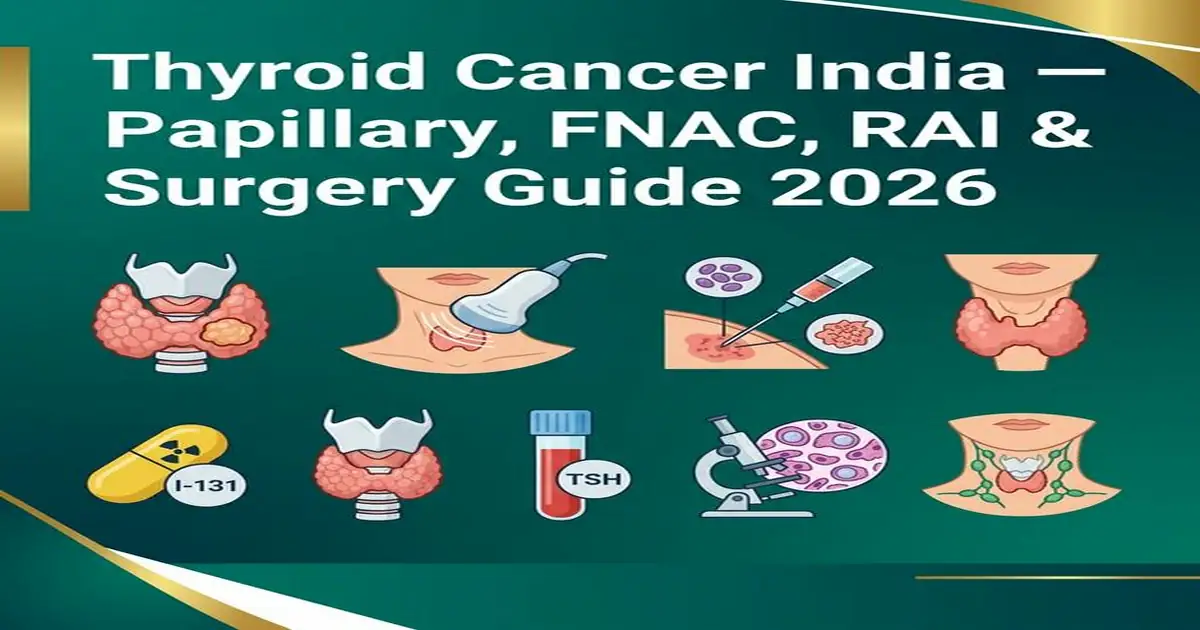
Types of Thyroid Cancer — Prognosis and Treatment
| Type | % of Cases | Origin | Key Features | Prognosis | Treatment |
|---|---|---|---|---|---|
| Papillary Thyroid Carcinoma (PTC) | 85–90% | Follicular cells; TSH-driven growth | Slow growing; spreads to cervical lymph nodes (but lymph node spread does NOT worsen prognosis significantly in PTC); psammoma bodies (calcified spheres — pathognomonic); “Orphan Annie eye” nuclei on histology; iodine-avid; BRAF mutation (V600E) in 60% — prognostic marker; includes microcarcinoma (<1cm) — often incidental, managed conservatively | Excellent — 10-year survival >95% for low-risk PTC; 85–90% for high-risk PTC; one of the most curable cancers; even lymph node metastases do not significantly reduce survival | Total thyroidectomy (most PTC) or hemithyroidectomy (low-risk PTC <4cm, no extrathyroidal extension); radioactive iodine (RAI/I-131) ablation post-surgery for intermediate/high-risk PTC; TSH suppression therapy (levothyroxine at doses keeping TSH suppressed to 0.1–0.5 for low-risk, <0.1 for high-risk); lifelong thyroglobulin monitoring |
| Follicular Thyroid Carcinoma (FTC) | 5–10% | Follicular cells | Spreads haematogenously (blood-borne — to lung, bone, brain) rather than via lymph nodes; CANNOT be distinguished from follicular adenoma (benign) by FNAC — requires histology (capsular/vascular invasion); iodine-avid (can be treated with RAI); minimally invasive vs widely invasive subtype | Good for minimally invasive (10-year survival 90%+); worse for widely invasive or distant metastases (50–60% 10-year survival) | Total thyroidectomy; RAI ablation (iodine-avid); TSH suppression; monitoring with thyroglobulin and whole-body I-131 scan |
| Medullary Thyroid Carcinoma (MTC) | 3–5% | Parafollicular C-cells (produce calcitonin) | NOT iodine-avid — RAI ineffective; sporadic (75%) or hereditary (25% — MEN2 syndrome: RET proto-oncogene mutation; MEN2A = MTC + phaeochromocytoma + parathyroid adenoma; MEN2B = MTC + phaeo + marfanoid habitus + mucosal neuromas); marker: serum calcitonin (elevated even with small MTC — excellent screening biomarker); CEA also elevated | Intermediate — 10-year survival 75–80% if localised; 40% with distant metastases | Total thyroidectomy + central neck dissection; NO RAI (not iodine-avid); kinase inhibitors (vandetanib, cabozantinib) for metastatic MTC; genetic testing all MTC patients for RET mutation; family screening if RET positive (prophylactic thyroidectomy for RET carriers) |
| Anaplastic Thyroid Carcinoma (ATC) | <1% | Follicular cells (dedifferentiated from PTC/FTC) | Rapidly growing neck mass; invasion of surrounding structures (trachea, oesophagus, carotid); almost all present with Stage IV disease; locally and systemically aggressive; often on background of pre-existing goitre/PTC | Extremely poor — median survival 5–6 months from diagnosis; one of the most aggressive human cancers; lenvatinib + pembrolizumab combination showing modest benefit in BRAF-mutant ATC | Multidisciplinary: surgery if resectable (rare); external beam radiation; chemotherapy (doxorubicin-based); targeted therapy (dabrafenib + trametinib if BRAF V600E+ — significant response rate); best supportive care/palliative care discussion early |
Thyroid Nodule Assessment — TIRADS & Bethesda Classification
| Stage | Classification | Malignancy Risk | Action |
|---|---|---|---|
| Ultrasound assessment — TI-RADS (Thyroid Imaging Reporting and Data System) | TI-RADS 1–2: benign; TI-RADS 3: mildly suspicious; TI-RADS 4A/B: moderately suspicious; TI-RADS 5: highly suspicious (spiculated margins, microcalcification, taller-than-wide shape, irregular border, marked hypoechogenicity) | TI-RADS 2: <2%; TI-RADS 3: 5–10%; TI-RADS 4A: 10–20%; TI-RADS 4B: 20–70%; TI-RADS 5: >70–90% | TI-RADS 1–2: no FNAC needed; TI-RADS 3: FNAC if >2.5cm; TI-RADS 4A: FNAC if >1.5cm; TI-RADS 4B–5: FNAC regardless of size |
| FNAC (Fine Needle Aspiration Cytology) — Bethesda System | Bethesda I (non-diagnostic — repeat needed); Bethesda II (benign — 0–3% malignancy); Bethesda III (AUS/FLUS — 6–18% malignancy); Bethesda IV (follicular neoplasm — 10–40%); Bethesda V (suspicious for malignancy — 45–75%); Bethesda VI (malignant — 97–99%) | Bethesda II: very low; Bethesda V–VI: high | Bethesda II: clinical follow-up; Bethesda III: repeat FNAC or molecular testing; Bethesda IV: hemithyroidectomy (diagnostic); Bethesda V–VI: total thyroidectomy |
Frequently Asked Questions
I found a thyroid nodule on ultrasound — should I be worried?
Discovering a thyroid nodule — either by feeling a lump in the neck or incidentally on neck ultrasound done for other reasons — is extremely common and almost always benign: Scale of thyroid nodule prevalence: Thyroid nodules are present in up to 65–70% of adults when examined with high-resolution ultrasound; clinically palpable nodules (detectable by examination) are found in 4–7% of adults; the lifetime cumulative risk of a thyroid nodule being malignant is approximately 5% of palpable nodules and <1% if picked up only on ultrasound screening; in other words, the vast majority of thyroid nodules found incidentally — the “thyroid incidentaloma” — are completely benign and require no treatment. Features that are reassuring (benign by ultrasound): Purely cystic nodule (fluid-filled — almost never malignant); spongiform appearance (multiple tiny cysts in nodule — 99.7% benign); smooth well-defined margins; isoechoic or hyperechoic on ultrasound; coarse “eggshell” calcification (benign pattern — different from microcalcification); no internal vascularity on Doppler. Features that increase suspicion (warrant FNAC): Microcalcifications (tiny punctate calcifications within nodule — associated with psammoma bodies of PTC); hypoechoic solid nodule (darker than thyroid tissue); irregular/spiculated/infiltrative margins; taller-than-wide shape on transverse view; extension beyond thyroid capsule (extrathyroidal extension); enlarged neck lymph nodes on same side. What to do with a thyroid nodule: Step 1: TSH measurement — if suppressed TSH (low TSH), nodule may be autonomously functioning (“hot nodule”) → thyroid scintigraphy (nuclear scan); hot nodules are almost never malignant — can cause hyperthyroidism. Step 2: Thyroid ultrasound with TI-RADS assessment — characterise the nodule (this is the key investigation). Step 3: Based on TI-RADS + size → FNAC if indicated (Bethesda classification). Step 4: Act on Bethesda category. The over-investigation problem in India: Many Indian patients have incidental neck ultrasound findings (during thyroid function tests ordered for symptoms like fatigue, hair loss, weight gain) and are sent for FNAC on every nodule found, regardless of TI-RADS category — causing enormous patient anxiety, unnecessary procedures, and follow-up chains for nodules with <2% malignancy risk; applying TI-RADS criteria prevents unnecessary FNAC in most thyroid nodule patients.
What surgery is needed for thyroid cancer?
The extent of thyroid surgery (hemithyroidectomy vs total thyroidectomy) depends on tumour size, type, extrathyroidal extension, and nodal status — and is one of the most debated areas in thyroid oncology: Hemithyroidectomy (lobectomy — removing one lobe of thyroid): Appropriate for: Low-risk PTC (<4cm, confined to thyroid, no cervical lymph node metastases, no extrathyroidal extension, no distant metastases, BRAF-negative); follicular neoplasm on FNAC (Bethesda IV) requiring diagnostic surgery; advantages: preserves some thyroid function (patient may not require lifelong thyroxine); avoids bilateral recurrent laryngeal nerve risk; lower hypoparathyroidism risk. Total thyroidectomy (removal of entire thyroid): Required for: PTC >4cm; any extrathyroidal extension; bilateral thyroid tumours; known lymph node metastases; follicular carcinoma; medullary carcinoma; patient preference or requirement for RAI ablation; advantages: enables RAI treatment; facilitates thyroglobulin monitoring (any detectable thyroglobulin post-total thyroidectomy indicates recurrent/residual disease — very sensitive marker). Complications of thyroid surgery — India context: Recurrent laryngeal nerve (RLN) injury: RLN runs posterior to thyroid lobe → damage → hoarseness (unilateral) or voice/swallowing/breathing difficulties (bilateral — rare but serious); rates: 1–2% permanent injury at high-volume centres; higher at lower-volume centres; intraoperative nerve monitoring (IONM) used at tertiary centres. Hypoparathyroidism: parathyroid glands (4 tiny glands embedded in posterior thyroid) accidentally removed or devascularised during total thyroidectomy → hypocalcaemia (low blood calcium → muscle cramps, tingling, tetany); permanent hypoparathyroidism in 1–3% at expert centres; temporary in 10–20%; calcium + vitamin D supplementation post-total thyroidectomy. Surgeon volume matters enormously: Outcomes in thyroid surgery (complication rates, completeness of resection) are strongly volume-dependent; high-volume thyroid surgeons (>50 cases/year) have 3–5× lower complication rates than low-volume surgeons; refer to endocrine surgery units at tertiary centres (AIIMS, PGI Chandigarh, CMC Vellore, Apollo, Tata Memorial) for thyroid cancer surgery.
What is radioactive iodine (RAI) and who needs it after thyroid cancer surgery?
Radioactive iodine (RAI — I-131) therapy is one of the most elegant targeted therapies in oncology — utilising the thyroid’s unique biological property of actively concentrating iodine to deliver targeted irradiation to thyroid cancer cells: How RAI works: Thyroid follicular cells express sodium-iodide symporter (NIS) → actively pump iodine into cells; thyroid cancer cells derived from follicular cells (PTC, FTC) retain NIS expression → concentrate RAI → internal beta-radiation destroys residual thyroid/cancer tissue; absolutely requires: prior total thyroidectomy (to remove most iodine-concentrating normal thyroid tissue); TSH stimulation (RAI uptake is TSH-dependent — TSH drives NIS expression); achieved either by T4 withdrawal (stop levothyroxine × 4–6 weeks → hypothyroid state stimulates pituitary TSH) or recombinant human TSH injection (Thyrogen — avoids hypothyroid symptoms; preferred where available India ₹20,000–30,000 per injection × 2 doses). Who needs RAI post-thyroidectomy: High-risk thyroid cancer: RAI ablation strongly indicated — extrathyroidal extension, lymph node metastases, distant metastases, large tumour (>4cm), aggressive histological variants (tall cell, columnar cell PTC); Intermediate-risk: RAI may be beneficial (multi-focal PTC, vascular invasion FTC); Low-risk PTC after total thyroidectomy: RAI not routinely recommended (NCCN 2023 — RAI no benefit in low-risk PTC; avoids unnecessary radiation exposure). RAI dose and delivery in India: Administered as oral capsule or liquid in nuclear medicine department under radiation safety protocols; patient isolated in lead-lined room for 24–72 hours (radiation precautions for family, especially children and pregnant women); facilities: available at most NABH-accredited tertiary hospitals with nuclear medicine departments (AIIMS, PGI, JIPMER, major Apollo/Fortis centres); cost: ₹15,000–40,000 per RAI session. RAI side effects: Sialadenitis (salivary gland inflammation — painful swollen cheeks; prevented by lemon drops/lemon juice to stimulate saliva during/after RAI); dry mouth long-term; temporary worsening of thyroiditis; very small increased secondary cancer risk with very high cumulative doses; no significant fertility effects at standard ablative doses.
How is thyroid cancer monitored long-term after treatment?
Long-term follow-up after thyroid cancer treatment is essential — because PTC can recur decades after primary treatment, and monitoring enables detection of recurrence at a stage when further surgery or RAI can still be curative: The thyroglobulin test — the key monitoring tool: Thyroglobulin (Tg) is a protein produced ONLY by thyroid tissue (normal or malignant); after total thyroidectomy, serum thyroglobulin should be undetectable (<0.2 ng/mL); any detectable thyroglobulin = residual or recurrent thyroid tissue (either benign remnant or cancer recurrence); Rising thyroglobulin level = almost certain recurrence requiring investigation; Anti-thyroglobulin antibodies (TgAb) interfere with Tg measurement — must be checked simultaneously with every Tg test; elevated TgAb makes Tg unreliable — trend of TgAb level is used instead (rising TgAb also suggests recurrence). Monitoring schedule for PTC post-treatment (low-risk): 6–12 weeks post-surgery: TSH, fT4, Tg, TgAb; 6 months: neck ultrasound + Tg; 12 months: neck ultrasound + stimulated Tg (TSH withdrawn or Thyrogen) + whole body I-131 scan if indicated; Years 1–5: annual neck ultrasound + Tg; Years 5–10: 2-yearly if Tg remains undetectable; lifelong monitoring. TSH suppression therapy — levothyroxine dosing: PTC cells express TSH receptors — TSH stimulates PTC growth; levothyroxine (thyroxine/T4) given at supra-physiological doses suppresses pituitary TSH production → reduces tumour growth stimulus; Low-risk PTC: TSH target 0.5–2 mIU/L (normal range — not fully suppressed); Intermediate/high-risk PTC: TSH target 0.1–0.5 mIU/L; High-risk with known disease: TSH <0.1 mIU/L; Balance: excessive TSH suppression causes: atrial fibrillation risk (especially in elderly), bone density reduction (particularly post-menopausal women — increased fracture risk); risk-benefit balancing of TSH suppression intensity in PTC follow-up. Management of recurrence: Structural recurrence (lymph node or distant metastases detected): surgery (lymph node dissection) if localised and resectable; RAI if RAI-avid; external beam radiation for non-resectable local recurrence; targeted therapies (lenvatinib, sorafenib) for RAI-refractory metastatic DTC (differentiated thyroid cancer); pembrolizumab for ATC.
What to Read Next
- Thyroid Disease — Hypothyroidism vs Hyperthyroidism: Understanding the Thyroid Before Nodule Found on Scan
- Cancer Awareness India — Thyroid Cancer: India’s Most Common Endocrine Cancer; Most Have Excellent Prognosis
- Diabetes & Thyroid — Insulin Resistance Linked to Thyroid Dysfunction; Both Very Common Indian Comorbidities
- Osteoporosis — TSH Suppression Therapy for Thyroid Cancer Accelerates Bone Loss; Calcium/Vitamin D Essential
- Vitamin D — Post-Thyroidectomy Hypoparathyroidism Requires Calcium + Active Vitamin D (Calcitriol) Supplementation
A thyroid nodule found on neck ultrasound is one of the most anxiety-provoking incidental findings in modern medicine. The statistics are reassuring: over 95% of thyroid nodules are completely benign. Of those that are malignant, over 95% are papillary carcinoma — one of the most curable cancers in human medicine. The anxiety is disproportionate to the biology. The goal of rational thyroid nodule assessment is to identify the rare dangerous minority while reassuring and monitoring the vast benign majority — without creating a cascade of unnecessary investigations, unnecessary surgery, and unnecessary lifelong anxiety.
About This Guide: Written by the StudyHub Health Editorial Team (studyhub.net.in) based on ATA (American Thyroid Association) Management Guidelines 2015 (updated 2023), NCCN Thyroid Carcinoma Guidelines 2024, and Indian Thyroid Society (ITS) recommendations. Last updated: March 2026.
✅ Thyroid Nodule Reality: >95% of thyroid nodules are benign. >85% of thyroid cancers are papillary type with >95% 10-year survival. A thyroid cancer diagnosis is frightening — but papillary thyroid cancer, properly treated, is one of the most survivable cancers. Do not start treatment at low-volume centres — refer to expert endocrine surgery units.
🔬 Key Monitoring Test: After total thyroidectomy for thyroid cancer, your most important monitoring blood test is serum thyroglobulin (Tg). It should be undetectable after successful treatment. Any rise in Tg level requires urgent reassessment. Report any rising Tg result to your endocrinologist immediately.
⚕️ Medical Disclaimer: This article provides general educational information about thyroid nodules and thyroid cancer. All thyroid nodule assessment, FNAC, surgery, and RAI decisions require qualified endocrinologist, endocrine surgeon, and nuclear medicine physician assessment. Do not interpret thyroid ultrasound reports without specialist guidance.