
Last Updated: March 2026 | Reading Time: 8 minutes | ~1,900 words
Typhoid fever (enteric fever) remains one of India’s most significant preventable infections — caused by Salmonella enterica serotype Typhi (S. typhi) transmitted exclusively through contaminated food and water (faecal-oral route). India accounts for an estimated 4–10 million typhoid cases annually — the highest burden globally — driven by inadequate sanitation, unsafe drinking water, open defecation (now significantly reduced), and rapidly spreading antibiotic resistance. In the post-monsoon period, typhoid cases spike dramatically as flooding contaminates groundwater and water supply systems. With India’s Jal Jeevan Mission aiming to provide piped water to all rural households by 2024, and the Typhoid Conjugate Vaccine (TCV) recommended for inclusion in India’s national immunisation programme, the trajectory for typhoid is improving — but millions still suffer annually, and the rising burden of extensively drug-resistant (XDR) typhoid is a serious concern.
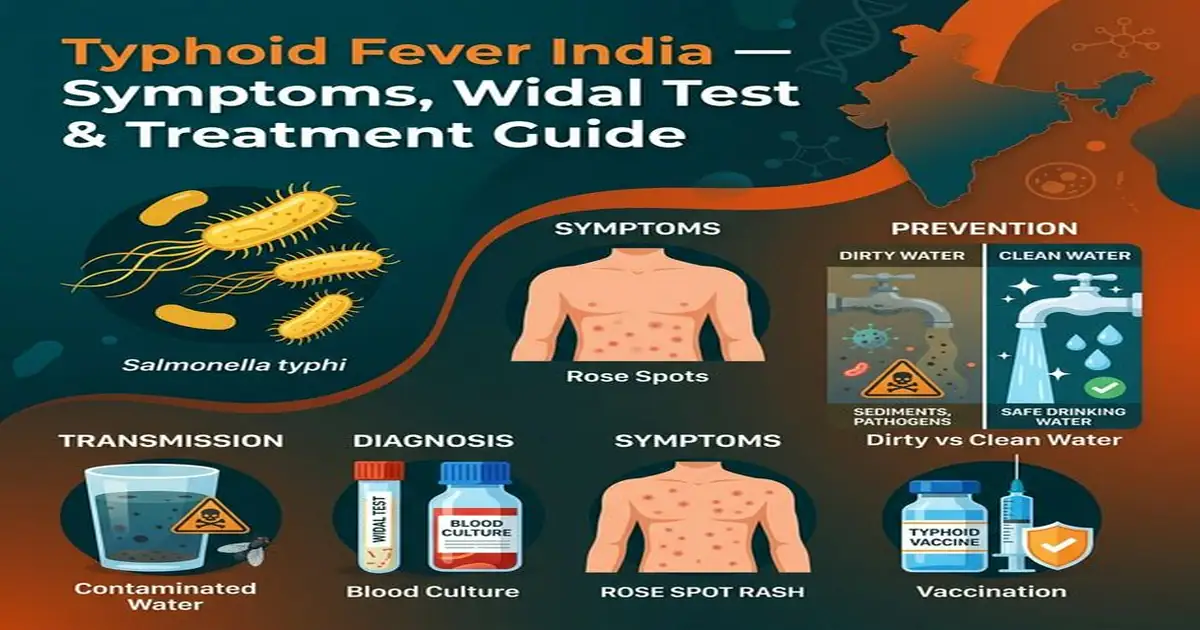
How Typhoid Spreads — Faecal-Oral Transmission Chain
S. typhi is a human-only pathogen — there is no animal reservoir. Transmission requires a chain from infected human faeces (or the chronic carrier state) → contaminated water or food → new host. Incubation period: 6–30 days (typically 1–3 weeks) depending on infecting dose. Key transmission routes in India: Contaminated drinking water — the most important route; groundwater contamination during floods, leakage of sewage into distribution pipes, and overhead water tank contamination; boiling water or using a working RO filter eliminates typhoid risk. Street food from unhygienic vendors — chaat, juice stalls, cut fruit, and ice creams prepared with contaminated water or ice; cooling water used to keep items “fresh.” Chronic carriers — 1–5% of typhoid survivors become chronic carriers — continuing to excrete S. typhi in their faeces or urine for >1 year (often for life) despite clinical recovery; the gallbladder is the reservoir (particularly in people with gallstones); carriers may work as food handlers — a significant public health issue. Unwashed hands — after defecation, before preparing food; food handler hygiene is critical.
Typhoid Symptoms — Week by Week
| Week | Clinical Features | Pathophysiology |
|---|---|---|
| Week 1 (Days 1–7) | Gradual onset fever, rising stepwise (38→39→40°C over days); severe frontal headache; malaise; dry cough; relative bradycardia (pulse slower than expected for temperature height — Faget’s sign); constipation (early, adults) or diarrhoea (children) | S. typhi ingested → invades Peyer’s patches of ileum → bacteraemia begins; bacteria multiply in reticuloendothelial system (liver, spleen, bone marrow) |
| Week 2 (Days 7–14) | Sustained high fever (plateau 39–40°C); severe toxaemia; abdominal distension; hepatosplenomegaly (enlarged liver + spleen); rose spots (salmon-coloured 2–4 mm maculopapular spots on trunk — seen in 20–30% of patients); diarrhoea (“pea soup” stools) in some | Secondary bacteraemia; bacteria invade gallbladder (chronic carrier establishment); intestinal inflammation of Peyer’s patches at maximum |
| Week 3 (Days 14–21) | Most dangerous phase; complications: intestinal perforation (sudden severe abdominal pain — surgical emergency); intestinal haemorrhage (per rectum bleeding); typhoid encephalopathy (confusion, seizures); hepatitis; pneumonia; myocarditis | Peyer’s patch necrosis → perforation risk; coagulation abnormalities; multi-organ involvement |
| Week 4 (Days 21–28) | Gradual defervescence (fever resolution); slow recovery; weakness, weight loss persist; relapse possible (5–10%) if antibiotic course inadequate or prematurely stopped | Resolution of bacteraemia with treatment; immune clearance |
Typhoid Diagnosis — Widal Test vs Blood Culture
| Test | What It Detects | Accuracy | India Context |
|---|---|---|---|
| Widal Test (tube agglutination) | Antibodies against S. typhi O and H antigens; positive titre: O ≥1:80 or H ≥1:160 in endemic areas (titres vary by endemic baseline) | Sensitivity 47–77%; specificity 50–92% — highly variable; notorious for false positives and negatives; NOT reliable in endemic India | Most commonly ordered test in India; most routinely misinterpreted; positive Widal alone is INSUFFICIENT for diagnosis; prior vaccination, prior typhoid, malaria, and other infections cause false positives; widely overused |
| Blood Culture (gold standard) | Grows S. typhi from blood; definitively diagnoses typhoid; identifies antibiotic sensitivity (crucial for resistance) | Sensitivity 40–80% (higher in first week, lower after antibiotics started); 100% specificity — no false positives | Requires laboratory culture facility; takes 3–7 days; available at district hospitals and above; STRONGLY recommended before starting antibiotics to identify resistance patterns; should be standard of care but often skipped for convenience |
| Bone marrow culture | Highest sensitivity (90–95%) — even after antibiotic exposure; from bone marrow aspirate | Most sensitive test available | Reserved for difficult-to-diagnose cases or treatment failures; not first-line |
| Typhidot / TUBEX (rapid IgM serology) | Anti-S. typhi IgM antibodies — detects earlier than Widal | Better than Widal; sensitivity 70–80%; specificity 75–85% — still not perfect; good point-of-care option at PHC level | More practical than blood culture at peripheral level; increasingly preferred over Widal in updated guidelines |
| NS1 typhoid rapid antigen | S. typhi Vi polysaccharide antigen in blood/urine | In development/limited data; research stage | Future diagnostic of interest |
Antibiotic Treatment — India’s Drug Resistance Challenge
| Drug | Status India | Notes |
|---|---|---|
| Ceftriaxone (IV) | Current first-line for severe typhoid; 7–14 days | Third-generation cephalosporin; excellent bioavailability; suitable for hospitalised patients; cost ₹100–300/day; covers MDR strains |
| Azithromycin (oral) | First-line for uncomplicated typhoid at community level; 5–7 days | Excellent oral bioavailability; intracellular penetration important for S. typhi in macrophages; effective for MDR typhoid; cost ₹5–20/tablet; widely available |
| Fluoroquinolones (ciprofloxacin, ofloxacin) | ⚠️ NOT recommended as empiric first-line — high resistance rates in India (70–80% rates in some regions) | Historically first-line; widespread quinolone resistance now renders these unreliable without sensitivity confirmation; still used where sensitivity confirmed |
| Chloramphenicol, Ampicillin, Co-trimoxazole | ⚠️ Multi-Drug Resistant (MDR) typhoid resistant to all three — widespread in India since the 1990s | No longer recommended empirically; historically important first-line drugs; MDR typhoid now endemic throughout India |
| Carbapenems (meropenem, imipenem) | Reserved for XDR typhoid (extensively drug-resistant — resistant to ceftriaxone + fluoroquinolones + azithromycin) | XDR typhoid first emerged in Pakistan (2016–); imported cases in India documented; major public health concern; requires ICU-level management |
Frequently Asked Questions
Is the Widal test reliable for diagnosing typhoid?
The Widal test is the most commonly performed and most commonly misinterpreted diagnostic test in Indian medicine. Every primary care clinic, district hospital, and diagnostic lab in India offers it — and the results are routinely over-interpreted to the detriment of patients. What the Widal test actually measures: The Widal test measures agglutinating antibodies against S. typhi O (somatic) and H (flagellar) antigens. These antibodies are present in typhoid — but also in: prior typhoid infection (antibodies persist for years); prior typhoid vaccination (especially the injectable Vi polysaccharide vaccine); cross-reaction with other Salmonella species; malaria; other febrile illnesses; some autoimmune conditions. In India — where typhoid is endemic and many people have been previously exposed or vaccinated — baseline antibody titres in healthy individuals are already elevated. A “positive” Widal titre of 1:80 or 1:160 in an Indian patient with fever may represent any of the above rather than active typhoid. The core problem: Antibodies detected by Widal appear 7–10 days after illness onset (a diagnostic is least useful when you need it most — early in disease). Multiple studies from India show Widal sensitivity of 47–75% and specificity of 50–90% in endemic settings — translating to many false positives AND false negatives. What should happen instead: Blood culture should be the first investigation for suspected typhoid — especially before starting antibiotics. Where blood culture is unavailable, Typhidot (rapid IgM) is a better point-of-care alternative than Widal. A positive Widal in isolation, without clinical correlation and in the absence of blood culture, should be interpreted with significant caution. Unfortunately, the entrenched use of Widal in India means billions of rupees are spent on this test annually, and millions of patients receive unnecessary antibiotics based on a misunderstood result.
What are the complications of typhoid in India?
Typhoid without appropriate treatment can progress to life-threatening complications — most commonly in Week 3 of illness, when Peyer’s patch necrosis reaches its maximum: Intestinal Perforation (most feared complication): Occurs in 1–3% of hospitalised typhoid patients. The necrotic Peyer’s patches (lymphoid tissue in the terminal ileum) slough off → hole in the bowel wall → intestinal contents leak into the peritoneal cavity → bacterial peritonitis + septicaemia. Clinical presentation: sudden severe abdominal pain (patient who was unwell but stable suddenly develops board-like rigid abdomen and acute distress); rebound tenderness; fever may paradoxically drop at this point (false improvement). This is a surgical emergency — laparotomy within hours; mortality 10–30% even with surgery. Intestinal Haemorrhage: Erosion of mesenteric blood vessels by necrotic Peyer’s patches → bleeding into the intestinal lumen → blood per rectum (fresh red blood or malaena — black tarry stool). Treatment: bed rest, IV fluids, blood transfusion if significant haemorrhage; endoscopic or surgical management for major bleeds. Typhoid Encephalopathy: Altered consciousness, delirium, seizures, coma — mechanisms include cerebral oedema, direct toxic effect, vasculitis, and electrolyte abnormalities. High mortality when severe. Hepatitis: Mild liver enzyme elevation common (present in 50%+); frank jaundice with hepatomegaly in 5%; rarely liver failure. Distinguish from viral hepatitis — typhoid hepatitis has mildly elevated transaminases with predominant alkaline phosphatase elevation pattern. Myocarditis: Cardiac involvement — ECG changes, arrhythmias, cardiac failure — in severe cases; relative bradycardia (Faget’s sign) is the classic typhoid cardiovascular finding. Osteomyelitis and focal infection: S. typhi bacteraemia can seed bone → osteomyelitis; particularly in patients with sickle cell disease (SCD) — an India-relevant comorbidity. Nephritis, orchitis, parotitis, and cholecystitis are rarer focal complications.
How can typhoid be prevented in India?
Typhoid prevention operates at three levels — individual behaviour, community sanitation, and vaccination: Individual level — food and water safety: Drink only boiled water (boil vigorously for 1 minute — all Salmonella killed at 70°C), or properly filtered water (RO + UV recommended; UV alone kills bacteria but does not remove chemical contaminants; RO leaves static water that can be recontaminated if stored incorrectly). Do not drink water from unknown sources, hand pumps in endemic areas, or unbottled water when travelling. Avoid raw salads, cut fruit, and street juices unless you can verify hygiene standards. Wash hands with soap before eating and after toilet use — the most impactful hygiene intervention at zero cost. If eating street food (a cultural reality in India), prefer hot freshly cooked items (cooking kills bacteria) over cold or room-temperature preparations. Community level — WASH (Water, Sanitation, Hygiene): Every household toilet significantly reduces typhoid transmission — Swachh Bharat Mission has dramatically increased sanitation coverage. Open defecation directly contaminates groundwater and soil — its elimination is the most impactful structural intervention for typhoid. Piped treated water supply (Jal Jeevan Mission) — chlorinated and tested — eliminates the contaminated water route. Vaccination — Typhoid Conjugate Vaccine (TCV): TCV (e.g., Typbar-TCV by Bharat Biotech) — a significant advance over older vaccines. Single dose; effective from 6 months of age; 80%+ efficacy; provides 10+ years protection (conjugated vaccine — carrier protein boosts immune memory); safe. Recommended for: children 6 months to 15 years in endemic areas (the primary WHO recommendation); travellers to endemic areas; people in outbreak settings; household contacts of carriers. India’s NTAGI (National Technical Advisory Group on Immunisation) has recommended TCV inclusion in UIP (Universal Immunisation Programme) — rollout pending health ministry decision. Currently available privately ₹800–1,500/dose. Older Vi polysaccharide vaccine (Typhim Vi): only from 2 years; weaker immune response; no memory response; 65–77% efficacy for 3 years — still used; being superseded by TCV. Oral typhoid vaccine (Vivotif): 4-dose oral live attenuated vaccine; used internationally but not commonly in India.
Why is antibiotic resistance in typhoid a crisis?
Typhoid’s antibiotic resistance evolution is a textbook case of the global antimicrobial resistance (AMR) crisis — with India at its epicentre: The resistance timeline: 1948: Chloramphenicol introduced — transformed typhoid from often-fatal disease to treatable infection. 1989–1990s: Multi-Drug Resistant (MDR) typhoid emerged in India — simultaneous resistance to chloramphenicol, ampicillin, and co-trimoxazole (the three historic first-line drugs); driven by plasmid-mediated resistance gene transfer. Fluoroquinolones (ciprofloxacin) became the new first-line. 2000s–present: Nalidixic acid-resistant S. typhi (NARST) — reduced fluoroquinolone susceptibility — emerged and spread throughout India; fluoroquinolone treatment failures became common; azithromycin and ceftriaxone moved to first-line. 2016–present: XDR (Extensively Drug-Resistant) typhoid emerged in Pakistan — resistant to all first-line oral antibiotics (chloramphenicol, ampicillin, trimethoprim, fluoroquinolones, AND third-generation cephalosporins); only carbapenems and azithromycin retain activity against most XDR strains. India has documented XDR typhoid from imported cases and increasingly from indigenous transmission. Why India drives this crisis: High antibiotic use without prescription (antibiotics available OTC at many Indian pharmacies despite regulations); self-medication culture; incomplete antibiotic courses (stopping once feeling better — allows partial suppression and selection pressure for resistant strains); livestock antibiotic use adds to environmental resistance pool; inadequate diagnostic testing (treat empirically without blood culture sensitivity data); poor WASH infrastructure creates constant transmission opportunities. Consequences: XDR typhoid patients cannot be treated with any affordable oral antibiotic — they require inpatient IV carbapenem therapy at significant cost; this creates catastrophic out-of-pocket health expenditure for already vulnerable families. The solution requires: Mandatory blood culture + sensitivity testing before antibiotic prescription; prescription-only antibiotic dispensing enforcement; TCV vaccination to reduce incidence and antibiotic selection pressure; WASH infrastructure investment; antibiotic stewardship programmes at hospital level.
How long does typhoid take to recover and when can you return to work?
Recovery from typhoid depends on severity, presence of complications, and antibiotic treatment: Uncomplicated typhoid with appropriate antibiotics: Fever typically takes 3–7 days to resolve after starting effective antibiotics (azithromycin or ceftriaxone for sensitive strains — longer for resistant strains). Clinical recovery: 2–4 weeks total illness duration; significant weakness, weight loss (3–5 kg typical in 3-week illness), and fatigue persist for 2–4 weeks after fever resolution. Return to normal activity: 4–6 weeks from illness onset; physical work and exercise should be delayed longer — splenic rupture (from enlarged spleen) risk with heavy exertion in the recovery period. Stool cultures and clearance monitoring: S. typhi may be excreted in stool for 3 months after clinical recovery; 1–5% excrete for longer than 1 year (chronic carrier state). Food handlers and healthcare workers should not return to work until THREE consecutive negative stool cultures (spaced 1 month apart) confirm clearance. This is mandatory under Food Safety and Standards Authority of India (FSSAI) regulations — though enforcement is limited. Chronic carrier treatment: Prolonged high-dose ciprofloxacin (4 weeks) or amoxicillin eliminates chronic carriage in 60–80% of patients without gallstones. Patients with gallstones (the primary reservoir) may require cholecystectomy (gallbladder removal) for definitive carrier elimination — an important clinical decision for food handlers. Relapse: 5–10% of typhoid patients relapse 1–3 weeks after apparent recovery — relapse is typically milder; treat with same antibiotic regimen. Relapse more common with chloramphenicol than with fluoroquinolones or cephalosporins. Adequate course completion (full 7–14 days depending on drug) markedly reduces relapse risk.
What to Read Next
- Dengue & Malaria — India’s Other Major Monsoon Febrile Illnesses
- Tuberculosis — India’s Largest Infectious Disease Burden — Also Antibiotic-Resistance Crisis
- Iron Deficiency Anaemia — Typhoid Fever Worsens Underlying Anaemia
- Liver Disease — Chronic Typhoid Carriers Have Gallbladder as Reservoir
- Vitamin B12 — Prolonged Typhoid Illness + Antibiotic Course Disrupts GI Absorption
Typhoid is fundamentally a disease of poverty, inadequate water infrastructure, and antibiotic misuse. Each clean water connection under Jal Jeevan Mission prevents dozens of typhoid cases. Each blood culture done before prescribing antibiotics guides treatment and slows resistance. Each TCV vaccine administered protects one child for a decade. The solutions are not complicated — they are equitable distribution of infrastructure and knowledge.
About This Guide: Written by the StudyHub Health Editorial Team (studyhub.net.in) based on WHO Typhoid Guidelines, IDSA Guidelines, and ICMR AMR Surveillance Programme data. Last updated: March 2026.
Authoritative Sources: WHO — Typhoid | ICMR India | Typhoid Coalition | CDC — Typhoid
⚕️ Medical Disclaimer: This article is for general informational and educational purposes. Typhoid requires medical evaluation and proper antibiotic treatment. Never self-medicate with leftover antibiotics. Blood culture before antibiotic is essential. Intestinal perforation — sudden severe abdominal pain in typhoid — is a surgical emergency, call 108 immediately.