
Last Updated: March 2026 | Reading Time: 9 minutes | ~2,000 words
India is a tropical country bathed in sunlight for most of the year — yet 70–90% of Indians are Vitamin D deficient or insufficient. This is one of the most jarring paradoxes in Indian public health. Vitamin D deficiency is not a minor inconvenience — it is now understood to be linked to immune dysfunction, bone disease, diabetes, depression, cardiovascular disease, autoimmune conditions, and increased cancer risk. Understanding why India has this problem — and what actually works to fix it — requires more nuance than “get more sun.” This guide gives you the full picture.
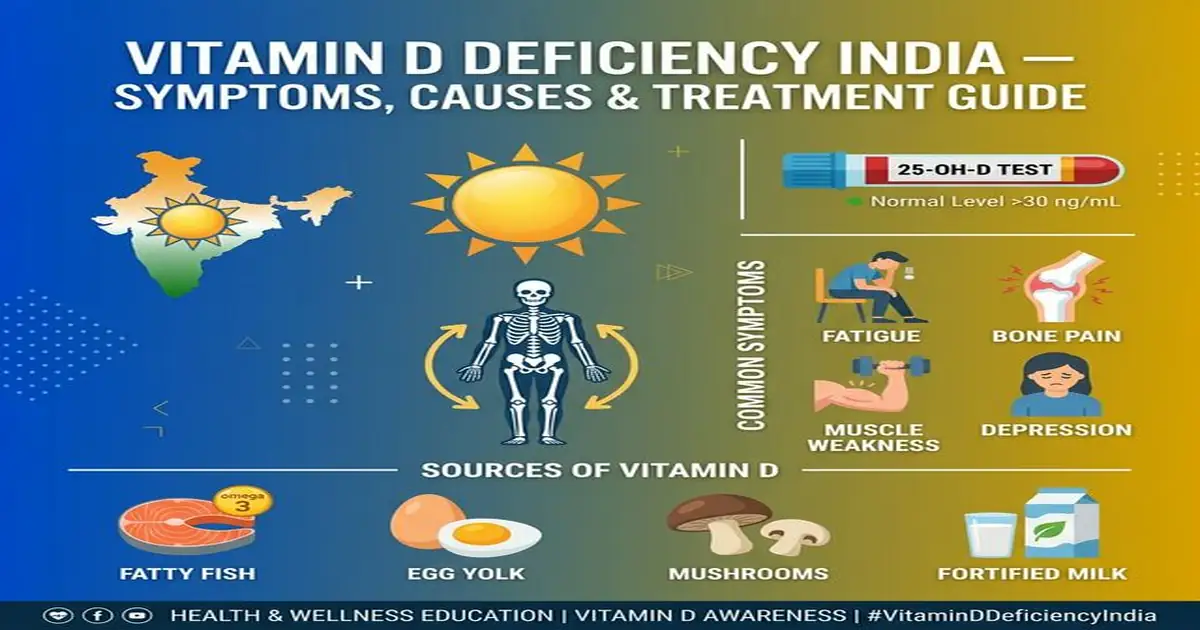
Vitamin D Levels — What the Numbers Mean
| 25-OH Vitamin D Level (ng/mL) | Status | Clinical Implications |
|---|---|---|
| < 10 ng/mL | Severe Deficiency | Risk of rickets (children), osteomalacia (adults), muscle weakness, immune failure |
| 10–19 ng/mL | Deficiency | Bone loss, fatigue, muscle aches, immune impairment, depression risk |
| 20–29 ng/mL | Insufficiency | Sub-optimal bone health and immune function; most Indians fall here |
| 30–60 ng/mL | Optimal / Sufficient | Adequate for all physiological functions; target range |
| 60–100 ng/mL | High-normal | Safe; some evidence for additional cancer-protective benefit |
| > 150 ng/mL | Toxicity (rare) | Hypercalcaemia — requires mega-dose supplementation to reach |
Why Are Indians So Vitamin D Deficient Despite Abundant Sunlight?
| Reason | Explanation |
|---|---|
| Dark skin (higher melanin) | Melanin acts as natural sunscreen — Indians need 3–5× more sun exposure than fair-skinned people to produce the same Vitamin D |
| Indoor lifestyle / fear of sunburn | Air-conditioned offices, avoiding midday sun, using umbrellas — all reduce UV-B exposure to near zero for most urban Indians |
| Sunscreen use | SPF 15 reduces Vitamin D synthesis by 99% — good for skin cancer prevention but eliminates D production |
| Clothing that covers skin | Only skin fully exposed to UV-B produces Vitamin D — covered arms and legs = minimal D synthesis |
| Air pollution | Particulate matter in Indian cities (especially Delhi, Mumbai) filters UV-B radiation significantly — city dwellers produce less D even when outdoors |
| Vegetarian diet | Most dietary Vitamin D comes from fatty fish, egg yolks, and liver — sources minimal in Indian vegetarian diets |
| Latitude is misleading | Sun angles during winter in North India mean effective UV-B is absent for 4–5 months despite sunny skies |
Symptoms of Vitamin D Deficiency — Complete List
| Symptom | Mechanism | Severity |
|---|---|---|
| Fatigue and low energy | Vitamin D receptors in mitochondria — deficiency impairs cellular energy production | Most common; present even at mild deficiency |
| Bone pain (especially back, hips, legs) | Without D, calcium cannot be properly incorporated into bone — bones become soft (osteomalacia in adults) | Moderate deficiency (<20) |
| Muscle weakness and cramps | Vitamin D regulates calcium in muscle cells; deficiency impairs muscle contraction | Moderate-to-severe |
| Frequent infections (colds, flu, respiratory) | Vitamin D activates immune cells (T-cells, macrophages) and produces antimicrobial peptides (cathelicidins) | Even at insufficiency levels |
| Depression and low mood | Vitamin D regulates serotonin synthesis; receptors in hippocampus and prefrontal cortex regulate mood | Linked to levels <20 ng/mL |
| Hair loss | Vitamin D receptors in hair follicles regulate growth cycles; deficiency causes telogen effluvium | Often missed as a Vitamin D symptom |
| Slow wound healing | Vitamin D essential for collagen synthesis and immune response in wound repair | Moderate-severe deficiency |
| Bone fractures (stress fractures) | Weakened bone density (low BMD); especially in weight-bearing bones | Severe / long-standing deficiency |
| Rickets (children) | Severe Vitamin D deficiency → failure of bone mineralisation → bow legs, soft skull, delayed teeth | Severe deficiency in children |
| Increased risk of autoimmune disease | Vitamin D is a key immune modulator — deficiency linked to higher rates of MS, Type 1 diabetes, rheumatoid arthritis, Hashimoto’s thyroiditis | Chronic insufficiency |
The Vitamin D Test — 25-OH Vitamin D
The correct test is 25-Hydroxyvitamin D (25-OH-D or 25(OH)D) — available at all major labs in India for ₹800–1,500. This measures the storage form of Vitamin D in the blood — the best indicator of overall Vitamin D status. Do NOT test 1,25-dihydroxyvitamin D (calcitriol) for deficiency screening — it is often normal or high even in severe deficiency because the kidneys upregulate conversion of the little D3 available. Always report total 25-OH-D, and interpret against the reference table above. Get tested in September–October (post-monsoon, before the ideal sun exposure window) to catch deficiency before winter worsens it.
How Much Sun Do Indians Actually Need?
| Skin Type (Indian Context) | Required Daily Sun Exposure for Adequate D | Best Time |
|---|---|---|
| Fair-skinned Indian (Type III) | 15–20 minutes, arms + legs exposed | 10 AM–2 PM (peak UV-B) |
| Medium-brown Indian (Type IV — most common) | 25–35 minutes, arms + legs exposed | 10 AM–2 PM |
| Dark-skinned Indian (Type V–VI) | 45–60 minutes, large body surface exposed | 10 AM–2 PM |
☀️ The 3 rules for effective sun-based Vitamin D: (1) Expose arms AND legs — not just face and hands; (2) Go out between 10 AM and 2 PM when UV-B is adequate; (3) No sunscreen during the D-production period. After 30 min, apply SPF when returning indoors. A shadow shorter than your height = adequate UV-B for D synthesis.
Vitamin D Supplementation — Correct Dosing Guide
| Deficiency Level | Loading Dose | Maintenance Dose | Retest After |
|---|---|---|---|
| Severe deficiency (<10 ng/mL) | 60,000 IU weekly × 8–12 weeks (sachet or capsule) | 2,000–4,000 IU daily or 60,000 IU monthly | 3 months |
| Deficiency (10–19 ng/mL) | 60,000 IU weekly × 8 weeks OR 60,000 IU daily × 10 days | 1,500–2,000 IU daily or 60,000 IU monthly | 3 months |
| Insufficiency (20–29 ng/mL) | 60,000 IU weekly × 4–6 weeks | 1,000–2,000 IU daily or 60,000 IU monthly | 3 months |
| Maintenance (30–60 ng/mL) | No loading dose needed | 1,000–2,000 IU daily (or 60,000 IU fortnightly) | 6–12 months |
- 💊 Common Indian brands: D-Rise 60K (Glenmark), Calcirol 60K sachets (Cadila), Uprise D3 (Eris), Tayo 60K (Franco-Indian). All are cholecalciferol (D3) — the preferred form.
- 🥛 Take with a high-fat meal: Vitamin D is fat-soluble — absorption increases 2–3× when taken with a meal containing fat (whole milk, curd, nuts, eggs). Never take on empty stomach.
- 🤝 Pair with Vitamin K2: K2 (MK-7 form, 100–200mcg/day) directs calcium absorbed via Vitamin D to bones and away from arteries — reduces calcification risk with supplementation. Brands: Revital K2+D3, Calshine K2D3.
- 💊 Check Calcium too: If supplementing Vitamin D aggressively, check serum calcium (within CBC or separately) — Vitamin D toxicity causes hypercalcaemia.
Best Food Sources of Vitamin D for Indians
| Food | Vitamin D Content (IU/serving) | Practical Use for Indians |
|---|---|---|
| Fatty fish — surmai, rohu, pomfret, sardines | 400–800 IU / 100g | 2–3 servings/week. Best dietary D source for non-vegetarians. |
| Egg yolk | 40–80 IU per yolk | 3–4 eggs/day; free-range eggs have 3–4× more D than battery farmed |
| Mushrooms (sun-dried/UV-exposed) | 200–2,000+ IU / 100g | Dry shiitake or button mushrooms in sunlight (gills up) for 2 hours → natural D2. A practical vegetarian source. |
| Fortified cow/buffalo milk | 40–100 IU / 250ml (fortified) | Check label — most Indian brands (Amul, Mother Dairy) now fortify. 3 glasses/day contributes ~300 IU: helpful but insufficient alone. |
| Fortified paneer | Varies — ~40–80 IU / 100g | Choose fortified varieties where available |
| Cod liver oil | 400–1,360 IU / teaspoon | Older remedy still effective; widely available but strong taste. 1 tsp covers daily D need. |
Frequently Asked Questions
Can Vitamin D deficiency cause hair loss?
Yes — Vitamin D deficiency is a well-established but frequently overlooked cause of hair loss, particularly the diffuse shedding pattern called telogen effluvium. Vitamin D receptors (VDR) are expressed in hair follicle stem cells in the bulge region — the part of the follicle responsible for hair regeneration. Research shows that VDR signalling is essential for initiating the anagen (growth) phase of the hair cycle; without adequate Vitamin D, hair follicles remain in the resting (telogen) or shedding phase longer. Multiple studies report significantly lower serum Vitamin D levels in women with telogen effluvium compared to controls, and several clinical trials show improved hair density after Vitamin D supplementation. The complicating factor in Indian women: hair loss is often caused by a combination of low iron (ferritin), low Vitamin D, and low B12 — all three need to be corrected simultaneously for full hair recovery. Never treat hair loss with biotin supplements without first testing Vitamin D, ferritin, and B12 — the evidence for biotin in non-deficient individuals is essentially zero, while the evidence for these three is strong.
How long does it take for Vitamin D to work?
The timeline depends on the symptom and the severity of deficiency. Blood levels of 25-OH-D respond within 2–4 weeks of adequate supplementation — rising by approximately 1 ng/mL per 100 IU of additional daily D3. So moving from 10 to 30 ng/mL requires ~2,000 IU daily for 10 weeks (or an 8-week loading course). For symptoms: Fatigue often improves within 4–6 weeks of adequate supplementation. Muscle weakness and pain typically improve within 4–8 weeks. Mood and depression improvement may take 8–12 weeks. Bone density improvement takes 6–12 months of sustained adequate levels — bone remodelling is a slow process. Immune improvements (fewer infections) become apparent over 3–6 months. Hair loss improvement takes 3–6 months of adequate Vitamin D before new growth becomes visible. The key failure mode in Indian patients: taking a course of 60,000 IU weekly for 8 weeks, feeling better, then stopping — and returning to deficiency within 3–4 months. Vitamin D requires *permanent* maintenance supplementation (or permanent adequate sun exposure) because the sources in Indian diet are minimal and sun exposure is inadequate for most urban Indians year-round.
Can you get enough Vitamin D from sunlight in India?
Theoretically yes, practically no — for most urban Indians. The theoretical calculation works: a medium-brown Indian with arms and legs exposed during peak UV-B hours (10 AM–2 PM) for 30–35 minutes can synthesise 10,000–20,000 IU of Vitamin D3 in a single session — far more than needed. The practical reality: this requires exposing large skin surface area (arms AND legs — not just face and hands), at the right time of day, without sunscreen, on a clear day (no heavy monsoon overcast), and consistently year-round. For Delhi and northern India, effective UV-B essentially ceases from November to February despite sunny skies — the sun angle is too low. For most IT workers, office professionals, and urban homemakers who move between air-conditioned environments, this level of sun exposure simply does not happen. The realistic conclusion for most Indians: supplement with 1,000–2,000 IU daily Vitamin D3, and use sun exposure opportunistically when it does happen — rather than relying on sun as the primary strategy and finding (on testing) that levels are still deficient.
Is Vitamin D deficiency linked to depression?
The link between Vitamin D and depression is one of the most studied areas in nutritional psychiatry — and the evidence has become increasingly compelling. Vitamin D receptors are densely expressed in brain regions involved in mood regulation: the hippocampus, prefrontal cortex, and cingulate cortex. Vitamin D plays roles in the synthesis of serotonin (via the enzyme TPH2), dopamine regulation, and neuroprotection against inflammatory damage. Epidemiologically, people with low Vitamin D have significantly higher rates of clinical depression — a 2020 meta-analysis of 65,000+ participants found Vitamin D deficiency associated with 31% higher odds of depression. Multiple randomised trials of Vitamin D supplementation in depressed patients with deficiency show significant improvement in depression scores. However, the effect size is modest compared to standard antidepressants — and Vitamin D correction alone does not cure clinical depression. The current evidence-based approach: check Vitamin D in all patients presenting with depression or anxiety (it is cheap and correctable); treat deficiency aggressively with supplementation as an adjunct to standard care; do not rely on it as monotherapy for moderate-to-severe depression. Seasonal Affective Disorder (SAD), which causes depressive episodes in winter, has particular association with low Vitamin D levels — and Vitamin D supplementation shows benefit in SAD specifically.
What is the best Vitamin D supplement in India?
The key considerations when choosing a Vitamin D supplement in India: (1) Form: D3 (cholecalciferol) is always preferred over D2 (ergocalciferol) — D3 raises and maintains blood levels approximately twice as effectively as D2 and lasts longer in the body. All the major Indian brands (D-Rise, Calcirol, Uprise, Tayo) contain D3. (2) Dosing form: 60,000 IU weekly sachets (cholecalciferol dissolved in medium-chain triglycerides or arachis oil) ensure loading and are convenient for compliance; daily 1,000–2,000 IU capsules are better for long-term maintenance once levels are restored. (3) Add Vitamin K2 (MK-7 form): As Vitamin D increases calcium absorption, K2 is needed to direct that calcium into bones (not arteries). Combination D3+K2 products (Calshine K2D3, Revital K2+D3) simplify this. (4) Fat-soluble absorption: All Vitamin D supplements should be taken with the largest meal of the day (lunch or dinner) which typically contains fat — this increases absorption by 2–3 fold. (5) Testing-based dosing: The ideal approach is to test first (25-OH-D), then dose based on actual deficiency severity — not to take a standard dose without knowing baseline. Retesting after 3 months of loading confirms whether levels have reached target.
What to Read Next
- Vitamin B12 Deficiency — Commonly Co-Exists with Low Vitamin D in India
- Iron Deficiency Anemia — Third of the “Triple Deficiency” Common in India
- PCOS — Vitamin D Deficiency is Universal in Indian PCOS Patients
- Thyroid Symptoms — Hashimoto’s Linked to Vitamin D Deficiency
- Fatty Liver — Vitamin D Deficiency Independently Worsens NAFLD
The sun is free — and India has plenty of it. But for most urban Indians, lifestyle has effectively blocked the benefit. A 25-OH-D blood test costs ₹900 and takes one day. If you are Indian and have not tested, assume you are deficient and act accordingly. The supplement is cheap, safe, and can meaningfully improve energy, immunity, mood, and bone health within months.
About This Guide: Written by the StudyHub Health Editorial Team (studyhub.net.in) based on ICMR Vitamin D task force guidelines 2024, Endocrine Society Vitamin D guidelines, and WHO nutrition recommendations. Last updated: March 2026.
Authoritative Sources: Endocrine Society — Vitamin D Guidelines | ICMR — Vitamin D Task Force India | Mayo Clinic — Vitamin D | WHO — Vitamin D
⚕️ Medical Disclaimer: This article is for general informational and educational purposes only. Vitamin D supplementation at high doses requires medical supervision and regular blood testing to avoid toxicity. Test your 25-OH-D level before starting high-dose supplementation. Always consult your doctor before significant supplementation changes.