
Buddhism is one of the major religions of the world that originated from the Indian sub-continent and has now spread to large parts of South-east Asia. The origin of Buddhism is attached to the story of Siddhartha who came to be known as Buddha. The traditions, beliefs, and practices in Buddhism are attributed to Buddha.
It is the world’s fourth-largest religion after Christianity, Islam, and Hinduism. Around 7 percent of the world’s population embraces Buddhism. Buddhists make up approximately 0.7 percent of India’s population, or roughly 8.4 million individuals, with the majority being in Maharashtra.
Basics about Buddha
Gautam Buddha was born at Lumbini (in present-day Nepal) in 563 BC as Siddhartha Gautam, to mother Queen Maya and father King Suddhodana of the Sakyan kingdom under the Kshatriya Clan. He was born on the auspicious day of Vaishakhi Purnima. He was married to Princess Yashodhara and had a son named Rahul.
At the age of 29, he left his house riding on his horse Kanthaka and along with the charioteer Channa, to find the truth of life. He wandered as an ascetic for the next six years of his life. Then, he went to Gaya (Bihar) and sat under a pipal tree. There he thought about everything, freed himself from all attachments, and discovered the truth—the secret of happiness. At the age of 35, on the same day of his birth, he attained enlightenment (Nirvana) under that pipal tree and became Buddha, the Enlightened One.
After attaining Nirvana in Bodh Gaya, he gave his first sermon to his five companions at the Deer Park in Sarnath near Varanasi. This event was called Dharma-chakra-pravartana (Turning the Wheel of Law).
First Five Disciples of Buddha (at Sarnath)
- Kaudinya
- Bhadrika
- Vashpa
- Mahanaman
- Ashvajit
The Three Jewels (Triratna)
The three Jewels embraced under Buddhism are:
- Buddha: The Enlightened One
- Dhamma: Teachings of Buddha (doctrine)
- Sangha: The Monastic Order
Out of the three jewels or triratnas, the concept of Sangha (the Order) was initiated by Buddha at the time of giving the first sermon at Sarnath. These five companions along with Buddha became a Sangha (a group).
Buddha attained Mahaparinirvana at Kushinagar (Malla Mahajanapada) in Uttar Pradesh at the age of 80 in probably 483 BC. He is said to be contemporary for the major part of his life to King Bimbisara and for the last few years to Ajatashatru of the Haryanka Dynasty.
Buddha is known in various Buddhist texts also as Tathagata and Sakyamuni. The predecessor of Buddha under Buddhism was Kassapa Buddha and his successor will be Maitreya (Future Buddha).
Early Buddhist Schools
After the passing of Buddha, the original Sangha is believed to have split into two early schools between 383 and 250 BC:
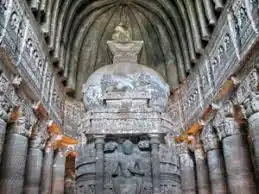
Sthavira Nikaya: Sub-sects included Mahisasaka, Sarvastivada, Sankrantika, Sautrantika, Dharmaguptaka, Vatsiputriya, Dharmottariya, Bhadrayaniya, Sannagarika, and Sammitiya.
Mahasamghika: Sub-sects included Gokulika, Prajnaptivada, Bahusrutiya, Ekavyaharikas, and Caitika.
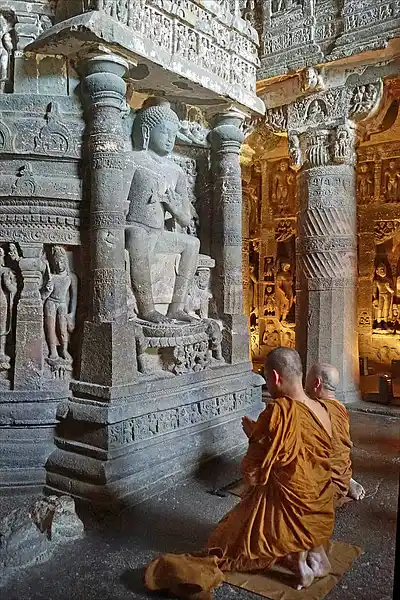
Other sub-sects not identified under the above two schools were Hemavatika, Rajagiriya, Siddhatthaka, Pubbaseliya, Aparaseliya, and Apararajagirika. Later Buddhist schools included Theravada, Mahayana, Vajrayana, etc.
Concepts and Philosophy under Buddhism
The basic tenets of Buddhism are explained through the Four Noble Truths:
- The truth of suffering (Dukkha)
- The truth of the origin of suffering (Samudaya)
- The truth of the cessation of suffering (Nirodha)
- The truth of the path to the cessation of suffering (Marga)
Life is full of suffering (dukkha). All aspects of life contain the seeds of sorrow. Sorrow is caused by desires. This keeps a person caught in samsara, the endless cycle of repeated rebirth, dukkha, and dying again. If one gets rid of desires and needs, then one can be free and at peace. This can be attained through following the ‘Noble Eightfold Path’.
The Noble Eightfold Path
- Kind, truthful, and Right speech
- Honest, peaceful, and Right action
- To find the right livelihood which does not harm any being
- Right effort and cultivating self-control
- Right mindfulness
- Right meditation and concentrating on the meaning of life
- The worth of the sincere and intelligent man is through right thoughts
- Avoid superstition and cultivate right understanding
According to Buddha, the Middle Path (Madhyam Marg) or Middle Way describes the character of the Noble Eightfold Path that leads to liberation. Buddhism rejects the authenticity of Vedas. It also rejects the concept of the existence of Soul (atman) unlike Jainism.
Once Buddha attained Mahaparinirvana at Kushinagar in 483 BC, there was a need to compile his teachings. Hence, four Buddhist Councils were held in a span of the next 500 years to collate this material into Pitakas. The result was the writing of three major pitakas—Vinaya, Sutta, and Abhidhamma—that when combined were called Tripitaka. All of these have been written in Pali Language.
Four Buddhist Councils
| Council | Place and Year | Patronage and Chairman | Details |
|---|---|---|---|
| First Council | At Rajgir (around 483 BC). Held at Saptaparni cave immediately after Buddha’s death. | Patron: King AjatashatruChairman: Mahakasyapa | Upali recited Vinaya Pitaka (rules of order). Anand recited Sutta Pitaka (collection of sermons/doctrines). |
| Second Council | At Vaishali (383 BC). Approx. 100 years after Buddha’s death. | Patron: King KalasokaChairman: Sabakami | Held mainly due to the 10 disputed points under the Vinaya Pitaka. |
| Third Council | At Patliputra (250 BC). | Patron: King AshokaChairman: Moggaliputta-Tissa | Compilation of Abhidhamma Pitaka took place. |
| Fourth Council | At Kundalvana, Kashmir (72 AD). | Patron: King KanishkaChairman: Vasumitra | Resulted in the division into Hinayana and Mahayana. Asvaghosha participated; deliberations were in Sanskrit. |
Note: One more fourth Buddhist Council was held in Sri Lanka.
It is recorded that in the fourth council in King Kanishka’s reign, there was a split in Buddhism and two sects were born: Hinayana and Mahayana Buddhism. In later periods, the Hinayana school declined and two more new schools were born. Thus, the four major schools developed are:
- Hinayana Buddhism
- Mahayana Buddhism
- Theravada Buddhism
- Vajrayana Buddhism
Practices and Major Schools
Practices of Buddhism include taking refuge in the Buddha, the Dhamma, and the Sangha, study of scriptures, observance of moral precepts, renunciation of craving and attachment, the practice of meditation, the cultivation of wisdom, loving-kindness, and compassion.
1. Hinayana Buddhism
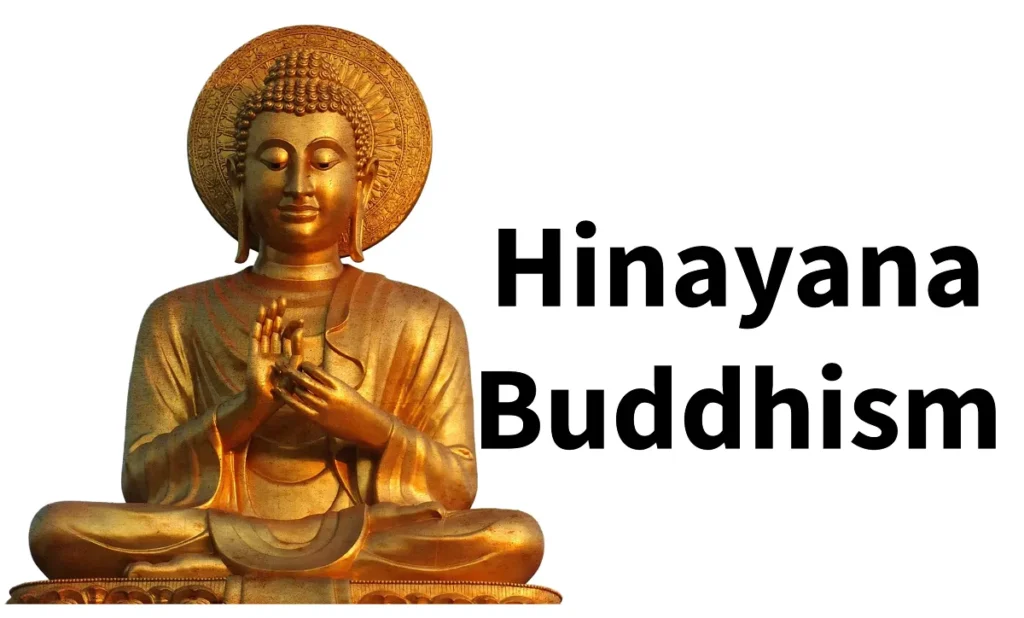
It means the lesser vehicle.
The school includes the followers of the original preaching of the Buddha. It is more of an orthodox school.
They did not believe in idol or image worship of Buddha.
They believe in individual salvation and try to attain individual salvation through self-discipline and meditation. The ultimate aim is Nirvana.
One of the sub-sects of Hinayana is Sthaviravada or Theravada.
The Hinayana scholars used Pali Language to interact with the masses.
Emperor Ashoka patronised the Hinayana sect as the Mahayana school came into being much later.
Hinayana school in its original form is almost non-existent in the present age.
2. Mahayana Buddhism
It means the greater vehicle.
The school is more liberal and believes in the heavenliness of Buddha and Bodhisattvas embodying Buddha Nature. The ultimate goal is “spiritual upliftment”.
Mahayana followers believe in idol or image worship of Buddha.
The concept of Bodhisattva is the result of Mahayana Buddhism. It is also called “Bodhisattvayana”, or the “Bodhisattva Vehicle”.
Followers believe in the Bodhisattva concept of the salvation of all conscious individuals (universal liberation).
A bodhisattva seeks complete enlightenment for the benefit of all beings. A bodhisattva who has accomplished this goal is called a Samyaksainbuddha.
Prominent texts include Lotus Sutra, Mahavamsa, etc.
The Six Perfections (Paramitas): According to the Lotus Sutra, these are:
Dana (generosity)
Sila (virtue, morality, discipline)
Ksanti (patience, tolerance)
Virya (energy, diligence)
Dhyana (one-pointed concentration)
Prajna (wisdom and insight)
The Mahayana scholars predominantly used Sanskrit.
Emperor Kanishka of the Kushana dynasty is said to be the founder of the Mahayana sect in the 1st century AD.
Presently, the majority of Buddhist followers belong to the Mahayana sect (approx. 53.2% as per 2010 data).
Countries following it include Nepal, Bangladesh, Japan, Vietnam, Indonesia, Malaysia, Singapore, Mongolia, China, Bhutan, Tibet, etc.
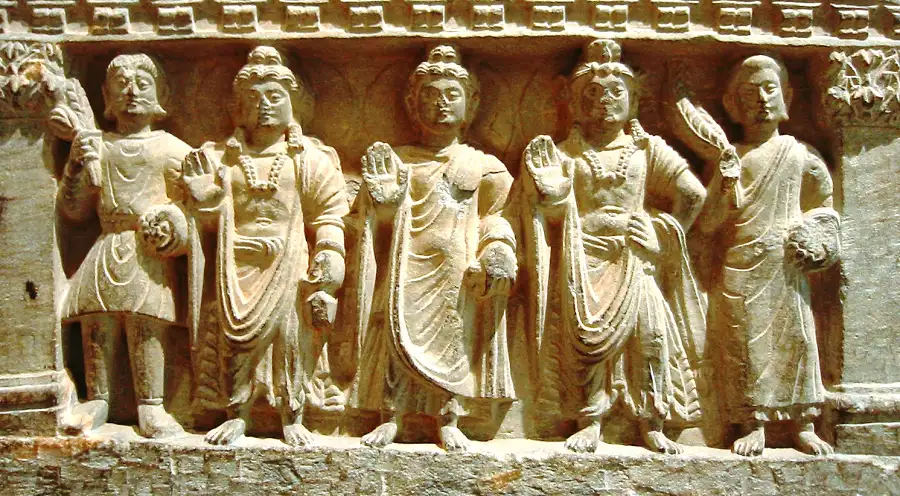
Madhyamaka School
It is a school under Mahayana Buddhism. The school is based on Sunyata Doctrine and was founded by the prominent philosopher Nagarjuna in the 2nd-3rd century AD. The central idea of Sunyata Doctrine lies in the fact that all things or phenomena (dharmas) are empty (sunya) of nature, substance, or essence (svabhava). Chandrakirti was a great scholar of this school.
Bodhisattva in Buddhism
A Bodhisattva is one who has generated Bodhicitta (a spontaneous wish and a compassionate mind) to attain Buddhahood for the benefit of all sentient beings.
On the path to becoming a Buddha, a bodhisattva proceeds through 10 grounds or bhumis: Great Joy, Stainless, Luminous, Radiant, Very difficult to train, Obviously transcendent, Gone afar, Immovable, Good discriminating wisdom, and Cloud of Dharma.
Prominent Bodhisattvas:
- Avalokitesvara: Known as Padmapani (holding a Lotus). The listener of the world’s cries who uses skillful means to aid. Depicted in Ajanta Caves. Incarnates as the Dalai Lama.
- Vajrapani: Protective deity depicted in Ajanta. Manifests all the powers of Buddha.
- Manjusri: Associated with the Wisdom of Buddha. Depicted with a wielding sword.
- Samantabhadra: Associated with practice and meditation. Forms the Shakyamuni trinity with Buddha and Manjusri.
- Ksitigarbha: Vowed not to achieve Buddhahood till hell is completely emptied.
- Maitreya: The Future Buddha who will appear on Earth. Laughing Buddha is said to be an incarnation of Maitreya.
- Akasagarbha: Associated with the element of space.
- Tara: Associated with Vajrayana; represents virtues of success.
- Vasudhara: Associated with wealth and prosperity (popular in Nepal).
- Skanda: Guardian of viharas.
- Sitatapatra: Protector against supernatural danger.
Dipankar Buddha
Dipankara was one of the Buddhas of the past who reached enlightenment prior to Gautam Buddha. He is respected under all three sub-sects: Mahayana, Vajrayana, and Theravada.
3. Theravada Buddhism
- It refers to the school of elder monks.
- Uses Buddha’s teaching preserved in the Pali Canon as its doctrinal core.
- Ultimate Goal: Cessation of kleshas (states like anxiety, fear, anger) and attainment of Nirvana by practicing the Noble Eightfold Path.
- Samatha (calming the mind) and Vipassana (insight into impermanence, suffering, and non-self) are integral parts.
- Believes in vibhajjavada (“teaching of analysis”).
- Visuddhimagga (The Path of Purification), written by Buddhaghosa (5th century AD), is a great treatise of this school. It discusses seven stages of purification (satta-visuddhi).
- Pali is the sacred language.
- It is contemplated to be a successor of the Hinayana school.
- Around 35.8 percent of Buddhists belong to this school.
- Countries: Sri Lanka, Cambodia, Laos, Thailand, Myanmar, etc.
4. Vajrayana Buddhism (Tantric Buddhism)
- Scholars contemplate it developed as a result of royal courts sponsoring both Buddhism and Shaivism (influenced by Hinduism).
- The main deity is Tara.
- Combines Brahmanical rituals with Buddhist philosophies.
- Based on Mahayana philosophy but believes in Tantras, Mantras, and Yantras as a faster vehicle to liberation.
- Mantras are seen as an easy path to Buddhahood compared to the rigorous six perfections of Mahayana.
- Followed by approx. 5.7 percent of the Buddhist population.
- Countries: Tibet, Bhutan, Mongolia, Kalmykia, etc.
Historical Context and Figures
Places Visited by Buddha
The kingdoms he visited were Kosala and Magadha. Places included: Kapilavastu, Rajgriha, Vaishali, Gaya, Bodh Gaya, Sarnath, Kosambi, Shravasti (capital of Kosala), Kushinagar, Nalanda, Mathura, Varanasi, Saket, Champapuri, etc.
Prominent Disciples (Ancient Period)
- Sariputta (Chief Disciple)
- Mahamoggallana (Chief Disciple)
- Ananda (Listened to teachings the most)
- Mahakasyapa
- Purna Maitrayani-putra
- Anuruddha
- Rahul
- Katyayana
- Upali
- Ananthapindaka
- Subhuti
- Jivaka
16 Arhats of Buddha
An Arhat under Theravada is one who has achieved Nirvana. Under Mahayana, an Arhat is advanced but has not yet attained it, or has attained peace for himself but is not willing to give it up for others (unlike a Bodhisattva). In total, 16 legendary Arhats prevail. Nagasena and Rahul (Buddha’s son) are considered to be among the 16 Arhats.
Other Prominent Personalities
- Nagasena: Answered questions by King Menander I (Milinda) recorded in Milinda Panho (150 BC).
- Nagarjuna: Founder of Madhyamaka School (150-250 AD).
- Vasubandhu: Proponent of Mahayana (4th-5th century AD).
- Bodhidharma: Transmitted Buddhism to China (5th-6th century AD).
- Buddhaghosa: Famous for Visuddhimagga (5th century).
- Padmasambhava: The ‘Second Buddha’ across Tibet/Himalayas (8th century).
- Atisa: Key figure in the spread of Mahayana/Vajrayana in Asia (11th century).
- Dalai Lama: Modern spiritual leaders of the Yellow Hat School of Tibetan Buddhism.
Navayana Buddhism
Navayana School is considered to be a new branch of Buddhism propounded by Dr. B.R. Ambedkar. It is different from the traditionally recognised branches of Theravada, Mahayana, and Vajrayana and rejects them. It discards practices such as renouncing monkhood, monastism, karma, rebirth, samsara, meditation, enlightenment, and the Four Noble Truths considered foundational in traditional Buddhism. It radically re-interprets Buddhism by revising the original teachings of Buddha to be about class struggle and social equality.