
A flourishing civilisation emerged on the banks of the river Indus in the second half of the third millennium BCE and spread across large parts of North-Western and Western India. This is what is known as Harappan Civilisation or Indus Valley Civilisation (IVC). A marked feature of this ancient civilisation was the vivid imagination and artistic sensibilities exuded by the numerous sculptures, seals, potteries, jewelleries, etc. found at the excavation sites. Harappa and Mohenjo-daro – the two major sites of this civilisation – are among the earliest and finest examples of urban civic planning. The planned network of roads, houses and drainage systems indicate the planning and engineering skills that developed during those times.
important sites of the Indus Valley Civilisation and their archaeological findings are:
- Harappa in present Pakistan on the bank of River Ravi – 2 rows of six granaries with big platform, stone symbol of lingam and yoni, mother goddess sculpture, wheat and barley in wooden mortar, dice, copper scale and mirror. Moreover, sculpture of dog chasing a deer in bronze metal, and a red sand stone male torso have been excavated.
- Mohenjo-daro in present Pakistan on the River Indus – the citadel, the great bath, the great granary, post cremation burial, sculpture of bearded priest, the famous bronze statue of the Dancing Girl and Pashupati Seal.
- Dholavira in Gujarat – giant water reservoir, unique water harnessing system, stadium, dams and embankments, inscription comprising 10 large sized signs like an advertisement board. It is the latest IVC city to be discovered.
- Lothal (Manchester of Indus Valley Civilisation) in Gujarat – important site for naval trade, had a dockyard, rice husk, fire altars, painted jar, modern day chess, terracotta figures of horse and ship, instruments for measuring 45, 90 and 180 degree angles, practice of burial of cremated remains.
- Rakhigarhi in Haryana is considered to be the largest site of Indus Valley Civilisation. Granary, cemetery, drains, terracotta bricks have been found here. It is called the provincial capital of Harappan Civilisation.
- Ropar is located on the banks of River Sutlej in Punjab, India – Dog buried with human in oval pit burials, copper axe. Roper in the first Harappan site of independent India. First site to be excavated after independence.
- Balathal and Kalibangan in Rajasthan – bangle factory, toy carts, bones of camel, decorated bricks, citadel and lower town, fire altar.
- Surkotada in Gujarat – first actual remains of the horse bones.
- Banawali in Haryana on the dried-up Saraswati river – toy plough, barley grains, lapis lazuli, fire altars, oval shaped settlement, only city with radial streets and oval shaped settlements.
- Alamgirpur in Meerut, Uttar Pradesh on the banks of Yamuna – Eastern most site of IVC. Major findings are broken blade made of copper, ceramic items and Impression of a cloth on a trough.
- Mehrgarh in Pakistan, considered precursor to Indus Valley Civilisation. Pottery, copper tools have been found.
- Chanhudaro (Lancashire of India) located in present day Pakistan – only Indus city without a citadel. Bead making factory and use of lipsticks has been found.
- Kot Diji located in present day Pakistan. Tar, statues of Bull and mother goddess have been excavated from here.
- Suktagandor western most site of IVC, located in Pakistan. Bangles of clay have been found here.
- Balu (Haryana) various plant remains have been found. (earliest evidence of Garlic).
- Daimabad (Maharashtra) southern most site of IVC. Bronze sculptures including a Bronze Chariot has been discovered here.
- Kerala-no-dhoro (Gujarat) salt production centre during IVC.
- Kot Bala (Pakistan) earliest evidence of furnace.
- Mand (Jammu and Kashmir) Northern most site of IVC.
- Other prominent sites of IVC include Mehrgar (Pakistan), Desalpur (Gujarat), Pabumath (Gujarat), Rangpur (Gujarat), Shikarpur (Gujarat), Sanauli (UP), Kunal (Haryana),Karanpura (Rajasthan), Ganeriwala (Punjab), etc.
Architecture in Harappan Civilization
The remains of Harappa and Mohenjo-daro reveal a remarkable sense of town planning. The towns were laid out in a rectangular grid pattern. The roads ran in north-south and east-west direction and cut each other at right angles.
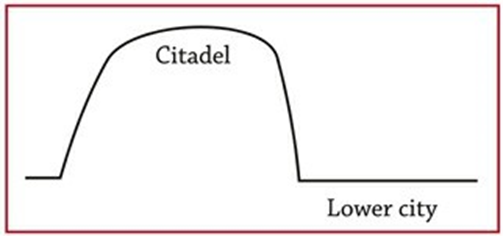
Mainly three types of buildings have been found in the excavation sites – dwelling houses, public buildings and public baths. The Harappans used burnt mud bricks of standardised dimensions for the purpose of construction. Many layers of well-baked brick were laid out and then joined together using gypsum mortar.
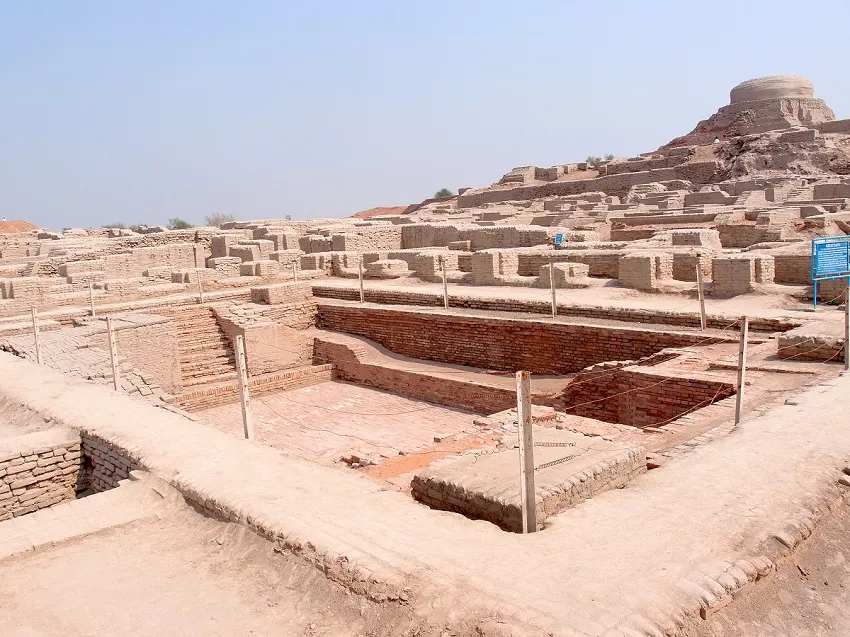
The city was divided into two parts–An upraised citadel and the lower-part of the city. An upraised citadel in the western part was used for constructing buildings of large dimensions, such as granaries, administrative buildings, pillared halls and courtyard. Some of the buildings in the citadel might have been the residence of the rulers and aristocrats. However, Indus Valley Civilisation sites do not have large monumental structures such as temples or palaces for rulers unlike Egyptian and Mesopotamian Civilisation. The granaries were intelligently designed with strategic air ducts and raised platforms which helped in storage of grains and protecting them from pests.
An important feature of the Harappan cities is the prevalence of public baths, which indicate the importance of ritualistic cleansing in their culture.
These baths also had an array of galleries and rooms surrounding it. The most famous example of a public bath is the ‘Great Bath’ in the excavated remains of Mohenjodaro.
In the lower part of the city, small one- roomed houses have been found which might have been used as quarters by the working class people. Some of the houses have stairs which indicate they might have been double storied. Mostly buildings have private wells and properly ventilated bathrooms.
The most striking feature of Harappan Civilisation is the advanced drainage system. Small drains ran from each house and were connected to larger drains running alongside the main roads. The drains were covered loosely to allow regular cleaning and maintenance. Cesspits were placed at regular intervals. The importance placed on hygiene – both personal and public, is quite impressive. Presence of wells has also been observed at many sites.
Sculptures of Harappan Civilisation
The Harappan sculptors were extremely adept at handling three-dimensional volumes. The most commonly found were seals, bronze figures and potteries.
Seals:
Archaeologists have found numerous seals of different shapes and sizes all across the excavation sites. While most of the seals are square, it was found that triangular, rectangular and circular seals were also being used. Steatite, a soft stone found in the river beds, was although the most common material used to make seals, yet agate, chert, copper, faience and terracotta seals have also been found. Some instances of gold and ivory seals have also been found.
Most of the seals have inscriptions in a pictographic script which is yet to be deciphered. The script was written mostly from right to left, but, bi- directional writing style i.e. right to left on one line and left to right on another line has also been found. Animal impressions were also there (generally five) which were carved intaglio on the surfaces. The common animal motifs were unicorn, humped bull, rhinoceros, tiger, elephant, buffalo, bison, goat, markour, ibex, crocodile, etc. However, no evidence of cow has been found on any seal. Generally, the seals had an animal or human figure on one side and an inscription on the opposite side or inscriptions on both the sides. Some seals had inscriptions on a third side as well.
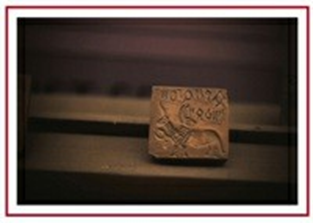
Seals were primarily used for commercial purposes and helped in communication. Discovery of various seals in Mesopotamia and various sites such as Lothal indicate that seals were extensively used for trade. Some seals with a hole on them have been found on dead bodies indicating its use as amulets, carried on the persons of their owners, probably seen as some form of identification. Mathematical images have also been found on some seals, which might have been used for educational purposes as well. Seals with symbol similar to ‘Swastika’ design have also been found.
Pashupati Seal:
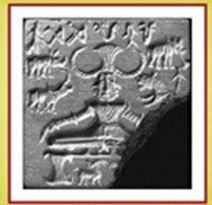
A steatite seal discovered at Mohenjo-daro depicts a human figure or a deity seating cross-legged. The figure, referred to as Pashupati wears a three-horned headgear and is surrounded by animals. An elephant and a tiger are there on the left side of the figure while a rhinoceros and a buffalo are seen on the right side.
Bronze Figures:
The Harappan Civilisation saw a wide scale practise of bronze casting. The bronze statues were made using “lost wax technique” or “Cire Perdue”. In this technique, wax figures are first coated with wet clay and allowed to dry. The clay coated figures are then heated, allowing the wax inside to melt. The wax is then poured out through a tiny hole and liquid metal is poured inside the hollow mould. After the metal has cooled down and solidified, the clay coat is removed and a metal figure of the same shape as the wax figure is obtained. Even now, the same technique is practiced in many parts of the country.
Examples: Bronze Dancing Girl of Mohenjo-daro, bronze bull of Kalibangan, etc.

Dancing Girl
The Dancing Girl is the world’s oldest bronze sculpture. Found in Mohenjo-daro, this four inch figure depicts a naked girl wearing only ornaments, which include bangles in the left arm, and amulet and bracelet on the right arm. She stands in a ‘tribhanga’ dancing posture with the right hand on her hip.
Terracotta
Terracotta refers to the use of fire baked clay for making sculptures. Compared to the bronze figures, the terracotta sculptures found are less in number and crude in shape and form. They were made using pinching method and have been found mostly in the sites of Gujarat and Kalibangan. Examples: Mother Goddess, mask of horned deity, toys, etc
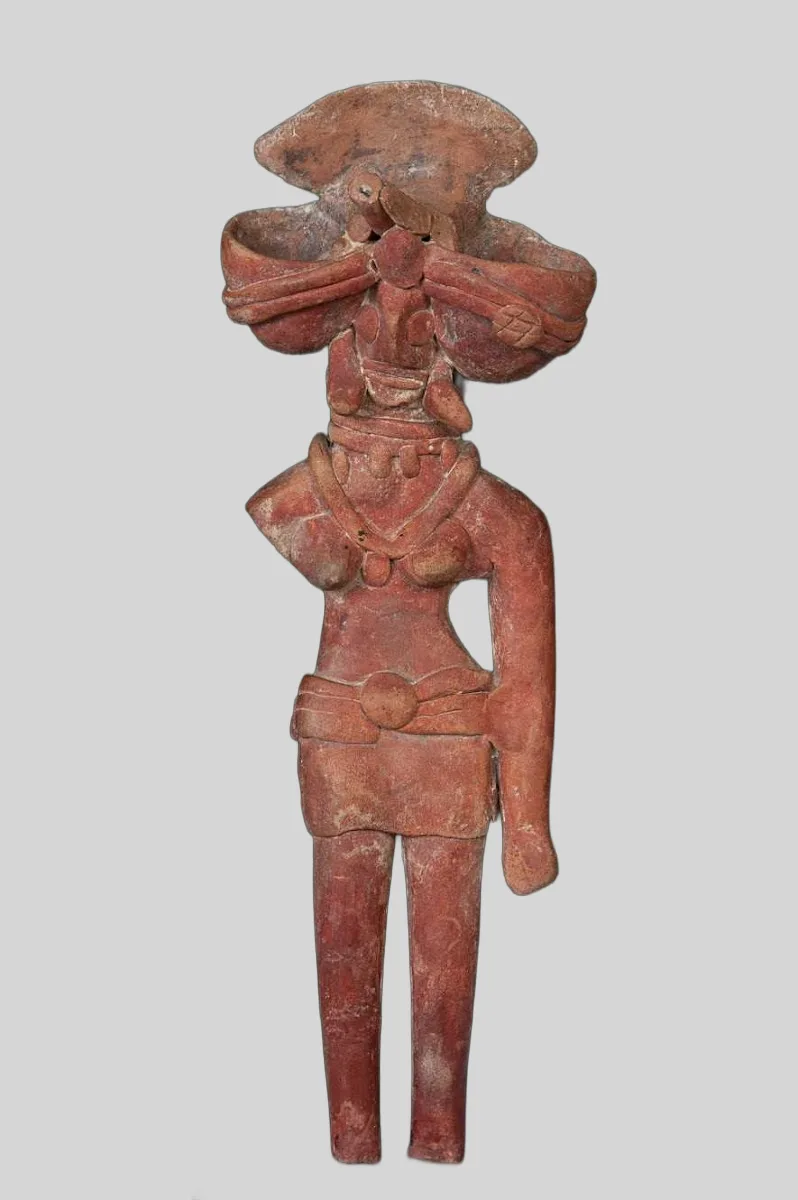
Mother Goddess
The Mother Goddess figures have been found in many Indus sites, which highlights its importance. It is a crude figure of a standing female adorned with necklaces hanging over prominent breasts. She wears a loincloth and a girdle. She also wears a fan-shaped headgear. The facial features are also shown very crudely and lacks finesse. She was probably worshipped for prosperity. She might also have been a goddess of fertility cults.
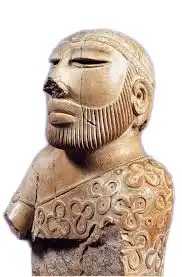
Bearded Priest
Bearded Priest (found in Mohenjo-daro and made of Steatite). It is the figure of a bearded man, draped in a shawl with trefoil patterns. The eyes are elongated, and half closed as in meditation.
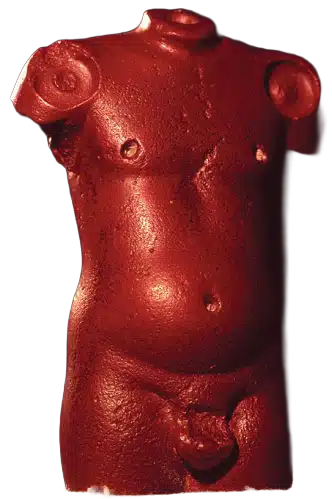
Red sandstone figure of a male torso
Red sandstone figure of a male torso (found in Harrapa and made of Red sandstone). The torso has a frontal posture with well baked shoulders and a prominent abdomen. There are socket holes in the neck and shoulders, probably for the attachment of head and arms.
Pottery:
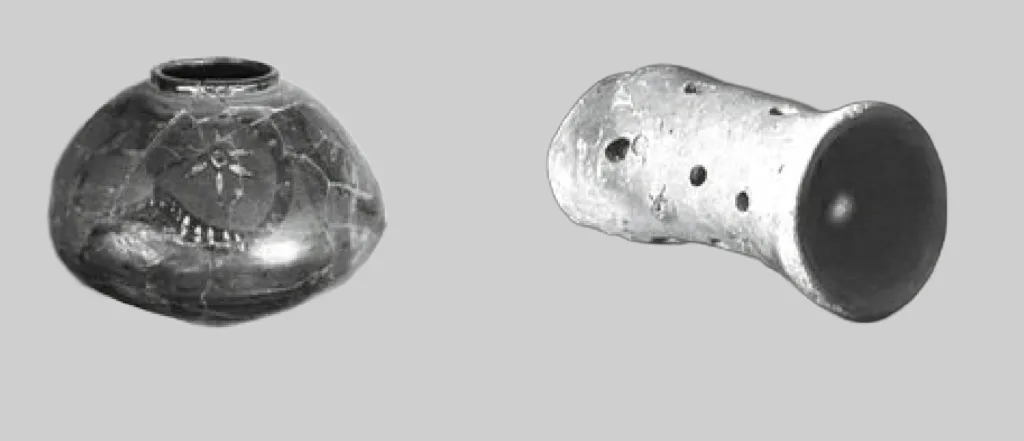
The potteries found at the excavation sites can be broadly classified into two kinds – plain pottery and painted pottery. The painted pottery is also known as Red and Black Pottery as it used red colour to paint the background and glossy black paint was used to draw designs and figures on the red background. Trees, birds, animal figures and geometrical patterns were the recurring themes of the paintings.
Most of the potteries that have been found are very fine wheel-made wares, with a very few being handmade. Some examples of polychrome pottery have also been found, though very rare. The potteries were used for three
main purposes:
- Plain pottery was used for household purposes, mainly storage of grains and water.
- Miniature vessels, generally less than half an inch in size, were used for
decorative purposes. - Some of the potteries were perforated – with a large hole in the bottom and small holes across the sides. They might have been used for straining liquor.
Ornaments:
The Harappans used a large variety of materials, from precious metals and gemstones to bones and even baked clay, to make ornaments. Both men and women wore ornaments like necklaces, fillets, armlets and finger rings.
Girdles, earrings and anklets were worn only by women.
Beads made from carnelian, amethyst, quartz, steatite, etc. were quite popular and were produced on a large scale, as is evident from the factories discovered in Chanhudaro and Lothal. For fabric, the Harappans used cotton and wool, which were spun by rich and poor alike. The people of the time were conscious of fashion as well, as can be inferred from the different styles of hair and beard.