Chapter 1 Introduction to Planet “Earth”

Essential of Oceanography

Table of Contents

Overview

The world ocean is the most prominent feature on Earth.
Oceans cover 70.8% of Earth’s surface.
The origin and development of life on Earth are connected to the ocean.
The oceans have a long history on Earth.

Earth’s Oceans

Earth has one ocean.

It is divided into four principle oceans and one other.

  • Pacific Ocean
  • Atlantic Ocean
  • Indian Ocean
  • Arctic Ocean
  • Southern, or Antarctic, Ocean

Ocean Size and Depth

Pacific Ocean

  • World’s largest ocean
    • Accounts for more than half of Earth’s ocean space
  • World’s deepest ocean
  • Earth’s largest geographic feature
  • Named in 1520 by Ferdinand Magellan

Atlantic Ocean

  • Half the size of the Pacific Ocean
  • Shallower than the Pacific Ocean
  • Separates the Old World from the New World

Indian Ocean

  • Smaller than the Atlantic Ocean
  • Similar depth as the Atlantic Ocean
  • Primarily in the Southern Hemisphere

Arctic Ocean

  • Seven percent the size of the Pacific Ocean
  • Shallowest world ocean
  • Permanent layer of sea ice a few meters thick

Southern Ocean or Antarctic Ocean

  • Circumnavigates Antarctica
  • Is really the parts of the Pacific, Atlantic, and Indian Oceans that lie south of 50° S latitude

The Seven Seas

  • Smaller and shallower than oceans Salt water
  • Usually enclosed by land
    • Sargasso Sea defined by surrounding ocean currents
  • Directly connected to the ocean

Before the 15th century, Europeans considered the seven seas to be the following:

  1. Red Sea
  2. Mediterranean Sea
  3. Persian Gulf
  4. Black Sea
  5.  Adriatic Sea
  6. Caspian Sea
  7. Indian Ocean

Comparing Oceans to Continents

  • Average ocean depth is 3682 meters (12, 080 feet)
  • Average continental elevation is 840 meters (2756 feet)
  • Deepest ocean trench is the Mariana Trench at 11,022 meters (36,161 feet)
  • Highest continental mountain is Mt. Everest at 8850 meters (29,035 feet)

Early Exploration of the Oceans

  • Early “explorers” used boats to seek new fishing grounds for food.
  • The ocean facilitated trade and interaction between cultures.

Pacific Navigators

  • The peopling of the Pacific Islands required extensive travel in open boats and exceptional navigation skills.
  • It was difficult because islands are widely scattered

Pacific People

  • No written records exist of Pacific human history before the 16th century.
  • Archeological evidence suggests island occupation by people from New Guinea as early as 4000–5000 B.C.
  • Thor Heyerdahl sailed on a balsa raft – the Kon Tiki – to demonstrate migration of South Americans to Pacific Ocean islands.

European Navigators

  • Phoenecians – first from Western Hemisphere to develop navigation arts
  • Navigated circa 2000 B.C.
  • Explored Mediterranean Sea, Red Sea, and Indian Ocean
  • First circumnavigation of Africa
  • Greek Pytheas
  • Sailed northward using a simple method to determine latitude in 325 B.C.
  • Navigated using the North Star
  • Eratosthenes determined Earth’s

Europeans

  • Herodotus produced inaccurate world map around 450 B.C.
  • Claudius Ptolemy produced fairly accurate world map around 150 A.D.
    • Erroneously updated Eratosthenes’ original circumference estimation, later causing Christopher Columbus
  • to believe he had reached Asia

The Middle Ages

  • Arabs dominant navigators in the Mediterranean Sea
  • Traded extensively with East Africa, India, and Southeast Asia
  • Learned to use Indian Ocean monsoon winds for travel
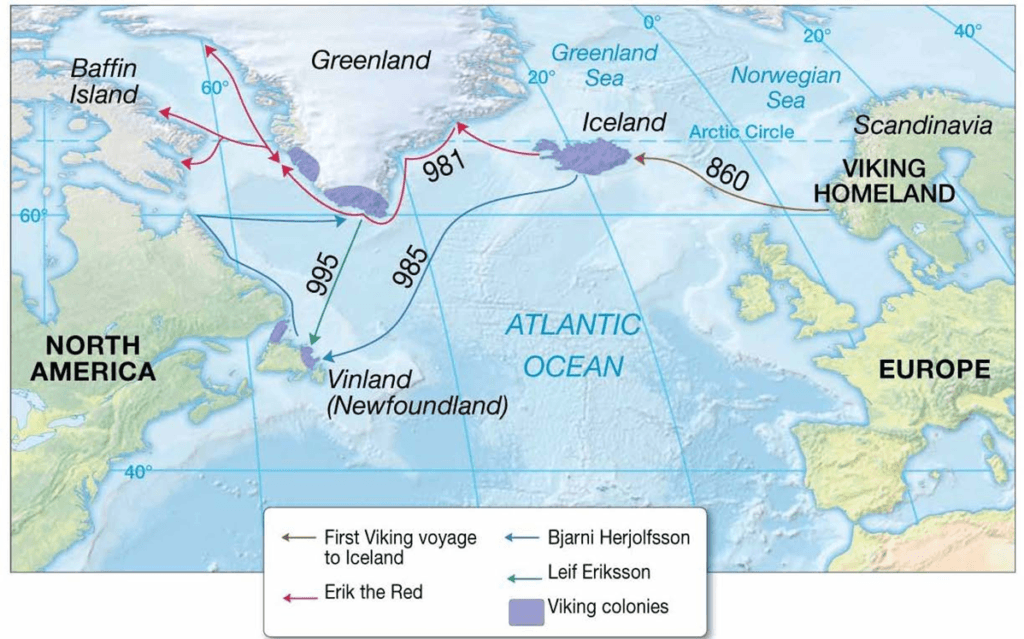
  • Vikings explored North Atlantic Ocean
    • Settled Iceland and Greenland in 9th and 10th centuries A.D.
    • Leif Eriksson designated part of eastern Canada Vinland (now Newfoundland) in 995 A.D.
    • Greenland, Vinland settlements abandoned by 1450 A.D. due to climatic cooling

Viking Routes and Colonies
The Age of Discovery in Europe 1492–1522

  • Search for new Eastern trade routes by sea
    • Prince Henry the Navigator of Portugal sought trade routes around Africa.
    • Europeans explore North and South America.
      • Christopher Columbus was financed by the Spanish to find new trade routes to Asia.
      • Englishman John Cabot arrived in northeast North America in 1497.
  • Spaniard Ferdinand Magellan circumnavigated the globe.
    • Was killed on a Pacific Island in 1521
  • Juan Sebastian del Caño completed the circumnavigation in 1522.
  • Voyages paved the way for the Spanish to take gold from the Incas and Mayas.
  • Spain’s maritime dominance ended when England defeated the Spanish Armada in 1588.

Voyages of Columbus and Magellan

Voyaging for Science

  • The English wanted to retain maritime superiority.
  • Captain James Cook (1728–1779) undertook three scientific voyages.
    • Ships HMS Endeavour, Resolution,
    • Adventure
    • Mapped many islands in Pacific
    • Systematically measured ocean characteristics
    • Marine chronograph (longitude)

More high-technology tools available today

  • Sonar
  • Robotics
  • Computers
  • Satellites

Nature of Scientific Inquiry

  • Natural phenomena governed by physical processes
  • Physical processes similar today as in the past
  • Scientists discover these processes and make predictions.
  • Called the scientific method

The Scientific Method

Chapter 1 Introduction to Planet “Earth”

Theories and Truth

  • Science never reaches absolute truth.
  • Truth is probable and based on available observations.
  • New observations yield scientific progress. In reality, scientists have no formal method.

Formation of Earth and the Solar System

  • Nebular hypothesis –
    • all bodies in the solar system formed from nebula
    • Nebula = cloud of gases and space dust
      • Mainly hydrogen and helium

Nebular Hypothesis

  • Gravity concentrates material at center of cloud (Sun).
  • Protoplanets form from smaller concentrations of matter (eddies).

Protoearth

  • Larger than Earth today
  • Homogeneous composition
  • Bombarded by meteorites
    • Moon formed from collision with large asteroid
  • Radioactive heat
    • Spontaneous disintegration of atoms
    • Fusion reactions
  • Heat from contraction (protoplanet shrinks due to gravity)
  • Protoearth partially melts
  • Density stratification (layered Earth)
Chapter 1 Introduction to Planet “Earth”

Density Stratification

  • High density = heavy for its size
  • Early Earth experienced gravitational separation.
    • High-density materials (iron and nickel) settled in core.
    • Less dense materials formed concentric spheres around core.

Earth’s Internal Structure

  • Layers defined by
    • Chemical composition
    • Physical properties

Layers by Chemical Composition

  • Crust
    • Low-density, mainly silicate minerals
  • Mantle
    • Mainly iron (Fe) and magnesium (Mg) silicate minerals
  • Core
    • High-density, mainly iron (Fe) and nickel (Ni)

Layers by Physical Properties

  • Lithosphere
  • Asthenosphere
  • Mesosphere
  • Outer core
  • Inner core

Lithosphere

  • Cool, rigid shell
  • Includes crust and upper mantle
  • About 100 km
  • (60 miles) thick

Continental vs. Oceanic Crust

Oceanic CrustContinental Crust
Main rock typeBasalt (dark-colored igneous rock)Granite (light-colored igneous rock)
Density (grams per cubic centimeter)3.02.7
Average thickness8 kilometers (5 miles)35 kilometers (22 miles)

Asthenosphere

  • Relatively hot, plastic
  • Flows with high viscosity
    • Important for movement of lithospheric plates
  • Base of lithosphere to about 700 km (430 miles) deep.

Isostatic Adjustment

  • Vertical movement of Earth’s crust
  • Buoyancy of lithosphere on asthenosphere –
    • Less dense continental crust floats higher than denser oceanic crust.
  • Isostatic rebound – rising of crust formerly weighed down by glacier ice

Origin of Earth’s Atmosphere

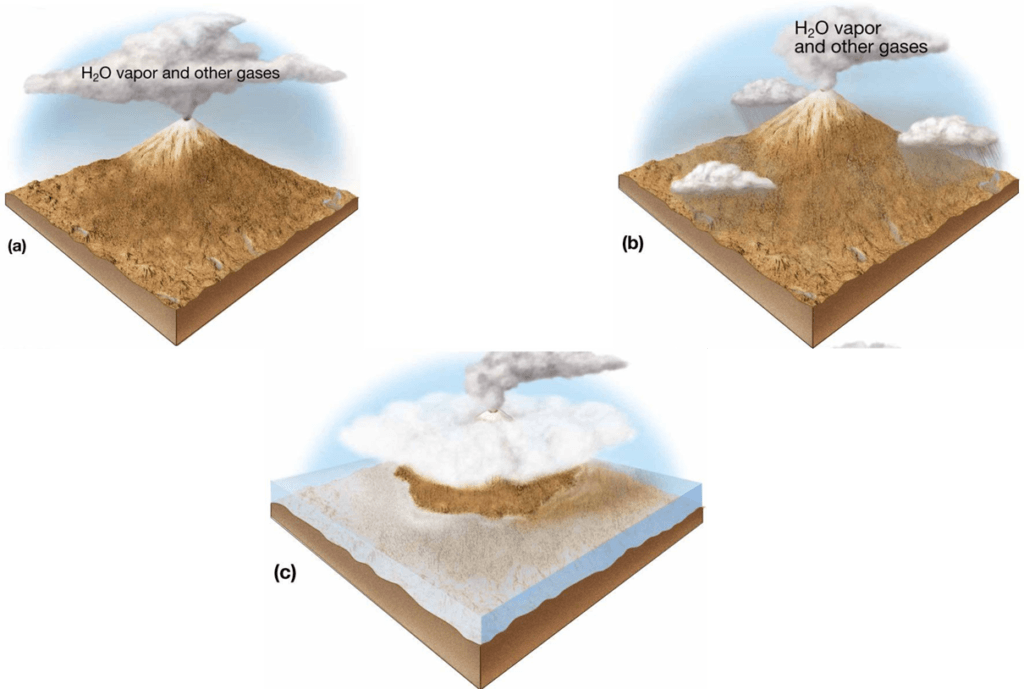
  • Outgassing – occurred during density stratification
    • Water vapor
    • Carbon dioxide
    • Hydrogen
    • Other gases
  • Earth’s early atmosphere different from today

Origin of Earth’s Oceans

  • Outgassed water vapor fell as rain.
  • The first permanent oceans formed 4 billion years ago.
  • Salinity developed from dissolved rock elements.
    • Early acidic rain dissolved more crustal minerals than today.
Chapter 1 Introduction to Planet “Earth”

Life’s Possible Ocean Origins

  • Earth’s earliest known life forms are 3.5-billion-year-old bacteria fossilized in ocean rocks.
  • These are the building blocks for life on early Earth.
  • There is no direct evidence of early Earth’s environment.

Oxygen

  • Humans require O2.
  • Ozone (O3) protects from ultraviolet radiation.
  • Early Earth had little free oxygen.
  • The lack of ozone may have helped originate life.

Stanley Miller’s Experiment

Organic molecules formed by ultraviolet light, electrical spark (lightning), and a mixture of water, carbon dioxide, hydrogen, methane, and ammonia.

Chapter 1 Introduction to Planet “Earth”

Evolution and Natural Selection

  • Organisms adapt and change through time.
  • Advantageous traits are naturally selected. Traits are passed to the next generation.
  • Organisms adapt to environments.
  • Organisms can modify environments.

Plants and Animals Evolve

  • Heterotrophs
    • Very earliest life
    • Require external food supply
  • Autotrophs
    • Evolved later
    • Manufacture own food supply

First Autotrophs

  • Probably similar to modern anaerobic bacteria
    • Survive without oxygen
  • Chemosynthesis from chemicals at deep hydrothermal vents
  • Supports idea of life’s origins on deep ocean floor in absence of light

Photosynthesis and Respiration

  • Complex autotrophs developed chlorophyll.
  • This allowed the use of the Sun for photosynthesis.
  • Cellular respiration

Great Oxidation Event

  • 2.45 billion years ago
  • Increased oxygen and ozone eliminated the anaerobe food supply.
  • Light and oxygen kill anaerobes. Cyanobacteria adapted and thrived.

Changes to Earth’s Atmosphere

  • Photosynthetic organisms are responsible for life as we know it today.
  • Reduce CO2, increase O2 to 21%
  • High oxygen = biodiversity increase
  • Low oxygen associated with extinction events

Plants and Earth’s Environment

Age of Earth

  • Radiometric age dating
    • Spontaneous change/decay
    • Half-life
  • Earth is about 4.6 billion years old.

Radioactive Decay

Geologic Time Scale

NOTE-The content provided, which aligns with Essentials of Oceanography by Alan P. Trujillo and Harold V. Thurman (11th edition)

Reference: All images and content are taken from Essentials of Oceanography by Alan P. Trujillo and Harold V. Thurman, 12th Edition.

READ ALSO  Chapter 4 Marine Sediments

Leave a Reply

CSIR NET Exam: EARTH, ATMOSPHERIC, OCEAN AND PLANETARY SCIENCES

Exam Pattern: EARTH, ATMOSPHERIC, OCEAN AND PLANETARY SCIENCES 

 PART APART BPART CTOTAL
Total questions205080150
Max No. of Questions to attempt15352575
Marks for each correct answer224200
Marks for each incorrect answer (Negative marking for part A & B is @ 25%, and part C is @ 33%)0.50.51.32

The candidate is required to answer a maximum of 15, 35, and 25 questions from Part-A, Part-B, and Part-C, respectively. If more than the required number of questions are answered, only the first 15, 35, and 25 questions in Part A, Part B, and Part C, respectively, will be taken up for evaluation.

Below each question in Part A, Part B, and Part C, four alternatives or responses are given. Only one of these alternatives is the “correct” option to the question. The candidate has to find, for each question, the correct or the best answer.

Syllabus

EARTH, ATMOSPHERIC, OCEAN AND PLANETARY SCIENCES

PAPER I (PART B)

  1. The Earth and the Solar System

    • Milky Way and the solar system.
    • Modern theories on the origin of the Earth and planetary bodies.
    • Earth’s orbital parameters, Kepler’s laws of planetary motion.
    • Geological Time Scale; space and time scales of processes in the solid Earth, atmosphere, and oceans.
    • Radioactive isotopes and their applications.
    • Meteorites: chemical composition and primary differentiation of the Earth.
    • Basic principles of stratigraphy.
    • Theories about the origin of life and fossil records.
    • Earth’s gravity, magnetic fields, and thermal structure: Geoid and spheroid concepts; Isostasy.
  2. Earth Materials, Surface Features, and Processes

    • Gross composition and physical properties of important minerals and rocks.
    • Properties and processes responsible for mineral concentrations.
    • Distribution of rocks and minerals in Earth’s units and India.
    • Physiography of the Earth; weathering, erosion, and soil formation.
    • Energy balance of Earth’s surface processes.
    • Physiographic features and river basins in India.
  3. Interior of the Earth, Deformation, and Tectonics

    • Basic concepts of seismology and Earth’s internal structure.
    • Physico-chemical and seismic properties of Earth’s interior.
    • Stress and strain concepts; rock deformation.
    • Folds, joints, and faults; causes and measurement of earthquakes.
    • Interplate and intraplate seismicity; paleomagnetism.
    • Sea-floor spreading and plate tectonics.
  4. Oceans and Atmosphere

    • Hypsography of continents and ocean floors: continental shelves, slopes, abyssal plains.
    • Physical and chemical properties of seawater; residence times of elements.
    • Ocean currents, waves, tides, thermohaline circulation, and conveyor belts.
    • Major water masses, biological productivity, and fluid motion.
    • Atmospheric structure and heat budget; greenhouse gases and global warming.
    • General circulation, monsoon systems, ENSO, cyclones, and local systems in India.
    • Marine and atmospheric pollution, ozone depletion.
  5. Environmental Earth Sciences

    • Properties of water and the hydrological cycle.
    • Energy resources: uses, degradation, alternatives, and management.
    • Ecology, biodiversity, and natural resource conservation.
    • Natural hazards and remote sensing applications.

PAPER I (PART C)

I. Geology

  1. Mineralogy and Petrology

    • Point group, space group, and lattice concepts.
    • Crystal field theory, mineralogical spectroscopy, and bonding in mineral structures.
    • Genesis, properties, and crystallization of magmas.
    • Metamorphic structures, textures, and thermobarometry.
    • Petrogenesis of Indian rock suites: Deccan Traps, charnockites, ophiolites, and more.
  2. Structural Geology and Geotectonics

    • Stress and strain analysis; Mohr circles.
    • Geometry and mechanics of folds, faults, and ductile shear zones.
    • Plate boundaries, mantle plumes, and Himalayan orogeny.
  3. Paleontology and Applications

    • Life origin theories, evolution models, and mass extinctions.
    • Applications of fossils in age determination, paleoecology, and paleogeography.
    • Micropaleontology in hydrocarbon exploration.
  4. Sedimentology and Stratigraphy

    • Classification of sediments and sedimentary rocks.
    • Sedimentary environments and basin evolution.
    • Stratigraphic principles, correlation methods, and sequence stratigraphy.
    • Phanerozoic stratigraphy of India.
  5. Marine Geology and Paleoceanography

    • Ocean floor morphology, ocean circulation, and thermohaline processes.
    • Factors influencing oceanic sediments and paleoceanographic reconstruction.
  6. Geochemistry

    • Atomic properties, periodic table, thermodynamics of reactions, and isotopes in geochronology.
    • Applications of stable isotopes in Earth processes.
  7. Economic Geology

    • Ore formation processes, mineral deposit studies, and petroleum geology.
    • Coal and unconventional energy resources.
  8. Precambrian Geology and Crustal Evolution

    • Evolution of Earth systems and Precambrian characteristics of India.
    • Precambrian–Cambrian boundary.
  9. Quaternary Geology

    • Quaternary stratigraphy, climate variability, and human evolution.
    • Dating methods and tectonic geomorphology.
  10. Applied Geology

  • Remote sensing and GIS.
  • Engineering properties of rocks; construction investigations.
  • Methods of mineral exploration and groundwater studies.

II. Physical Geography

  1. Geomorphology: Landform processes, DEM analysis, extraterrestrial geomorphology.
  2. Climatology: Radiation balance, wind systems, ENSO, and climate classification.
  3. Biogeography: Plant and animal associations, Indian biogeography, and conservation.
  4. Environmental Geography: Man-land relationships, hazards, and ecological balance.
  5. Geography of India: Physical geography, climatology, agriculture, and population characteristics.

III. Geophysics

  1. Signal Processing: Fourier transforms, filters, and signal analysis.
  2. Field Theory: Newtonian potential, Green’s theorem, and seismic wave propagation.
  3. Numerical Analysis and Inversion: Least squares, optimization, and pattern recognition.
  4. Gravity and Magnetic Methods: Data interpretation and anomaly analysis.
  5. Seismic Methods: Ray theory, reflection/refraction techniques, seismic stratigraphy.
  6. Well Logging: Techniques for lithology, porosity, and fluid saturation interpretation.

(IV) METEOROLOGY

1) Climatology

  • Same as under Geography.

2) Physical Meteorology

  • Thermal Structure of the Atmosphere and Its Composition.
  • Radiation:
    • Basic laws – Rayleigh and Mie scattering, multiple scattering.
    • Radiation from the sun, solar constant, effect of clouds, surface and planetary albedo.
    • Emission and absorption of terrestrial radiation, radiation windows, radiative transfer, Greenhouse effect, net radiation budget.
  • Thermodynamics of Dry and Moist Air:
    • Specific gas constant, adiabatic and isentropic processes, entropy and enthalpy.
    • Moisture variables, virtual temperature, Clausius–Clapeyron equation.
    • Adiabatic processes of moist air, thermodynamic diagrams.
  • Hydrostatic Equilibrium:
    • Hydrostatic equation, variation of pressure with height, geopotential, standard atmosphere, altimetry.
  • Vertical Stability of the Atmosphere:
    • Dry and moist air parcel and slice methods, tropical convection.
  • Atmospheric Optics:
    • Visibility and optical phenomena – rainbows, haloes, corona, mirage, etc.

3) Atmospheric Electricity

  • Fair weather electric field in the atmosphere and potential gradients.
  • Ionization in the atmosphere, electrical fields in thunderstorms.
  • Theories of thunderstorm electrification, structure of lightning flash, mechanisms of earth-atmospheric charge balance, and the role of thunderstorms.

4) Cloud Physics

  • Cloud classification, condensation nuclei, growth of cloud drops and ice-crystals.
  • Precipitation mechanisms: Bergeron–Findeisen process, coalescence process.
  • Precipitation of warm and mixed clouds, artificial precipitation, hail suppression, fog and cloud dissipation.
  • Radar observation of clouds and precipitation:
    • Radar equation, rain drop spectra, radar echoes of hailstorms, tornadoes, hurricanes, and rainfall measurements.

5) Dynamic Meteorology

  • Basic Equations and Fundamental Forces:
    • Pressure, gravity, centripetal and Coriolis forces.
    • Continuity and momentum equations (Cartesian and spherical coordinates).
    • Scale analysis, inertial flow, geostrophic and gradient winds, thermal wind.
    • Divergence and vertical motion, Rossby, Richardson, Reynolds, and Froude numbers.
  • Atmospheric Turbulence:
    • Mixing length theory, planetary boundary layer equations, Ekman layer, eddy transport of heat, moisture, and momentum.
  • Linear Perturbation Theory:
    • Internal and external gravity waves, inertia waves, gravity waves, Rossby waves, wave motion in the tropics, barotropic and baroclinic instabilities.
  • Atmospheric Energetics:
    • Kinetic, potential, and internal energies; conversion into kinetic energy; available potential energy.

6) Numerical Weather Prediction (NWP)

  • Computational instability, filtering of sound and gravity waves.
  • Filtered forecast equations, barotropic and baroclinic models.
  • Objective analysis, data assimilation techniques, satellite applications in NWP.

7) General Circulation and Climate Modelling

  • Observed zonally symmetric circulations, meridional circulation models.
  • General circulation modelling principles: grid-point and spectral GCMs.
  • Climate variability phenomena: ENSO, QBO, MJO, etc.
  • Ocean-atmosphere coupled models.

8) Synoptic Meteorology

  • Weather observations and transmission, synoptic charts.
  • Synoptic weather forecasting, prediction of weather elements, and hazardous weather phenomena.
  • Tropical Meteorology:
    • ITCZ, monsoons, tropical cyclones, jet streams.
  • Extra-Tropical Features:
    • Jet streams, extratropical cyclones, anticyclones.
  • Air masses and fronts: sources, classification, frontogenesis, and associated weather.

9) Aviation Meteorology

  • Meteorological role in aviation, weather hazards during takeoff, cruising, and landing.
  • In-flight hazards: icing, turbulence, visibility issues, gusts, wind shear, thunderstorms.

10) Satellite Meteorology

  • Polar orbiting and geostationary satellites.
  • Applications in identifying synoptic systems, cyclones, temperature estimation, rainfall prediction, and temperature/humidity soundings.

(V) OCEAN SCIENCES

1) Physical Oceanography

  • T-S diagrams, mixing processes, characteristics of water masses.
  • Wind-generated waves, shallow and deep-water wave dynamics.
  • Coastal processes: wave reflection, refraction, diffraction, littoral currents, rip currents, tsunami, and more.
  • Ocean Circulation:
    • Global conveyor belt circulation, Ekman’s theory, upwelling processes.

2) Chemical Oceanography

  • Composition of seawater, chemical exchanges, and classification of elements.
  • Element chemistry under special conditions (estuaries, vents, etc.).
  • Carbonate chemistry, biological pumps, and sedimentary deposit factors.

3) Geological Oceanography

  • Topics as listed under “Marine Geology & Paleoceanography.”

4) Biological Oceanography

  • Classification of marine environments and organisms.
  • Primary and secondary production, factors affecting biodiversity.
  • Human impacts on marine communities and climate change effects.


How Study Hub Can Help You Prepare for the Earth, Atmospheric, Ocean, and Planetary Sciences Syllabus

Preparing for the extensive and demanding syllabus of Earth, Atmospheric, Ocean, and Planetary Sciences (702) requires a strategic approach and access to comprehensive study resources. Study Hub (accessible at studyhub.net.in) offers unparalleled support to help candidates excel in this challenging domain. Here’s how Study Hub can guide your preparation:


Comprehensive Coverage of Topics

At Study Hub, we provide in-depth study materials, mock tests, and curated articles to help candidates grasp even the most complex topics. Our resources are designed to address every aspect of the syllabus, including:

  1. Meteorology: Understand critical concepts like the thermal structure of the atmosphere, radiative transfer, vertical stability, numerical weather prediction, general circulation and climate modelling, and the role of satellite meteorology in observing weather systems such as cyclones, monsoons, and thunderstorms.

  2. Ocean Sciences: Dive into topics such as physical oceanography, chemical oceanography, geological oceanography, and biological oceanography. Study Hub’s resources emphasize key aspects like upwelling processes, estuarine circulation, ocean eddies, Ekman theory, and global conveyor belt circulation—helping you understand the intricate processes of ocean systems.

  3. Atmospheric Dynamics and Energetics: Through articles, conceptual guides, and practice questions, candidates gain a strong grasp of fundamental equations, vorticity, geostrophic winds, Rossby waves, atmospheric turbulence, and barotropic and baroclinic instabilities.

  4. Planetary Sciences: Our expertly crafted content helps students explore planetary structures, processes, and phenomena with precision, complementing other topics under Earth Sciences for an interdisciplinary understanding.


Mock Tests and Evaluation Framework

We align our mock tests and sample papers with the pattern of the Earth Sciences examination:

  • Objective Analysis for Numerical Weather Prediction (NWP): Test your knowledge of filtered forecasting models and data assimilation techniques.
  • Synoptic Meteorology Practices: Work on real-world weather data and forecast exercises involving tropical cyclones, ITCZ systems, monsoon depressions, and jet streams.
  • Topic-specific tests ensure mastery in areas like atmospheric optics, biochemical nutrient cycling, and the impact of human activities on ecosystems.

Why Study Hub is the Perfect Partner for Your Earth Sciences Preparation

  1. Academic Rigor: Study Hub maintains an academic tone throughout its resources, ensuring in-depth coverage of essential keywords such as radiative budget, MJO (Madden-Julian Oscillation), Quasi-Biennial Oscillation (QBO), and ENSO phenomena.
  2. Focused on Practical Applications: Be it radar observations, wave refraction techniques, or the impact of anthropogenic inputs on marine biodiversity, we emphasize the practical relevance of each topic for better comprehension.
  3. Adaptive Materials: From simple T-S diagrams to advanced topics like geopotential variation and numerical baroclinic models, we tailor our resources to match both beginner and advanced levels of understanding.
Scroll to Top