Overview
The world ocean is the most prominent feature on Earth.
Oceans cover 70.8% of Earth’s surface.
The origin and development of life on Earth are connected to the ocean.
The oceans have a long history on Earth.
Earth’s Oceans
Earth has one ocean.
It is divided into four principle oceans and one other.
- Pacific Ocean
- Atlantic Ocean
- Indian Ocean
- Arctic Ocean
- Southern, or Antarctic, Ocean

Ocean Size and Depth

Pacific Ocean
- World’s largest ocean
- Accounts for more than half of Earth’s ocean space
- World’s deepest ocean
- Earth’s largest geographic feature
- Named in 1520 by Ferdinand Magellan
Atlantic Ocean
- Half the size of the Pacific Ocean
- Shallower than the Pacific Ocean
- Separates the Old World from the New World
Indian Ocean
- Smaller than the Atlantic Ocean
- Similar depth as the Atlantic Ocean
- Primarily in the Southern Hemisphere
Arctic Ocean
- Seven percent the size of the Pacific Ocean
- Shallowest world ocean
- Permanent layer of sea ice a few meters thick
Southern Ocean or Antarctic Ocean
- Circumnavigates Antarctica
- Is really the parts of the Pacific, Atlantic, and Indian Oceans that lie south of 50° S latitude
The Seven Seas
- Smaller and shallower than oceans Salt water
- Usually enclosed by land
- Sargasso Sea defined by surrounding ocean currents
- Directly connected to the ocean
Before the 15th century, Europeans considered the seven seas to be the following:
- Red Sea
- Mediterranean Sea
- Persian Gulf
- Black Sea
- Adriatic Sea
- Caspian Sea
- Indian Ocean
Comparing Oceans to Continents
- Average ocean depth is 3682 meters (12, 080 feet)
- Average continental elevation is 840 meters (2756 feet)
- Deepest ocean trench is the Mariana Trench at 11,022 meters (36,161 feet)
- Highest continental mountain is Mt. Everest at 8850 meters (29,035 feet)

Early Exploration of the Oceans
- Early “explorers” used boats to seek new fishing grounds for food.
- The ocean facilitated trade and interaction between cultures.
Pacific Navigators
- The peopling of the Pacific Islands required extensive travel in open boats and exceptional navigation skills.
- It was difficult because islands are widely scattered

Pacific People
- No written records exist of Pacific human history before the 16th century.
- Archeological evidence suggests island occupation by people from New Guinea as early as 4000–5000 B.C.
- Thor Heyerdahl sailed on a balsa raft – the Kon Tiki – to demonstrate migration of South Americans to Pacific Ocean islands.
European Navigators
- Phoenecians – first from Western Hemisphere to develop navigation arts
- Navigated circa 2000 B.C.
- Explored Mediterranean Sea, Red Sea, and Indian Ocean
- First circumnavigation of Africa
- Greek Pytheas
- Sailed northward using a simple method to determine latitude in 325 B.C.
- Navigated using the North Star
- Eratosthenes determined Earth’s
Europeans
- Herodotus produced inaccurate world map around 450 B.C.
- Claudius Ptolemy produced fairly accurate world map around 150 A.D.
- Erroneously updated Eratosthenes’ original circumference estimation, later causing Christopher Columbus
- to believe he had reached Asia

The Middle Ages
- Arabs dominant navigators in the Mediterranean Sea
- Traded extensively with East Africa, India, and Southeast Asia
- Learned to use Indian Ocean monsoon winds for travel
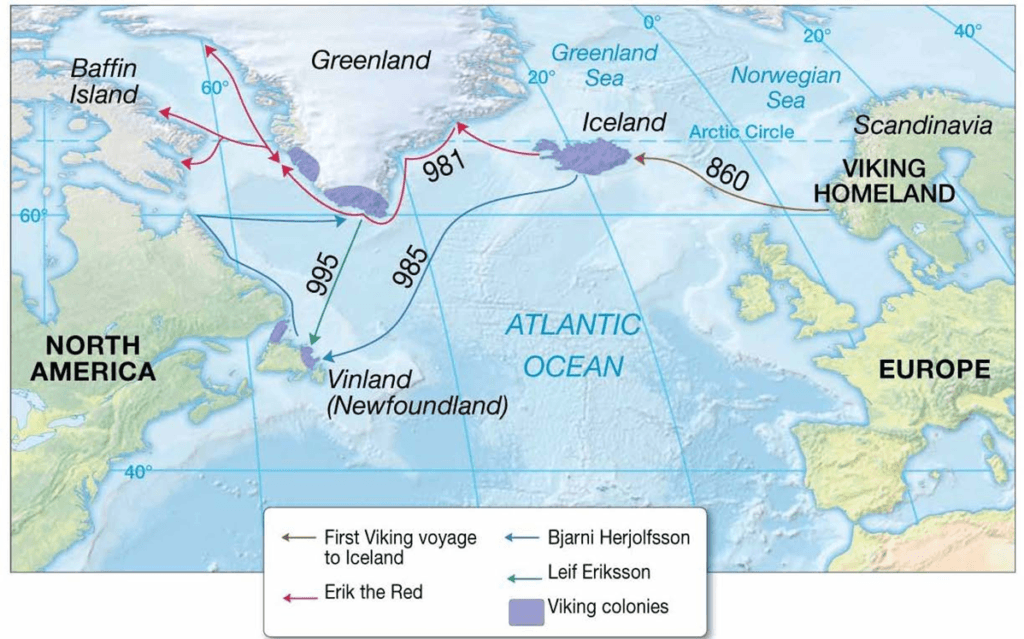
- Vikings explored North Atlantic Ocean
- Settled Iceland and Greenland in 9th and 10th centuries A.D.
- Leif Eriksson designated part of eastern Canada Vinland (now Newfoundland) in 995 A.D.
- Greenland, Vinland settlements abandoned by 1450 A.D. due to climatic cooling
Viking Routes and Colonies
The Age of Discovery in Europe 1492–1522
- Search for new Eastern trade routes by sea
- Prince Henry the Navigator of Portugal sought trade routes around Africa.
- Europeans explore North and South America.
- Christopher Columbus was financed by the Spanish to find new trade routes to Asia.
- Englishman John Cabot arrived in northeast North America in 1497.
- Spaniard Ferdinand Magellan circumnavigated the globe.
- Was killed on a Pacific Island in 1521
- Juan Sebastian del Caño completed the circumnavigation in 1522.
- Voyages paved the way for the Spanish to take gold from the Incas and Mayas.
- Spain’s maritime dominance ended when England defeated the Spanish Armada in 1588.
Voyages of Columbus and Magellan

Voyaging for Science
- The English wanted to retain maritime superiority.
- Captain James Cook (1728–1779) undertook three scientific voyages.
- Ships HMS Endeavour, Resolution,
- Adventure
- Mapped many islands in Pacific
- Systematically measured ocean characteristics
- Marine chronograph (longitude)
More high-technology tools available today
- Sonar
- Robotics
- Computers
- Satellites
Nature of Scientific Inquiry
- Natural phenomena governed by physical processes
- Physical processes similar today as in the past
- Scientists discover these processes and make predictions.
- Called the scientific method
The Scientific Method

Theories and Truth
- Science never reaches absolute truth.
- Truth is probable and based on available observations.
- New observations yield scientific progress. In reality, scientists have no formal method.
Formation of Earth and the Solar System
- Nebular hypothesis –
- all bodies in the solar system formed from nebula
- Nebula = cloud of gases and space dust
- Mainly hydrogen and helium
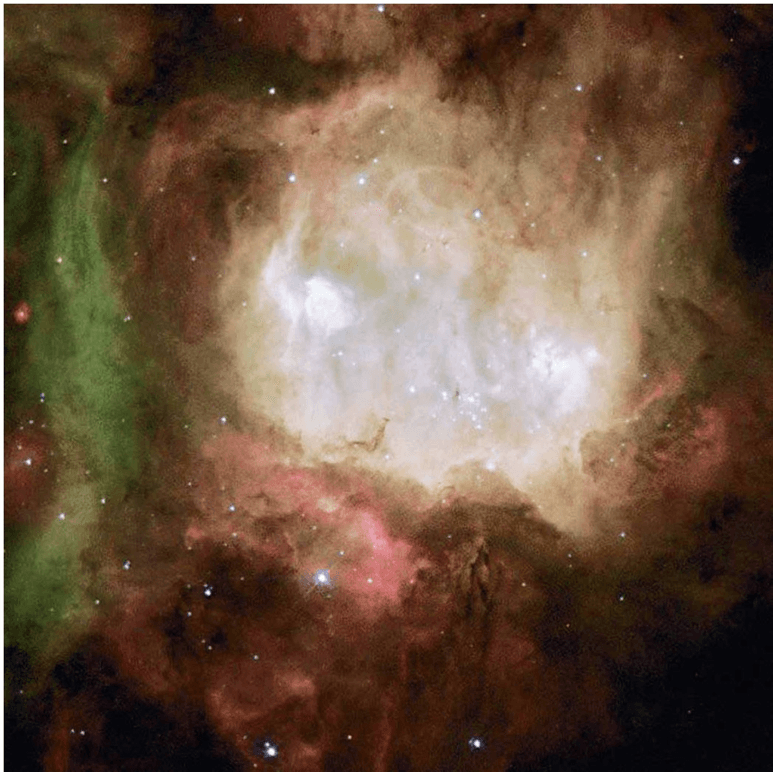
Nebular Hypothesis
- Gravity concentrates material at center of cloud (Sun).
- Protoplanets form from smaller concentrations of matter (eddies).

Protoearth
- Larger than Earth today
- Homogeneous composition
- Bombarded by meteorites
- Moon formed from collision with large asteroid
- Radioactive heat
- Spontaneous disintegration of atoms
- Fusion reactions
- Heat from contraction (protoplanet shrinks due to gravity)
- Protoearth partially melts
- Density stratification (layered Earth)

Density Stratification
- High density = heavy for its size
- Early Earth experienced gravitational separation.
- High-density materials (iron and nickel) settled in core.
- Less dense materials formed concentric spheres around core.
Earth’s Internal Structure
- Layers defined by
- Chemical composition
- Physical properties

Layers by Chemical Composition
- Crust
- Low-density, mainly silicate minerals
- Mantle
- Mainly iron (Fe) and magnesium (Mg) silicate minerals
- Core
- High-density, mainly iron (Fe) and nickel (Ni)
Layers by Physical Properties
- Lithosphere
- Asthenosphere
- Mesosphere
- Outer core
- Inner core
Lithosphere
- Cool, rigid shell
- Includes crust and upper mantle
- About 100 km
- (60 miles) thick

Continental vs. Oceanic Crust
| Oceanic Crust | Continental Crust | |
|---|---|---|
| Main rock type | Basalt (dark-colored igneous rock) | Granite (light-colored igneous rock) |
| Density (grams per cubic centimeter) | 3.0 | 2.7 |
| Average thickness | 8 kilometers (5 miles) | 35 kilometers (22 miles) |
Asthenosphere
- Relatively hot, plastic
- Flows with high viscosity
- Important for movement of lithospheric plates
- Base of lithosphere to about 700 km (430 miles) deep.
Isostatic Adjustment
- Vertical movement of Earth’s crust
- Buoyancy of lithosphere on asthenosphere –
- Less dense continental crust floats higher than denser oceanic crust.
- Isostatic rebound – rising of crust formerly weighed down by glacier ice

Origin of Earth’s Atmosphere
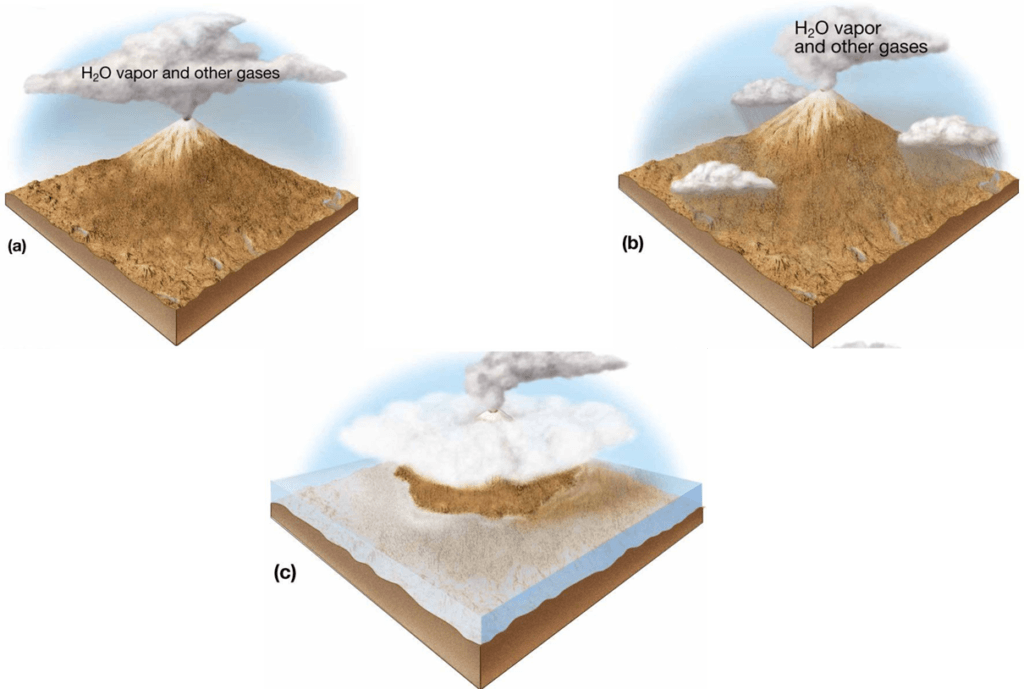
- Outgassing – occurred during density stratification
- Water vapor
- Carbon dioxide
- Hydrogen
- Other gases
- Earth’s early atmosphere different from today
Origin of Earth’s Oceans
- Outgassed water vapor fell as rain.
- The first permanent oceans formed 4 billion years ago.
- Salinity developed from dissolved rock elements.
- Early acidic rain dissolved more crustal minerals than today.
Life’s Possible Ocean Origins
- Earth’s earliest known life forms are 3.5-billion-year-old bacteria fossilized in ocean rocks.
- These are the building blocks for life on early Earth.
- There is no direct evidence of early Earth’s environment.
Oxygen
- Humans require O2.
- Ozone (O3) protects from ultraviolet radiation.
- Early Earth had little free oxygen.
- The lack of ozone may have helped originate life.
Stanley Miller’s Experiment
Organic molecules formed by ultraviolet light, electrical spark (lightning), and a mixture of water, carbon dioxide, hydrogen, methane, and ammonia.

Evolution and Natural Selection
- Organisms adapt and change through time.
- Advantageous traits are naturally selected. Traits are passed to the next generation.
- Organisms adapt to environments.
- Organisms can modify environments.
Plants and Animals Evolve
- Heterotrophs
- Very earliest life
- Require external food supply
- Autotrophs
- Evolved later
- Manufacture own food supply
First Autotrophs
- Probably similar to modern anaerobic bacteria
- Survive without oxygen
- Chemosynthesis from chemicals at deep hydrothermal vents
- Supports idea of life’s origins on deep ocean floor in absence of light
Photosynthesis and Respiration
- Complex autotrophs developed chlorophyll.
- This allowed the use of the Sun for photosynthesis.
- Cellular respiration

Great Oxidation Event
- 2.45 billion years ago
- Increased oxygen and ozone eliminated the anaerobe food supply.
- Light and oxygen kill anaerobes. Cyanobacteria adapted and thrived.
Changes to Earth’s Atmosphere
- Photosynthetic organisms are responsible for life as we know it today.
- Reduce CO2, increase O2 to 21%
- High oxygen = biodiversity increase
- Low oxygen associated with extinction events

Plants and Earth’s Environment

Age of Earth
- Radiometric age dating
- Spontaneous change/decay
- Half-life
- Earth is about 4.6 billion years old.
Radioactive Decay

Geologic Time Scale

NOTE-The content provided, which aligns with Essentials of Oceanography by Alan P. Trujillo and Harold V. Thurman (11th edition)
Reference: All images and content are taken from Essentials of Oceanography by Alan P. Trujillo and Harold V. Thurman, 12th Edition.