Ocean Currents
An ocean current is a continuous general movement of ocean water in a specific direction. As an analogy, it can be perceived as a river flowing over the ocean surface. Ocean currents are one of the most important mechanisms through which heat is distributed across the planet.
About 10% of the water in the world’s oceans is involved in surface currents. Most surface currents move water in the horizontal and vertical direction within the top layer above the thermocline — the layer in the ocean where temperature changes steeply with depth. The water beneath the thermocline also circulates, but the movement is very slow compared to the surface.
If you recall, the heat budget is different across latitudes — there is a heat surplus in the tropics and a heat deficit in the arctic region (beyond 40 degrees N and S). All weather phenomena and circulatory systems exist to transfer heat from the tropics towards the poles and maintain the global heat balance. Ocean currents follow the same principle — they serve as one of the primary mechanisms for redistributing thermal energy across the planet.
Ocean currents are categorized as warm ocean currents and cold ocean currents. It is important to note that warm and cold are not based on their absolute temperature. The classification is based on their impact on the destination region.
- A current that moves towards the pole in both hemispheres is classified as a warm current because it is carrying warm water from lower latitudes to upper latitudes.
- On the contrary, a current flowing from upper latitudes towards the tropics is classified as a cold current because it brings colder water from polar regions to warmer areas.
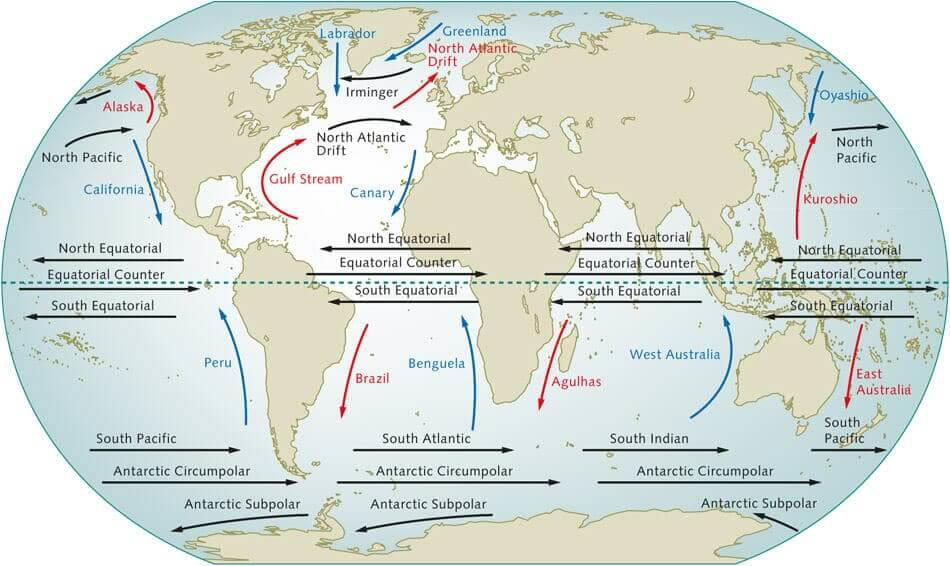
In prelims, a question can be asked on the character of ocean currents. Ocean currents will be numbered as 1, 2, 3 and 4 and it will be asked whether they are cold or warm, or which of them are cold/warm. You don’t need to know the name of those currents — they can be hypothetical also. Just by seeing the direction of the flow of ocean currents, you will be able to answer the question.
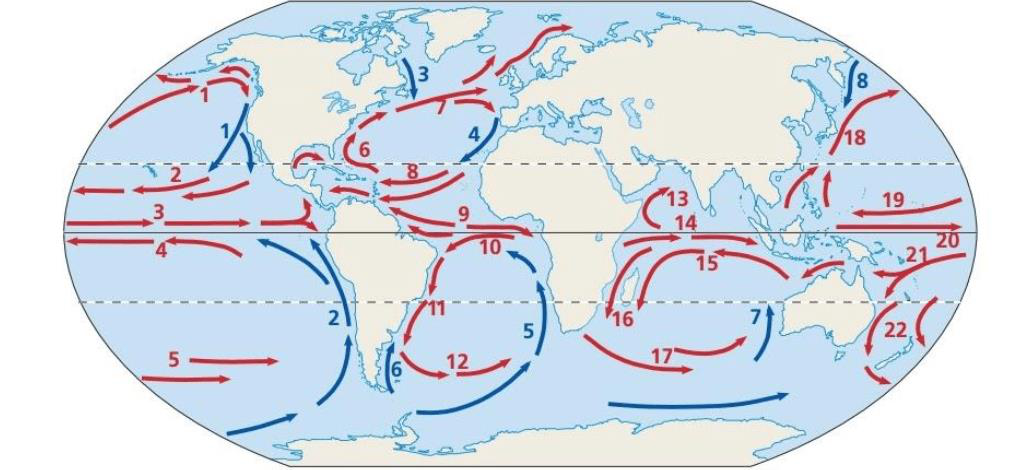
For example, two currents may be in the same latitudes but because of their direction of motion, they are categorized differently — one as cold and the other as warm.
Note: There are some exceptions to this general rule. It is advisable to check the important ocean currents from a World Map for thorough understanding.
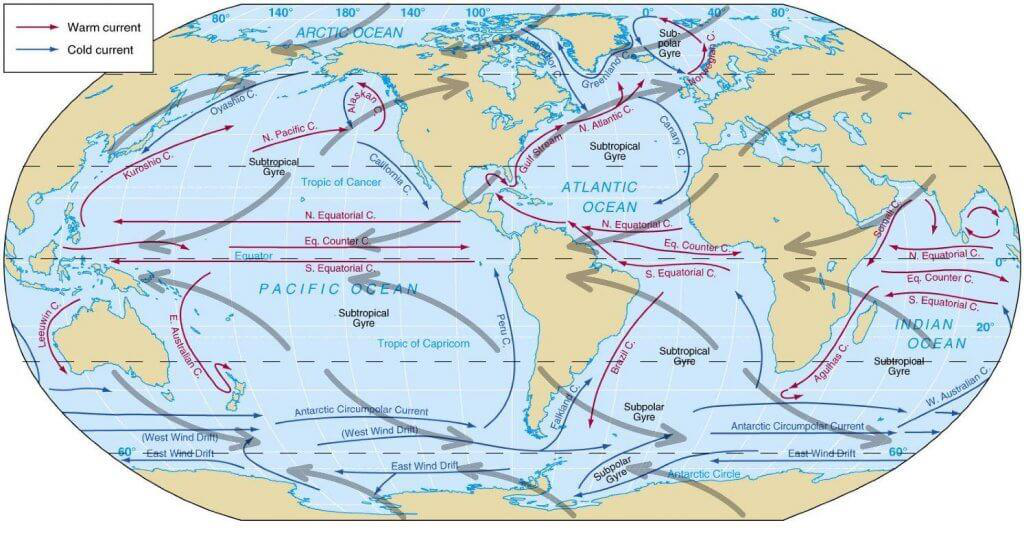
Types of Ocean Currents
Based on depth
- Ocean currents may be classified based on their depth as surface currents and deep water currents:
- Surface currents constitute about 10 percent of all the water in the ocean. These waters occupy the upper 400 meters of the ocean and are driven primarily by wind and the Coriolis force.
- Deep water currents make up the remaining 90 percent of the ocean water. These waters move around the ocean basins due to variations in density and gravity. This deep ocean circulation is also known as thermohaline circulation or the “Global Conveyor Belt”.
- The density difference is a function of different temperatures and salinity. Water that is colder and saltier is denser and tends to sink.
- These deep waters sink into the deep ocean basins at high latitudes where the temperatures are cold enough to cause the density to increase significantly.
Based on temperature
- Ocean currents are also classified based on temperature as cold currents and warm currents:
- Cold currents bring cold water into warm water areas (from high latitudes to low latitudes). These currents are usually found on the west coast of the continents in the low and middle latitudes (true in both hemispheres). The currents flow in a clockwise direction in the Northern Hemisphere and in an anti-clockwise direction in the Southern Hemisphere. In the higher latitudes of the Northern Hemisphere, cold currents are also found on the east coast. Examples include the Peru (Humboldt) Current, Canary Current, Benguela Current, California Current, and Labrador Current.
- Warm currents bring warm water into cold water areas (from low to high latitudes). They are usually observed on the east coast of continents in the low and middle latitudes (true in both hemispheres). In the Northern Hemisphere, they are also found on the west coasts of continents in high latitudes. Examples include the Gulf Stream, Kuroshio Current, Brazil Current, and Agulhas Current.
Forces Responsible For Ocean Currents
Primary Forces
Influence of insolation
- Heating by solar energy causes the ocean water to expand. Due to this thermal expansion, near the equator, the ocean water level is about 8 cm higher than in the middle latitudes.
- This height difference creates a very slight gradient, and the water naturally tends to flow down the slope. This flow is normally from east to west.
Influence of wind (atmospheric circulation)
- Wind blowing on the surface of the ocean pushes the water to move. Friction between the wind and the water surface affects the movement of the water body in its course.
- Winds are responsible for both the magnitude and direction of ocean currents (Coriolis force also affects the direction). Example: Monsoon winds are responsible for the seasonal reversal of ocean currents in the Indian Ocean.
- The oceanic circulation pattern roughly corresponds to the earth’s atmospheric circulation pattern.
- The air circulation over the oceans in the middle latitudes is mainly anticyclonic (Sub-tropical High Pressure Belt). This pattern is more pronounced in the Southern Hemisphere than in the Northern Hemisphere due to differences in the extent of landmass. The oceanic circulation pattern also corresponds with this anticyclonic flow.
- At higher latitudes, where the wind flow is mostly cyclonic (Sub-polar Low Pressure Belt), the oceanic circulation follows this cyclonic pattern.
- In regions of pronounced monsoonal flow (Northern Indian Ocean), the monsoon winds influence the current movements, which change directions according to seasons — flowing in one direction during the southwest monsoon and reversing during the northeast monsoon.
Influence of gravity
- Gravity tends to pull the water down to pile and create gradient variation. It acts as a leveling force, trying to flatten the water surface and thereby contributing to the horizontal flow of water from areas of higher water level to lower water level.
Influence of Coriolis force
- The Coriolis force intervenes and causes the water to move to the right in the Northern Hemisphere and to the left in the Southern Hemisphere.
- These large accumulations of water and the flow around them are called Gyres. The Coriolis force, together with wind patterns and continental boundaries, produces large circular currents in all the ocean basins.
- One such notable circular current formation is the Sargasso Sea — a body of stagnant water trapped within the North Atlantic Gyre.
Secondary Forces
- Temperature differences and salinity differences are the secondary forces that drive ocean currents.
- Differences in water density affect the vertical mobility of ocean currents (vertical currents).
- Water with high salinity is denser than water with low salinity. In the same way, cold water is denser than warm water.
- Denser water tends to sink, while relatively lighter water tends to rise.
- Cold-water ocean currents occur when the cold water at the poles sinks and slowly moves towards the equator along the ocean floor.
- Warm-water currents travel out from the equator along the surface, flowing towards the poles to replace the sinking cold water. This creates a continuous global loop of circulation.
Important ocean currents
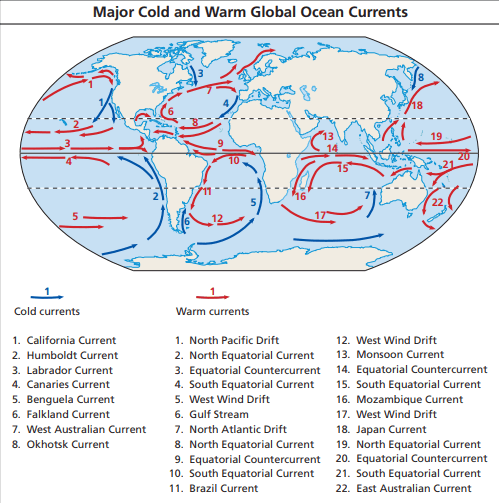
It is important to remember which ocean currents are cold and which are warm. A good practice is to study a World Map of Ocean Currents and note the direction and temperature classification of each major current.
NOTE: Major fishing grounds of the world exist where warm and cold ocean currents meet. The mixing of warm and cold water brings nutrient-rich water to the surface, which supports abundant marine life. Examples include the Grand Banks of Newfoundland (where the warm Gulf Stream meets the cold Labrador Current) and the seas around Japan (where the warm Kuroshio meets the cold Oyashio Current).
Causes of Ocean Currents
Planetary Winds
Planetary winds play a vital role in the formation and sustenance of ocean currents. Since planetary winds blow with consistency over the surface of the ocean, they tend to push the water in one direction because of friction. This is the main cause of the flow of ocean water.
Because of the Coriolis Effect, in the Northern Hemisphere currents flow to the right of the wind direction, while in the Southern Hemisphere currents flow to the left. Intervening continents and basin topography often block the continuous flow of water and frequently deflect the moving water into a circular pattern. This circular motion of water along the periphery of the ocean basin is called a Gyre.
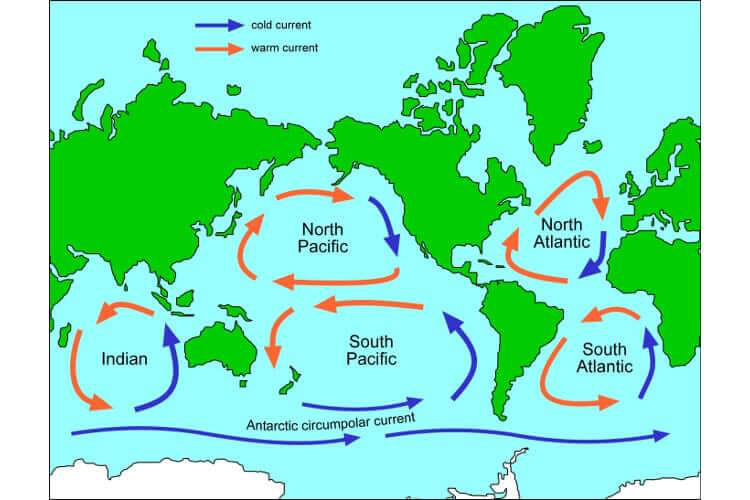
There are five major gyres in the world’s oceans — the North Atlantic Gyre, South Atlantic Gyre, North Pacific Gyre, South Pacific Gyre, and the Indian Ocean Gyre. Each gyre is formed by the combined influence of planetary winds, the Coriolis force, and continental boundaries.
Effect of the temperature
There are marked variations in the horizontal and vertical distribution of temperatures in the ocean. In general, the temperature decreases as we move towards the pole from the equator.
There is an inverse relationship between temperature and density of the water — the higher the temperature, the lower the density. As a result, the warm and low-density water from the equatorial region moves towards the colder polar waters along the surface. Contrary to this, there is a movement of ocean water below the surface in the form of a subsurface current from colder polar areas to warmer equatorial areas.
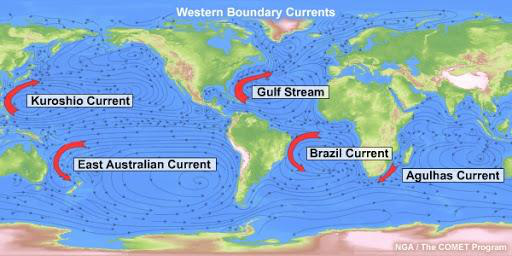
The Gulf Stream and the Kuroshio Current (both warm currents) are very good examples of surface currents driven by temperature differences. The Gulf Stream alone transports approximately 30 million cubic meters of water per second, making it one of the most powerful ocean currents in the world.
Salinity
The salinity of the ocean varies from place to place. Water with high salinity is denser than water with low salinity. Ocean currents on the water surface are generated from areas of low salinity to areas of high salinity.
For example, there are ocean currents moving from the ocean to inland seas — ocean current flows from the Atlantic to the Mediterranean Sea through the Strait of Gibraltar. A similar ocean current is seen from the Indian Ocean to the Red Sea via Bab Al Mandab. The Peru Current also originates because of the difference in density.
In the Mediterranean Sea, the rate of evaporation is very high, which increases the salinity and density of the water. This denser Mediterranean water sinks and flows out into the Atlantic as a deep undercurrent, while less saline Atlantic water flows in at the surface to replace it.
Rotation of Earth
The rotation of the earth from west to east on its axis is the cause of a deflective force called the Coriolis force.
Similar to winds, the Coriolis force deflects ocean currents in the Northern Hemisphere towards the right and in the Southern Hemisphere towards the left. Because of this, at the periphery of the ocean, ocean currents form a clockwise circulation in the Northern Hemisphere and a counterclockwise circulation in the Southern Hemisphere. This giant loop is called a Gyre.
A gyre formed in the North Atlantic is of special importance as it traps the inner water of the ocean and makes it stagnant. This stagnant body of water is known as the Sargasso Sea, named after the Sargassum weed found in it. Sargassum is a unique vegetation endemic to this area, and the Sargasso Sea is an internationally protected area. It is the only sea in the world that is totally inside an ocean, with no land boundaries — defined entirely by the circular motion of ocean currents around it.
Configuration of the coastline
Coastline plays an important role in governing the direction of the flow of ocean currents. For example, the equatorial current, after being obstructed by the Brazilian coast, is bifurcated into two branches. The Northern branch is called the Caribbean Current, while the Southern branch is called the Brazilian Current.
Note: After hitting a coastline, apart from moving towards North and South, some of the water also moves downward — this is called Downwelling. This water penetrates deep into the ocean and moves parallel to the surface current as an undercurrent. It comes out on the other side of the ocean as Upwelling.
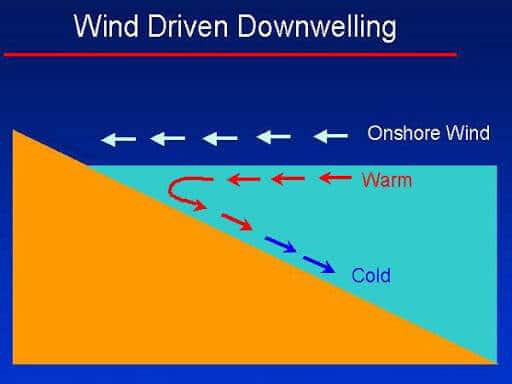
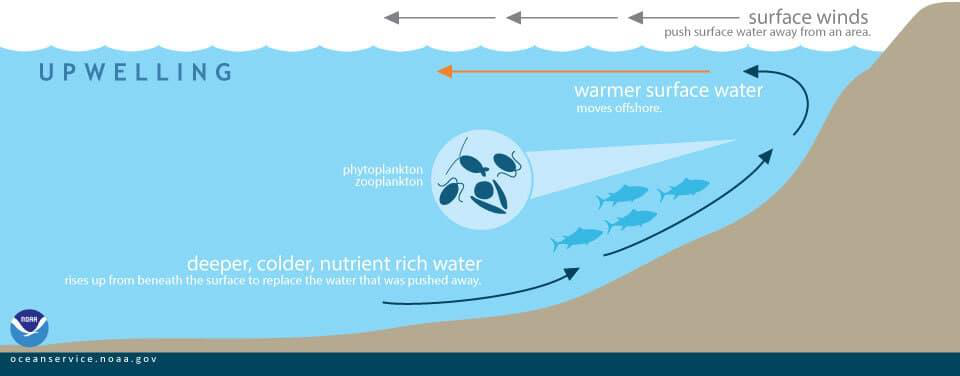
Since this upwelling water comes from great depth, it is relatively cold and brings a large quantity of nutrients to the surface. These nutrients support the growth of phytoplankton, which forms the base of the marine food chain. Regions where upwelling is present are rich fishing grounds — for example, the Peru coast (where the Peru or Humboldt Current creates one of the most productive fishing zones in the world).
Desert Formation and Ocean Currents
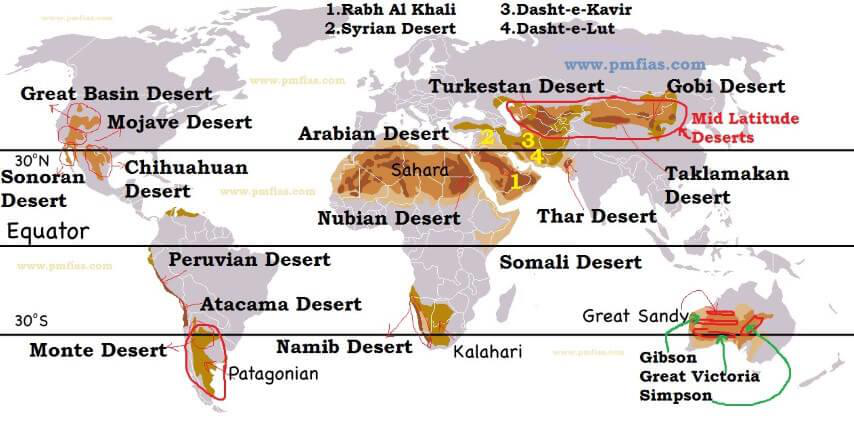
Major hot deserts are located between 20-30 degree latitudes and on the western side of the continents. Why?
- The aridity of hot deserts is mainly due to the effects of off-shore Trade Winds, hence they are also called Trade Wind Deserts.
- The major hot deserts of the world are located on the western coasts of continents between latitudes 15° and 30° N and S. (This has been asked as a question in Previous Mains Exam.)
- They include the biggest desert — the Sahara Desert (3.5 million square miles). The next biggest is the Great Australian Desert. Other major hot deserts include the Arabian Desert, Iranian Desert, Thar Desert, Kalahari Desert, and Namib Desert.
- These hot deserts lie along the Horse Latitudes or the Sub-Tropical High-Pressure Belts where the air is descending — a condition least favorable for precipitation of any kind to take place.
- The rain-bearing Trade Winds blow off-shore (away from the land) and the Westerlies that are on-shore blow outside the desert limits, beyond the 30-degree latitude belt.
- Whatever winds reach the deserts blow from cooler to warmer regions, and their relative humidity is lowered, making condensation almost impossible.
- There is scarcely any cloud in the continuous blue sky. The relative humidity is extremely low, decreasing from 60 percent in coastal districts to less than 30 percent in the desert interiors. Under such conditions, every bit of moisture is evaporated and the deserts are thus regions of permanent drought. Precipitation is both scarce and highly unreliable.
- On the western coasts, the presence of cold currents gives rise to mists and fogs by chilling the on-coming air. This air is later warmed by contact with the hot land, and very little rainfall occurs. The cold current stabilizes the lower atmosphere, preventing the formation of rain-bearing clouds.
- The desiccating effect of the cold Peruvian Current along the Chilean coast is so pronounced that the mean annual rainfall for the Atacama Desert is not more than 1.3 cm — making it one of the driest places on earth.
- Similarly, the cold Benguela Current contributes to the extreme aridity of the Namib Desert in southwestern Africa, and the cold Canary Current reinforces the dryness of the western Sahara Desert.
Atlantification
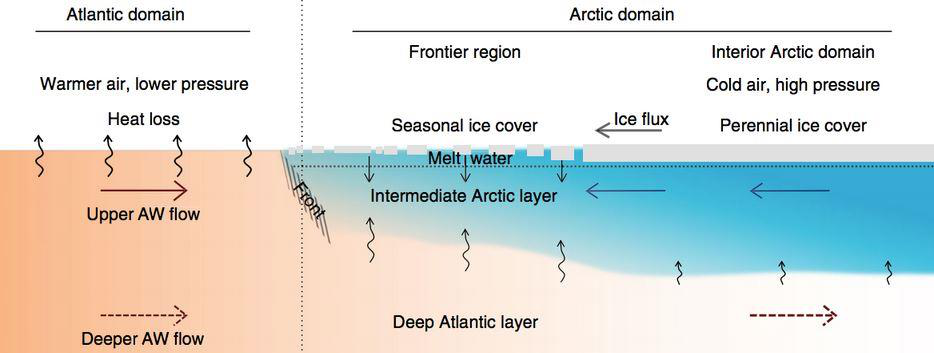
- Streams of warmer water from the Atlantic Ocean flow into the Arctic at the Barents Sea. This warmer, saltier Atlantic water is usually located fairly deep under the more buoyant Arctic water at the surface.
- Lately, however, the Atlantic water has been creeping upward. The heat contained in this Atlantic water is helping to keep ice from forming and is melting existing sea ice from below. This process is called “Atlantification”.
- As a result, the Arctic sea ice is now getting hit from both sides — from the top by a warming atmosphere and at the bottom by a warming ocean.
- Traditionally, the Arctic Ocean was well stratified — with a cold, fresh surface layer sitting above the warmer, saltier Atlantic layer. As global temperatures rise, this stratification is weakening, allowing more heat to reach the surface.
- Atlantification is creating a self-reinforcing cycle — as more sea ice melts, the surface water becomes less insulating, which allows even more heat from below to reach the surface, causing further ice loss.
- Scientists are closely monitoring this process because Atlantification has significant implications for global climate patterns, Arctic ecosystems, and the overall strength of the Atlantic Meridional Overturning Circulation (AMOC).
FAQs
What are ocean currents?
Ocean currents are continuous, directional movements of ocean water driven by forces such as planetary winds, temperature differences, salinity variations, gravity, and the Coriolis force. They can be classified as warm or cold based on the temperature of the water they carry relative to the destination region.
What is the difference between warm and cold ocean currents?
Warm currents carry warm water from lower latitudes towards the poles and are usually found on the east coast of continents. Cold currents carry cold water from higher latitudes towards the equator and are usually found on the west coast of continents. The classification is based on impact on the destination region, not absolute temperature.
What are gyres and how are they formed?
Gyres are large circular systems of ocean currents that rotate around the periphery of ocean basins. They are formed by the combined action of planetary winds, the Coriolis force, and the blocking effect of continental landmasses. In the Northern Hemisphere, gyres rotate clockwise; in the Southern Hemisphere, they rotate counterclockwise.
What is the Sargasso Sea?
The Sargasso Sea is a stagnant body of water located within the North Atlantic Gyre. It is the only sea in the world that has no land boundaries — it is defined entirely by circulating ocean currents. It is named after the Sargassum weed found in it and is an internationally protected area.
How do cold ocean currents cause desert formation?
Cold ocean currents on the western coasts of continents cool the incoming air, creating mist and fog but preventing rain cloud formation. This stabilizes the atmosphere and lowers humidity, making condensation impossible. This is why major hot deserts like the Atacama, Namib, and western Sahara are located on western coasts between 15° and 30° latitudes.
What is Atlantification?
Atlantification is the process by which warmer, saltier water from the Atlantic Ocean intrudes into the Arctic Ocean. This Atlantic water melts sea ice from below and prevents new ice from forming. It is a self-reinforcing cycle — as more ice melts, more heat reaches the surface, causing further ice loss. The Arctic ice is now being hit from above by a warming atmosphere and from below by a warming ocean.
Reference: All images and content are taken from Essentials of Oceanography by Alan P. Trujillo and Harold V. Thurman, 12th Edition.