El-Nino, La-Nina, ENSO, El Nino Modoki
El Niño and La Niña are opposite phases of what is known as the El Niño–Southern Oscillation (ENSO) cycle. ENSO is a recurring climatic pattern that involves changes in the temperature of waters in the eastern and central tropical Pacific Ocean, along with shifts in upper and lower-level winds, sea level pressure, and tropical rainfall patterns across the Pacific Basin.
El Niño is often called the warm phase and La Niña is called the cold phase of ENSO. These shifts from the normal surface temperatures can have large-scale effects on global weather and overall climate.
El Nino
The phrase “El Niño” means “The Christ Child” in Spanish. It was first used by fishermen along the coasts of Ecuador and Peru because the warming of coastal waters typically showed up around Christmas time.
- El Niño is the name given to the occasional development of warm ocean surface waters along the coast of Ecuador and Peru. El Niño events do not happen on a fixed schedule — they occur irregularly at intervals of 2–7 years, though the average is about once every 3-4 years.
- When this warming happens, the usual upwelling of cold, nutrient-rich deep ocean water gets significantly reduced. The cold water that normally comes up from below is blocked by the warm water sitting on top.
- El Niño normally shows up around Christmas and usually lasts for a few weeks to a few months. But sometimes an extremely warm event can develop that goes on for much longer.
- In the 1990s, a strong El Niño developed in 1991 and lasted until 1995. Another major one ran from fall 1997 to spring 1998 — this was one of the strongest El Niño events ever recorded. More recently, the 2015-16 El Niño was also classified as a “super El Niño.”
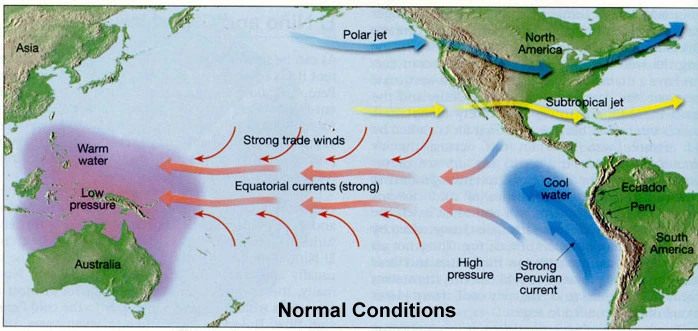
Normal Conditions
- In a normal year, a surface low pressure develops over the region of northern Australia and Indonesia, and a high-pressure system sits over the coast of Peru. Because of this pressure difference, the trade winds over the Pacific blow strongly from east to west.
- This easterly flow of trade winds carries warm surface waters westward, bringing convective storms (thunderstorms) to Indonesia and coastal Australia.
- Along the coast of Peru, cold nutrient-rich bottom water wells up to the surface to replace the warm water that got pulled to the west. This upwelling is what makes the Peruvian coast one of the richest fishing zones in the world.
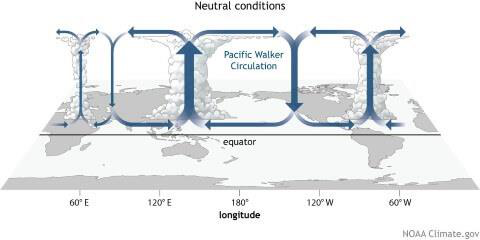
Walker circulation (Occurs during Normal Years)
- The Walker circulation (Walker cell) is caused by the pressure gradient force that results from a high pressure system over the eastern Pacific and a low pressure system over Indonesia.
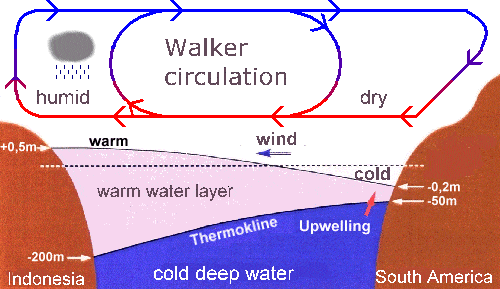
- If you take a cross-section of the Pacific Ocean along the equator, you can see the atmospheric circulation pattern — air rises over Indonesia (where there is low pressure and warm water), moves eastward at the upper levels, descends over the eastern Pacific (where there is high pressure and cold water), and flows back westward along the surface as trade winds. This loop is the Walker Cell.
- The Walker cell is indirectly related to upwelling off the coasts of Peru and Ecuador. The strong easterly trade winds push surface water away from the South American coast, and cold water from below rises to fill the gap. This cold water brings nutrients to the surface, which increases fishing stocks.
- Note the position of the thermocline in this system. In normal conditions, the thermocline is shallow near the South American coast (allowing cold water to reach the surface) and deep near Indonesia (where warm water is piled up).
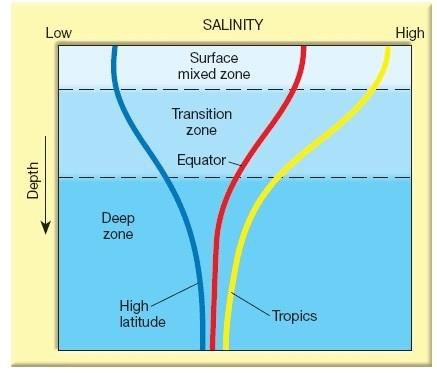
What is the difference between thermocline and Halocline?
A halocline is most commonly confused with a thermocline. A thermocline is a zone in a body of water where temperature drops sharply with depth. A halocline is where salinity changes sharply with depth. These two can overlap and together they form a pycnocline — the zone where density changes rapidly with depth. The pycnocline covers both salinity gradients (halocline) and temperature gradients (thermocline). Haloclines are commonly found in water-filled limestone caves near the ocean.
During El Nino year
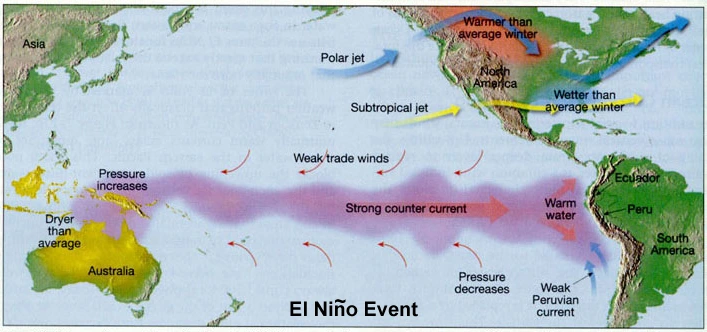
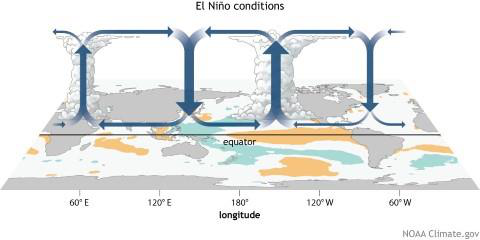
- In an El Niño year, air pressure drops over large areas of the central Pacific and along the coast of South America.
- The normal low-pressure system over Indonesia gets replaced by a weak high in the western Pacific. This flip in the pressure pattern is what we call the Southern Oscillation.
- This pressure change causes the trade winds to weaken, which means a Weak Walker Cell. In severe cases, the Walker Cell can even get reversed — with air rising over the eastern Pacific instead of the western Pacific.
- With the trade winds weakened, the equatorial counter current (the current that flows along the doldrums from west to east) is no longer held back. Warm ocean water starts accumulating along the coastlines of Peru and Ecuador.
- This pile-up of warm water causes the thermocline to drop in the eastern Pacific. With the thermocline pushed deeper, the cold nutrient-rich deep water can no longer reach the surface. Upwelling is effectively shut off.
- The result — drought hits the western Pacific (Australia, Indonesia), heavy rains come to the equatorial coast of South America, and convective storms and hurricanes develop over the central Pacific.
Effects of El Nino
- The warmer waters have a devastating effect on marine life off the coast of Peru and Ecuador. Without cold, nutrient-rich upwelling, the food chain collapses from the bottom up.
- Fish catches off the coast of South America drop sharply compared to normal years (because there is no upwelling to bring nutrients to the surface).
- Severe droughts hit Australia, Indonesia, India, and southern Africa.
- Heavy rains and flooding occur in California, Ecuador, and the Gulf of Mexico.
- Coral bleaching events increase worldwide because of the rise in ocean temperatures. The 2015-16 El Niño triggered one of the worst global coral bleaching events ever recorded.
How El Nino impacts monsoon rainfall in India
- El Niño and Indian monsoons are inversely related. When El Niño is strong, monsoon rainfall in India tends to be below normal.
- The most prominent droughts in India — six of them — since 1871 have been El Niño droughts. This includes the recent ones in 2002 and 2009.
- But here’s the thing — not all El Niño years lead to drought in India. For instance, 1997/98 was a very strong El Niño year but India did not face a drought. Why? Because of a positive IOD (Indian Ocean Dipole) that year, which countered the El Niño effect.
- On the other hand, a moderate El Niño in 2002 caused one of the worst droughts in India. So the strength of El Niño alone does not decide the monsoon — other factors like IOD and MJO also play a role.
- El Niño directly impacts India’s agrarian economy. It tends to lower the production of summer crops like rice, sugarcane, cotton, and oilseeds.
- The final impact shows up as higher food inflation and lower GDP growth, since agriculture contributes around 14% of the Indian economy.
- Latest: As of 2026, climate models indicate a high probability (over 60%) that El Niño conditions may develop between June and July 2026. The IMD has issued a cautious forecast for the 2026 monsoon season, projecting potentially below-normal rainfall if El Niño strengthens.
El Nino Southern Oscillation [ENSO]
- El Niño is about the circulation of water — warm water shifting from the western to the eastern Pacific. The Southern Oscillation is about the circulation of atmospheric pressure — pressure seesawing between the two sides of the Pacific. Most of the time, these two happen together. That is why their combination is called ENSO — El Niño Southern Oscillation.
- Southern Oscillation, in oceanography and climatology, is a coherent inter-annual fluctuation of atmospheric pressure over the tropical Indo-Pacific region.
To understand the difference clearly:
- Only El Niño = Warm water in Eastern Pacific + Cold water in Western Pacific
- Only SO = Low Pressure over Eastern Pacific + High Pressure over Western Pacific
- ENSO = [Warm water in Eastern Pacific + Low Pressure over Eastern Pacific] + [Cold water in Western Pacific + High Pressure over Western Pacific]
When both El Niño and the Southern Oscillation occur together, the combined effect on global weather is much stronger than either one alone.
Southern Oscillation Index and Indian Monsoons
- Southern Oscillation is a see-saw pattern of pressure changes observed between the Eastern Pacific and Western Pacific.
- When the pressure is high over the equatorial Eastern Pacific, it is low over the equatorial Western Pacific — and the other way round.
- This pattern of low and high pressures creates a vertical circulation along the equator. The air rises over the low-pressure area and sinks over the high-pressure area. This is the Walker Circulation.
- The location of low pressure — and the rising limb of the Walker Cell — over the Western Pacific is considered good for monsoon rainfall in India. When this rising limb shifts eastward from its normal position (as it does during El Niño years), monsoon rainfall in India goes down.
- Because of this close connection between El Niño and the Southern Oscillation, the two are jointly referred to as an ENSO event.
- The periodicity of SO is not fixed — it varies from two to five years.
- The Southern Oscillation Index (SOI) is used to measure the intensity of the Southern Oscillation. It is the difference in pressure between Tahiti in French Polynesia (representing the Central Pacific) and Port Darwin in northern Australia (representing the Eastern Indian Ocean/Western Pacific).
- The positive and negative values of SOI (Tahiti pressure minus Port Darwin pressure) are pointers towards good or bad rainfall in India. Positive SOI (high pressure at Tahiti, low at Darwin) = normal conditions = good monsoon. Negative SOI (low pressure at Tahiti, high at Darwin) = El Niño conditions = weak monsoon.
Indian Ocean Dipole effect (Not every El Nino year is same in India)
- Although ENSO was statistically effective in explaining several past droughts in India, in recent decades the ENSO-Monsoon relationship seemed to weaken. For example, 1997 was a strong ENSO year but it failed to cause a drought in India.
- Scientists later discovered that just like ENSO operates in the Pacific Ocean, a similar seesaw ocean-atmosphere system was at play in the Indian Ocean. It was discovered in 1999 and named the Indian Ocean Dipole (IOD).
- The IOD is defined by the difference in sea surface temperature between two poles — a western pole in the Arabian Sea (western Indian Ocean) and an eastern pole in the eastern Indian Ocean south of Indonesia. Hence the name “dipole.”
- IOD develops in the equatorial region of the Indian Ocean from April to May and peaks in October.
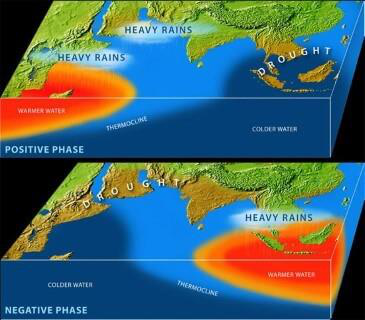
- Positive IOD: Winds over the Indian Ocean blow from east to west (from Bay of Bengal towards the Arabian Sea). The Arabian Sea becomes much warmer and the eastern Indian Ocean around Indonesia becomes colder and dry. A positive IOD generally supports good monsoon rainfall in India.
- Negative IOD: The reverse happens — Indonesia becomes warmer and gets more rain, while the western Indian Ocean cools. A negative IOD tends to suppress monsoon rainfall in India.
- It was demonstrated that a positive IOD often negated the effect of El Niño, resulting in increased monsoon rains even during ENSO years. This happened in 1983, 1994, and 1997.
- The two poles of the IOD — the eastern pole (around Indonesia) and the western pole (off the African coast) — were found to independently and cumulatively affect the quantity of monsoon rains in India.
- Similar to ENSO, the atmospheric component of the IOD was later discovered and named the Equatorial Indian Ocean Oscillation (EQUINOO) — the oscillation of warm water and atmospheric pressure between the Bay of Bengal and the Arabian Sea.
- Latest: As of mid-2026, the IOD is currently neutral but forecasters expect positive IOD conditions to develop by July-August 2026. If this happens, it could help counter the rainfall-suppressing effects of the developing El Niño for the 2026 monsoon season.
Impact on IOD on Cyclogenesis in Northern Indian Ocean
- Positive IOD (Arabian Sea warmer than Bay of Bengal) → more cyclones than usual form in the Arabian Sea.
- Negative IOD → stronger than usual cyclogenesis in the Bay of Bengal. Cyclone formation in the Arabian Sea gets suppressed.
- This is why during positive IOD years, we sometimes see unusual cyclone activity in the Arabian Sea — like Cyclone Kyarr (2019) which was the strongest tropical cyclone recorded in the Arabian Sea in decades.
The El Niño Modoki
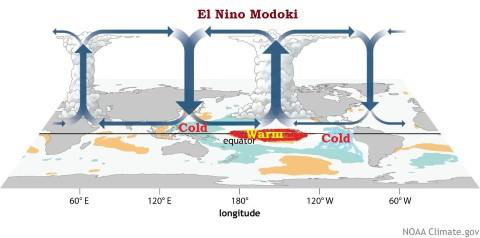
- El Niño Modoki is a coupled ocean-atmosphere phenomenon in the tropical Pacific. “Modoki” is a Japanese word meaning “similar but different.”
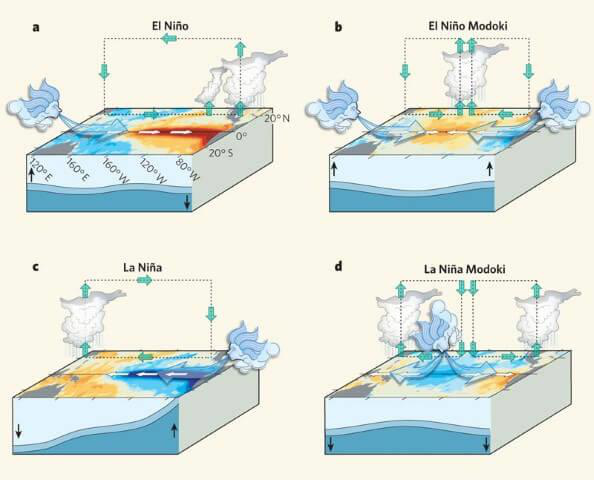
- It is different from conventional El Niño. In a regular El Niño, there is strong anomalous warming in the eastern equatorial Pacific. In El Niño Modoki, the warming happens in the central tropical Pacific, while both the eastern and western tropical Pacific show cooling.
- So the warm water sits in the middle of the Pacific instead of being pushed to the eastern edge.
El Niño Modoki Impacts
- The El Niño Modoki pattern — warm centre flanked by cool regions on both sides — creates a different pressure and wind pattern compared to regular El Niño.
- It results in an anomalous two-cell Walker Circulation over the tropical Pacific, with a wet region sitting in the central Pacific instead of the eastern Pacific.
- The impacts of El Niño Modoki on Indian monsoon are different from regular El Niño. Some studies suggest that Modoki events can actually increase monsoon rainfall in certain parts of India, particularly in the northwest, while regular El Niño tends to reduce it.
- El Niño Modoki also tends to increase drought conditions in Japan and bring wetter conditions in Australia — the opposite of what a regular El Niño does.
La Nina
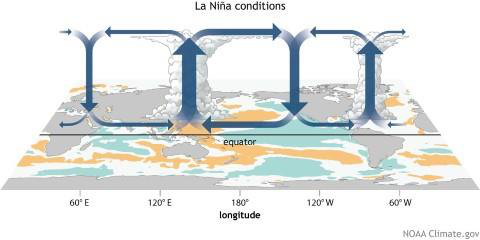
- After an El Niño event, weather conditions usually go back to normal. But in some years, the trade winds become extremely strong and an abnormal build-up of cold water happens in the central and eastern Pacific. This event is called La Niña. “La Niña” means “The Little Girl” in Spanish — the opposite of El Niño.
- A strong La Niña occurred in 1988 and scientists believe it may have been responsible for the severe summer drought over central North America. During this period, the Atlantic Ocean saw very active hurricane seasons in 1998 and 1999.
- One of the hurricanes that developed during this time, named Mitch, was the strongest October hurricane to form in about 100 years of record keeping. It caused massive destruction in Central America.
- La Niña events, like El Niño, do not follow a fixed schedule. They can last anywhere from a few months to a couple of years. A “double-dip” or “triple-dip” La Niña — where La Niña conditions persist across two or three consecutive years — is also possible. The 2020-2023 period saw a rare triple-dip La Niña.
Effects of La Nina
Some of the weather effects of La Niña include:
- La Niña is marked by lower-than-normal air pressure over the western Pacific. These low-pressure zones contribute to increased rainfall in that region.
- Abnormally heavy monsoons in India and Southeast Asia.
- Cool and wet winter weather in southeastern Africa.
- Wet weather in eastern Australia.
- Cold winters in western Canada and the northwestern United States.
- Winter drought in the southern United States.
- La Niña conditions enhance the rainfall associated with the Southwest monsoon in India, but have a negative impact on rainfall associated with the Northeast monsoon (which brings rain to Tamil Nadu and southeast India in winter).
- Rainfall linked to the summer monsoon in Southeast Asia tends to be greater than normal, especially in northwest India and Bangladesh. This generally benefits the Indian economy because agriculture and industry both depend on good monsoon rains.
- Strong La Niña events are associated with catastrophic floods in northern Australia. The 2010-11 La Niña caused some of the worst flooding in Queensland’s history.
- La Niña events bring rainier-than-normal conditions over southeastern Africa and northern Brazil.
- Drier-than-normal conditions are observed along the west coast of tropical South America, the Gulf Coast of the United States, and the pampas region of southern South America.
- La Niña usually has a positive impact on the fishing industry of western South America. The strong trade winds push warm water away, and upwelling brings cold, nutrient-rich water to the surface. These nutrients support plankton growth, which in turn supports fish and crustacean populations.
Madden-Julian Oscillation (MJO)
Madden–Julian Oscillation (MJO) is the largest element of intra-seasonal variability in the tropical atmosphere. It is an oceanic-atmospheric phenomenon that affects weather across the globe.
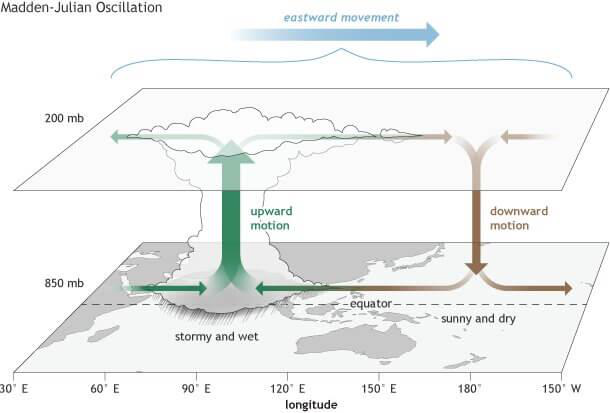
MJO brings major fluctuations in tropical weather on weekly to monthly timescales. You can think of it as an eastward-moving “pulse” of cloud and rainfall near the equator that typically recurs every 30 to 60 days. It travels from west to east and is most prominent over the Indian Ocean and Pacific Ocean.
While El Niño and IOD stay fixed over their respective ocean basins, MJO is a traversing phenomenon — it keeps moving across the globe.
Phases of Madden-Julian Oscillation
The MJO has two parts or phases. Strong MJO activity often splits the tropics into two halves — one half in the enhanced phase and the other in the suppressed phase.
- Enhanced rainfall (convective) phase: Surface winds converge and air gets pushed upward through the atmosphere. At the top, the winds diverge (spread out). This rising motion increases condensation and leads to more clouds and heavier rainfall.
- Suppressed rainfall phase: Winds converge at the top of the atmosphere, forcing air to sink down. As the air sinks from high altitudes, it warms up and dries out. This suppresses cloud formation and rainfall, resulting in clear skies and dry conditions.
- This entire dipole structure — wet on one side, dry on the other — moves from west to east across the tropics. Wherever the enhanced phase passes, there is more cloudiness, rainfall, and storminess. Wherever the suppressed phase passes, there is more sunshine and dry weather.
How Does MJO Affect Indian Monsoon?
- IOD, El Niño, and MJO are all oceanic-atmospheric phenomena that affect weather on a large scale. But there is a key difference — IOD stays over the Indian Ocean, El Niño stays over the Pacific, but MJO keeps moving. It travels through eight phases as it circles the globe.
- When MJO is over the Indian Ocean during the monsoon season, it brings good rainfall over the Indian subcontinent. This is the enhanced convective phase passing over India.
- When MJO has a longer cycle and stays over the Pacific Ocean, it brings bad news for the Indian monsoon. The enhanced phase is too far east to help India.
- MJO is linked with active and break spells of the monsoon. When the MJO pulse is over the Indian Ocean, India experiences active monsoon spells (heavy rain). When it moves past towards the Pacific, India enters a break spell (dry period).
Periodicity of MJO:
- If the MJO cycle is about 30 days, it brings good rainfall during the monsoon season because it visits the Indian Ocean more often in the four-month monsoon window.
- If the cycle stretches to 40 days or more, MJO does not return to the Indian Ocean frequently enough, and the monsoon gets weaker. Could even lead to a dry monsoon.
- Shorter the MJO cycle, better the Indian monsoon. Simply because a shorter cycle means more visits to the Indian Ocean during the monsoon period.
- The presence of MJO over the Pacific Ocean along with an El Niño is the worst combination for monsoon rains. Both factors work together to suppress rainfall over India.
- On the other hand, MJO sitting over the Indian Ocean along with a positive IOD is the best-case scenario — even if El Niño is active, this combination can still deliver good monsoon rains.
FAQs
What is El Nino?
El Nino is the occasional warming of ocean surface waters along the coast of Ecuador and Peru in the eastern Pacific. It occurs irregularly every 2-7 years. During El Nino, trade winds weaken, upwelling of cold nutrient-rich water stops, and the warm water shifts to the eastern Pacific. This causes droughts in Australia, Indonesia, and India, and heavy rainfall in South America.
What is La Nina?
La Nina is the opposite of El Nino. It occurs when trade winds become extremely strong, causing an abnormal build-up of cold water in the central and eastern Pacific. La Nina enhances monsoon rainfall in India and Southeast Asia, brings floods to Australia, and causes drought in the southern United States. It usually benefits the fishing industry along the South American coast due to strong upwelling.
What is ENSO?
ENSO stands for El Nino Southern Oscillation. It is the combined effect of El Nino (ocean water circulation) and the Southern Oscillation (atmospheric pressure seesaw between the eastern and western Pacific). When both occur together, their impact on global weather is much stronger. The Southern Oscillation Index (SOI) measures this by comparing pressure at Tahiti and Port Darwin.
What is the Indian Ocean Dipole (IOD)?
The Indian Ocean Dipole is a seesaw pattern of sea surface temperatures in the Indian Ocean. It has two poles — a western pole in the Arabian Sea and an eastern pole near Indonesia. Positive IOD (warm Arabian Sea, cool Indonesia) supports good monsoon rainfall and can counter El Nino effects. Negative IOD suppresses monsoon rainfall. IOD was discovered in 1999.
What is El Nino Modoki?
El Nino Modoki is a variation of El Nino where anomalous warming occurs in the central Pacific instead of the eastern Pacific. Both the eastern and western Pacific show cooling. “Modoki” is Japanese for “similar but different.” It creates a two-cell Walker Circulation and can have different impacts on the Indian monsoon compared to conventional El Nino.
What is MJO and how does it affect the Indian monsoon?
The Madden-Julian Oscillation (MJO) is an eastward-moving pulse of cloud and rainfall near the equator that recurs every 30-60 days. When MJO passes over the Indian Ocean during monsoon season, India gets good rainfall (active spell). When it moves to the Pacific, India enters a dry spell (break). A shorter MJO cycle (30 days) is better for the monsoon because it returns to the Indian Ocean more frequently.
Reference: All images and content are taken from Essentials of Oceanography by Alan P. Trujillo and Harold V. Thurman, 12th Edition.