- When we talk about changes in sea level, we mean fluctuations in the mean sea level — the average level of the sea surface. So technically, these are relative changes in sea level.
- During a relative rise in sea level, either the land may sink, or the sea surface may rise, or both can happen at the same time. It works both ways — what matters is the relative position of the sea surface compared to the land.
- Latest: According to NASA satellite data, global mean sea level has been rising at approximately 3.4 mm per year since the early 1990s. In 2024 alone, sea level rose by about 5.9 mm — well above the long-term average. The rate of rise has more than doubled over the past three decades.
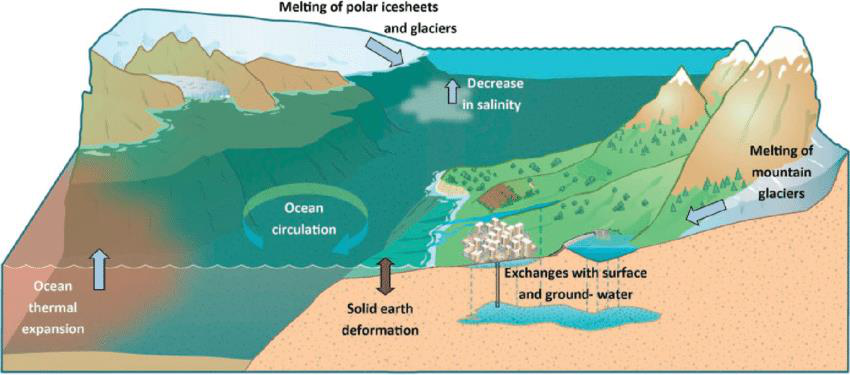
The Major Categories of Change in Sea Level are Mentioned Below
There are two broad types of sea-level change:
1. Eustatic Changes
- Eustatic changes happen when the volume of seawater itself changes. The land stays in place — the water level goes up or down.
- Rise in sea level: When global temperatures go up, ice sheets and glaciers melt. The meltwater flows into the oceans, increasing the volume of ocean water. On top of that, warmer water expands (thermal expansion). Both of these cause the sea level to rise.
- Fall in sea level: During ice ages, huge quantities of water get locked up in glaciers and ice caps on land. This removes water from the ocean, reducing its volume and dropping the sea level. During the last Ice Age, the sea level was about 120-130 metres lower than today.
2. Tectonic Changes
Tectonic changes occur when the level of the land itself changes. The water volume stays roughly the same, but the land moves — either up or down. Tectonic changes happen through three sub-processes:
(a) Isostatic Changes
- Isostatic changes happen due to the addition or removal of weight (load) on the land surface.
- During the Ice Age, massive ice sheets sat on top of land. This tremendous weight pushed the land downward (subsidence). The result — an apparent rise in sea level relative to the coast, even though the total volume of ocean water had actually decreased.
- When the ice melted and the weight was removed, the land started bouncing back up. This process is called isostatic rebound (or post-glacial rebound). Scandinavia is a classic example — it is still rising at a rate of about 1 cm per year because the land is still recovering from the weight of the ice that melted thousands of years ago.
(b) Epeirogenic Movement
- Epeirogenic movement is a broad-scale, gentle tilting of entire continents. There is no folding or faulting involved — just slow uplift or subsidence over very large areas.
- When one part of a continent rises relative to the mean sea level, it looks like the sea is retreating from that coast. At the same time, another part of the same continent may subside, causing an apparent rise in sea level along that coast.
- Think of it like a seesaw — one end goes up, the other goes down. The sea level has not actually changed, but it appears to have changed relative to the land.
(c) Orogenic Movement
- Orogenic movement is related to the folding and flexuring (stretching) of the earth’s crust. This is the process that builds mountain ranges.
- When mountains are formed, the continental crust gets shortened and thickened. The land rises high above the sea level — this creates an apparent fall in sea level relative to the now-elevated landmass.
- The Himalayas, for instance, were formed by the collision of the Indian Plate with the Eurasian Plate. The land was pushed up so high that the relative sea level in that region dropped dramatically.
Relevance of the study of sea-level changes
Why should we study sea-level changes? There are several practical reasons:
- Sea-level records provide key evidence about past climate change. They also give us a benchmark for estimating tectonic uplift rates in earlier geological periods.
- Sea level directly controls the rate and pattern of erosion and deposition along coastlines. When sea level rises, erosion increases. When it falls, new land is exposed.
- By studying sea-level fluctuations, we can assess whether a coastal location is suitable for industrial development — there is no point building a factory in an area that might get flooded in 50 years.
- Sea-level changes determine the availability of agricultural land in coastal areas. Submergence of land in the future could endanger food security.
- By predicting which areas will be submerged, low-lying countries like Bangladesh, the Maldives, and the Netherlands can build coastal dykes and embankments in advance.
- Mapping areas likely to be hit by storm surges and periodic flooding requires knowledge of future sea-level rise.
- Identifying areas of future submergence also helps in selecting suitable locations for tidal power generation plants.
- India-specific: IPCC AR6 projections show that sea levels along the Indian coast have been rising at about 3.7 mm per year since 2000 (up from 1.8 mm/year in the 1970s-80s). Mumbai could see a rise of approximately 76 cm by 2100 under medium-emission scenarios. Kolkata, sitting in the Ganges delta, faces compound risk from sea-level rise, land subsidence, and storm surges.
Mechanisms of the change in sea-level
The fluctuations of sea level involve three basic mechanisms:
- Changes in ocean water volume
- Changes in ocean basin volume
- Changes in the geoid (the shape of the Earth)
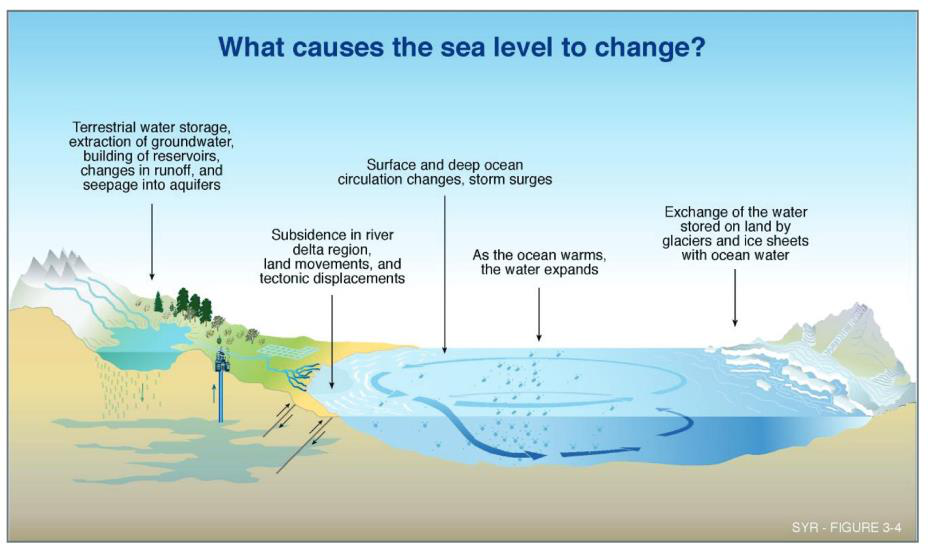
Changes in the Volume of Ocean Water
- If all the ice in Antarctica melts, the present sea level would rise by about 60 to 75 metres. The Greenland ice sheet alone would add another 5 metres to that.
- But here’s the thing — the total rise would not be 65-80 metres. Why? Because the added weight of all that extra ocean water would push the ocean floor downward due to isostatic compensation. The ocean basin would sink under the load.
- So the actual net rise in sea level would be about 40-50 metres — still catastrophic, but less than the raw number suggests.
- The exact isostatic adjustment of the land and ocean in such a scenario is still not clear because we do not have enough data to model it precisely.
- Latest: Greenland has now experienced an unbroken 29-year streak of annual mass loss. In 2024-25, it lost approximately 105-139 gigatonnes (Gt) of ice. Antarctica lost about 82 Gt of ice in 2024.
Changes in the Volume of the Ocean Basin
Changes in the volume of ocean basins were an important event of the Mesozoic Era and the early Cenozoic Era. Such changes happen through:
1. Changes in the volume of mid-oceanic ridges
- This is an important tectonic cause of sea-level rise. Mid-oceanic ridges are underwater mountain chains that run through the ocean floor.
- The volume of these ridges can change due to periodic reorganization of plate boundaries. If the lithosphere is warm, the spreading rate increases → the ridge swells up → its volume increases → it displaces more water → sea level rises.
- If the spreading rate slows down, the ridge cools and shrinks → less water displaced → sea level falls.
2. Accumulation of sediments on the ocean floor
- Rivers and winds carry sediment from the continents and deposit it on the ocean floor. This sediment takes up space in the ocean basin, reducing its volume.
- Less basin volume = water gets displaced upward = sea level rises.
- However, some sediment is also removed through subduction (when ocean floor dives under a continental plate) or upliftment (when ocean floor is pushed up as land). If we ignore these removal processes, the net effect is a rise in sea level.
3. Impact of orogenesis
- Mountain building (orogenesis) causes the continental crust to shorten and thicken. This reduces the total area of the continents.
- When the continent gets smaller, the ocean basin gets bigger. More basin volume = sea level falls.
- This is the opposite of what you might expect — mountain building actually lowers the sea level because it increases the volume of the ocean basin.
Short-Term Changes in Global Sea Level
- Short-term changes happen within a year. Normally, seasonal variations of about 5-6 cm in sea level are observed in a year. But in many coastal areas around the world, the fluctuations can reach 20-30 cm or more.
- The exact causes of all short-term changes are not fully understood. But they are likely due to a complex interaction of several factors:
1. Marine Water Density
- Temperature and salinity control the density of seawater. Low temperature + high salinity = high density = lower sea level. High temperature + low salinity = low density = higher sea level.
- This is why the eastern part of the Pacific Ocean has a sea level 30-50 cm higher than the Atlantic Ocean. The Atlantic is cooler and saltier, so its water is denser and occupies less volume.
2. Atmospheric Pressure
- Low atmospheric pressure = higher local sea level. And vice versa.
- Why? In a low-pressure zone, the air mass is moving upward. This upward pull effectively “sucks” the water surface up. Think of it as the atmosphere pulling the ocean surface upward in areas of low pressure. This is called the inverse barometer effect — for every 1 millibar drop in pressure, the sea level rises by approximately 1 cm.
3. Velocity of Ocean Currents
- Fast-flowing ocean currents, when they take a curved path, cause the sea level to rise on their outer fringes.
- This is due to the centrifugal effect — the same way water in a bucket rises on the outer edge when you spin it. The Gulf Stream, for example, causes measurably higher sea levels along the eastern coast of North America.
4. Ice Formation and Fall in Sea Level
- During winter, ocean water gets trapped in the ice caps of the northern and southern hemispheres. This removes water from the ocean and leads to a temporary, seasonal fall in sea level.
- When summer comes and the ice melts, the water returns to the ocean and sea level rises again. This is one reason why sea level shows seasonal oscillation.
5. Piling Up of Water Along Windward Coasts
- A local rise in sea level happens when wind drives water towards the coast. The water literally piles up against the shoreline.
- For example, the sea level rises along the coasts of South and East Asia during monsoon months. The monsoon winds blow from the ocean towards the land, pushing water onshore. This is a short-lived, seasonal effect.
- This same process causes storm surges during cyclones — strong winds push enormous amounts of water towards the coast, causing sudden and dangerous rises in local sea level.
Twentieth Century Short-Term Rise
- The twentieth century saw a notable short-term global sea-level rise driven by anthropogenic (human-caused) global warming. Burning fossil fuels has warmed the planet, causing the thermal expansion of ocean water — warmer water takes up more space.
- Between 1901 and 2018, global mean sea level rose by approximately 20 cm. The rate has been accelerating — from about 1.3 mm/year in the first half of the 20th century to over 3.4 mm/year in recent decades.
Impact of the Sea-Level Fall
When sea level drops, it has wide-ranging impacts on both landforms and ecosystems:
- Changes in the base level of rivers: When sea level falls, rivers have to cut deeper to reach their new base level. This increases the erosive power of rivers in their lower courses.
- Rejuvenated landforms: Rivers that had reached a state of equilibrium get a new burst of energy. They start cutting deeper valleys, forming terraces and gorges. This process is called rejuvenation.
- Extended shoreline: The coastline moves seaward as previously submerged land gets exposed. New land becomes available.
- Lengthening of rivers: Rivers have to flow a longer distance to reach the sea because the coast has moved further out.
- Death of coral reefs: Coral polyps cannot survive exposure to air. When sea level falls, shallow reefs get exposed above the waterline and the corals die. This happened on a massive scale during the Ice Ages when sea levels dropped by 120+ metres.
- Extension of ice caps: A fall in sea level often coincides with colder temperatures (since both are caused by ice ages). The ice caps extend further towards the equator.
Future Projections: IPCC AR6
- According to the IPCC Sixth Assessment Report (AR6), under a medium-emissions scenario (SSP2-4.5), global sea levels are “likely” to rise between 44-76 cm by 2100 (relative to 1995-2014 levels).
- Under high-emission scenarios, the rise could reach 1 metre or more. The IPCC has stated that a rise of 2 metres by the end of the century cannot be completely ruled out due to “deep uncertainty” about ice sheet processes like marine ice-cliff instability.
- For India specifically, sea levels along the coast have been rising at about 3.7 mm/year since 2000. Under medium-emission scenarios, an additional 15-25 cm of rise by 2050 is projected. Mumbai faces the highest risk — over 10% of its land area could be at risk of submergence by 2040.
- Sea-level rise is considered “virtually certain” to continue for centuries, even if greenhouse gas emissions are reduced to zero today. The ocean takes centuries to fully respond to the warming that has already occurred.
UPSC Previous Year Questions
Q1. (UPSC Prelims 2024) – Terrestrial Radiation
Statement-I: The atmosphere is heated more by incoming solar radiation than by terrestrial radiation.
Statement-II: Carbon dioxide and other greenhouse gases in the atmosphere are good absorbers of long-wave radiation.
- (a) Both correct and II explains I
- (b) Both correct but II does not explain I
- (c) I correct, II incorrect
- (d) I incorrect, II correct ✓
Answer: D — The atmosphere is heated INDIRECTLY by terrestrial radiation (Earth re-emits absorbed solar energy as longwave/infrared radiation → greenhouse gases absorb this). Statement-I is wrong because the atmosphere is heated more by Earth’s radiation, not directly by solar radiation. Statement-II is correct — CO₂ and greenhouse gases do absorb longwave radiation. This is the fundamental mechanism behind sea-level rise due to thermal expansion.
Q2. (UPSC Prelims 2021) – Ocean Temperature & Trade Winds
Consider the following:
1. In the tropical zone, western sections of oceans are warmer than eastern sections due to trade winds.
2. In the temperate zone, westerlies make eastern sections of oceans warmer than western sections.
- (a) 1 only
- (b) 2 only
- (c) Both 1 and 2 ✓
- (d) Neither 1 nor 2
Answer: C — Trade winds push warm surface water WESTWARD in the tropics (making western oceans warmer and causing upwelling of cold water on eastern coasts). Westerlies push warm water EASTWARD in the temperate zone (making eastern sections warmer). This wind-driven water movement is directly linked to sea-level differences — the western Pacific stands about 30-50 cm higher than the eastern Pacific due to water being pushed by trade winds.
FAQs
What are sea-level changes?
Sea-level changes are fluctuations in the mean sea level — the average level of the sea surface. These are relative changes, meaning either the land can move (up or down) or the volume of ocean water can change (increase or decrease), or both can happen simultaneously. The two major categories are eustatic changes (water volume changes) and tectonic changes (land level changes).
What are eustatic changes in sea level?
Eustatic changes happen when the volume of seawater itself changes. When ice sheets melt due to global warming, meltwater enters the ocean and sea level rises. Warmer water also expands (thermal expansion), adding to the rise. During ice ages, water gets locked in glaciers, reducing ocean volume and dropping sea level. The last Ice Age lowered sea levels by about 120-130 metres.
What are isostatic changes?
Isostatic changes occur when weight is added to or removed from the land. During the Ice Age, ice sheets pushed the land down (subsidence), causing an apparent sea-level rise. When the ice melted, the land started bouncing back up — this is called isostatic rebound. Scandinavia is still rising at about 1 cm per year because it is recovering from the weight of ice that melted thousands of years ago.
What causes short-term changes in sea level?
Short-term fluctuations (5-30 cm per year) are caused by five main factors — marine water density (temperature and salinity), atmospheric pressure (low pressure raises local sea level), velocity of ocean currents (curved paths cause rise on outer edges), ice formation during winter (traps water temporarily), and wind piling water along coasts (like during monsoons). These factors interact in complex ways.
How much will sea level rise by 2100?
According to IPCC AR6, under medium-emission scenarios, global sea levels will likely rise 44-76 cm by 2100. Under high-emission scenarios, the rise could exceed 1 metre. A rise of 2 metres cannot be ruled out due to uncertainty about ice sheet instability. For India, sea levels along the coast have been rising at 3.7 mm/year since 2000, and Mumbai could see approximately 76 cm rise by 2100.
What happens when sea level falls?
A fall in sea level causes several changes — rivers cut deeper due to lowered base level (rejuvenation), the shoreline extends seaward exposing new land, rivers lengthen to reach the retreating sea, coral reefs die from exposure to air, and ice caps extend further towards the equator. The last major sea-level fall occurred during the Ice Age when levels dropped by 120+ metres.
Reference: All images and content are taken from Essentials of Oceanography by Alan P. Trujillo and Harold V. Thurman, 12th Edition.