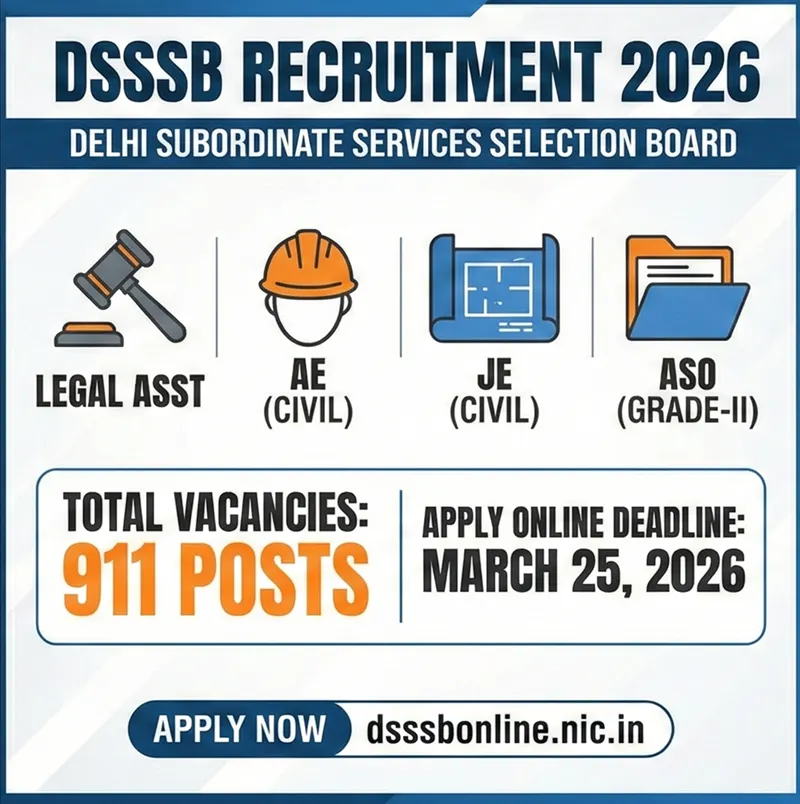
The Delhi Subordinate Services Selection Board (DSSSB) has prescribed specific examination schemes based on the post. Below is the detailed post-wise breakdown:
1. Assistant Engineer (AE) Civil & Junior Engineer (JE) Civil (Post Codes: 802/26 & 803/26)
- Exam Type: One Tier (Technical)
- Total Duration: 3 Hours
- Total Questions: 300 MCQs
- Total Marks: 300 Marks
- Section A (100 Marks): General Awareness, General Intelligence & Reasoning, Arithmetical & Numerical Ability, Hindi Language & Comprehension, English Language & Comprehension. (20 questions/marks each).
- Section B (200 Marks): Multiple Choice Questions (MCQs) of 1 mark each on the subject concerned (Civil Engineering).
2. Legal Assistant (Post Code: 801/26)
- Exam Type: Two Tier (Technical-II)
- Tier-I (2 Hours | 200 Marks):
- Section A (100 Marks): General Awareness, Reasoning, Math, Hindi, and English (20 marks each).
- Section B (100 Marks): Domain/Subject-specific MCQs (1 mark each).
- Note: Tier-I is qualifying in nature for shortlisting candidates for Tier-II.
- Tier-II (3 Hours | 300 Marks):
- Part I (100 Marks): Subject-specific MCQs (1 mark each) covering the qualifying subject syllabus.
- Part II (200 Marks): 100 Advanced level Subject-specific MCQs (2 marks each) to evaluate problem-solving and application of concepts.
3. Grade-II (GNCTDSS) / Assistant Section Officer (Post Code: 804/26)
- Exam Type: Two Tier (General)
- Tier-I (2 Hours | 200 Marks): General Awareness, Reasoning, Numerical Ability, Hindi Language, and English Language. (40 questions/marks per section).
- Tier-II (3 Hours | 300 Marks):
- Part I – Objective (200 Marks): General Awareness, Reasoning, Numerical Ability, English Language, and Computer Proficiency (40 marks each).
- Part II – Descriptive (100 Marks): Essay/Expansion of Ideas in English (50 Marks), Letter/Application Writing in English (25 Marks), Precis Writing in English (25 Marks).
Main Focus Things & Crucial Exam Rules (Must Read)
To ensure candidates don’t make critical mistakes, here are the most important rules and highlights officially mentioned in the DSSSB 01/2026 notification:
- Strict Negative Marking: DSSSB has introduced a split negative marking scheme. A deduction of 0.25 marks will be made for every wrong 1-mark MCQ, and 0.50 marks will be deducted for every wrong 2-mark MCQ.
- Minimum Qualifying Marks: To even be considered for the merit list, candidates must score minimum qualifying marks:
- General/EWS: 40%
- OBC (Delhi): 35%
- SC/ST/PH (PwBD): 30%
- Ex-Servicemen get a 5% relaxation (minimum up to 30%).
- The OBC Category Rule (Very Important): Only OBC (Delhi) candidates are eligible for OBC reservation and age relaxation. Candidates possessing OBC certificates from outside Delhi will be treated as Un-Reserved (UR/General) candidates and must apply under the UR category.
- Post Preference Submission: Candidates applying for Combined Examinations will have to submit their post/department preferences strictly at the time of the online e-dossier calling. Once submitted, this preference is treated as final and irreversible. If a candidate fails to fill out their preference during the e-dossier window, they will not be considered for final selection.
- Normalization of Marks: If the examinations are conducted in multiple shifts, DSSSB will use the “Score Normalization Based on Deviation Method” to ensure fairness in evaluating the difficulty level across different shifts.
- Bilingual Question Papers: All question papers will be set in both English and Hindi, except for the specific Language comprehension sections (which will be in their respective languages).