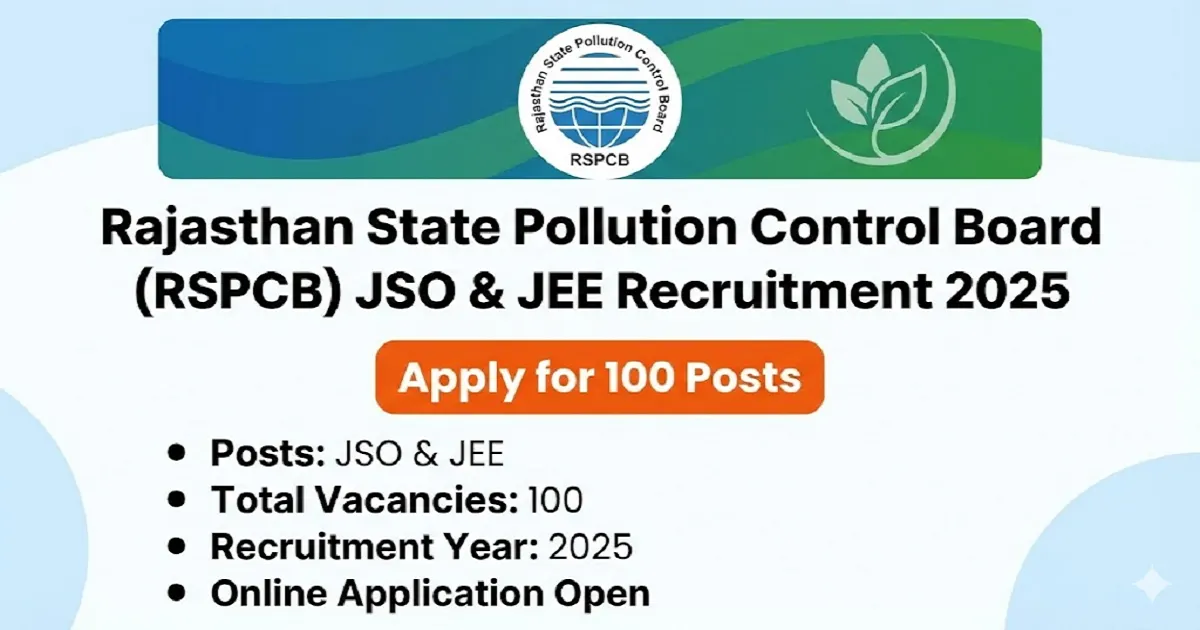
Are you ready to seize a Golden Opportunity in the government sector? The RSPCB Recruitment 2025 is finally here, offering a massive chance for Science and Engineering graduates to secure a prestigious career. The Rajasthan State Pollution Control Board has officially released the notification for 100 elite vacancies of Junior Scientific Officer (JSO) and Junior Environmental Engineer (JEE). This is your gateway to a high-paying government job in Rajasthan with an attractive salary structure (Pay Matrix Level 10-12).
However, time is ticking! Don’t miss the deadline or risk losing this life-changing chance. Many candidates face rejection due to simple application mistakes or waiting until the last date. In this detailed guide, we cover everything you need to know—from the RSPCB Syllabus and eligibility criteria to the direct Apply Online RSPCB link. Read on to ensure your application is flawless and secure your spot in this highly competitive recruitment drive before it’s too late!
Eligibility For JSO & JEE Recruitment 2025
Junior Scientific Officer:-
First Class M.Sc./M.S. in any branch of Chemistry/Soil Science/Environmental Science/Microbiology after B.Sc./B.S. in any discipline of Science from a University established by Law in India or a Foreign Qualification recognized equivalent thereto.
Junior Environmental Engineer:-
M.Tech./M.E. degree in Environmental Engineering after B.Tech./B.E. degree in Biotechnology/ Chemical/Civil/Mining/Environmental/Textile Engineering from a University established by Law in India or Foreign Qualification recognized as equivalent thereto
Or
First Class B.Tech./B.E. Degree in any of the above branches of Engineering from a University established by Law in India or a Foreign Qualification recognized equivalent thereto.
Note:- if a class/division is not awarded, minimum of 60% marks in aggregate shall be considered equivalent to first class/division. If a Grade Point System is adopted, the CGPA will be converted to equivalent marks as per procedure adopted by the respective University/Institution.
Syllabus, Examination Scheme For RSPCB Recruitment 2025):-
JUNIOR SCIENTIFIC OFFICER (Syllabus & Examination Scheme):- PART-A
Environmental General knowledge:
This section will contain questions National/International events related to environment and common understanding of environmental processes, National Green Tribunal Act, 2010, Pollution Indices.
Environmental Impact Assessment/Environmental Legislations in India:
Basic concept of Environmental Impact Assessment and Environment Management Plan, Prediction and assessment of impacts on air, water, biota, noise, cultural and socioeconomic environment, Rapid and comprehensive Environmental Impact Assessment.
Environment (Protection) Act 1986, its amendments and various rules/notification made thereunder, Water (Prevention & Control of Pollution) Act, 1974, Air (Prevention & Control of Pollution) Act, 1981.
Water/Waste Water/Industrial Waste Water Analysis:
Physical, chemical and biological characteristics of water, waste water and Sewage, performance evaluation of waste water treatment system.
Air and Noise Pollution:
Sources of air pollution; Properties of air pollutants; Meteorological factors influencing dispersion of air pollutants, Gaussian plume model for dispersion of air pollutants and its application; Effects on human health. Control technology for particulate and gaseous pollutants from industries. Air pollution due to Automobiles and emission control; Principles of measurements and equipment use for major parameters (Water/Air/Noise), Basics of noise pollution, Measurement and management of noise and effects on human beings, Ambient Air Quality standards & Air Quality Index.
Municipal Solid Waste, Biomedical Waste, E-Waste, Plastic Waste and Hazardous Solid Waste:
Problems associated with Solid Waste viz; municipal, biomedical, hazardous, e-waste, plastic waste etc., its generation, classification, characterization, analysis, treatment, reuse, recycle etc., Risk associated with hazardous waste & its Assessment; Waste Minimization; Priorities in hazardous waste management; hazardous waste treatment.
PART-B
General Knowledge (with special reference to history, art, culture, traditions, literature, heritage and geography of Rajasthan), Mathematics, reasoning and current affairs.
Examination Scheme:
There will be one paper consisting of two parts having multiple choice type questions. There will be total 75 numbers of questions of 3 marks each. The question paper will be in Hindi and English (Bilingual).
| Paper-Subject | No. of questions | Time | Total Marks |
| PART-A | 060 | 90 Minutes | 225 |
| PART-B | 015 | ||
| Note: -(1) Each Question will carry 3 marks. | |||
| (2) One mark will be deducted for each incorrect answer. | |||
| (3) 40% shall be the pass mark. | |||
JUNIOR ENVIRONMENTAL ENGINEER (Syllabus Examination Scheme):- PART-A
Environmental General Knowledge:
This section will contain questions on National/International events related to environment and common understanding of environmental processes, National Green Tribunal Act, 2010, Pollution Indices.
Water/Waste Water/Industrial Waste Water Engineering:
Unit processes/Operations related to water and waste water treatment, namely Equalization Coagulation; Flocculation; Settling; filtration; Disinfection; Aeration; Adsorption etc.
Physical, chemical and biological characteristics of water and Sewage; Activated sludge process and its modifications; treatment ponds and aerated lagoons; Trickling filters; Rotating biological contactors; Sequencing Batch reactor and Membrane Batch Reactor.
Anaerobic digestion; Anaerobic filter and UASB, Nitrification & De- nitrification.
Characteristics and treatment of waste water from Textile, Tannery, Dairy, Distillery, Pharmaceutical Industry, Organic Chemical, Vegetable Oil Refinery.
Air and Noise Pollution:
Sources of air pollution; Properties of air pollutants; Meteorological factors influencing dispersion of air pollutants; Gaussian plume model for dispersion of air pollutants and its applications, Effects on human health. Control technology for particulate and gaseous pollutants from industries. Air pollution due to Automobiles and emission control; Basic of noise pollution, Measurement and management of noise. Permissible noise levels in different zones, Effects of noise on human beings, Ambient Air Quality standards & Air Quality Index.
Environmental Impact Assessment/Environmental Legislations in India:
Basic concept of Environmental Impact Assessment, Environmental Impact Statement and Environment Management Plan; Prediction and assessment of impacts on air, water, biota, noise, cultural and socioeconomic environment; Rapid and comprehensive Environmental Impact Assessment. Environment (Protection) Act 1986, its amendments and various rules/notification made thereunder. Water (Prevention & Control of Pollution) Act, 1974, Air (Prevention & Control of Pollution) Act, 1981.
Municipal Solid Waste, Biomedical Waste, E-Waste, Plastic Waste and Hazardous Solid Waste:
Problems associated with Solid Waste viz; municipal, biomedical, hazardous, e-waste, plastic waste etc., its generation; classification; characterization; analysis; Onsite Collection Handling, storage Transport and Processing of solid waste; Recovery of Resources, Conversion Products and Energy generation from solid waste. Hazardous waste definition; Risk associated with hazardous waste & its Assessment; Waste Minimization; Priorities in hazardous waste management; hazardous waste treatment.
PART-B
General Knowledge (with special reference to history, art, culture, traditions, literature, heritage and geography of Rajasthan), Mathematics, reasoning and current affairs.
Examination Scheme:- There will be one paper consisting of two parts having multiple choice type questions. There will be total 75 numbers of questions of 3 marks each. The question paper will be in Hindi and English (Bilingual).
| Paper-Subject | Total Marks | ||
| PART-A | 225 | ||
| PART-B | |||
| Note:- (1) Each Question will carry 3 marks. | |||
| (2) One mark will be deducted for each incorrect answer. | |||
| (3) 40% shall be the pass mark. | |||
PAYMENT OF FEES:
ONLINE MODE
- The application form is integrated with the payment gateway and the payment process can be completed by following the instructions.
- The payment can be made by using Debit Cards (RuPay/Visa/MasterCard/Maestro), Credit Cards, Internet Banking, IMPS, Cash Cards/ Mobile Wallets.
- After submitting your payment information in the online application form, PLEASE WAIT FOR THE INTIMATION FROM THE SERVER. DO NOT PRESS BACK OR REFRESH BUTTON IN ORDER TO AVOID DOUBLE CHARGE.
- On successful completion of the transaction, an e-Receipt will be generated.
- Non-generation of ‘E-Receipt’ indicates PAYMENT FAILURE. On failure of payment, Candidates are advised to login again using their Provisional Registration Number and Password and repeat the process of payment.
- Candidates are required to take a printout of the e-Receipt and online Application Form containing fee details .Please note that if the same cannot be generated, online transaction may not have been successful. 7. For Credit Card users: All charges are listed in Indian Rupee. If you use a nonIndian credit card, your bank will convert to your local currency based on prevailing exchange rates.
- To ensure the security of your data, please close the browser window once your transaction is completed.
- There is facility to print application form containing fee details after payment of fees.
FAQs
What is the start date to apply for RSPCB JSO & JEE Recruitment 2025?
The online application starts on November 26, 2025.
What is the last date for the RSPCB Recruitment 2025?
The last date to apply online is December 16, 2025.
How many vacancies are released in RSPCB 2025 Notification?
There are a total of 100 vacancies (27 for JSO and 73 for JEE).
What is the age limit for RSPCB JSO and JEE posts?
Candidates must be between 18 and 40 years of age as of 01.01.2026.
What is the salary for the JSO post in RSPCB?
The Junior Scientific Officer (JSO) post is under Pay Matrix Level-12.