
Let me ask you something directly.
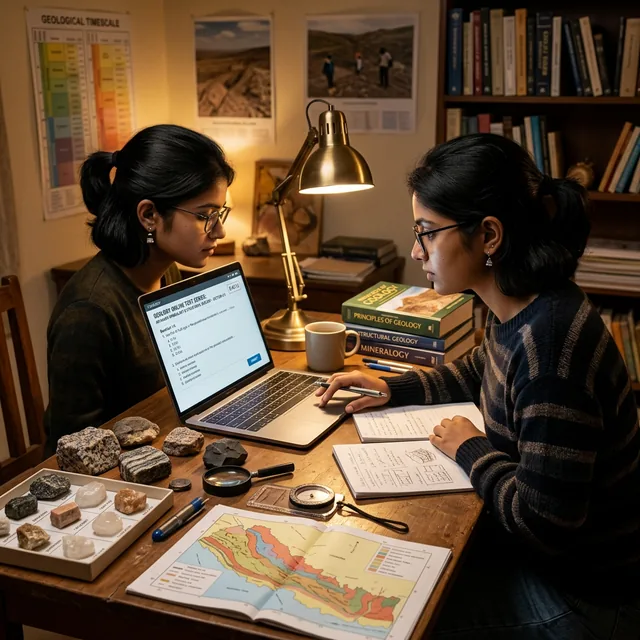
You have probably spent four to five years studying Geology at the postgraduate level. You understand Bowen’s Reaction Series, the Barrovian metamorphic zones, the intricacies of Indian stratigraphy, and the genesis of ore deposits. You have the knowledge. But have you ever sat in front of a computer screen, with a timer counting down from two hours, and answered 120 tricky objective questions on Geology while simultaneously worrying about negative marking?
If you have not, you are not truly prepared for the UPSC Combined Geo-Scientist Examination (CGSE) 2027.
This is the gap that destroys bright students every year. They prepare hard in isolation, but they have never experienced the pressure of a real exam simulation. They know the concepts but freeze when they see a two-statement question where both statements appear correct. They run out of time in Paper I (General Studies) because they never practiced managing both papers in a single sitting.
That is the gap we built the StudyHUB UPSC GSI Pre-Test Series (GS + Geology) 2027 to eliminate. And we have done it at a price that every Indian student can afford: just Rs. 499, with complete access valid until 28th February 2027.
Understanding the Exam You Are Actually Preparing For
Before we go deeper into the test series, let us understand the beast. The UPSC Combined Geo-Scientist Examination 2027 is a three-stage, all-India competitive examination conducted by the Union Public Service Commission. Clearing it leads to recruitment into some of the most respected scientific positions in the country — Geologist and Scientist B in the Geological Survey of India (GSI), Junior Hydrogeologist in the Central Ground Water Board (CGWB), and related Group-A Gazetted posts.
Stage 1: The Prelims (400 Marks, Objective Type)
The Prelims is a Computer-Based Test happening on a single day. Two papers, back-to-back:
- Paper-I: General Studies — 100 marks, 2 hours. Common for all streams. Tests Current Affairs, History, Geography, Polity, Economy, Environment, and General Science.
- Paper-II: Geology (for Geology/Hydrogeology discipline) — 300 marks, 2 hours. Tests your core subject knowledge at the M.Sc. level. Each correct answer earns 2.5 marks. Each wrong answer deducts 0.833 marks.
The marks from Prelims are directly counted in the final merit. This is not just a qualifying test. If you score 320 in Prelims, you already have a massive head start over someone who scored 270, even if they later score identically in the Mains.
Stage 2: The Mains (600 Marks, Descriptive Type)
The Mains consists of three descriptive papers (each 200 marks), typically involving diagram-rich, concept-heavy essay writing. This stage rewards candidates who have crystal-clear conceptual understanding and strong answer-writing discipline.
Stage 3: Personality Test / Interview (200 Marks)
The personality test at UPSC Bhavan tests your presence of mind, communication, and suitability for a high-level government scientific role.
The point is: the Prelims is where most aspirants are eliminated. Winning the Prelims with a high score is how you set yourself apart. And the only way to win the Prelims is to practice — aggressively and consistently — under real exam conditions.
Paper-I General Studies: The One Topic That Separates Winners from Repeaters
Be honest with yourself. How much time are you currently spending on the GS paper?
If your answer is “not much,” you are not alone. Geology students, by nature, tend to be deeply specialized. They have spent years in labs, in the field, studying petrographic slides and geological maps. The idea of studying Indian Polity and Current Affairs feels alien — almost insulting to their science background.
But here is what the data tells us: the GS paper is the single biggest differentiator in the Prelims cutoff battle. In a field where perhaps 300 marks of Geology scores are clustered closely together, a 10-to-15 mark advantage in GS can mean the difference between making it to the Mains and going home empty-handed.
The UPSC GSI Paper-I GS syllabus covers the following topics:
- Current Events of National and International Importance
- History of India and the Indian National Movement
- Indian and World Geography (Physical, Social, Economic)
- Indian Polity and Governance (Constitution, Political System, Panchayati Raj, Rights Issues)
- Economic and Social Development (Poverty, Sustainability, Social Sector)
- Environmental Ecology, Bio-diversity, and Climate Change
- General Science (Physics, Chemistry, Biology)
You do not need to become a GS scholar. You need to score a solid 35–45 marks out of 100, targeting the most high-yield, frequently tested topics. Our UPSC GSI GS test series is designed precisely for this strategy.
Inside the StudyHUB Test Series: A Complete Breakdown of Both Papers
Now let us get into the meat of what you actually get when you enroll in the UPSC GSI Pre-Test Series (GS + Geology) 2027 at StudyHUB.

Section A: Paper-I General Studies Tests
Our GS module is divided into two sub-sections: Topic-Wise Tests and Full-Length GS Mock Tests. Here is the complete list:
Topic-Wise GS Tests:
- Economy Tests 1, 2, and 3 — Covers Budgets, GDP, Poverty, Social Sector Schemes
- Environment Tests 1, 2, 3, and 4 — Ecology, Biodiversity, Climate Change, National Parks
- Geography Tests 1, 2, 3, and 4 — India’s Physical Divisions, Rivers, Monsoon, World Geography
- History Tests 1, 2, 3, and 4 — Ancient to Modern, Freedom Struggle, Key Personalities
- Polity Tests 1 and 2 — Constitution, Parliament, Panchayati Raj, Judiciary
- Biology Tests 1 and 2 — Cell Biology, Human Physiology, Ecology (Basic)
- Physics Tests 1, 2, and 3 — Mechanics, Thermodynamics, Optics, Modern Physics (Basic)
GS Full-Length Mock Tests:
- GS Mock Test 1 to 6 (CGSE Pattern) — Each test simulates the real Paper-I in terms of marks, difficulty, and time limit.
GS E-Notes and Reference Materials:
- Polity E-Notes Book for UPSC GSI
- Indian Constitution and Indian Polity (Civil Services Prelims level)
- Indian History for UPSC CGSE with Sample Free Preview
- Environment and Ecology for UPSC CGSE with Sample Preview
- Indian Polity Daily Revision Notes
Section B: Paper-II Geology Tests
This is the core engine of the test series. We have built a massive, comprehensive battery of topic-wise tests and full mock tests covering the entire UPSC GSI Geology syllabus 2027.
Topic-Wise Geology Tests:
- Structural Geology Tests 1, 2, and 3 — Folds, Faults, Stress-Strain, Stereographic Projections
- Geomorphology Tests 1, 2, and 3 — Landforms, Processes, Tectonic Geomorphology
- Economic Geology Tests 1 and 2 — Ore Genesis, Ore Classifications, Indian Mineral Deposits
- Hydrology and Hydrogeology Tests 1 and 2 — Darcy’s Law, Aquifer Types, Groundwater Chemistry
- Paleontology Tests 1, 2, and 3 — Invertebrate Morphology, Evolution Trends, Microfossils
- Igneous Petrology Tests 1, 2, and 3 — Magma Types, IUGS Classification, Bowen’s Series, Crystallization
- Metamorphic Petrology Tests 1, 2, and 3 — Facies, Barrovian Zones, Pressure-Temperature Paths
- Sedimentary Petrology Tests 1, 2, 3, and 4 — Textures, Structures, Environments, Diagenesis
- Stratigraphy Tests 1, 2, and 3 — Indian Stratigraphy, Stratigraphic Nomenclature, Geological Time Scale
- Mineralogy and Crystallography Tests 1, 2, 3, and 4 — Silicate Groups, Optical Properties, Crystal Systems
Full-Length Geology Mock Tests (CGSE Pattern):
- CGSE Geology Full Mock Tests 1 through 10 — Simulates the exact 300-mark Paper-II in 2 hours
- 2026 Geology Full Mock Tests 1 through 10 — Based on updated trends from the 2026 cycle
Geology E-Notes and Study Material:
- Economic Geology (Free Preview)
- Mineralogy and Crystallography
- Indian Stratigraphy
- Ore Minerals and Deposits
- Chronological Subdivisions
- Geology Common Part
- Orogeny
- Petroleum Resources of India (Free Preview)
- Coal Resources of India

Why StudyHUB’s GSI Test Series Offers the Best Value in India
Let us talk about what your money actually gets you — because when you compare what is available in the market, the difference is genuinely hard to believe.
If you search for UPSC GSI online coaching and test series in India, you will find that most comprehensive programs charge anywhere from Rs. 5,000 to Rs. 20,000 or more. Some platforms charge separately for GS and Geology, meaning you end up paying multiple fees just to cover both papers. And many of these programs have validity periods of just a few months, putting unnecessary pressure on your study timeline.
Now consider what you are getting from StudyHUB for a single, all-inclusive enrollment:
- Over 20 full-length Geology mock tests (CGSE Pattern)
- 6 full-length GS mock tests
- 30+ topic-wise tests covering every chapter in both Paper-I and Paper-II
- Complete E-Notes for Geology, General Studies, and Polity
- Uninterrupted access until 28th February 2027
- Everything for just Rs. 499 — a single, one-time payment
We are not cutting corners on quality to offer you this price. We built this test series because we believe that a postgraduate student who has dedicated four to five years to studying Geology should not have to spend a month’s salary just to practice for an exam. Quality preparation must be accessible to every deserving student in India, regardless of their financial background. That is the philosophy behind Rs. 499, and it is a promise we intend to keep.
How Serious Students Should Use This Test Series: A Week-by-Week Strategy
Enrolling is the easy part. Winning the GSI exam requires a disciplined study plan that combines your regular reading with systematic test practice. Here is how we recommend using the StudyHUB UPSC GSI test series for maximum impact:
Phase 1: Foundation Building (Month 1 through Month 6)
During this phase, you are primarily building your conceptual base. Read your standard books for each Geology topic — Dana for Mineralogy, Billings for Structural Geology, Kummel for Paleontology, and so on. Read NCERT books for Geography and Laxmikanth for Polity.
How to use the test series: After finishing each individual chapter or topic, immediately attempt the corresponding topic-wise test on StudyHUB. Attempting the Mineralogy Tests right after finishing your crystallography reading is one of the most effective learning techniques in competitive exam preparation. This reinforces the concept and shows you exactly where your understanding is still fuzzy.
Phase 2: Integration and Practice (Month 7 through Month 10)
By this phase, you should have covered the majority of both the GS and Geology syllabi. Start attempting the CGSE Geology Full Mock Tests (Tests 1 to 10) and the GS Full Mock Tests (Tests 1 to 6). Attempt one full geology mock and one full GS mock every week. Review and analyze every single question you got wrong.
How to use the test series: Pay close attention to which topic is costing you the most marks. If Stratigraphy and Paleontology are your weak zones, go back to the topic-wise tests for those subjects and redo them. This analytics-driven feedback loop is what separates toppers from also-rans.
Phase 3: Maximum Intensity (Month 11 until February 2027)
This is the final stretch. Attempt all remaining full mock tests, including the 2026 Geology Full Mock Tests. By now, you should be taking a full Paper-I GS simulation followed two hours later by a full Paper-II Geology simulation — exactly mirroring the real exam structure. This builds the mental stamina and time management skills needed to maintain focus across a gruelling 4-hour exam day.
Who Exactly Is This Test Series Designed For?
The StudyHUB UPSC GSI Pre-Test Series 2027 is built for:
- Fresh Geology/Earth Science M.Sc. Graduates planning to target the 2027 exam cycle in their first real attempt.
- Repeaters who appeared in GSI 2026 and want to correct specific weak areas identified in the previous attempt.
- GATE and NET Geology students who want a supplementary GSI-specific objective practice resource alongside their other preparation.
- Working Professionals in Earth Sciences who are targeting a lateral move into the GSI or CGWB but need flexible, self-paced study material.
If you fall into any of these categories, you would be making a genuine mistake in not enrolling for Rs. 499.
Frequently Asked Questions
What is the syllabus for the UPSC Combined Geo-Scientist Exam 2027?
The UPSC GSI Prelims syllabus consists of two papers. Paper-I covers General Studies including History, Geography, Polity, Economy, Environment, and General Science. Paper-II covers Geology at the M.Sc. level, including Physical Geology, Structural Geology, Mineralogy, Petrology, Paleontology, Stratigraphy, Economic Geology, and Hydrogeology.
How many tests are included in the StudyHUB GSI 2027 Test Series?
The course includes over 100 tests in total — including 20+ full-length Geology mock tests, 6 full-length GS mock tests, and 30+ topic-wise tests across all major chapters of both Paper-I and Paper-II.
Until when is this test series valid?
The test series is valid until 28th February 2027. You get almost a full year of uninterrupted, unrestricted access from the date of enrollment.
What is the price?
The entire course — both GS and Geology — is priced at just Rs. 499/-. This is one of the most affordable and comprehensive test series available in India for the UPSC Combined Geo-Scientist Examination.
Is this test series suitable for both GSI 2026 and 2027?
Yes. The course includes dedicated 2026 cycle full mock tests in addition to the standard 2027-oriented tests, making it valuable for students targeting either exam cycle.
Your GSI Journey Starts with a Single Enrollment
There has never been a better time to start preparing for the UPSC Geoscientist Recruitment 2027. Every week you wait is a week your competition uses to practice, identify their weaknesses, and get sharper.
For just Rs. 499 — less than a dinner out — you can gain access to the most comprehensive, syllabus-mapped, CGSE-pattern test series available online today. Over 100 tests. Both papers. E-Notes included. Valid all the way to February 2027.
Stop reading about preparation. Start doing it.
🎯 Enroll Now and Start Practicing Today:
👉 UPSC GSI Pre-Test Series (GS + Geology) 2027 — Rs. 499 | Valid Till 28 Feb 2027
Found this article helpful? Share it with every geology postgraduate you know who is targeting the GSI exam. Drop your questions about the UPSC GSI syllabus, strategy, or this test series in the comments below — we respond to every single one.