Last Updated: March 2026 | Reading Time: 10 minutes | ~2,200 words | Category: Plate Tectonics
The boundaries between tectonic plates are the most geologically active zones on Earth — the sites where the vast majority of earthquakes, volcanoes, mountain ranges, and ocean trenches are produced. There are three fundamental types of plate boundaries, defined by the relative motion of the two plates meeting at each boundary: Divergent (plates move apart, new crust is created), Convergent (plates move toward each other, crust is destroyed or deformed), and Transform (plates slide horizontally past each other, crust is neither created nor destroyed). Each type produces a distinctive suite of geological features — and understanding these features, together with the global and Indian examples of each, is essential for UPSC, SSC, NDA, and state PCS competitive exams. India sits at the intersection of multiple plate boundaries: the Himalayan belt (one of Earth’s grandest convergent boundaries), the Andaman-Nicobar arc (a subduction convergent boundary), the Carlsberg and Southwest Indian Ridges (divergent boundaries creating the Indian Ocean), and the Owen Fracture Zone (transform boundary in the Arabian Sea). No country on Earth has a more dramatic interplay of all three plate boundary types than India.
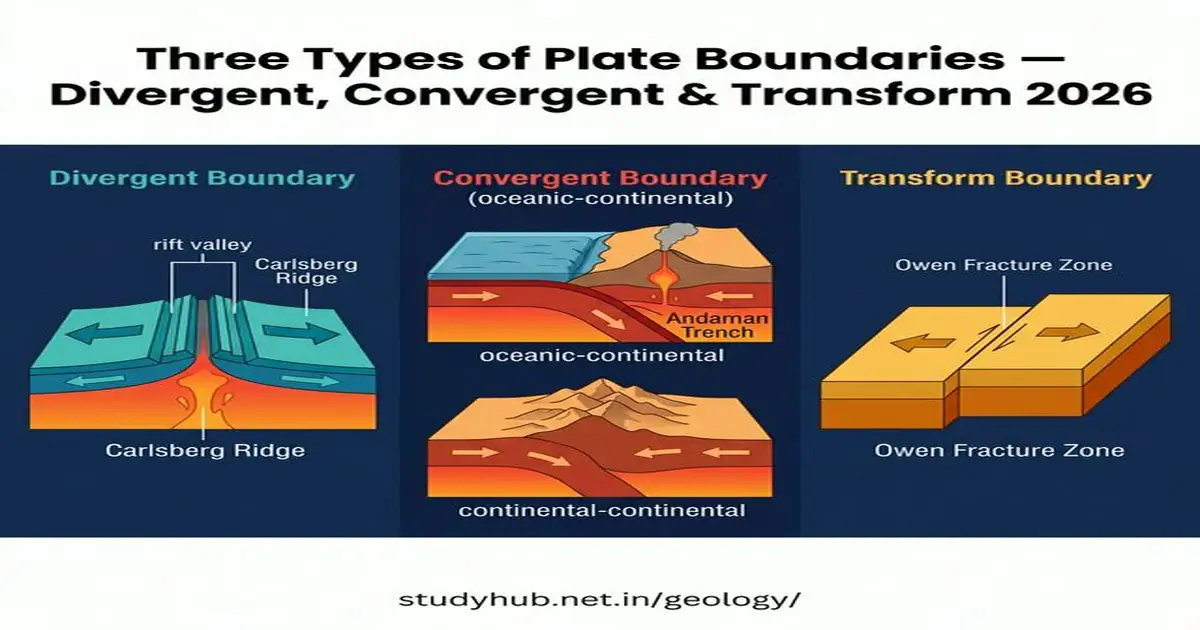
Types of Plate Boundaries — Divergent, Convergent & Transform Explained 2026
1. Divergent Plate Boundaries (Constructive Margins)
| Feature | Details |
|---|---|
| Definition | Plates move APART. Magma from the asthenosphere wells up to fill the gap → new oceanic (or continental) crust is continuously created. Also called “constructive margins” because new lithosphere is constructed here |
| Driving Force | Ridge push (the elevated ridge topography creates a gravitational sliding force) + mantle upwelling beneath the ridge. Decompression melting of asthenospheric peridotite as pressure drops → basaltic melt → erupts as pillow lavas at ridge crest |
| Features Formed | Oceanic divergence: Mid-ocean ridges (underwater mountain chains: 2,000–3,000 m above ocean floor); Central rift valley (slow-spreading ridges only — deep axial graben, 30–50 km wide, 1–3 km deep); Pillow lavas; Hydrothermal vents (black smokers — superheated seawater reacting with fresh basalt); Shallow earthquakes (always <70 km depth — thin, hot lithosphere). Continental divergence: Rift valley (initial opening, e.g., East African Rift); Grabens and horsts; Flood basalts; Eventually → new ocean basin forms (e.g., Red Sea = young ocean, Gulf of Aden = slightly older) |
| Earthquake Type | Shallow focus only (0–70 km). Normal (extensional) fault earthquakes. Low to moderate magnitude. No volcanoes at transform offsets of mid-ocean ridges (fracture zones) |
| Volcanism | Basaltic (mafic) volcanism — low silica, low viscosity, effusive (not explosive). MORB (Mid-Ocean Ridge Basalt) — the most abundant rock type on Earth’s surface (covering nearly 70% of Earth’s surface area under oceans). Hotspot volcanism occasionally superimposed (Iceland: straddles Mid-Atlantic Ridge + sits on Iceland mantle plume) |
| Global Examples | Mid-Atlantic Ridge (separating North and South America from Europe and Africa; Iceland straddles it at surface); East Pacific Rise (fastest spreading, Pacific); East African Rift (continental divergence — Kenya, Ethiopia, Tanzania; Lake Tanganyika, Lake Malawi = rift lakes — future ocean forming); Red Sea Rift (Arabia separating from Africa — very young ocean, <30 Ma, still in early stage: flooded rift valley) |
| India Examples | Carlsberg Ridge (NW Indian Ocean, 2.5 cm/yr total, separates Indian Plate from African/Somali Plate — created the Arabian Sea); Southwest Indian Ridge / SWIR (separates Indian from Antarctic Plate, 1.4 cm/yr — one of Earth’s slowest, deep rift valley); Southeast Indian Ridge / SEIR (separates Australian from Antarctic Plate); Andaman Sea backarc rift (minor oceanic spreading behind the Andaman Arc — Andaman Sea itself is an actively opening ocean basin) |
2. Convergent Plate Boundaries (Destructive Margins)
| Sub-Type | Plates Involved | Features Formed | India / Global Examples |
|---|---|---|---|
| Oceanic-Continental Convergence (Andean Type) | Dense, thin oceanic plate subducts beneath less dense, thicker continental plate. The oceanic plate cannot resist the density contrast — it always sinks | Ocean trench (deepest features on Earth; 6–11 km below sea floor); Volcanic arc on continental side (andesitic composition — higher silica, more viscous, explosive eruptions); Accretionary prism/wedge (scraped-off oceanic sediments); Fold-and-thrust belt; Intermediate earthquakes (70–300 km) + deep earthquakes (300–700 km) in descending slab (Wadati-Benioff zone) | Andes Mountains (Nazca oceanic plate subducting under South American continental plate — producing the world’s classic example); Cascades (Juan de Fuca under North American plate); Japanese example: Pacific plate subducting under Eurasian plate producing Japan’s volcanic arc |
| Oceanic-Oceanic Convergence (Island Arc Type) | Two oceanic plates converge; the older/denser/cooler one subducts beneath the younger/warmer one | Deep ocean trench; Volcanic island arc (andesitic/basaltic composition); Accretionary wedge; Forearc basin (between arc and trench); Backarc basin (extensional rifting behind the arc — sometimes producing new oceanic crust); Wadati-Benioff zone (shallow + intermediate + deep earthquakes in slab) | Mariana Trench (Pacific plate subducting under Philippine plate — deepest point on Earth, 11,034 m); Tonga Trench (Pacific under Australian/Pacific); Andaman-Nicobar Islands (India): Indian oceanic plate subducting under Burma Plate (Sunda Arc) producing Andaman Arc — volcanic islands including Barren Island (India’s only active volcano) and Narcondam Island |
| Continental-Continental Convergence (Himalayan Type / Collision) | Two continental plates converge. Neither can subduct (continental crust is too buoyant — low density, 2.7 g/cm³ — to sink into denser mantle). Instead, crust thickens, buckles, and shortens → high mountain ranges | No ocean trench (no subduction of continental crust). No arc volcanism (no subducting slab to dehydrate and generate magma). Intense folding and thrusting → thrust belts and nappes; Crustal thickening (Moho deepens to 70 km under Himalayas); High mountains; Shallow-to-intermediate earthquakes; Suture zone (where ocean once was, now marked by ophiolites = fragments of Tethys Ocean floor) | Himalayas (Indian continental plate colliding with Eurasian continental plate, ~50 Ma–present; still active at 5 cm/yr convergence); Alps (African Plate colliding with Eurasian Plate — Tethys Ocean closure); Zagros Mountains (Arabia colliding with Eurasia); Tibetan Plateau = doubled continental crust (70–80 km thick Moho) |
3. Transform Plate Boundaries (Conservative Margins)
| Feature | Details |
|---|---|
| Definition | Plates slide HORIZONTALLY past each other. No new crust is created (unlike divergent), and no crust is destroyed (unlike convergent). Hence also called “conservative margins.” Motion is strike-slip (horizontal shear) |
| Fault Type | Strike-slip fault (movement parallel to fault plane, no up-down component). Can be right-lateral (dextral) — block to your right moves toward you — or left-lateral (sinistral) — block to your left moves toward you. Most transform faults connecting mid-ocean ridge segments are right-lateral or left-lateral depending on geometry |
| Features Formed | Linear fault zone (straight, sharp surface trace); No volcanoes (no magma generation); Frequent large shallow earthquakes (0–20 km depth — brittle upper crust); Pressure ridges (transpressive zones along fault); Pull-apart basins / sag ponds (transtensional zones); Offset streams and valleys (fault offsets drainage); Fault-controlled valleys and ridges (parallel linear topography) |
| Global Examples | San Andreas Fault (California, USA): Pacific Plate sliding NW past North American Plate at ~5.5 cm/yr; right-lateral/dextral; Los Angeles is on Pacific Plate, San Francisco on North American Plate — they are moving toward each other at ~5 cm/yr. North Anatolian Fault (Turkey): Anatolian microplate sliding west relative to Eurasian Plate; right-lateral; 1999 İzmit earthquake (7.6 Mw) killed ~17,000. Alpine Fault (New Zealand South Island): Pacific-Australian plate transform; major right-lateral fault |
| Ocean Transform Faults | Most transform faults are the short sections connecting offset mid-ocean ridge segments. Between active ridge segments they are transform faults (active shear zone); beyond the ridge segments they are fracture zones (inactive scars on the ocean floor, no relative motion). Fracture zones are among the most linear features on Earth’s ocean floor |
| India Examples | Owen Fracture Zone (Arabian Sea, west of Pakistan coast): right-lateral transform fault separating Indian Plate from Arabian Plate; active seismic zone; 1945 Makran earthquake (8.1 Mw) + tsunami partly related to this structural zone; extends from the Carlsberg Ridge northward. Fracture zones in Indian Ocean: numerous inactive fracture zones cross the Indian Ocean floor (Vema, Crozet, Amsterdam, Ninetyeast Ridge — the Ninetyeast Ridge is a now-inactive hotspot trail of the Kerguelen hotspot, not a fracture zone, but the longest linear structure on Earth’s ocean floor at 5,000 km) |
Three Plate Boundaries — Master Comparison Table
| Property | Divergent | Convergent (Subduction) | Convergent (Collision) | Transform |
|---|---|---|---|---|
| Plate Motion | Move APART | Move TOGETHER (one subducts) | Move TOGETHER (neither subducts) | Slide PAST each other |
| Crust Created/Destroyed | CREATED (new seafloor) | DESTROYED (oceanic slab subducted) | NEITHER — crust thickens | NEITHER — conservative |
| Other Name | Constructive margin | Destructive margin | Collisional/Orogenic belt | Conservative margin |
| Features | Mid-ocean ridge, rift valley, pillow lavas, hydrothermal vents | Ocean trench, volcanic arc, accretionary prism, Wadati-Benioff zone | Mountain belt, suture zone, ophiolites, thrust faults, no volcanoes | Strike-slip fault, no trench/ridge, no volcanoes, linear fault valley |
| Volcanism | Yes — basaltic MORB (effusive) | Yes — andesitic (explosive) | No (rare exception: post-collisional magmatism) | No |
| Earthquake Depth | Shallow (<70 km) | Shallow + intermediate + DEEP (Wadati-Benioff up to 700 km) | Shallow to intermediate (<300 km) | Shallow ONLY (<20 km) |
| India Example | Carlsberg Ridge, SWIR, Andaman backarc | Andaman Trench (Indian oceanic → Burma Plate) | Himalayas (Indian continental → Eurasian Plate) | Owen Fracture Zone (Indian → Arabian Plate) |
| India Volcano | — | Barren Island (India’s only active volcano) | No volcanoes | No volcanoes |
| Seismic Zones India | Zone II (Andaman backarc seafloor — no land) | Zone V (Andaman-Nicobar — highest) | Zone IV–V (Himalayan belt) | Zone III–IV (Gujarat/Kutch — diffuse intraplate near Makran) |
Frequently Asked Questions
Why are the Himalayas still rising if India collided with Eurasia 50 million years ago?
The Himalayan collision began approximately 50–55 million years ago (Early Eocene) when the continental crust of the Indian Plate first made contact with the Eurasian Plate (by this time, the Tethys Ocean floor — all oceanic lithosphere — had been completely subducted northward under Eurasia). However, this was not a single collision event that then stopped — it is an ongoing, continuously active collision, and here is why the mountains are still growing: India is still moving. GPS measurements confirm that the Indian Plate is moving NNE at 44–52 mm/yr (approximately 5 cm/yr). This convergence does not simply disappear — it must be accommodated somewhere. Accommodation mechanisms: The ~2 cm/yr of shortening measured across the Himalayan arc (from GPS stations in Nepal and Tibet) is absorbed by: (1) Underthrusting: The Indian continental lithosphere is being progressively pushed (“underthrust”) beneath the Tibetan Plateau along major thrust faults (MCT, MBT, MFT = Main Central Thrust, Main Boundary Thrust, Main Frontal Thrust). Each earthquake along these faults represents a sudden slip event reflecting this ongoing underthrusting. (2) Rock uplift vs surface uplift: Himalayas are being uplifted by ~5 mm/yr (current geodetic measurements), but they are simultaneously being eroded by ~4–5 mm/yr by rivers, glaciers, and weathering — explaining why the mountains are not getting taller at 5 mm/yr net, though they remain at similar elevations (steady-state topography where uplift ≈ erosion for much of the range). The erosion products are deposited in the Indo-Gangetic Plain (Siwalik sedimentary formations) and transported to the Indian Ocean (Bengal Fan — world’s largest deep-sea fan, with sediments entirely from Himalayan erosion). (3) Crustal thickening: As India is thrust under Tibet, the Tibetan crust thickens — this raises the plateau surface (isostatic response). The Moho under Tibet is at 75–80 km depth (world’s thickest crust) and continues deepening slowly. (4) Delamination: The dense lower portion of the Indian lithosphere (eclogitised lower crust) may periodically detach (“delaminate”) and sink into the mantle — triggering episodic uplift pulses as the lighter crust rebounds isostatically. For exam: Himalayas rising because India-Eurasia convergence (5 cm/yr) ongoing. Uplift rate: 5 mm/yr. Erosion rate: ~4–5 mm/yr. MCT, MBT, MFT = active thrust faults. Tibetan Plateau Moho: 75–80 km = world’s thickest crust. Siwalik sediments + Bengal Fan = erosion deposited.
Important for Exams — Plate Boundary Facts for UPSC, SSC & State PCS
Three types: Divergent (constructive, crust created); Convergent (destructive, crust destroyed/thickened); Transform (conservative, neither created nor destroyed). Divergent: Mid-ocean ridges + rift valleys; basaltic volcanism; shallow earthquakes; MORB. Continental = rift valley → future ocean. India: Carlsberg Ridge (India-Africa, 2.5 cm/yr), SWIR (India-Antarctica), Andaman backarc. Convergent subtypes: Oceanic-continental = trench + volcanic arc + accretionary wedge + Wadati-Benioff zone (deep earthquakes to 700 km). Oceanic-oceanic = island arc (e.g., Mariana Trench, Andaman Islands). Continental-continental = mountain belt, suture zone, ophiolites, NO volcanoes, NO deep ocean trench (Himalayas). Transform: Strike-slip faults; NO volcanoes; SHALLOW earthquakes only; San Andreas (California), North Anatolian (Turkey); India: Owen Fracture Zone (Arabian Sea). India plate boundaries: N = convergent (Himalayas, continental-continental); NE = convergent (Andaman Trench, oceanic-oceanic subduction, Zone V); W = transform (Owen Fracture Zone, Arabian Sea); SW = divergent (Carlsberg Ridge, 2.5 cm/yr); S = divergent (SWIR, 1.4 cm/yr). Wadati-Benioff zone: Named after Kiyoo Wadati (Japan, 1920s) and Hugo Benioff (USA, 1950s). Zone of deep earthquakes (up to 700 km) in subducting oceanic slab. Earthquakes deepen away from trench. Proves slab descends into mantle. Himalayas: Collision 50 Ma, still rising 5 mm/yr, India moving 5 cm/yr NNE. MCT, MBT, MFT = active thrust faults. Tibetan Moho = 75-80 km (world record). Barren Island = India’s only active volcano (above subducting Indian slab at Andaman). Ninetyeast Ridge = Kerguelen hotspot trail (not a plate boundary).
What to Read Next
- Plate Tectonics — Full Theory, History & Evidence 2026
- Sea Floor Spreading — Mid-Ocean Ridges, Magnetic Anomaly & Carlsberg Ridge 2026
- Himalayan Formation — Continental Collision, MCT, MBT & Tibetan Plateau 2026
- Lithosphere — Tectonic Plates & All Plate Boundaries Around India 2026
- Earthquakes — Types, Seismic Zones & Major India Earthquakes 2026
🎔 Exam Quick Reference — Plate Boundaries: Divergent = constructive, crust created, mid-ocean ridge, basaltic volcanism, shallow earthquakes, MORB. Convergent subduction = destructive, ocean trench, volcanic arc, Wadati-Benioff deep earthquakes (0-700km), andesitic volcanism. Convergent collision = Mountain belt, NO trench, NO volcanoes, ophiolites/suture zone, shallow-intermediate earthquakes. Transform = conservative, strike-slip fault, NO volcanoes, shallow earthquakes only. India: N=Himalayan collision (MCT/MBT/MFT, Zone IV-V). NE=Andaman subduction (Zone V, Barren Island volcano). W=Owen FZ (transform). S=Carlsberg Ridge+SWIR (divergent). Himalayas still rising 5mm/yr (India moving 5cm/yr NNE). Tibetan Moho 75-80km (world deepest).
🌍 India Plate Boundary Summary: India is uniquely surrounded by all three plate boundary types. NORTH: Continental-continental convergence = Himalayas (world’s highest mountains, ongoing at 5cm/yr, seismically Zone IV-V). NORTHEAST: Oceanic-oceanic convergence = Andaman Trench + Sunda Arc (Burma Plate) = Barren Island active volcano, 2004 tsunami (9.1 Mw), Zone V (highest). WEST: Transform = Owen Fracture Zone in Arabian Sea (Indian-Arabian plate, right-lateral, 1945 Makran earthquake/tsunami = 8.1 Mw). SOUTHWEST: Divergent = Carlsberg Ridge (India-Africa, 2.5 cm/yr). SOUTH: Divergent = Southwest Indian Ridge (India-Antarctica, 1.4 cm/yr). SE: Divergent = SEIR (Australia-Antarctica). Rodriguez Triple Junction = where Indian+African+Antarctic plates all meet.
About This Guide: Written by the StudyHub Geology Editorial Team (studyhub.net.in/geology/) based on NCERT Class 11 Physical Geography Chapters 3-4, Tarbuck & Lutgens “Essentials of Geology” (13th Ed.), DeMets et al. NUVEL-1A plate kinematic model, Bilham et al. (2001) GPS measurements of India-Eurasia convergence, and GSI/NGRI reports on Indian seismicity. Last updated: March 2026.