Last Updated: March 2026 | Reading Time: 11 minutes | ~2,400 words | Category: Plate Tectonics
The Himalayas — Earth’s highest and geologically youngest mountain system — are the most monumental product of plate tectonics in the modern world. Stretching approximately 2,500 km in a sweeping arc from Nanga Parbat (Pakistan, 8,126 m) in the northwest to Namche Barwa (China/Arunachal Pradesh, 7,782 m) in the southeast, the Himalayas encompass the world’s 10 highest peaks, including Mount Everest (Sagarmatha, 8,848.86 m — remeasured 2020), Kangchenjunga (8,586 m along the Sikkim border), and scores more above 6,000 m. They are the direct, ongoing result of the collision between the Indian continental plate (moving NNE at ~5 cm/yr) and the Eurasian continental plate — a collision that began approximately 50–55 million years ago (Early Eocene) and continues today with undiminished intensity. Understanding the Himalayan orogeny — its timeline from Gondwana separation to active mountain building, its structural zones (MCT, MBT, MFT), its relationship to the Tibetan Plateau, and its seismic implications for India — is one of the most important topics in physical geography for all competitive exams including UPSC, SSC, CDS, and NDA.
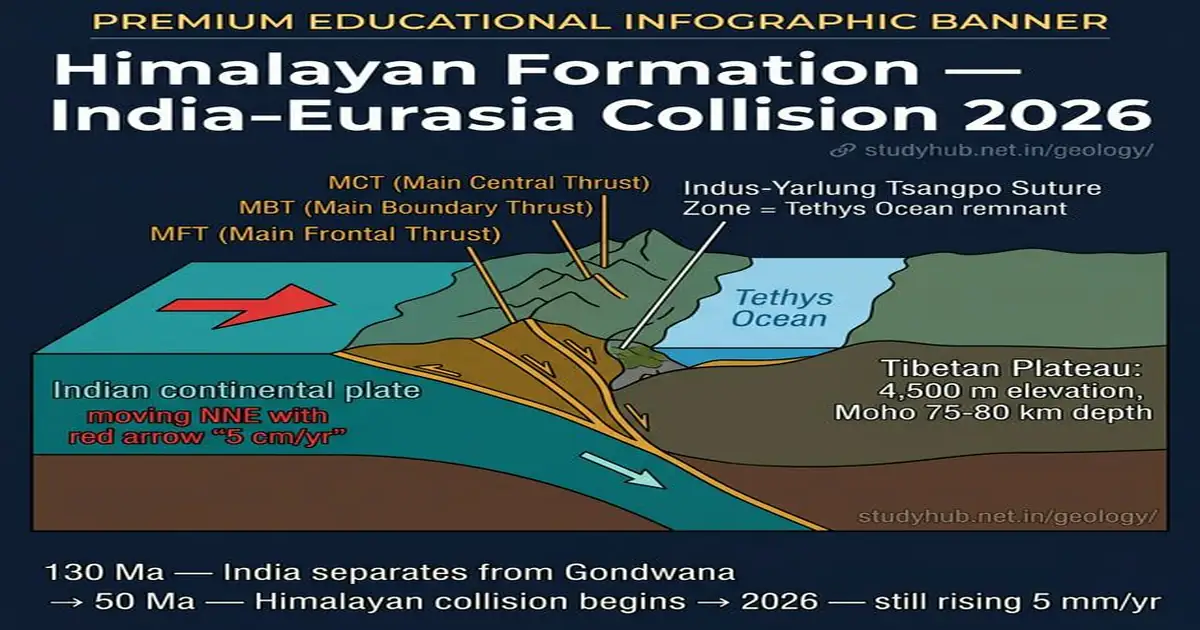
Himalayan Formation — India-Eurasia Collision, Thrust Faults & Tethys Story 2026
Stage-by-Stage Timeline: India’s Journey from Gondwana to Himalayas
| Stage / Time (Ma) | Event | Geological Record |
|---|---|---|
| ~700–550 Ma | India part of Gondwana (southern supercontinent). Pan-African / East African Orogeny assembles Gondwana. India at ~60–70°S. Tethys Ocean does not yet exist — Gondwana is a single landmass | Eastern Ghats Granulite Belt (800–1,000 Ma) = Gondwana assembly metamorphic event. Southern Granulite Terrain of India = pre-Gondwana Precambrian basement (up to 3.0 Ga). Aravalli-Delhi Fold Belt = older Precambrian orogenic structures preserved in Indian craton |
| ~300 Ma | Gondwana ice age. India, Africa, Australia, Antarctica, S. America all glaciated near South Pole. Tethys Sea begins forming as Gondwana starts to differentiate from Laurasia (Pangaea assembled, Tethys = wedge-shaped equatorial sea between them) | Talchir Formation (Odisha): glacial tillites = India near South Pole. Began splitting from Pangaea into Gondwana segment. Gondwana Supergroup begins forming (Permian coal bearing strata Barakar Fm. immediately above Talchir) |
| ~250–200 Ma | Gondwana intact but rifting begins. India still joined to Africa, Antarctica, Australia, Madagascar. Tethys Ocean to India’s north (between Gondwana and Laurasia/Asia). Tethys progressively widens as Laurasia + Gondwana separate. Passive margin sedimentation on India’s north coast (future Tethys Himalaya) | Zanskar limestones and shales (Tethys Himalaya, Ladakh/Spiti): up to 10 km thick shallow marine sedimentary sequence = India’s north coast sediments deposited in Tethys Ocean. Spiti Shale (Permian-Triassic): richly fossiliferous = Tethys marine fauna (brachiopods, echinoids, ammonites). These are the “Tethyan Himalayas” = sedimentary rocks from north Indian Tethys shelf |
| ~130 Ma | India separates from Africa (East African continental margin). Indian Ocean begins forming (Carlsberg Ridge initiating). India starts northward journey across Tethys Ocean at ~8–10 cm/yr initial speed | Rajmahal Traps (Jharkhand, ~117 Ma): flood basalt eruption from Kerguelen plume = triggering mechanism for India-Australia rift. Commencement of DSDP/ODP drill-confirmed oceanic crust in western Indian Ocean. Madagascar separation ~88 Ma (western Indian margin rifted from Madagascar) |
| ~65.5 Ma | India at ~15–20°S. Réunion plume impacts base of Indian lithosphere. Massive flood basalt eruption. India-Seychelles separation. India accelerates to peak speed of ~18–20 cm/yr (fastest continental plate motion in geological record — possibly aided by plume-thinned lithosphere + slab pull from subducting Tethys) | Deccan Traps: 65.5 Ma, ~500,000 km² flood basalt, up to 3 km thick (Mahabaleshwar section, Maharashtra). Seychelles continental fragment separated from India’s northwestern margin. Deccan Traps basalt geochemistry retains Réunion-plume isotopic signature |
| ~55–50 Ma | Tethys Ocean completely subducted northward under Eurasia. Indian continental crust (north margin) first contacts Eurasian margin → India-Eurasia collision begins. India decelerates sharply (from ~18 cm/yr to ~5 cm/yr) as buoyant continental crust resists subduction. The Himalayan Orogeny begins | Indus-Yarlung Tsangpo Suture Zone (IYTSZ): ophiolites (fragments of Tethys Ocean floor + upper mantle) squeezed up at the collision suture. Ladakh Batholith (arc igneous rocks from subduction-related magmatism, ~60–55 Ma) = the Eurasian continental arc that formed above the subducting Tethys plate before India arrived. Marine fossils end at this stratigraphic level in Tethyan sequences |
| ~50–40 Ma | Early Himalayan shortening. India underthrusts Eurasia. Proto-Himalayas begin forming as deep-seated thrust sheets develop. Tethyan sedimentary sequence of India’s north coast is being obducted (thrust southward) over Indian continental crust. Greater Himalayan crystalline sequence being buried and metamorphosed | High-grade metamorphic rocks of Greater Himalayas (kyanite→sillimanite grade, temperatures 700–850°C, pressures 8–12 kbar) = deep burial and heating from 50–25 Ma. In situ leucogranites (Nanga Parbat, Manaslu leucogranite = partial melt of deeply buried metasediments). Early Siwalik fluvial sediments begin accumulating in Himalayan foreland basin |
| ~25–15 Ma | Main Central Thrust (MCT) major activity. Greater Himalayan crystalline basement thusts southward over Lesser Himalayan sequence along MCT. Himalayan channel flow model — partially molten Greater Himalayan sequence extruded southward between MCT (below) and South Tibetan Detachment (above) | Main Central Thrust (MCT): north-dipping, top-to-south thrust fault. Juxtaposes high-grade Greater Himalayan metamorphics (upper) with low-grade Lesser Himalayan Sequence (lower). Displacement on MCT: 100s of km cumulative. 850°C contact metamorphism beneath MCT in lesser Himalayas = “inverted metamorphism” (temperature increases downward below thrust — unique Himalayan phenomenon) |
| ~15–5 Ma | Main Boundary Thrust (MBT) becomes active. Lesser Himalayan sequence thrust southward over Indo-Gangetic alluvial foredeep along MBT. Thrusting propagates southward (piggyback thrusting sequence — each new thrust breaks south of the previous one) | Main Boundary Thrust (MBT): separates Lesser Himalayas (N) from Siwalik/Sub-Himalayan zone (S). Lesser Himalayan sequence: Precambrian sedimentary/metamorphic rocks (Shimla Slates, Ramgarh Group, Almora Nappe) thrust southward. Mid-Miocene Siwaliks begin thick accumulation in foreland |
| ~5 Ma–Present | Main Frontal Thrust (MFT) active. Himalayan deformation reaches its current southernmost limit. Siwalik molasse thrust southward over Indo-Gangetic Plain. Thrust propagation reaches Himalayan foothills and frontal ranges. India still moving NNE at 5 cm/yr; shortening across Himalayas = 1–2 cm/yr; mountains still rising 5 mm/yr | Main Frontal Thrust (MFT): southernmost active Himalayan thrust; separates Siwalik/Sub-Himalayas from the IndoGangetic Plain. Siwalik Group (Miocene-Pliocene, 5–2 Ma): continental conglomerate, sandstone, clay = Himalayan erosion products. GPS-measured shortening. Recurrence of major Himalayan earthquakes (1897 Shillong 8.1, 1905 Kangra 7.8, 1934 Bihar-Nepal 8.0, 1950 Assam 8.6, 2015 Nepal Gorkha 7.8) = active MCT/MBT/MFT |
Himalayan Structural Zones — North to South Cross-Section
| Zone (N→S) | Rock Types | Boundary (South) | Key Features |
|---|---|---|---|
| Tibetan (Trans-Himalayan) Zone | Ladakh Batholith (granite, diorite = arc igneous rocks); Indus Molasse (continental fluvial sediments) | Indus-Yarlung Tsangpo Suture Zone (IYTSZ) | Magmatic arc that formed above subducting Tethys Ocean before India-Eurasia collision. Ladakh Granite (60–45 Ma) = source of beautiful pink granite seen in Leh architecture |
| Indus-Yarlung Tsangpo Suture Zone (IYTSZ) | Ophiolites (peridotite, gabbro, pillow basalt, chert = former Tethys Ocean floor); radiolarian chert; melange | Northern edge of Tethyan Himalayas | The “scar” of the Tethys Ocean — where the two plates met 50 Ma. Ladakh Ophiolite Complex = one of world’s best-preserved ophiolite sequences (harzburgite, dunite, lherzolite = former Tethys upper mantle). Marks the suture = exact point of plate junction |
| Tethyan (Upper) Himalaya | Sedimentary rocks: Cambrian-Eocene limestones, shales, sandstones (Tethys marine sequences, 10 km total thickness); Spiti Shale; Zanskar limestone | South Tibetan Detachment (STD) — a normal fault (extension!) parallel to the range | Fossils of Tethys Ocean fauna: ammonites, brachiopods, echinoids, corals, crinoids. North face of Everest = Tethyan limestone (summit of Everest = marine Ordovician limestone!). Cambro-Ordovician limestone on Mt. Everest summit = former Tethys sea floor sediment now at 8,849 m — ultimate testimony to collision power |
| Greater (Higher/Central) Himalaya | High-grade metamorphic rocks: gneiss, schist, marble, migmatite (kyanite → sillimanite grade); in situ leucogranites (Manaslu, Nanga Parbat leucogranite) | Main Central Thrust (MCT) | Core of the Himalayan metamorphic belt. Buried to 30+ km depth at peak of collision (700–850°C, 10–12 kbar). Re-exposed by erosion. Contains the highest peaks: Everest (8,849m), Kangchenjunga, Makalu, Cho Oyu — all in Greater Himalayan crystalline sequence. Inverted metamorphic grade below MCT = bizarre downward increase in metamorphic temperature |
| Lesser (Middle/Lower) Himalaya | Low-grade metamorphic rocks: phyllite, slate, quartzite (Precambrian age, Lesser Himalayan Sequence); Almora Nappe; Ramgarh Group | Main Boundary Thrust (MBT) | Less dramatic topography (1,000–3,000 m). Rich in kyanite schist, quartzite. India’s main tourist Himalayas (Shimla, Mussoorie, Darjeeling valleys between MBT and MCT). Thermal springs (Manikaran, Vashisht) = deep circulation water heated by radioactive decay in metamorphic rocks |
| Sub-Himalaya (Siwalik Zone) | Miocene-Pliocene continental sediments: sandstone, claystone, conglomerate (Siwalik Group = Miocene–Early Pleistocene erosion of rising Himalayas) | Main Frontal Thrust (MFT) | Low foothills (200–1,200 m). Contains vertebrate fossils: Sivapithecus (fossil ape ancestor, 8–12 Ma), Stegodon (fossil elephant), Hipparion (fossil horse). Sivapithecus fossils from Siwaliks = evidence India + Asia underwent faunal exchange after collision opened land corridors. Important Siwalik localities: Potwar Plateau (Pakistan), Ramnagar (J&K), Haripurnagar (HP) |
| Indo-Gangetic Plain | Holocene-Recent alluvium: unconsolidated silt, sand, gravel (Khadar = young riverine alluvium; Bhangar = older terrace alluvium) | Himalayan Frontal Zone (HFF/MFT) | The foreland basin — subsiding under the weight of the Himalayan thrust stack (flexural subsidence). Filled with up to 6 km of Siwalik/Pleistocene-Holocene sediment in the deepest parts. 7 major Himalayan rivers drain into it: Indus, Jhelum, Chenab, Ravi, Beas, Sutlej (western group = Indus system) + Ganga, Yamuna, Ghaghara, Gandak, Kosi (eastern group = Ganga system) + Brahmaputra (transverse river, antecedent = older than Himalayas) |
Frequently Asked Questions
What are the three main thrust faults of the Himalayas — MCT, MBT, MFT?
The Himalayan arc contains a series of major sub-horizontal thrust fault systems that represent successive southward-propagating deformation fronts as India has underthrust Eurasia over the past 50 million years. These thrust faults are among the most important geological structures in the world, and they continue to generate major earthquakes. The three main thrust faults, from north to south, are: Main Central Thrust (MCT): The oldest and deepest of the three active Himalayan thrust systems (~25–15 Ma main activity, though still seismically active). The MCT is a north-dipping thrust fault that juxtaposes the high-grade Greater Himalayan Crystalline Sequence (GHCS — gneisses, migmatites, leucogranites) on top of the Lesser Himalayan Sequence (LHS — lower-grade phyllites, slates, quartzites). Displacement on the MCT is estimated at 100s of kilometres of cumulative top-to-south movement. The MCT generates one of geology’s most puzzling structural anomalies: “inverted metamorphism” — the metamorphic grade (temperature and pressure of original metamorphism) increases downward below the MCT, contrary to the normal pattern where deeper rocks are more metamorphosed. This inversion is explained by the hot MCT shear zone dragging heat downward into cooler Lesser Himalayan rocks during rapid thrusting. Main Boundary Thrust (MBT): A younger (~15–5 Ma) major thrust fault that forms the physiographic boundary between the Lesser Himalayas and the Sub-Himalayan/Siwalik Zone. The MBT juxtaposes Precambrian Lesser Himalayan rocks (N) over Miocene-Pliocene Siwalik molasse sediments (S). The MBT controls the dramatic topographic step between the Shivalik hills and the Himalayan ranges proper. The 2015 Nepal Gorkha earthquake (7.8 Mw) involved slip on faults related to the MBT-MCT system. Main Frontal Thrust (MFT): The youngest (~5 Ma–present) and southernmost active Himalayan thrust system — the current leading edge of Himalayan deformation. The MFT juxtaposes the Siwalik hills over the Indo-Gangetic alluvial plain. The MFT is the fault system most likely to produce the next great Himalayan earthquake (>8 Mw): the Main Frontal Thrust accumulated at least 10–15 m of elastic strain in the 1934 Bihar-Nepal earthquake zone that has not been released since. GPS measurements show 1–2 cm/yr of shortening locked on the MFT — which, if released in a single great earthquake, could produce a magnitude 8.5+ event. The 1897 Assam earthquake (8.7 Mw) and the 1934 Bihar-Nepal earthquake (8.0 Mw) both involved thrust fault systems of the Himalayan arc.
Important for Exams — Himalayan Formation Facts for UPSC, SSC & State PCS
India-Eurasia collision timing: 50–55 Ma (Early Eocene). Tethys Ocean now fully subducted. India still moving NNE at 5 cm/yr (GPS confirmed). Three thrust faults (N→S): MCT (Main Central Thrust, oldest, 25-15 Ma, juxtaposes Greater with Lesser Himalayas, inverted metamorphism) → MBT (Main Boundary Thrust, 15-5 Ma, juxtaposes Lesser Himalayas with Siwaliks) → MFT (Main Frontal Thrust, 5 Ma-present, youngest, juxtaposes Siwaliks with IGP). Thrusts propagate southward in time = piggyback thrusting. Himalayan structural zones (N→S): Trans-Himalayas (Ladakh Batholith, Indus Molasse) → Indus-Yarlung Tsangpo Suture Zone (IYTSZ, ophiolites = Tethys remnants) → Tethyan Himalayas (marine sediments, ammonites, summit of Everest = Ordovician limestone) → Greater Himalayas (high-grade metamorphics, highest peaks) → Lesser Himalayas (low-grade, tourists hills) → Sub-Himalayas/Siwaliks (Sivapithecus fossils) → Indo-Gangetic Plain. Tibetan Plateau: Elevation 4,500–5,000 m, Moho depth 75–80 km (world’s thickest continental crust). Himalayan seismicity: Zone IV-V throughout. Major quakes: 1897 Assam (8.7 Mw), 1905 Kangra (7.8 Mw), 1934 Bihar-Nepal (8.0 Mw), 1950 Assam (8.6 Mw), 2015 Nepal Gorkha (7.8 Mw). Summit of Everest: Marine Ordovician limestone = former Tethys Ocean sea floor now at 8,849 m. Tethys Ocean: Existed from ~250 Ma to ~50 Ma; subducted northward under Eurasia; remnants = Ladakh Ophiolite (former Tethys peridotite); marine fossils in Spiti/Zanskar = former Tethys shallow sea shelf. Inverted metamorphism below MCT: Grade increases downward = hot thrust dragged heat down into Lesser Himalayas. Siwaliks: Miocene-Pliocene continental sediments; Sivapithecus (fossil ape, 8-12 Ma); mark Himalayan foreland basin.
What to Read Next
- Types of Plate Boundaries — Convergent, Divergent & Transform with India Examples 2026
- Plate Tectonics — Full Theory, History & Evidence 2026
- Continental Drift — Wegener, Gondwana & India’s 130 Ma Journey 2026
- Earthquakes — Types, Focus, Epicentre & India Seismic Zones 2026
- Moho Discontinuity — India Depths Under Himalayas, Deccan & Andaman 2026
🎔 Exam Quick Reference — Himalayan Formation: Collision began: 50-55 Ma. India speed: ~20 cm/yr before collision → 5 cm/yr now. Three thrust faults (N→S): MCT (25-15 Ma, Greater/Lesser Himalaya boundary) → MBT (15-5 Ma, Lesser Himalaya/Siwalik boundary) → MFT (5 Ma-present, Siwalik/IGP boundary). Himalayan zones (N→S): Trans-Himalaya (Ladakh Batholith) → IYTSZ (ophiolites, Tethys remnant) → Tethyan Himalaya (marine fossils, ammonites) → Greater Himalaya (highest peaks, leucogranites) → Lesser Himalaya (tourist hills, MCT inverted metamorphism) → Siwaliks (Sivapithecus, Miocene) → IGP. Deccan Traps (65.5 Ma) = Réunion plume. Tibetan Plateau Moho: 75-80 km. Himalayan still rising 5 mm/yr. Summit Everest = Ordovician limestone = former Tethys seafloor. Ladakh Ophiolite = Tethys mantle remnant up at 4,000 m.
🌍 Unique India Geology Records: Highest mountain: Kangchenjunga (8,586 m, Sikkim border) = India’s highest peak within sovereign territory (Everest is in Nepal). Deepest Moho: Under Tibetan Plateau ~75-80 km (indirectly affects NW India / J&K). India’s fastest previous motion: 18-20 cm/yr northward during 65-50 Ma = fastest continental plate in geological record. Oldest Indian rocks: 3.0-3.4 Ga Precambrian basement in Dharwar Craton (Karnataka). Longest linear ocean feature near India: Ninetyeast Ridge (5,000 km, Kerguelen hotspot trail = thickened oceanic crust, NOT a plate boundary). Most active volcanic: Barren Island (Andaman, above subducting Indian slab = arc volcano). Deepest ocean trench near India: Andaman Trench (~4,400 m below sea level). Biggest earthquake in India: 1950 Assam earthquake (8.6 Mw).
About This Guide: Written by the StudyHub Geology Editorial Team (studyhub.net.in/geology/) based on NCERT Class 11 Physical Geography Chapter 5 (Minerals and Rocks) and NCERT Class 11 India Physical Environment Chapter 2 (Structure and Physiography), Bilham et al. (2001) India GPS convergence data, Beaumont et al. (2001) Himalayan channel flow model, Yin & Harrison (2000) Himalayan geological evolution review, and GSI (Geological Survey of India) report on Himalayan geology. Last updated: March 2026.