Last Updated: March 2026 | Reading Time: 10 minutes | ~2,100 words
Depression is India’s most prevalent mental health condition — and one of its most misunderstood. An estimated 56–70 million Indians live with depression, making India home to the world’s largest depression burden. Yet fewer than 10% ever receive any treatment. The barriers are deeply entrenched: mental illness is attributed to “weak character,” spiritual failure, or family dishonour; psychiatrists are avoided for fear of social stigma; and the treatment gap between those who need care and those who receive it is the largest in the world at over 85%. Depression is not sadness. It is not weakness. It is a medical illness — as real as diabetes or hypertension — with defined biological mechanisms, validated screening tools, and highly effective treatments. Understanding it may be the most important health education India can receive.
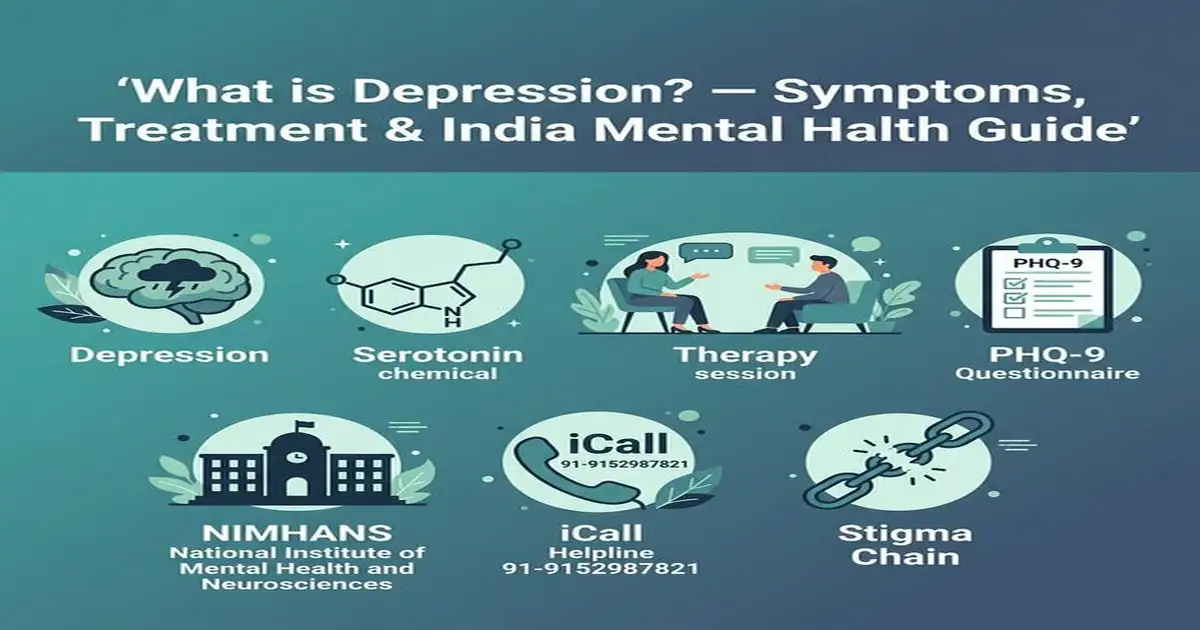
What is Depression? — More Than Sadness
Clinical depression (Major Depressive Disorder, MDD) is characterised by a persistent low mood or loss of interest/pleasure (anhedonia) lasting at least 2 weeks, accompanied by other symptoms that significantly impair work, relationships, and daily functioning. It is caused by a complex interaction of genetic predisposition, neurobiological changes (serotonin, norepinephrine, dopamine dysregulation; neuroinflammation; HPA axis hyperactivation; hippocampal atrophy), psychosocial stressors, and medical co-morbidities. In India, depression often presents differently than Western clinical descriptions — it is more commonly expressed through physical (somatic) symptoms: unexplained headaches, body aches, fatigue, and gastrointestinal symptoms, rather than explicit statements of “feeling sad.” This is why so many Indian depression patients visit orthopaedic and gastroenterology clinics repeatedly without treatment, never being screened for the underlying depression.
PHQ-9 — Screening for Depression (Self-Assessment)
The PHQ-9 (Patient Health Questionnaire-9) is the most widely used validated depression screening tool globally — and takes 3 minutes to complete. Over the past 2 weeks, how often have you been bothered by any of the following? (Score: 0=Not at all, 1=Several days, 2=More than half the days, 3=Nearly every day)
| # | Question |
|---|---|
| 1 | Little interest or pleasure in doing things |
| 2 | Feeling down, depressed, or hopeless |
| 3 | Trouble falling or staying asleep, or sleeping too much |
| 4 | Feeling tired or having little energy |
| 5 | Poor appetite or overeating |
| 6 | Feeling bad about yourself — or that you are a failure or have let yourself or your family down |
| 7 | Trouble concentrating on things, such as reading or watching television |
| 8 | Moving or speaking so slowly that others could notice — or being so fidgety or restless that you have been moving around more than usual |
| 9 | Thoughts that you would be better off dead or of hurting yourself in some way |
Scoring: 0–4 = Minimal/no depression; 5–9 = Mild depression; 10–14 = Moderate depression; 15–19 = Moderately severe; 20–27 = Severe depression. Score ≥10 warrants clinical evaluation. Any score >0 on Question 9 (suicidal thoughts) requires immediate clinical attention regardless of total score.
Types of Depression
| Type | Key Features | India Relevance |
|---|---|---|
| Major Depressive Disorder (MDD) | Episodes lasting 2+ weeks; significant functional impairment; may be single episode or recurrent | Most common; often presents somatically in India |
| Persistent Depressive Disorder (Dysthymia) | Lower-grade but chronic depression lasting 2+ years; “never quite right” feeling | Often unrecognised — dismissed as “pessimistic personality” |
| Perinatal/Postpartum Depression | Depression during pregnancy or within 1 year of childbirth; affects 20–25% of Indian mothers; can harm mother-infant bonding | Massively underdiagnosed in India; stigmatised (“you should be happy — you have a baby”) |
| Seasonal Affective Disorder (SAD) | Depression linked to seasonal light changes; less relevant in tropical India but present in high-altitude regions (J&K, Himachal) | Emerging recognition in North India hill regions |
| Bipolar Depression | Depression alternating with manic/hypomanic episodes; critical distinction — antidepressants alone can trigger manic switch; requires mood stabilisers | Often misdiagnosed as unipolar MDD in India; CRUCIAL to ask about prior manic episodes before prescribing antidepressants |
| Treatment-Resistant Depression (TRD) | Failure of 2+ adequate antidepressant trials; requires specialist management, esketamine, or ECT | ECT (electroconvulsive therapy) available at government psychiatric hospitals in India; effective, not like Hollywood depictions |
Treatment of Depression in India
| Treatment | Evidence | India Availability & Cost |
|---|---|---|
| SSRIs (Sertraline, Escitalopram, Fluoxetine) | First-line antidepressants; response in 4–6 weeks; must be continued 6–12 months after recovery to prevent relapse | Generic sertraline ₹2–5/tablet; widely available; DPCO price-controlled; available at government hospitals free under NMHP |
| SNRIs (Venlafaxine, Duloxetine) | Second-line or first-line in depression with anxiety or pain co-morbidity (duloxetine particularly good for somatic/pain depression) | Generic available at ₹5–15/tablet; duloxetine good for chronic pain + depression overlap |
| Cognitive Behavioural Therapy (CBT) | Equal to medication for mild-moderate depression; superior to medication for relapse prevention; evidence-based gold standard psychotherapy | Available at NIMHANS, government psychiatry departments (free/subsidised); private therapists ₹800–3,000/session; iCall online (TISS) ₹200–500/session |
| Interpersonal Therapy (IPT) | Particularly effective for post-partum depression and grief-related depression | Available at NIMHANS and some urban therapy centres |
| Combination (medication + therapy) | Superior to either alone for moderate-severe depression; most evidence-based approach | Best outcomes; referral to collaborating psychiatrist + psychologist |
| Exercise (as adjunct) | 30 min aerobic exercise 3–5×/week shown to reduce depression symptoms by 30–40%; antidepressant effect mechanism | Free; prescribed as treatment, not just lifestyle |
| ECT (Electroconvulsive Therapy) | Treatment-resistant depression; severe depression with suicidality; psychotic depression; rapid onset; 80%+ response rate | Available at NIMHANS, IHBAS Delhi, government psychiatric hospitals; done under general anaesthesia; no “electric shock movie” experience |
India Mental Health Helplines
| Service | Contact | Details |
|---|---|---|
| iCall (TISS Mumbai) | 9152987821 | Mon–Sat 8am–10pm; Hindi + English; trained psychologists; affordable sliding-scale fees |
| NIMHANS Helpline | 080-46110007 | 24/7; Karnataka-based but all-India accessible; expert psychiatric support |
| Vandrevala Foundation | 1860-2662-345 | 24/7; free; all languages; crisis support |
| iCall WhatsApp | 9152987821 | Chat-based counselling; for those who cannot make phone calls |
| KIRAN (Govt of India) | 1800-599-0019 | Free 24/7; all major Indian languages; NIMHANS-backed government helpline |
Frequently Asked Questions
Are antidepressants addictive?
This is the most important question standing between millions of Indians and appropriate treatment — and the answer requires careful, honest explanation. SSRIs and SNRIs (the modern antidepressants used as first-line treatment) are NOT addictive — they do not cause tolerance, craving, drug-seeking behaviour, or compulsive use that defines addiction. They do not produce euphoria (the primary driver of addiction). They work by gradually modifying neurochemistry to alleviate depression, not by creating artificial highs. However, a crucial nuance: SSRIs and SNRIs can cause discontinuation syndrome if stopped abruptly — symptoms including dizziness, irritability, “brain zaps,” flu-like feelings, and anxiety, which can last 1–2 weeks. This is NOT the same as withdrawal from an addictive substance — it does not involve craving, and it is prevented by tapering the dose gradually under medical supervision over 2–4 weeks. The practical message: take antidepressants for the full prescribed duration (minimum 6 months after recovery); do not stop abruptly; taper with medical guidance when the time comes. Old-generation antidepressants (benzodiazepines — diazepam/alprazolam, prescribed inappropriately by some practitioners for depression/anxiety) ARE potentially habit-forming with long-term use — but these are sedatives, not antidepressants, and are not appropriate first-line treatment for major depression. Avoid benzodiazepine-based treatment for depression.
Will antidepressants change my personality?
This fear — that antidepressants will turn a person into a “zombie” or fundamentally alter who they are — is one of the most common barriers to treatment in India and globally. The evidence tells a very different story: when SSRIs work for depression, patients consistently report feeling “more like themselves” — not less. The depression itself was changing their personality (withdrawal, irritability, inability to enjoy usual activities, cognitive impairment, loss of initiative). Effective treatment restores the pre-depression personality, not a new medicated one. What antidepressants do NOT do at therapeutic doses: blunt normal emotions; prevent normal crying at sad events; make people artificially happy or indifferent; impair memory or cognition (they often improve these by treating depression). What can occur in some patients: emotional blunting with some SSRIs at high doses (escitalopram slightly more than sertraline), or initial anxiety/agitation in the first 1–2 weeks — usually resolving. If a particular antidepressant causes distressing side effects, switching to a different one (within class or different class) often resolves the issue. The analogy: antidepressants in depression are like insulin in diabetes — they restore a physiological baseline that the disease has disrupted. They do not create an artificial personality; they return the person to their own.
Is depression more common in women in India?
Yes — globally and in India, depression affects women at approximately 2× the rate of men. The India-specific burden is significantly shaped by social and structural factors unique to the subcontinent: Domestic violence — IPV (intimate partner violence) affects 30–40% of married Indian women across all socioeconomic strata and is one of the strongest predictors of depression; women exposed to violence have 3× higher depression rates. Patriarchal family structures — limited autonomy, forced marriages, dowry demands, and subordination within joint families create chronic psychological stress that translates directly into depression. Perinatal period — 20–25% of Indian mothers develop perinatal depression (during or after pregnancy) — far higher than reported rates because it is so rarely screened for. Low education and economic dependence — financial vulnerability and inability to exit bad situations drives hopelessness. Menopause — hormonal transition increases depression risk; menopausal depression is particularly underdiagnosed in India. However, an important counterpoint: Indian men have significantly higher suicide rates than women (unlike most Western countries), suggesting men have higher depression severity when it does occur but are even less likely to seek help due to the profound stigma attached to male mental vulnerability in Indian culture. The message: depression in India is a systemic issue, not just an individual brain disease — it is produced by the conditions people live in, not just their neurobiology.
How long does it take for antidepressants to work?
One of the most important things to know before starting antidepressants is the time course — because many Indian patients stop medication after one week when they feel no improvement, experiencing failure or side effects, without reaching the therapeutic window. The timeline for SSRI/SNRI antidepressants: Week 1–2: Most patients notice some sleep improvement and reduced anxiety before mood improves; some experience side effects (nausea, headache, initial anxiety increase) — usually transient and resolving by week 2. Week 2–4: Energy and motivation often begin to improve before mood fully lifts — patients may feel more able to get out of bed but not yet happy. Week 4–6: Full antidepressant effect typically emerges — mood, concentration, social engagement improving. Response is defined as 50%+ reduction in PHQ-9 score. Week 6–8: If partial or no response, dose is increased or augmentation considered; if still inadequate at 8–12 weeks at adequate dose, switching to a different antidepressant. Remission (near-complete symptom resolution) takes 8–12 weeks in most responders. Critical message: if you are taking an antidepressant and considering stopping because “it’s not working” after only 2 weeks — speak to your psychiatrist first. The drug may not have reached its therapeutic window yet. Conversely, if severe side effects occur in the first week, call your doctor immediately — do not continue suffering needlessly when alternatives exist.
What should I do if someone I know is suicidal?
Suicidal thoughts are a medical emergency — and how people around a suicidal person respond in the immediate period determines whether that person lives. India has the highest absolute number of suicides in the world (~170,000/year) and a severe deficit in crisis response knowledge. What to do: Ask directly and calmly: “Are you thinking about ending your life?” — the fear of “putting the idea in someone’s head” is a myth; asking about suicidal thoughts NEVER increases suicide risk and often provides profound relief by breaking the isolation. Listen without judgment — do not say “you have so much to live for,” “think of your family,” or “this is a sin”; these responses shut down communication by adding guilt. Remove means — if the person has identified a method (pills, rope, weapon), try to secure or remove these without confrontation; means restriction is the most evidence-based crisis intervention. Stay with the person — do not leave a suicidal person alone if risk is acute. Seek professional help — KIRAN 1800-599-0019 (free, 24/7, all Indian languages); Vandrevala Foundation 1860-2662-345; nearest psychiatry emergency department. Warning signs of imminent risk: Talking about death/suicide as the only solution; giving away prized possessions; sudden calmness after prolonged depression (may indicate decision has been made); searching for methods online; increasing social withdrawal. India’s suicide prevention infrastructure is improving — the Mental Healthcare Act 2017 decriminalised suicide attempt, removing the legal barrier to seeking help that previously existed.
What to Read Next
- Vitamin B12 — B12 Deficiency Directly Causes Depression and Cognitive Decline
- Vitamin D — Low Vitamin D Strongly Associated with Depression Risk
- Thyroid — Hypothyroidism Causes Symptoms Identical to Depression
- Diabetes — Diabetes and Depression Have 2× Co-morbidity Rate
- Anemia — Severe Iron Deficiency Mirrors Depression Symptoms: Fatigue, Brain Fog
Depression is not a character flaw. It is not karma. It is not the result of too much attachment, excessive ambition, or insufficient devotion. It is a medical illness — like a broken bone — that heals with proper treatment. Asking for help is not weakness. It is the most courageous, clear-headed decision a suffering person can make.
About This Guide: Written by the StudyHub Health Editorial Team (studyhub.net.in) based on WHO Mental Health Atlas, NIMHANS National Mental Health Survey 2015–16, and APA (American Psychiatric Association) DSM-5 diagnostic criteria. Last updated: March 2026.
Authoritative Sources: NIMHANS India | WHO — Depression | ICMR India | APA — American Psychiatric Association
🆘 Crisis Support: If you or someone you know is in crisis, please call KIRAN: 1800-599-0019 (free, 24/7, all Indian languages) or iCall: 9152987821. You are not alone. Help is available.
⚕️ Medical Disclaimer: This article is for general informational and educational purposes only. Depression diagnosis requires clinical evaluation by a qualified psychiatrist or psychologist. Never adjust or stop antidepressant medication without medical guidance. If experiencing suicidal thoughts, seek emergency care or call a crisis helpline immediately.