Last Updated: March 2026 | Reading Time: 9 minutes | ~2,000 words
Parkinson’s disease (PD) is the fastest-growing neurological disorder globally — and India, with its ageing population and improving life expectancy, is experiencing a rapid rise in PD burden. An estimated 500,000–700,000 Indians currently live with Parkinson’s disease, with prevalence doubling every decade of age after 60. Despite this, Parkinson’s remains critically under-diagnosed in India: tremor is frequently attributed to ageing (“old age shaking”), freezing of gait is dismissed as weakness, and the non-motor symptoms — anosmia, constipation, depression, sleep disturbance — that precede the motor symptoms by years go unrecognised as PD heralds. The good news: Parkinson’s disease is one of the most treatable progressive neurological conditions. Levodopa — one of the most effective drugs in all of neurology — restores function dramatically; deep brain stimulation (DBS) provides remarkable motor control in advanced disease; and non-motor symptom management significantly improves quality of life. The tragedy is delayed diagnosis and inadequate treatment access.
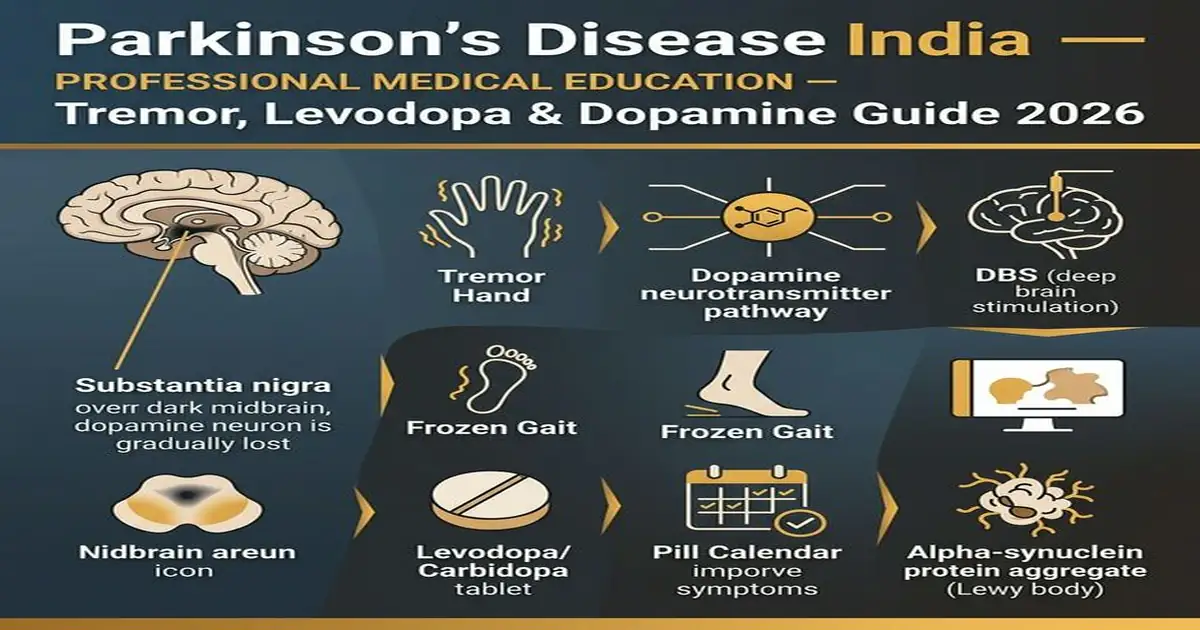
The TRAP Mnemonic — 4 Cardinal Motor Features
| TRAP Sign | Description | How to Identify | India Context |
|---|---|---|---|
| Tremor at rest | “Pill-rolling” tremor — rhythmic 4–6 Hz oscillation of thumb against index finger; characteristic: present at REST, diminishes or disappears with voluntary movement (unlike essential tremor which worsens with movement); unilateral onset (one side first), asymmetric throughout disease | Observe hands at rest in lap; ask patient to perform a task (tremor reduces during action); observe re-emergence when hands return to rest; typical frequency: 4–6 Hz (slower than essential tremor at 8–12 Hz) | Rest tremor is what brings most Indian patients to medical attention; frequently dismissed as “old age shaking” or attributed to weakness or vitamin deficiency; essential tremor misdiagnosis common — propranolol given (effective for essential tremor, NOT for PD tremor) |
| Rigidity | Increased muscle tone throughout range of movement; “cogwheel rigidity” — a ratchety, catch-release quality felt by examiner when passively moving a joint; “lead pipe” rigidity (uniform resistance) also seen; may manifest as shoulder pain (frozen shoulder misdiagnosis common in early PD) | Passively flex and extend wrist/elbow while patient is relaxed; feel for cogwheel catch; ask about shoulder pain (frozen shoulder as early PD is dramatically under-recognised); observe stiff, reduced arm swing when walking (unilateral reduced arm swing is an early sign) | Many Indian PD patients present to orthopaedic surgeons with shoulder pain before neurological diagnosis is established; shoulder MRI shows no structural cause → should trigger PD assessment; frozen shoulder non-responsive to physiotherapy in elderly = consider PD |
| Akinesia / bradykinesia | Slowness of voluntary movement (bradykinesia) and reduced amplitude of repetitive movements; most disabling feature functionally; manifests as: small cramped handwriting (micrographia); reduced facial expression (hypomimia — “masked face”); soft quiet voice (hypophonia); slow shuffling gait; difficulty with fine motor tasks (buttons, utensils) | Ask patient to tap thumb to index finger rapidly; observe that movements become progressively smaller and slower (decremental amplitude — diagnostic of PD); assess handwriting (micrographia — letters becoming smaller toward end of line); assess facial expressivity | Hypomimia (masked face) frequently causes families to believe the patient is “depressed” or “not interested” — actually this is a motor manifestation of PD, not an emotional one; micrographia often noted by family before formal diagnosis; soft voice misattributed to sadness |
| Postural instability | Impaired balance reflexes; loss of righting response; tendency to fall, especially when turning or when startled; “pull test” positive (patient takes more than 2 steps backward when examiner pulls shoulders from behind); leads to recurrent falls and hip fracture risk; typically a later-stage feature (early prominent falls suggest other diagnosis — PSP) | Pull test (examiner stands behind patient; gives a brief, unexpected backward pull on shoulders; normal = recover in 1–2 steps; PD = requires more correction or falls); assess gait: shuffling, reduced step height, festination (increasing acceleration); turning in multiple small steps rather than single pivot | Falls in Indian PD are catastrophically underestimated; hip fractures in PD patients have high mortality (25% within 1 year); physiotherapy and falls prevention strategies critically under-employed; Indian homes with steps, uneven floors, and wet bathrooms create high-risk environments for PD patients |
Non-Motor Symptoms — The Hidden Burden of Parkinson’s
| Domain | Non-Motor Symptom | Timing | Management |
|---|---|---|---|
| Autonomic | Constipation (one of earliest PD symptoms — often precedes motor symptoms by 10–20 years); orthostatic hypotension (dizziness on standing → falls); hypersalivation (drooling — not increased saliva production but reduced swallowing frequency); excessive sweating; urinary urgency/frequency; erectile dysfunction | Constipation and anosmia: 10–20 years before motor onset; orthostatic hypotension: often prominent with advancing disease and levodopa use | Constipation: high-fibre diet, hydration, macrogol, prucalopride; Orthostatic hypotension: compression stockings, fludrocortisone, midodrine; Drooling: sublingual atropine drops, glycopyrrolate, botulinum toxin to salivary glands; urinary: bladder diary, mirabegron (avoid anticholinergics — worsen cognition in PD) |
| Neuropsychiatric | Depression (affects 40–50% of PD patients — often unrecognised as separate from motor disability); anxiety; apathy (loss of motivation — distinct from depression); hallucinations (visual — small animals, people; typically well-formed; drug-induced at higher levodopa doses); dementia (Parkinson’s disease dementia — PDD — in 30–40% advanced PD; earlier onset = Lewy body dementia) | Depression and anxiety: throughout disease course; Hallucinations: typically with advancing disease, higher drug doses; Dementia: late stage typically, but 80% of patients with PD >20 years have cognitive impairment | Depression: SSRIs (sertraline, escitalopram); avoid TCAs (constipation, orthostatic effects worsen PD symptoms); Hallucinations: reduce/eliminate anticholinergic, amantadine, MAO-B inhibitors first; if persists: quetiapine (low dose) or clozapine (PD-specific safe antipsychotics — avoid haloperidol, risperidone, olanzapine — block dopamine, catastrophically worsen PD); Dementia: rivastigmine cholinesterase inhibitor (only drug approved for PDD) |
| Sleep | REM sleep behaviour disorder (RBD) — acting out dreams during REM sleep (hitting, kicking partner); insomnia; excessive daytime sleepiness (EDS — levodopa and dopamine agonist side effect); restless legs syndrome (RLS — “creepy crawly” legs worse at rest, relieved by movement) | RBD is a prodromal PD marker — isolated RBD: 80% will develop PD or Lewy body dementia within 10 years; this is the strongest single predictive marker for imminent PD | RBD: low-dose clonazepam at night; melatonin 3–9mg; bedroom safety (move furniture away from bed, pad bed rails, couple may need separate beds); EDS: address levodopa timing; modafinil for resistant EDS; RLS: low-dose dopamine agonist (pramipexole), iron supplementation if ferritin low |
| Sensory | Hyposmia/anosmia (loss of smell — one of earliest PD symptoms, predates motor by years); pain (musculoskeletal from rigidity; central pain; neuropathic pain); paraesthesiae; visual disturbance (contrast sensitivity reduction) | Anosmia: many years before diagnosis; musculoskeletal pain: throughout disease; central pain: advanced disease | Anosmia: no pharmacological treatment; important for safety (cannot smell gas leaks, burning food); pain: physiotherapy for musculoskeletal; optimise levodopa timing; gabapentin for neuropathic; refer pain specialist for complex central pain |
Frequently Asked Questions
How is Parkinson’s disease treated with levodopa?
Levodopa has been the cornerstone of Parkinson’s disease treatment for over 50 years and remains the most effective drug in the PD pharmacological armamentarium. Understanding how it works, why timing matters critically, and what the complications of long-term therapy look like is essential for both patients and caregivers: How levodopa works: Parkinson’s disease results from loss of dopaminergic neurons in the substantia nigra pars compacta → reduced dopamine in the striatum → impaired motor control. Levodopa is the immediate precursor of dopamine; it crosses the blood-brain barrier (dopamine itself cannot) → converted to dopamine in surviving neurons → restores dopamine signalling → dramatically improves motor function. It is always combined with carbidopa (Syndopa, Syndopa-CR in India) or benserazide (Madopar in India) — peripheral decarboxylase inhibitors that prevent levodopa conversion to dopamine outside the brain, reducing peripheral side effects (nausea, vomiting, hypotension) and increasing brain delivery. Starting levodopa — the India challenge: Standard starting dose: Levodopa/carbidopa 100/25mg (Syndopa 100) 3 times daily; titrate gradually. Available forms in India: Syndopa 100 (levodopa 100mg + carbidopa 25mg) — ~₹6–10/tablet; Syndopa Plus (250/25mg); Madopar (benserazide combination); Syndopa CR (controlled-release — smooths plasma levels, useful for nighttime dosing). Generic levodopa/carbidopa costs: ₹150–500/month for standard doses — affordable but a significant burden for advanced patients on higher doses. The critical importance of timing: Levodopa has a 60–90 minute half-life — plasma levels fluctuate significantly with each dose. As disease progresses (typically 3–5 years into treatment), patients experience: “Wearing off” — motor symptoms return predictably 3–4 hours after each dose before the next dose kicks in; “Dyskinesia” — involuntary writhing movements at peak dose (too much dopamine effect); “On-off” phenomenon — unpredictable sudden switching between good motor function (“on”) and near-immobility (“off”); these are the most disabling complications of advanced PD. Management of motor fluctuations: More frequent smaller doses (4–5 times/day instead of 3×); Add MAO-B inhibitor (rasagiline, selegiline) — reduces levodopa breakdown, smooths response; Add COMT inhibitor (entacapone, opicapone) — extends levodopa half-life; Controlled-release formulations; Duodopa (intestinal levodopa gel infusion via PEG-J tube) for severe fluctuations — available select centres India; Apomorphine infusion (subcutaneous pump). What worsens levodopa absorption — critical India issue: High-protein meals drastically impair levodopa absorption (amino acid competition at intestinal transporters); give levodopa 30–60 minutes BEFORE meals or 90 minutes AFTER; avoid large protein meals (dal, paneer, pulses, chicken) within 1 hour of doses; a “low-protein during day, normal protein at evening meal” strategy can dramatically improve motor function in fluctuating patients.
How is Parkinson’s tremor different from essential tremor?
Essential tremor (ET) is the most common movement disorder — it is 10–20× more common than Parkinson’s disease — and the most common cause of diagnostic confusion with PD tremor in India: Key distinguishing features:
| Feature | Parkinson’s Tremor | Essential Tremor |
|---|---|---|
| When present | At REST; decreases with voluntary action | During ACTION (holding cup, writing); absent at complete rest |
| Body parts affected | Hands (pill-rolling thumb+index), chin, legs; rarely head or voice | Hands (bilateral); head (yes-yes or no-no nodding); voice (quavering) |
| Frequency | Slower: 4–6 Hz | Faster: 8–12 Hz |
| Symmetry | Asymmetric (one side first, stays more severe) | Usually bilateral and symmetric |
| Associated features | Slowness (bradykinesia), rigidity, gait change, reduced arm swing | NO slowness, NO rigidity, gait normal; often family history |
| Effect of alcohol | Does not improve significantly with alcohol | Dramatically improves with even small amount of alcohol |
| Response to propranolol | Poor — propranolol does NOT help PD tremor significantly | Excellent — propranolol 40–120mg/day first-line treatment for ET |
| Response to levodopa | Excellent for bradykinesia/rigidity; variable for tremor (some PD tremor is levodopa-resistant) | No benefit from levodopa |
Clinical implication: A patient with action tremor (worse holding a cup, writing) + bilateral symmetric tremor + family history + normal gait = almost certainly essential tremor, not PD; treat with propranolol. A patient with rest tremor (disappears when picking something up, returns when hand rests in lap) + one arm reduced swing + slowness = PD until proved otherwise; neurological assessment required.
What is deep brain stimulation (DBS) and who is eligible in India?
Deep brain stimulation (DBS) is the most significant surgical advance in Parkinson’s disease management and represents one of the most dramatic surgical interventions in all of medicine — a patient who is “frozen” and severely disabled in the “off” state may become virtually indistinguishable from a normal person within minutes of DBS activation: How DBS works: DBS involves implanting a thin electrode into specific brain targets (subthalamic nucleus — STN, or globus pallidus internus — GPi) through stereotactic neurosurgery; the electrode is connected by subcutaneous wire to an implantable pulse generator (IPG — “brain pacemaker”) placed under the skin of the chest/abdomen; the IPG delivers continuous electrical stimulation to the target nucleus; this modulates abnormal oscillatory activity in the basal ganglia → restores normal motor circuit function. The effect: DBS reduces “off” time by 50–70%; reduces dyskinesia by 60–70%; lowers levodopa dose requirements by 30–40%; dramatically improves motor fluctuations and quality of life. Who is eligible for DBS in India: Confirmed PD diagnosis (NOT atypical Parkinsonism — PSP, MSA, DLB — where DBS does not work); Good levodopa response (the “golden rule” for STN-DBS: if levodopa doesn’t help significantly, DBS won’t help either — this is the single strongest predictor of DBS outcome); Motor fluctuations or disabling dyskinesia despite optimal medical therapy; Age typically <70 years (older patients have higher surgical risk and cognitive side effects); No dementia (DBS can worsen cognitive function in patients with cognitive impairment); No severe psychiatric disease (depression, psychosis); MRI-compatible DBS devices now preferred (allows future MRI brain imaging). DBS in India — availability: DBS surgery available at AIIMS Delhi, NIMHANS Bangalore, Christian Medical College Vellore, Apollo Hospitals, Fortis, and select other tertiary centres. Cost: ₹7–15 lakh total (surgery + device + hospitalisation); significantly less than USA (USD 50,000–100,000); devices covered by some government insurance schemes (PMJAY — Ayushman Bharat) at government hospitals. Emerging options: Focused Ultrasound (FUS) thalamotomy — non-invasive, no implant; uses focused ultrasound to lesion the thalamus (Vim); effective for tremor-dominant PD if DBS not feasible; available at select centres India 2024; single-sided treatment only.
What lifestyle changes and physiotherapy help in Parkinson’s?
Non-pharmacological management of Parkinson’s is evidence-based and dramatically improves outcomes — yet receives far less attention than medication in Indian clinical practice: Exercise — the most important non-drug intervention: Multiple high-quality RCTs demonstrate that aerobic exercise: Slows the rate of motor decline in PD (neuroprotective effect — exercise induces BDNF and GDNF neurotrophic factors, supports surviving dopaminergic neurons); Improves balance and reduces fall risk; Improves mood and reduces depression; Improves sleep quality; Improves gait speed and stride length. Best exercise types for PD: 1. Aerobic exercise (cycling, brisk walking, swimming): 150 minutes/week minimum; recumbent cycling shown to reduce tremor; 2. LSVT BIG therapy (Lee Silverman Voice Treatment BIG): an intensive, amplitude-focused physiotherapy programme explicitly designed for PD — teaches patients to make BIG movements to counter the hypokinesia tendency; evidence-based, 4 × 1-hour sessions/week × 4 weeks; 3. Tango dancing: multiple RCTs show tango improves balance, freezing of gait, and quality of life in PD — the rhythmic external cues, dual-task demands, and social engagement make it uniquely effective; 4. Tai chi: improves balance and reduces falls; RCT evidence from Fuzhong Li 2012; 5. Nordic walking with poles: provides rhythmic external cuing and upper body stabilisation. LSVT LOUD for speech: Hypophonia (soft voice) in PD responds to LSVT LOUD — intensive voice therapy programme (same BIG concept applied to voice amplitude); patients learn to project louder voice permanently; significant improvement in voice and swallowing; available at select speech therapy centres India. Falls prevention — critical in India: Falls assessment and prevention: Home assessment (remove rugs, improve bathroom handrails, ensure adequate lighting, remove obstacles from walking paths); Outdoor falls: warn of irregular surfaces (Indian pavements are notorious for hazards); Bathroom grab rails and non-slip mats (most PD falls in India occur in bathrooms). Freezing of gait strategies: Visual cues (walk over laser line, tape lines on floor, stepping over obstacle); Rhythmic auditory stimulation (walking to a metronome beat or rhythm — reduces freezing); Counting out loud while walking; Never rush a PD patient — freezing worsens with time pressure. Nutrition in PD — India-specific: Protein and levodopa timing (see levodopa FAQ); Mediterranean diet has observational evidence for slowing PD progression; avoid constipating foods (insufficient fibre/water → constipation worsens PD substantially); weight loss is common in advanced PD — calorie-dense, manageable-texture foods important; swallowing difficulties (dysphagia) emerge in ~80% of advanced PD — SALT (speech and language therapy) assessment important before aspiration pneumonia develops.
How should Parkinson’s disease be managed in India’s healthcare system?
India’s PD management landscape has specific strengths and critical gaps that determine patient outcomes: The diagnostic delay problem: Average diagnostic delay for PD in India: 3–5 years from symptom onset to diagnosis; the non-motor prodrome (anosmia, constipation, RBD, depression) is rarely connected to PD; motor symptoms are attributed to ageing; tremor gets propranolol (wrong, not effective for PD rest tremor); frozen shoulder gets physiotherapy for 6–12 months before PD is suspected. The result: patients reaching specialists only after significant functional decline, when neuroprotective window (if it exists) has passed. Neurologist access: India has ~1,500 neurologists — approximately 1 per million population vs 5–8 per 100,000 in Europe; most are concentrated in metro cities; tier-2 and tier-3 cities have minimal specialist access; rural India has almost none. Many PD patients in India are managed entirely by general practitioners without neurology input — often with incorrect drugs (older antipsychotics prescribed for hallucinations in PD are catastrophically harmful — haloperidol blocks dopamine, dramatically worsens symptoms and can cause neuroleptic malignant syndrome). Drug access: Levodopa/carbidopa: available, affordable (₹150–500/month standard doses); Dopamine agonists (pramipexole, ropinirole): available, moderately affordable (₹500–2,000/month); Rasagiline (MAO-B inhibitor): available (₹800–1,500/month); Entacapone (Stalevo — levodopa+carbidopa+entacapone combination): available, more expensive; Duodopa, apomorphine infusion: limited centres, very expensive; CGRP-targeting agents: not relevant to PD. Critical drug safety warnings for Indian patients: NEVER give these drugs to a PD patient (they block dopamine and cause severe worsening): Haloperidol (Serenace); Risperidone; Olanzapine; Metoclopramide (Reglan) — commonly given for nausea/vomiting in India, catastrophically worsens PD; Domperidone (Domcet) — in contrast to metoclopramide, does NOT cross the blood-brain barrier and IS SAFE for nausea in PD patients → use domperidone specifically (not metoclopramide) for PD nausea. Prochlorperazine (Stemetil): crosses BBB, worsens PD — avoid. The Indian PD caregiver burden: PD care falls overwhelmingly on family members (typically spouses, then adult children) in India’s limited social support infrastructure; caregiver burnout is common and severely undertreated; depression in PD caregivers is as prevalent as in patients; caregiver support groups (Parkinson’s Society of India — PSI) and respite care are emerging but remain scarce.
What to Read Next
- Dementia — Parkinson’s Disease Dementia (PDD) and Lewy Body Dementia: Overlapping Conditions
- Depression — Depression Affects 40-50% of PD Patients; SSRIs Are First-Line
- Sleep Disorders — REM Sleep Behaviour Disorder: The Strongest Predictor of Future PD
- Stroke — Vascular Parkinsonism from Stroke: A Key Differential Diagnosis
- Osteoporosis — PD Patients Have Higher Fall and Fracture Risk; Osteoporosis Prevention Critical
George Constable, a retired schoolteacher in Jaipur, noticed his handwriting getting smaller in 2018. He assumed it was arthritis. By 2020 his right hand trembled constantly. His local physician prescribed propranolol for “tremor” — no effect. By 2022, with a frozen gait and near-total loss of independence, he was finally seen by a neurologist in Jaipur who diagnosed PD. Within 3 weeks of starting levodopa, he was walking normally and his tremor had reduced by 70%. Four years of disability that could have been 3 months of deterioration before appropriate treatment. The science was there. The drug was ₹200/month. The diagnosis was missing.
About This Guide: Written by the StudyHub Health Editorial Team (studyhub.net.in) based on MDS (Movement Disorder Society) Clinical Diagnostic Criteria 2015, NICE PD Guidelines 2017, and Parkinson’s Society of India resources. Last updated: March 2026.
Authoritative Sources: Movement Disorder Society | Parkinson’s Society of India | NICE PD Guidelines
⚠️ Critical Drug Warning for PD Patients: NEVER give haloperidol, risperidone, olanzapine, or metoclopramide to a Parkinson’s patient — they block dopamine and can cause catastrophic worsening and neuroleptic malignant syndrome. For nausea in PD: use domperidone only (does not cross the blood-brain barrier). Show this card to every treating physician.
💊 Levodopa Timing Tip: Take levodopa 30–60 minutes BEFORE meals. High-protein foods (dal, paneer, chicken, pulses) block absorption and reduce the “on” time dramatically. Many patients get hours more functional time each day simply by adjusting protein meal timing.
⚕️ Medical Disclaimer: This article is for educational purposes only. Parkinson’s disease diagnosis and levodopa dosing must be managed by a qualified neurologist or movement disorder specialist. Do not adjust levodopa doses without medical supervision.