Last Updated: March 2026 | Reading Time: 9 minutes | ~2,000 words
India carries the world’s largest burden of avoidable blindness — an estimated 4.95 million blind individuals (WHO 2020), with cataract responsible for 66% of all blindness in India (NPCB 2019 survey). Despite the fact that cataract blindness is almost entirely preventable through a simple, safe, highly cost-effective 20-minute surgery, India performs only 6–7 million cataract surgeries per year — while the backlog continues to grow (estimated 8–10 million additionally blind each year from untreated cataracts). Glaucoma — the “silent thief of sight” — is the second leading cause of blindness in India, affecting approximately 12 million Indians with glaucoma (AIOS data), of whom an estimated 90% are undiagnosed. Glaucoma-related blindness is irreversible — unlike cataracts — making early detection and lifelong IOP (intraocular pressure) control the sole strategy. Both conditions disproportionately affect India’s ageing population and the rural poor — where access to ophthalmological care remains severely limited (approximately 11 ophthalmologists per million population in rural India vs WHO recommended 40 per million). The Pradhan Mantri Jan Arogya Yojana (PMJAY — Ayushman Bharat) covers cataract surgery and glaucoma filtration surgery for eligible beneficiaries — a transformative policy that has substantially expanded access. The National Programme for Control of Blindness and Visual Impairment (NPCBVI) continues to fund government cataract camps, corneal transplant networks, and visual rehabilitation programmes across India.
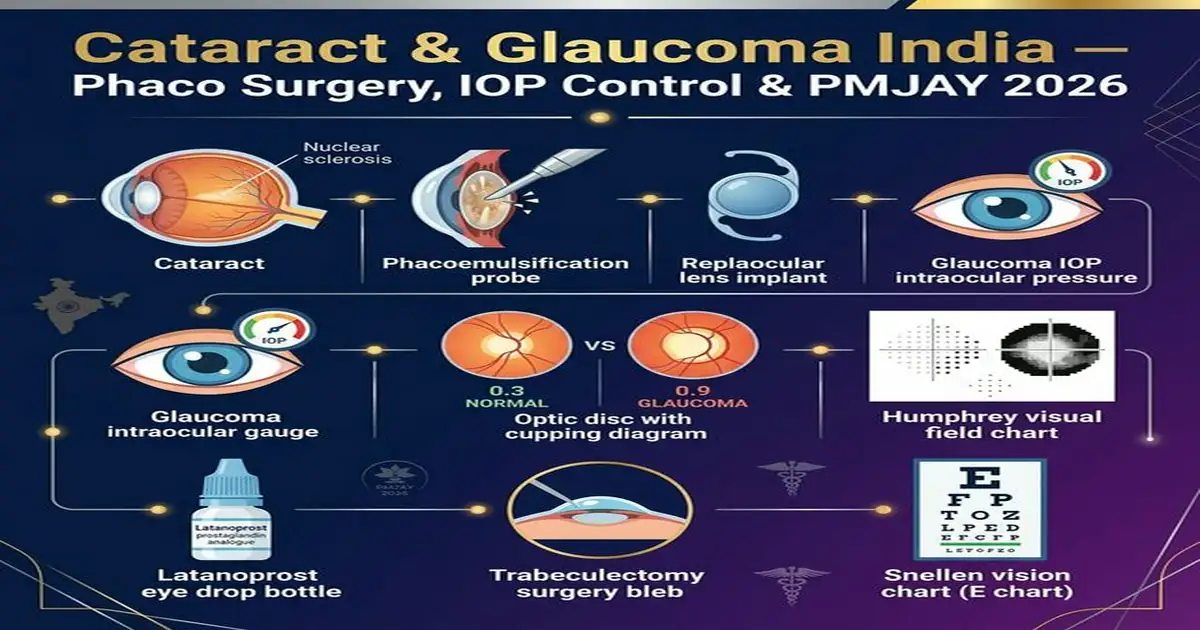
Cataract and Glaucoma India — Diagnosis, Surgery, Eye Drops and Prevention of Blindness
| Domain | Details | India Context |
|---|---|---|
| Cataract — Types, Symptoms & Risk Factors India | Cataract: opacification of the crystalline lens → reduced light transmission → progressive visual impairment; Types by morphology: Nuclear sclerosis (NS): most common age-related — progressive yellowing/browning of nucleus; graded NS1–NS4 (LOCS III — Lens Opacities Classification System); myopic shift (lens becomes more convex → temporarily improves near vision — “second sight of the aged” — then vision deteriorates as opacity worsens); Posterior subcapsular cataract (PSC): affects posterior capsule — causes glare + photophobia + near vision blurring; associated with: steroid use (prolonged inhaled/systemic/topical), diabetes, uveitis; Anterior/cortical cataract: spoke-like peripheral opacities; common in diabetes; Congenital cataract: white reflex (leukocoria) at birth/early infancy + absent red reflex → refer immediately — treat within weeks (amblyopia risk); Traumatic/secondary/metabolic: physical trauma; hypocalcaemia (tetany cataract); galactosaemia (infantile); Wilson’s disease (sunflower cataract); Risk factors India: ageing (most important); diabetes (sorbitol accumulation → osmotic lens damage → PSC); UV radiation exposure (India has high UV index + occupational outdoor exposure — farmers, fishermen → 60% higher cataract risk); smoking (doubles risk); malnutrition (Vit C, E deficiency → oxidative damage); steroid use (prolonged — including traditional Ayurvedic preparations containing corticosteroids unlabelled); prior eye trauma (manual labour, cricket injuries); Symptoms: painless progressive blurring; halos around lights; glare (driving at night); monocular diplopia; fading of colours; reduced contrast sensitivity; refraction change (myopic shift) | India cataract epidemiology: NPCB survey 2019: 66% of India’s blindness from cataract; 40.5 million with visual impairment; average age of cataract blindness: 60+ years; rural-urban gap: 80% of blind are rural; 75% female (women less likely to access surgery — mobility, awareness, economic dependence); state variation: highest cataract blindness states: UP, Bihar, Rajasthan, Odisha, MP (low surgical coverage + high UV + malnutrition); India-specific risk: prolonged outdoor work (farming, fishing, construction) under intense India sun WITHOUT sunglasses → UVB cataracts accelerated; advise all outdoor workers: UV-protective sunglasses (wraparound, UV400 — ₹150–300 at pharmacies); steroid misuse India: extremely common — self-medication with betamethasone eye drops for “red eyes” from pharmacist → PSC cataract; NEVER use steroid eye drops without ophthalmologist prescription |
| Cataract Surgery — Phacoemulsification, IOL Types & PMJAY | Surgical options (evolving India gold standard): Phacoemulsification (Phaco): GOLD STANDARD — ultrasonic probe breaks up and removes lens through 2.2mm microincision; IOL implanted (foldable — through same microincision); advantages: stitch-free, day-care, rapid recovery (1–2 days), better visual outcomes; Manual Small Incision Cataract Surgery (MSICS): 5–7mm tunnel incision; manual nucleus expression + IOL; major advantage: CHEAP (₹500–1,500 in NPCBVI camps vs ₹15,000–40,000 for phaco); visual outcomes equivalent to phaco at 6 weeks; used predominately in government hospitals + NPCBVI camps; Extracapsular cataract extraction (ECCE): now largely obsolete (10mm incision, sutures); IOL types: Monofocal IOL: corrects for one distance (usually distance — patient still needs reading glasses); most common type; Toric IOL: corrects pre-existing corneal astigmatism (premium lens — ₹10,000–30,000 extra); Multifocal/EDOF IOL: corrects multiple distances (near + intermediate + far — significantly reduces spectacle dependence); premium — ₹30,000–80,000 extra per eye; not ideal for glaucoma patients (reduced contrast sensitivity from IOL); Timing: do NOT delay surgery until “fully ripe” (mature/hypermature cataract → surgery more difficult, harder nucleus, higher complication rate — zonular weakness); visual acuity <6/18 in better eye = surgical indication; WHO: any cataract causing functional disability → operate; visually significant = operate; Complications: posterior capsule rupture + vitreous loss (most feared intraoperative — 0.5–2% phaco, 2–4% MSICS); endophthalmitis (devastating — rare, 0.02–0.1%); posterior capsule opacification (PCO — “secondary cataract” — 20–40% at 2 years → YAG laser capsulotomy in OPD, 5-minute painless procedure); cystoid macular oedema (CMO) | India cataract surgery access: NPCBVI: free cataract surgery at government hospitals; MSICS most common (cost-effective, mass volume); Phaco: growing in government hospitals with PMJAY funding; PMJAY (Ayushman Bharat — PM-JAY): covers cataract surgery (phaco + IOL) at empanelled private hospitals for beneficiaries (bottom 40% economically — 500M eligible); package rate: ₹8,000–15,000 per eye (significantly subsidised vs ₹40,000–80,000 market rate); AIIMS Delhi (Ophthalmology): government phaco — free; waiting: 3–6 months typical; Rotary / Lions Club cataract camps: MSICS + IOL in remote rural areas — significant contribution to NPCBVI targets; India phaco training: all India ophthalmology residents now trained in phaco — quality improving rapidly; post-op care India: avoid touching eye, topical antibiotics (chloramphenicol/moxifloxacin QID × 4 weeks) + topical steroid (prednisolone acetate — taper over 4 weeks); avoid bending/heavy lifting × 2 weeks; India misconception: “surgery is dangerous — wait till completely blind” → WRONG: modern phaco done at early–moderate cataract stage is SAFER and produces better vision than hypermature cataract surgery |
| Glaucoma — Types, Intraocular Pressure & Silent Damage | Glaucoma: optic neuropathy characterised by progressive retinal ganglion cell (RGC) loss → irreversible visual field defects → blindness; hallmark: pathological cupping of optic disc (increased cup-to-disc ratio — CDR; CDR ≥0.6 suspicious; asymmetric CDR ≥0.2 = significant); Types in India: Primary Open Angle Glaucoma (POAG): most common worldwide; aqueous humour outflow obstruction at trabecular meshwork → raised IOP (normal IOP: 10–21 mmHg; POAG: IOP >21 mmHg by Goldmann applanation tonometry); painless, asymptomatic until late — visual field loss peripheral first → tunnel vision → blindness; Normal Tension Glaucoma (NTG): optic neuropathy despite IOP ≤21 mmHg; vasospasm + ischaemia at optic nerve head; underrecognised India; Primary Angle Closure Glaucoma (PACG): unique Indian/Asian high prevalence (India PACG prevalence 2.5–3× higher than European populations); narrow anterior chamber angle → angle closure → acute (dramatic — red painful eye, severe headache, nausea/vomiting, corneal oedema → emergency!) or chronic (insidious like POAG); Gonioscopy essential to classify; Secondary glaucoma: uveitic (inflammatory → raised IOP); neovascular (diabetic/CRVO → rubeosis iridis → NVG — aggressive); steroid-induced (prolonged topical steroids → raised IOP — particularly Indian practice of using steroid eye drops chronically for red eye); pseudoexfoliation glaucoma (PXF — common South India + North India + elderly); Screening: IOP measurement (tonometry); optic disc assessment (CDR estimation on fundoscopy or disc photography); visual field testing (Humphrey automated perimetry — VF); OCT (optical coherence tomography) RNFL (retinal nerve fibre layer) measurement | India glaucoma burden: EGGA survey 2017: 12 million Indians with glaucoma; 5.5 million blind from glaucoma; 90% undiagnosed; India-specific: PACG particularly prevalent (narrow angle anatomy more common in Indian/Asian eyes — hyperopic, shorter axial length); PACG emergency (acute angle closure): EXTREMELY painful — mistaken as migraine, brain tumour → brought to neurologist/physician first → delay in ophthalmology referral → irreversible damage; clinical clue: unilateral severe eye pain + headache + nausea + blurred vision + haloes around lights + cloudy cornea + fixed mid-dilated pupil = OPHTHALMOLOGICAL EMERGENCY; steroid-induced glaucoma India: RAMPANT — self-medication with tobradex (tobramycin + dexamethasone combination) or betamethasone eye drops for any red eye from pharmacist → months of steroid → IOP rise → glaucomatous damage → “pharmacist blindness”; screening India: opportunistic — at every cataract camp + diabetic eye screening camp; ophthalmologist fundoscopy (dilated disc exam) → CDR ≥0.6 → IOP check → VF + OCT; family history: first-degree relative with glaucoma → 10× higher risk → screen from age 40 |
| Glaucoma Treatment — IOP-Lowering Eye Drops, Laser & Surgery | IOP reduction: CORNERSTONE of all glaucoma management (every 1 mmHg IOP reduction = 10% reduction in glaucoma progression risk — OHTS, AGIS, CNTGS); Target IOP: 30-50% reduction from baseline harmful IOP (or to <15 mmHg in NTG, <18 mmHg in moderate POAG, <12 mmHg in advanced); Prostaglandin analogues (PGAs): FIRST-LINE for POAG/OAG; once daily (nocturnal dosing); most IOP-lowering effect (25–35% reduction); types: latanoprost 0.005% (Xalatan; generics: Latoprost, Latanopros — ₹150–350/bottle); bimatoprost 0.01%/0.03% (Lumigan; generics); travoprost 0.004% (Travatan; generics); tafluprost 0.0015% (preservative-free — for sensitive eyes); side effects: periorbital skin darkening (very important India — cosmetically concerning in dark-skinned women); iris pigment darkening (irreversible — inform patient); prostaglandin-associated periorbitopathy (sunken upper eyelid, hollowed appearance with prolonged use); hypertrichosis (eyelash growth — some women consider cosmetically desirable); NO systemic absorption significant → SAFE in asthma + cardiac disease vs beta-blockers; Beta-blockers (timolol 0.5%): first-line historically; twice daily; avoid in asthma/COPD/2nd-3rd degree AVblock/low HR; systemic absorption significant (non-selective BB — β2 blockade → bronchospasm, masking hypoglycaemia); CAIs (Carbonic Anhydrase Inhibitors): topical (dorzolamide, brinzolamide) — fewer systemic effects than oral; oral acetazolamide (Diamox) — for acute angle closure crisis (250mg QID — reduces aqueous production acutely); Alpha-2 agonists: brimonidine 0.15%/0.2% — adjunct; avoid in infants (apnea risk); Laser treatment: Laser peripheral iridotomy (LPI): for PACG/narrow angles → creates drainage hole in iris → prevents angle closure — outpatient 5-min procedure; Selective Laser Trabeculoplasty (SLT): for POAG — laser trabeculoplasty → improves outflow → reduces IOP 20–30%; now considered as first-line alternative to eye drops (LiGHT trial — SLT vs drops: equivalent IOP control, better quality of life from no drops); Surgery: Trabeculectomy: filtration surgery — creates bleb (subconjunctival drainage reservoir); reduces IOP 40–50%; requires post-op antimetabolite (MMC — mitomycin C) to prevent bleb scarring; Glaucoma drainage devices (Ahmed valve, Baerveldt): for refractory glaucoma; MINIMALLY INVASIVE GLAUCOMA SURGERY (MIGS — iStent, Hydrus, XEN gel stent): emerging India | India glaucoma treatment adherence crisis: compliance with glaucoma eye drops is the biggest challenge in India (lifelong, asymptomatic disease — drops required forever even if vision perfectly fine subjectively); compliance rates India: 30–40% of glaucoma patients discontinue drops within 1 year; reasons: cost (latanoprost generic ₹150–300/month — significant for BPL patients), side effects (skin darkening → stopped by women), belief that “vision is fine — why continue drops?”, forgetting dosing schedule; strategies: fixed combination drops (dorzolamide + timolol — Cosopt-equivalent; latanoprost + timolol — Xalacom) reduce number of bottles and dosing frequency; SLT as alternative to drops (LiGHT trial) — once every 3–5 years vs lifelong daily drops; PMJAY: glaucoma filtration surgery (trabeculectomy) covered for eligible patients; AIIMS, RGIOPH (LV Prasad): free glaucoma care; patient education: “glaucoma drops preserve vision you have — they don’t restore lost vision — stop drops = go blind”; monitor with annual VF + OCT + IOP; steroid use: ALL patients on ANY steroid (topical/systemic/inhaled) who require long-term therapy need IOP monitoring every 6 months (steroid-induced OHT requires LAP switch or cessation) |
| Diabetic Eye Disease & Other Retinal Conditions India | Diabetic retinopathy (DR): leading cause of preventable blindness in working-age population worldwide; India specific: 400+ million diabetics → 20–30% with some DR; Stages: Non-Proliferative DR (NPDR): mild/moderate/severe — microaneurysms, haemorrhages, exudates, venous beading; Proliferative DR (PDR): neovascularisation of disc/retina → vitreous haemorrhage → tractional retinal detachment; Diabetic Macular Oedema (DMO): centre-involving DMO — vision loss from fluid accumulation at macula; All diabetics: annual dilated fundus examination (DFE) from diagnosis (T2DM) or 5 years after diagnosis (T1DM); OCT macula: detects DMO before symptoms; Imaging: fundus photography (FP) + OCT + fundus fluorescein angiography (FFA) for PDR; Treatment: DMO: intravitreal anti-VEGF injections — ranibizumab (Lucentis), bevacizumab (Avastin — off-label but widely used India — ₹3,000 vs ₹50,000 ranibizumab), aflibercept (Eylea); every 4–6 weeks initially → PRN; Laser photocoagulation (pan-retinal photocoagulation — PRP): for high-risk PDR → destroys ischaemic retina → reduces VEGF → halts neovascularisation; intravitreal anti-VEGF now preferred over PRP for PDR as well; intravitreal steroids (triamcinolone, dexamethasone implant Ozurdex) — for chronic/refractory DMO; surgical: vitrectomy for VH/TRD; Age-related macular degeneration (AMD): leading cause of blindness age 60+ in developed world; growing India; Dry AMD: geographic atrophy → no effective treatment (supplement AREDS2 — LuVita); Wet AMD: choroidal neovascularisation → anti-VEGF injections (same as DR — ranibizumab/bevacizumab/aflibercept/brolucizumab) | India diabetic eye care gap: most T2DM patients in India receive NO annual eye examination; reasons: patients unaware of need (ophthalmology visit seems unnecessary if no symptoms); limited referral from diabetologists to ophthalmologists; limited retina specialists (approximately 4,000 retina surgeons for 400M diabetics); solution: telemedicine fundus photography (non-mydriatic fundus camera → photograph → AI screening → refer if DR detected): multiple programmes (Aravind Eye Hospital AI screen — 98% sensitivity; AIIMS teleretinal; Google Health AI for DR India — deployed at Sankara Nethralaya); anti-VEGF cost India: ranibizumab/aflibercept: ₹30,000–60,000 per injection → 8+ injections first year → ₹240,000–480,000/year → NOT affordable; bevacizumab (off-label): ₹2,000–4,000/injection → widely used; PMJAY: vitreoretinal surgery (vitrectomy) covered; anti-VEGF injection partially covered; IOL-quality: NABH-accredited private eye hospitals + government (AIIMS, LV Prasad, Aravind, Sankara Nethralaya) have excellent quality retina care |
Frequently Asked Questions
When should I have cataract surgery — and is the surgery safe at my age?
The most deeply entrenched myth in Indian eye care — maintained across generations by family elders, misinformed neighbours, and even some general physicians — is that cataract surgery should be delayed “until the eye is fully ripe (pakka/pura ho jaye).” This belief causes unnecessary years of blindness and actually makes surgery MORE dangerous when eventually performed: The “ripe cataract” myth — why it is harmful: Hypermature (overripe) cataracts: when completely white (mature Morgagnian cataract) → lens nucleus becomes rock-hard → phacoemulsification (ultrasound probe) cannot break it efficiently → more ultrasound energy needed → more corneal damage → higher complication rate (posterior capsule rupture, corneal decompensation, endophthalmitis); Phacolytic glaucoma: protein leaks from overripe lens → obstructs trabecular meshwork → acute IOP rise → severe pain + additional visual damage (secondary glaucoma); Phacomorphic glaucoma: swollen intumescent lens → pushes iris forward → acute angle closure → emergency; Compliance blindness: patient delays → misses surgery window → develops irreversible macular or optic nerve changes from years of low vision; The correct timing — modern ophthalmology: Operate when cataract causes functional visual impairment: difficulty reading, driving, recognising faces, watching TV, working, maintaining independence; visual acuity <6/18 in the better eye = consider surgery; formal test: VFSS (Visual Function Score) — patient-reported impact on daily activities; Early–moderate cataracts (NS2–NS3): ideal for phaco — soft nucleus, minimum ultrasound energy, excellent outcomes; even NS1 with significant glare/PSC affecting night driving → surgical; “Second sight” temporary improvement (myopic shift) → patient thinks improving — do NOT wait further; Safety by age — evidence: Age is NOT a contraindication for cataract surgery; phacoemulsification has been successfully performed safely in patients 90+ years; fitness for surgery: local/topical anaesthesia (drops only — no injection) eliminates anaesthetic risk — systemic comorbidities (heart, lung, diabetes) do NOT contraindicate modern cataract surgery under topical anaesthesia; most centres: no blood tests, no ECG, no fitness certificates required for ASA I-II patients having topical phaco (NICE guidance); India-specific: elderly comorbidities (diabetes, hypertension) should be optimised (BSL, BP within range on day of surgery) but do NOT prevent surgery; warfarin: continue at therapeutic INR (phaco safely done at therapeutic anticoagulation — microincision, rare bleeding risk); What to expect from surgery India: Duration: 15–20 minutes per eye; anaesthesia: topical (eye drops) or peribulbar (injection around eye — less common now); admission: day-care (in at 8am, out at 12 noon); vision: often dramatically improved same evening/next morning (“I can see!”); post-op: pin-hole vision test day 1 shows clarity → spectacle prescription at 4–6 weeks; distance vision: usually excellent without glasses (if monofocal IOL) → reading glasses needed for near (or multifocal IOL for spectacle independence).
Can glaucoma be cured — and what happens if I stop my eye drops?
Glaucoma poses the greatest challenge in all of ophthalmology: it is a progressive, irreversible condition for which there is currently NO cure — only control. Every patient newly diagnosed with glaucoma must understand this fundamental truth to make informed treatment decisions: What glaucoma does to vision — and why drops matter: Mechanism: elevated IOP (or ischaemia at ONH in NTG) → progressive axonal loss → retinal ganglion cell death → visual field defect; pattern: peripheral visual field (VF) loss first (arcuate scotomata, nasal step) → tunnel vision → central vision loss → blindness; by the time a patient notices visual symptoms, 30–40% of optic nerve fibres are already irreversibly lost; Lost vision in glaucoma CANNOT be restored — even after IOP is controlled — existing damage is permanent; drops work by reducing IOP → slowing or halting further damage → preserving remaining vision; this is why drops must be continued even when “everything seems fine” — they are preventing future loss, not treating existing loss; What happens if drops are stopped: First 24 hours: IOP rises to pre-treatment level without the eye drops; within days–weeks: optic nerve damage accelerates; visual field loss progresses in a punctuated, step-wise pattern; unfortunately: each step-loss is not felt by the patient until it is irreversible; a patient who stops latanoprost for 3 months “without noticing change” may have lost a significant arc of visual field that they will never recover; analogy (for India patients): “glaucoma drops are like blood pressure medicine — you don’t feel the damage happening; stopping them silently damages the organ”; Monitoring frequency India: IOP check: every 3–4 months (initially); every 6 months when stable; Humphrey VF: every 6 months (at least annual — early glaucoma); OCT RNFL: annual (tracks fibre loss); fundus photography (disc photos): annual (detects cup enlargement); if controlled and stable for 2 years: monitoring can extend to every 6–12 months; if progression detected (VF + OCT concordant worsening): intensify treatment (add drop/switch/SLT/surgery); Coping and adherence strategies India: Fixed combination drops (one bottle = two drugs): dorzolamide 2% + timolol 0.5% (Cosopt): BD; latanoprost 0.005% + timolol 0.5%: nocturnal; reduces from 2 bottles/day to 1 → dramatically improves adherence; SLT laser: if adherence is major barrier → SLT (LiGHT trial: SLT as first-line safely reduces IOP equivalent to drops, lasts 3–5 years from single 5-minute treatment) → eliminates adherence problem for years; Financial assistance: PMJAY: covers trabeculectomy for eligible; Aravind Eye Hospital (Madurai/Chennai/Coimbatore/Puducherry): free or subsidised glaucoma care for poor; Government glaucoma drops: latanoprost generics at government hospitals (TNMSC, CMSS procurement): ₹80–150/bottle (vs ₹300–500 pharmacy); NINL (National Institutes for NIL?): check PMJAY empanelment; Total blindness prevention: with good IOP control + compliance, large majority of glaucoma patients live with useful vision their entire lifetime — glaucoma blindness is NOT inevitable with proper treatment.
What to Read Next
- Diabetes & Eyes — Diabetic Retinopathy: Annual Dilated Fundus Exam Every Diabetic; Anti-VEGF Bevacizumab ₹3K vs Ranibizumab ₹50K; PRP Laser for PDR; DMO OCT
- Hypertension & Eyes — Hypertensive Retinopathy AV Nipping, Flame Haemorrhages; BRVO/CRVO; Accelerated HT Papilloedema — Fundoscopy in All Uncontrolled HT
- Vitamin D & Eyes — Low Vit D Linked to AMD Risk; Vit D Deficiency + Myopia India; AREDS2 Supplement for Dry AMD: Lutein, Zeaxanthin, Omega-3, VitC, VitE, Zinc
- Osteoporosis & Cataract — Long-term Bisphosphonate Use; Steroid Use → Both Osteoporosis and Posterior Subcapsular Cataract; Monitor IOP in All Steroid Users
- Stroke & Eyes — Amaurosis Fugax (TIA Monocular Visual Loss); Stroke → Homonymous Hemianopia; Carotid USS for Embolic Eye Disease; Aspirin for CRAO
A 68-year-old woman from rural Jharkhand — brought to district hospital eye camp by ASHA worker. She has been blind in one eye for 3 years (“completely ripe, white eye”). Second eye: nuclear sclerosis grade 3 — VA 3/60. MSICS performed on second eye at camp (₹0 — PMJAY covered). Day 1 post-op: VA 6/12. She touches the surgeon’s feet. “My daughter-in-law was going to leave because I couldn’t manage the children or the kitchen.” Regarding the blind white eye: mature Morgagnian cataract — operated on day 2. Vitreous loss. VA ultimately 6/60 from corneal changes — not 6/9. The three-year wait cost her one eye’s perfect vision — and nearly cost her marriage, role, and dignity. The surgery was always available. The knowledge that it should be done early was not.
About This Guide: Written by the StudyHub Health Editorial Team (studyhub.net.in) based on NPCBVI India eye disease data 2019, AIOS Glaucoma Guidelines 2022, RCOphth Cataract Surgery Guidelines 2023, LiGHT Trial (Garg 2019), EGGA India Glaucoma Survey 2017, and Aravind Eye Care System protocols. Last updated: March 2026.
👁️ Cataract? Don’t Wait for “Fully Ripe”: Modern phacoemulsification surgery is safest at the early–moderate stage (NS2–NS3). Waiting for hypermature cataracts increases complications. Day-care, 20-minute procedure. PMJAY covers surgery at empanelled private hospitals. Government hospitals (AIIMS, medical colleges): free. Annual eye exam for all above age 40. White reflex in child = emergency referral same day.
🚫 NEVER Use Steroid Eye Drops Without Ophthalmologist Prescription: Betamethasone, tobramycin-dexamethasone (Tobradex), and prednisolone eye drops used for weeks/months without supervision cause both Posterior Subcapsular Cataract AND Steroid-Induced Glaucoma — both potentially causing permanent visual loss. For red eyes: see a doctor — NEVER buy steroid eye drops from a pharmacist without a prescription.
⚕️ Medical Disclaimer: This article provides general educational information about cataract and glaucoma. All ophthalmic examination, IOP measurement, visual field testing, OCT, IOL selection, cataract surgery, glaucoma medication prescribing, laser treatment, and surgical decisions require a qualified ophthalmologist, ideally a cataract/glaucoma subspecialist.