Last Updated: March 2026 | Reading Time: 8 minutes | ~1,900 words
Varicose veins are abnormally dilated, tortuous, superficial veins — most commonly affecting the lower limbs — caused by incompetent venous valves that allow retrograde blood flow (reflux), leading to increased venous pressure, progressive venous dilation, and a spectrum of complications from cosmetic concern to debilitating venous leg ulcers. Chronic Venous Disease (CVD) — the broader spectrum including spider veins, reticular veins, varicose veins, oedema, skin changes, and ulcers — affects approximately 20–40% of the adult population in India. True varicose veins (CEAP Class C2–C6) affect approximately 15–20% of Indian adults — with an estimated 150–200 million Indians having some degree of chronic venous insufficiency. Risk factors strongly linked to varicose veins in India: prolonged standing occupations (teachers, security guards, cooks, construction workers, traffic police — extremely common India); pregnancy (multiple pregnancies); obesity; family history (50% genetic component); age (increasing prevalence with age); female sex (hormonal influence — progesterone causes venous relaxation). Despite the enormous prevalence, most Indians with varicose veins either do not seek treatment (stoic tolerance of symptoms) or receive outdated treatments (traditional surgical stripping — now largely superseded by minimally invasive techniques). The modern treatment paradigm — Endovenous Laser Ablation (EVLA), Radiofrequency Ablation (RFA), and ultrasound-guided foam sclerotherapy — is becoming increasingly available in India at vascular surgery centres, offering day-care procedures with rapid return to work and excellent long-term outcomes.
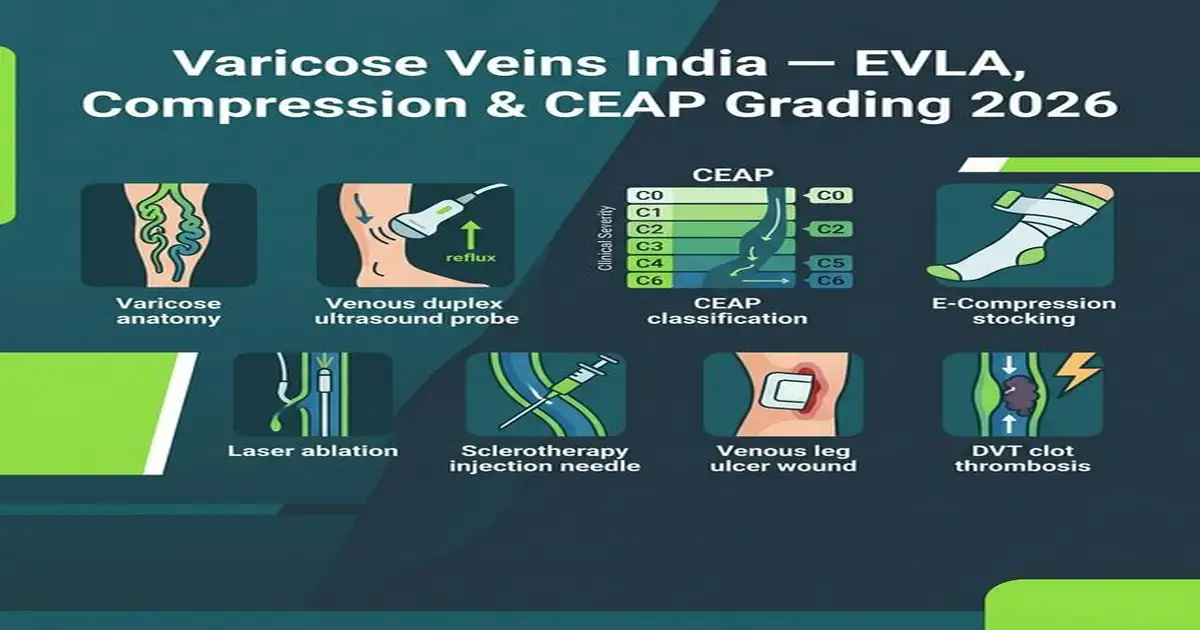
Varicose Veins India — CEAP Classification, Duplex Ultrasound and Treatment Options
| CEAP Class / Domain | Description & Features | Management | India Context |
|---|---|---|---|
| CEAP C0–C1 (No Visible Veins / Telangiectasia — Spider Veins) | C0: no visible signs of venous disease; symptomatic only (aching, heaviness, cramping — diagnose with duplex USS to confirm reflux); C1: telangiectasia (spider veins — capillary-level red/blue <1mm intradermal dilations) or reticular veins (blue-green 1–3mm subdermal); cosmetic concern primarily; NO significant venous reflux on duplex in most C1; symptoms: cosmetically distressing; occasional aching; Duplex ultrasound (colour flow Doppler): gold standard for venous assessment — identifies reflux in specific vein segments (GSV — great saphenous vein; SSV — small saphenous vein; perforator veins); reflux = retrograde flow >0.5 sec after Valsalva or calf compression-release manoeuvre; assessment: standing or reverse Trendelenburg position; maps anatomy for treatment planning; identifies DVT (deep vein thrombosis — DVT must be excluded before treating superficial varicosities) | C0 symptomatic: compression stockings (Class 1 — 15–20 mmHg); leg elevation; venoactive drugs (MPFF — Micronised Purified Flavonoid Fraction — Daflon 1000mg BD; horse chestnut extract — Venostat) — modest symptomatic relief; C1 telangiectasia/spider veins: microsclerotherapy (very fine needle injection 0.5% sodium tetradecyl sulphate/STD or polidocanol into spider veins) — cosmetic procedure; 2–4 sessions; laser (NDYAG external skin laser — cosmetic) for fine telangiectasia; no medical indication for treatment | India C0-C1: most patients present very late (C4–C6) due to stoic tolerance; C1 (spider veins): large cosmetic demand in urban India; available at vascular clinics in Mumbai, Delhi, Bangalore, Hyderabad; micropigmentation/microsclerotherapy clinics: ₹3,000–8,000 per session (cosmetic — not covered by insurance); symptom education: “heaviness in legs by evening, relieved by elevation” = early CVD → compression stocking as first step; venoactive drugs India: Daflon (MPFF — Servier) and generics (Venixxa, Vasodyne): ₹50–80/tablet; evidence: RELIEF study — MPFF reduces symptoms in C2–C4 CVD; commonly prescribed at PHC/GP level India |
| CEAP C2–C3 (Varicose Veins & Oedema) | C2: varicose veins — dilated tortuous superficial veins ≥3mm diameter in standing position; typically GSV (great saphenous vein) tributaries on medial thigh/calf; SSV (small saphenous vein) tributaries on posterior calf; symptoms: aching, heaviness, throbbing, itching, leg fatigue (worse end of day, worse after prolonged standing); muscle cramps (nocturnal — electrolyte-independent); phlebitis (thrombophlebitis) — acute red, tender cord along varicose vein segment; C3: ankle oedema (pitting — bilateral/unilateral); must exclude cardiac/renal/hepatic oedema (symmetric, pitting, JVP elevated → venous/cardiac; non-pitting → lymphoedema); standing oedema that resolves with elevation = venous oedema (C3) | Compression therapy: graduated compression stockings (GCS) — CORNERSTONE of CVD management; Class 2 (20–30 mmHg): for C2 varicose veins with symptoms; Class 3 (30–40 mmHg): for severe CVD, post-thrombotic syndrome; measure ankle and calf circumference → correctly sized prescription stockings; wear from waking to bedtime; does NOT treat underlying reflux but controls symptoms; Definitive treatment (C2–C3 varicose veins): EVLA (Endovenous Laser Ablation): 1470nm or 810nm laser fibre introduced into GSV under tumescent anaesthesia → laser energy denatures vein wall → vein shrinks and is absorbed; NICE UK, SVS (US), AVF guidelines: EVLA preferred over surgical stripping (faster recovery, less pain, less bruising, equivalent long-term results — EVRF trial + REACTF trial); day-care procedure; local tumescent anaesthesia; back to work in 1–3 days; RFA (Radiofrequency Ablation — ClosureFAST): similar mechanism to EVLA but uses radiofrequency heat; similar outcomes to EVLA (RECOVERY trial); High ligation + stripping (traditional surgery): still performed at government hospitals without EVLA/RFA; more morbid — GA, inpatient, longer recovery; gold standard historically — now second-line where minimally invasive unavailable; Foam sclerotherapy (UGFS): ultrasound-guided foam sclerotherapy (1–3% STD or polidocanol foam injected under USS guidance into GSV/tributaries) → chemical ablation; lower complete occlusion rate than EVLA/RFA for truncal veins; cheaper; good for recurrent varicose veins and small tributaries | India treatment landscape: EVLA: available at major vascular surgery centres — AIIMS Delhi (Dept Vascular Surgery), KEM Mumbai, CMC Vellore, Fortis, Apollo, Medanta; private: ₹40,000–90,000 per limb (EVLA); government: free/subsidised at AIIMS, medical colleges; traditional stripping: still most common at district hospitals (govt) — ₹10,000–20,000; UGFS: ₹8,000–20,000 per session; India-specific risk factors for varicose veins: road-side vendors standing all day; school teachers; Tamil Nadu traffic police — who stand 8+ hours; pregnant women (multiparous — North India; South India); factory workers (garment industry — Tiruppur, Surat — standing assembly line workers); occupational varicose veins should be covered by workplace health scheme (ESI — ESIC hospital: free varicose vein treatment for ESIC-insured workers) |
| CEAP C4–C5 (Skin Changes & Healed Ulcer) | C4a: pigmentation (lipodermatosclerosis — LDS — brown/haemosiderin staining from red cell extravasation), eczema (venous eczema — itchy, weeping skin around ankle); C4b: white atrophy (atrophie blanche — white stellate scarring with telangiectasia — very high ulcer risk), lipodermatosclerosis (fibrosis, induration, inverted champagne bottle leg); C5: healed venous leg ulcer (skin healed but scar present — very high recurrence risk without ongoing compression); Lipodermatosclerosis India: extremely painful — burning, tight-skin sensation around ankle; often mistaken for cellulitis (cellulitis: fever, spreading erythema, leucocytosis — distinguish carefully; LDS: no fever, chronic, sclerotic skin); Venous eczema: intensely itchy, weeping around medial ankle; often complicated by: sensitisation contact dermatitis (to topical agents — particularly neomycin, lanolin, emollients containing sensitisers — India: common); secondary bacterial infection (Staphylococcal + Streptococcal superinfection) | C4: intensive compression therapy (Class 3 stockings or multilayer compression bandaging — Profore or equivalent); topical mild steroid (e.g., Triamcinolone acetonide or betamethasone — for acute venous eczema; short course); moisturiser (simple emollient — plain petroleum jelly/white soft paraffin — safest → low sensitisation risk); treat underlying varicosities (EVLA/RFA) — prevents progression to active ulceration; C4b (high ulcer risk): prioritise definitive vein treatment; LDS treatment: Stanozolol (fibrinolytic anabolic steroid — reduces LDS fibrosis — 5mg BD × 8-12 weeks): not widely available but proven; pentoxifylline 400mg TDS (improves microcirculation); Venous eczema: distinguish from contact dermatitis (patch testing if chronic/refractory); C5: lifelong Class 3 compression → prevents ulcer recurrence; early EVLA if anatomically suitable (ablating GSV reduces ulcer recurrence — ESCHAR trial) | India C4-C5 access: venous eczema frequently misdiagnosed as fungal infection (tinea) or simple eczema — treated with antifungals or steroids alone without addressing underlying venous disease; clinical clue: perimalleolar location + pigmentation + association with varicose veins → venous cause likely; LDS India: extremely common in those with untreated varicose veins for 10–20 years; LDS late stage (inverted champagne bottle leg) → venous ulcer inevitable without intervention; ESIC hospital: provides compression bandaging + wound care for insured workers with C4–C5 CVD |
| CEAP C6 — Active Venous Leg Ulcer (VLU) | C6: active venous leg ulcer — most advanced, most disabling CVD complication; most common cause of chronic leg ulcer in India and globally (60–70% of all chronic leg ulcers); site: medial malleolus (gaiter area) — classic location — where venous pressure highest; morphology: shallow, irregular margin, sloping edge (unlike arterial ulcer — deep, “punched-out” edges), wet base, granulating, often large, very painful; surrounding: pigmentation, LDS, venous eczema, varicose veins; chronicity: months–years without treatment; infection: frequent — Staphylococcus aureus, Pseudomonas, MRSA; recurrence: 70% without corrective varicose vein treatment; Differential: arterial ulcer (ABPI <0.8 — toe pressure, ABI measurement essential before compression — DO NOT apply high-compression if arterial disease — worsens ischaemia); mixed arterio-venous (ABPI 0.6–0.8: reduced compression safe if skilled); neuropathic (diabetic foot — plantar location); malignant (Marjolin’s ulcer — chronic wound malignant transformation — biopsy if atypical/non-healing ≥3 months) | ABPI (Ankle-Brachial Pressure Index): MANDATORY before applying compression to any leg ulcer (identifies arterial insufficiency — compression contraindicated if ABPI <0.6, use with caution ABPI 0.6–0.8); Wound management: TIME principle — Tissue debridement (sharp/enzymatic/maggot); Infection control (silver dressings, iodocadexomer, systemic antibiotics only for clinical infection — not colonisation); Moisture balance (alginate/foam dressings for exudate); Edge advancement (skin grafting for large non-healing VLU); Compression bandaging: high-compression 4-layer bandaging (Profore equivalent — 40 mmHg at ankle) — gold standard VLU compression (Cochrane 2012 — highest healing rates); reduced compression (short-stretch: Comprilan) for ABPI 0.6–0.8; Definitive varicose vein treatment: EVLA/RFA/foam sclerotherapy of refluxing truncal veins → ESCHAR trial: reduces recurrence from 56% to 13% at 3 years; pentoxifylline 400mg TDS: adjunct; skin graft (split-thickness): for large VLU not healing with compression × 3 months | India VLU management gap: most VLU patients in India managed by general physicians/dermatologists without ABPI measurement → inappropriate compression applied to arterially insufficient limbs → ischaemia worsening; or NO compression applied even to venous ulcers (patient/carer cannot afford or apply multilayer bandaging); ESIC: free wound care for insured workers; wound care centres: Apollo, Fortis, Wockhardt (Mumbai) — specialised wound care nursing; affordable compression India: Profore 4-layer equivalent: ₹1,500–2,500/set (1 week); reusable short-stretch compression (Comprilan) ₹2,000 one-time; total wound care cost: significant barrier in low-income patients; NPWT (negative pressure wound therapy/VAC): for large non-healing VLU → available at major wound care centres ₹5,000–15,000 per week; PMJAY: VLU treatment covered at empanelled hospitals for beneficiaries |
Frequently Asked Questions
Are compression stockings enough for varicose veins — and when is surgery needed?
Compression stockings are the cornerstone of varicose vein symptom management — but they are NOT a cure. Understanding when compression is sufficient and when definitive treatment is required is essential for appropriate management: What compression stockings do (and don’t do): Mechanism: graduated compression (highest at ankle → decreasing towards knee/thigh) squeezes superficial veins → forces blood into deep venous system → reduces superficial venous hypertension → reduces symptoms; they do NOT close or ablate the varicose veins — reflux continues while stockings are not worn; symptom relief: excellent — aching, heaviness, swelling, cramps typically improve 60–80% with correctly-fitted Class 2 compression; limitations: they must be worn every day from waking — compliance is the biggest challenge (hot Indian climate + arthritis/obesity making self-application difficult); do NOT prevent progressive skin changes (C4) or ulceration if underlying reflux not treated; Compression classes India available: Class 1 (15–20 mmHg): mild venous disease, travel DVT prevention, pregnancy; Class 2 (20–30 mmHg): most varicose veins C2–C3, lymphoedema mild; Class 3 (30–40 mmHg): post-VLU healed (C5), post-thrombotic syndrome, severe CVD; commonly available brands India: Sigvaris (Switzerland — ₹2,500–4,500/pair), Mediven (BAUERFEIND — ₹2,000–4,000), Jobst, BSN Essity; Indian brands (cheaper): Tynor compression stocking (₹400–800 — lower compression accuracy — but better compliance due to cost); When definitive treatment (EVLA/RFA/surgery) is needed: Symptomatic C2 not controlled with compression; C3 oedema; C4 skin changes (lipodermatosclerosis, eczema — to prevent ulceration); C5 healed ulcer (to prevent recurrence); C6 active VLU (adjunct to compression — ESCHAR trial: ulcer healing AND recurrence reduction); acute superficial thrombophlebitis (recurrent, extensive); bleeding varicose vein (emergency — traumatic vessel rupture — apply direct pressure → seek emergency care → definitive treatment soon after); cosmetic (C2 — patient-driven); EVLA vs surgery India decision: if EVLA/RFA available and GSV diameter >4mm with axial reflux on duplex → EVLA preferred; SSV (small saphenous) reflux → SSV-EVLA or surgery (anatomical consideration — sural nerve proximity); recurrent varicose veins (post surgery/post EVLA) → ultrasound-guided foam sclerotherapy (UGFS) often most practical; perforator veins incompetence → SEPS (subfascial endoscopic perforator surgery) or perforator sclerotherapy if contributing to ulceration; pre-procedure: duplex ultrasound vein mapping mandatory (not optional — identifies anatomy, reflux pattern, perforator sites, deep vein patency).
How can I prevent varicose veins — especially if I stand all day at work in India?
Prevention of varicose vein progression and symptom severity is particularly important in India given the large population employed in occupations requiring prolonged standing — teachers, vendors, construction workers, security guards, nurses, cooks, factory workers, traffic police: Lifestyle and occupational preventive strategies: Avoid prolonged static standing: if occupation requires standing, take 5–10 minute sitting/walking breaks every 45–60 minutes; intermittent walking (even brief — 2 minutes) activates calf muscle pump → propels venous blood upward → reduces venous stasis; Leg elevation: elevate legs above heart level for 15–30 minutes after work (lie with legs on 2–3 pillows or propped against wall) — drains dependent venous pooling → significant symptom relief; Calf muscle pumping exercises: ankle circles, toe-heel rocking (even while standing at work) → activates deep venous return; Weight management: BMI >30 increases intra-abdominal pressure → impedes femoral venous drainage → accelerates varicose vein progression; even 5–10 kg weight loss reduces symptoms significantly; Compression: prophylactic Class 1 stockings (15-20 mmHg) for all prolonged standing occupation workers (cost: ₹400–800 Tynor; more effective graduated: ₹2,000–4,000 Sigvaris/Mediven); pregnant women: Class 1 from first trimester throughout pregnancy and 6 weeks postpartum; Avoid constrictive clothing: tight waistbands → increased abdominal pressure → venous reflux; Indian traditional dress: consider effect of tight sari petticoat band; Hydration: adequate hydration reduces blood viscosity → venous flow improved; India-specific: reducing prolonged squatting in labour positions (squatting increases intra-abdominal venous pressure) though ergonomically complex; Footwear: low-heeled shoes (moderate heel 2–3cm) — optimises gastrocnemius-soleus (calf pump) activation; very flat footwear or very high heels → impairs calf pump → venous pooling; Pharmacological prevention: MPFF (Daflon 1000mg/day) — reduces symptoms in C2–C3; modest evidence for preventing progression; widely used India; horse chestnut extract (Aescin — Venostat): reduces venous permeability → reduces oedema + symptoms; useful adjunct for symptom prevention; Surveillance: annual duplex USS if family history + occupation risk factor + symptomatic → detect reflux before C4 develops; early EVLA at C2 stage (appropriate patient) → prevents progression to C4/C5/C6 + massive future treatment costs and suffering; India-specific issue: ESIC coverage of varicose vein treatment for insured employees: all formal sector workers covered by ESIC for varicose vein evaluation and surgery at ESIC hospitals — many workers unaware of this entitlement → advise all formal sector workers with occupational varicose veins to claim ESIC benefit.
What to Read Next
- Obesity — BMI >30 Worsens Varicose Veins via Intra-Abdominal Venous Hypertension; Weight Loss 5-10kg = Symptom Improvement; Bariatric Surgery Reduces VLU Recurrence
- Pregnancy — Varicose Veins in Pregnancy: Class 1 Stockings from Trimester 1; Progesterone Relaxes Venous Wall; EVLA After Delivery; Postpartum DVT Risk
- Diabetes + Leg Ulcer — Diabetic Neuropathic Ulcer (Plantar) vs Venous Leg Ulcer (Medial Malleolus); ABPI Mandatory; Mixed Arteriovenous Ulcer in DM + CHD
- Hypertension — Venous Oedema vs Amlodipine-Induced Oedema (C3 — but Pitting, Bilateral, From Drug Side-Effect); Distinguish CVD Oedema From Drug-Induced
- Skin — Venous Eczema Misdiagnosed as Atopic Eczema; Perimalleolar Location + Haemosiderin Staining = Venous; Compression NOT Topical Steroids Alone
A 52-year-old school teacher from Lucknow — 25 years of standing 6–7 hours/day. Brings herself for “ulcer on ankle that won’t heal — 8 months now.” CEAP C6. Medial malleolus ulcer. Vaseline and bandage changed by local pharmacist weekly. No duplex, no ABPI, no specialist. Duplex today: GSV reflux grade 4 + perforator incompetence at medial ankle. ABPI: 0.92 (no arterial disease). 4-layer compression bandaging started. Wound debridement. She has ₹12,000 ESIC coverage — EVLA scheduled 4 weeks later. At 3 months: ulcer healed. At 6 months: wearing Class 3 stocking. No recurrence. “The pharmacist told me it was a boil. He told me to put dettol on it.” The right diagnosis was duplex + ABPI + vascular specialist. The right treatment was compression first + EVLA second. Eight months of suffering — resolved in 12 weeks of correct care.
About This Guide: Written by the StudyHub Health Editorial Team (studyhub.net.in) based on NICE CG168 Varicose Veins 2013 (updated 2020), SVS Clinical Practice Guidelines Chronic Venous Disease 2023, ESCHAR Trial, and Vascular Society of India protocols. Last updated: March 2026.
🧦 Stand All Day at Work? Start Compression Stockings Today: If you’re a teacher, security guard, cook, vendor, factory worker, or nurse who stands 6+ hours daily and has leg aching, heaviness, or swelling by evening — you likely have early chronic venous disease. Class 2 compression stockings (20–30 mmHg) relieves symptoms 60–80%. Tynor brand available at pharmacies: ₹400–800. Sigvaris/Mediven: ₹2,500–4,000. ESIC-covered workers: free vascular treatment — claim your benefit.
⚠️ Leg Ulcer? Get ABPI Before Any Compression: DO NOT apply tight compression bandaging to a leg ulcer without first measuring ABPI (Ankle-Brachial Pressure Index) to exclude arterial disease. If ABPI <0.6 → high compression = arterial ischaemia worsening. Any vascular clinic or hospital can measure ABPI in 5 minutes. Venous leg ulcers (medial malleolus, surrounding pigmentation) require high compression + vascular specialist referral for definitive varicose vein treatment.
⚕️ Medical Disclaimer: This article provides general educational information about varicose veins and chronic venous disease. All CEAP staging, duplex ultrasound assessment, EVLA/RFA/surgical decisions, ABPI measurement, and wound management of venous leg ulcers require qualified vascular surgeon or phlebologist expertise. Do not apply compression bandaging to leg ulcers without specialist assessment.