Last Updated: March 2026 | Reading Time: 8 minutes | ~1,900 words
Pancreatitis — inflammation of the pancreas — is one of the most common and potentially dangerous gastrointestinal emergencies in India, and one of the most mismanaged due to widespread myths about “NPO (nil per os — nothing by mouth) for weeks” and inappropriate use of antibiotics. India has a unique pancreatitis burden: in addition to the global causes (gallstones — 40–50%, alcohol — 30–35%), India has a distinct entity — Tropical Calcific Pancreatitis (TCP) — a specific form of chronic pancreatitis affecting young, non-alcoholic patients from Kerala, Karnataka, and other South Indian coastal states, linked to cassava (tapioca) consumption and nutritional deficiencies, causing juvenile-onset pancreatic diabetes and pancreatic calcification. India’s overall acute pancreatitis (AP) incidence is approximately 50–80 cases per 100,000 population per year, with mortality ranging from 1–2% (mild AP — interstitial) to 20–30% in severe AP with infected pancreatic necrosis. Pancreatitis in India is frequently undertreated with inadequate fluid resuscitation (most preventable source of mortality) and overtreated with broad-spectrum antibiotics (given prophylactically without evidence — drives resistance, no benefit in sterile necrosis). Chronic pancreatitis affects approximately 100–200 per 100,000 population in India — causing chronic abdominal pain, malabsorption (steatorrhoea, fat-soluble vitamin deficiency), and endocrine failure (pancreatogenic diabetes — Type 3c).
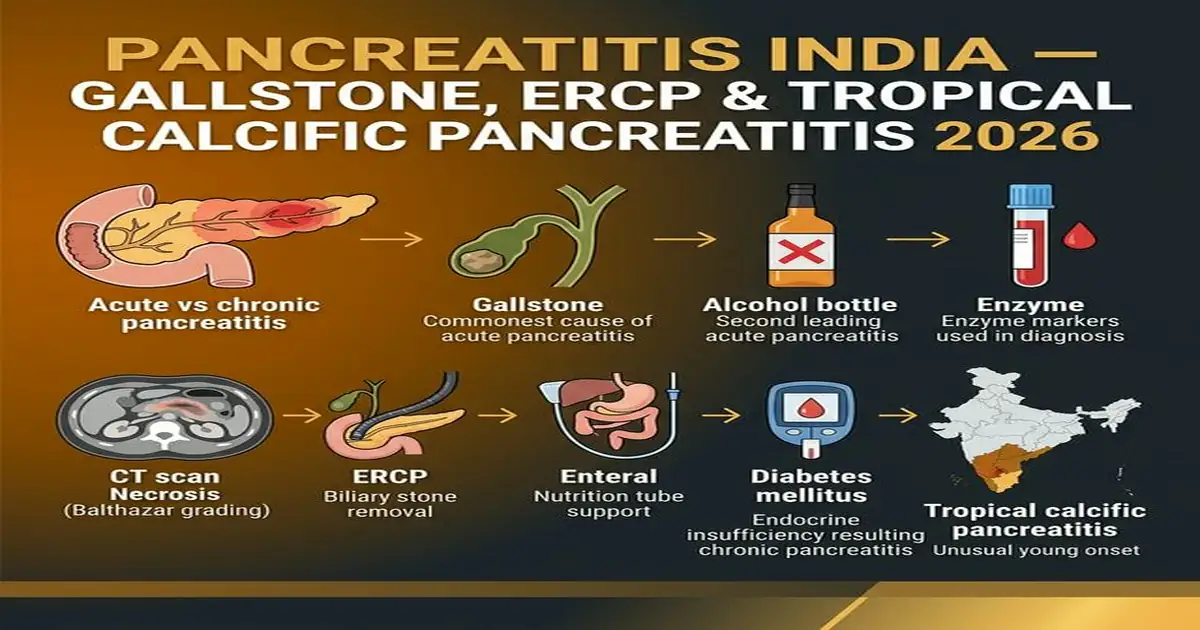
Pancreatitis India — Causes, Severity, Management and Tropical Calcific Pancreatitis
| Domain | Details | India Context |
|---|---|---|
| Acute Pancreatitis — Causes, Diagnosis & Severity | Causes (mnemonic I GET SMASHED): Idiopathic (10–15%); Gallstones (40–50% India — most common); Ethanol/Alcohol (30–35%); Trauma; Steroids; Mumps (and viral — CMV, EBV, Coxsackie); Autoimmune (Type 1 AIP — IgG4-related); Scorpion sting (Tityus trinitatis — South America; Indian yellow scorpion Mesobuthus tamulus — causes AP in Maharashtra, Rajasthan); Hypertriglyceridaemia (TG >1000 mg/dL — causes severe AP — plasmapheresis may be required); ERCP (post-ERCP pancreatitis — 3–5%); Drugs (valproate, azathioprine, thiazides, stavudine, pentamidine, tetracycline, sulphonamides); Diagnosis: serum lipase (>3× ULN — sensitivity 97%, specificity 99% — preferred over amylase); serum amylase (>3× ULN — sensitive but non-specific); LFTs + bilirubin (gallstone cause: elevated ALP, GGT, bilirubin → biliary AP); USS abdomen (gallstones, biliary dilation, pancreatic oedema); CT abdomen with contrast (CECT — “pancreatic protocol”) — NOT required in mild AP; indicated if: diagnostic uncertainty, worsening at 48–72h, suspected complications (necrosis, pseudocyst, abscess); Revised Atlanta Classification 2012 (severity): Mild AP: no organ failure, no local complications; Moderately Severe AP: transient organ failure (<48h) or local complications; Severe AP (SAP): persistent organ failure (>48h); organ failure defined: respiratory (PaO2/FiO2 <300), renal (creatinine >170 µmol/L), cardiovascular (SBP <90 despite resuscitation); Balthazar CT Severity Index (CTSI): CT grade A–E (A = normal; E = 2+ peripancreatic collections) + % necrosis (0/1/2 points) → total 0–10; CTSI ≥6: high morbidity/mortality; Modified CTSI/CTSI used at AIIMS, PGI, KEM | India AP causes: gallstone AP strongly linked to female sex, obesity, multiparity (classic “fat, fertile, forty, fair” — fair less relevant India); alcohol AP: predominantly males (rural; hooch/country liquor in UP/Bihar/Rajasthan); hypertriglyceridaemia AP India: increasingly recognised with rising dyslipidaemia + diabetes prevalence; triglyceride level routinely ordered in young AP without gallstones + alcohol; scorpion sting AP: particularly Maharashtra (Vidarbha region) + Rajasthan — envenomation → massive ACh release → pancreatic stimulation → AP; seen at rural district hospitals in peak summer; blood amylase India: still widely ordered (historical); lipase preferred (more specific); CECT pancreas: available at most district hospitals now (digital radiography expansion); IAP (Indian Association of Pancreatology): published India-specific AP guidelines (2018, updated 2022) emphasising aggressive IVF + early enteral nutrition + avoiding prophylactic antibiotics |
| Acute Pancreatitis — Management (The 3 Key Principles) | Principle 1 — Aggressive IV fluid resuscitation (MOST IMPORTANT): Goal: maintain organ perfusion; prevent pancreatic ischaemia (secondary necrosis from poor perfusion); Ringer’s Lactate (RL): preferred over Normal Saline (0.9% NaCl) — Wu 2011 RCT + WATERFALL 2022 trial: RL reduces SIRS + inflammatory markers vs NS; flow rate: 250–500 mL/hour for first 24–48h; target: urine output ≥0.5 mL/kg/h, HR <100, MAP >65 mmHg; BUN fall of 5 mg/dL at 24h: independently predicts favourable outcome; avoid fluid overload: in elderly/cardiac patients — careful balance; Principle 2 — Early enteral nutrition (NOT prolonged NPO): Myth debunked: “pancreatitis = NBM (nil by mouth) for days/weeks” — COMPLETELY WRONG; evidence: Meta-analyses (Al-Omran 2010, Petrov 2009, Stimac 2016): early enteral nutrition (within 24–48h) vs TPN: reduces infectious complications by 55%, reduces organ failure, reduces mortality; nasogastric (NG) route as effective as nasojejunal (NJ) route in most AP (PYTHON trial, ESPEN); mild AP: oral diet can start within 24h if patient tolerating, pain resolving — start with solid low-fat diet (NOT gradual liquid → soft → solid progression — ECAP trial 2007); severe/vomiting: nasogastric tube + continuous enteral feed; TPN: only if ENF not tolerated >72h; Principle 3 — Antibiotics ONLY for proven/strongly suspected infection: NO prophylactic antibiotics in AP (ACS, BSG, IAP, ESPEN guidelines): multiple RCTs (Isenmann 2004, Dellinger 2007, Garcia-Barrasa 2009): prophylactic antibiotics in severe AP/necrosis → NO reduction in infected necrosis, NO mortality benefit; drives resistant organisms; infected pancreatic necrosis (IPN): fever + CT necrosis + WCC rise after day 7 → FNA (fine-needle aspiration) Gram stain + culture → confirm infection → imipenem/meropenem + fluconazole; walled-off necrosis (WON): infection → endoscopic transmural drainage (ETD — step-up approach) preferred over open necrosectomy (PANTER trial: minimally invasive > open for WON) | India AP management failures: (1) fluid: most district hospitals give “maintenance IV fluids” (1L/8h) rather than aggressive resuscitation → pancreatic ischaemia → necrosis progression preventable; (2) NPO myth: patients kept nil by mouth for days, weeks → severe malnutrition → poor outcomes; many India hospitals still routinely keep AP patients NPO for days “to rest the pancreas”; this is OBSOLETE — early feeding within 24-48h is now standard of care; (3) prophylactic antibiotics: given universally in most India hospitals (“to prevent infection”) — leading cause of carbapenem-resistant Enterobacteriaceae (CRE) in ICU — based on completely debunked evidence; IAP 2022 Guideline: IVF RL 500 mL/h first 4h → reduce to maintain UO ≥0.5 mL/kg/h; early oral/nasogastric feeding 24-48h; antibiotics only for confirmed IPN (culture+) or clinical sepsis with fever + imaging changes; early ERCP (within 24–72h) for gallstone AP with cholangitis (ASGE grade 3 biliary obstruction) |
| Gallstone Pancreatitis — ERCP & Cholecystectomy Timing | Gallstone (biliary) AP: stone migrates from gallbladder into bile duct → impaction at ampulla of Vater → obstruction of both bile duct + pancreatic duct → enzyme activation; indicators of gallstone causation: elevated ALP >3× ULN: 83% PPV for gallstone AP; USS: gallbladder stones (± CBD stones); elevated bilirubin; ALT >150 U/L; MRCP (magnetic resonance cholangiopancreatography): non-invasive CBD stone detection; sensitivity 85-95% for CBD stones; ERCP (Endoscopic Retrograde Cholangiopancreatography): therapeutic — for CONFIRMED CBD stone + AP with cholangitis (fever + jaundice + AP); ERCP + sphincterotomy + stone extraction; timing: within 24h if acute cholangitis (Tokyo Grade II/III); within 72h if persistent biliary obstruction (dilated CBD + rising bilirubin) without cholangitis; NOT required if stones pass spontaneously (bilirubin normalising, CBD not dilated) — most mild gallstone AP stones pass on their own; Laparoscopic cholecystectomy (LC): MANDATORY after every episode of gallstone AP — within same admission if mild AP (safe, reduces recurrence); within 4–6 weeks maximum if moderate/severe AP (to prevent second AP attack — 25–30% recurrence risk if cholecystectomy delayed >4 weeks); failure to do cholecystectomy after gallstone AP = preventable second attack | India ERCP access: available at all tertiary hospitals (AIIMS, PGI, KEM, CMC Vellore, Medanta, Fortis); private: ₹20,000–50,000; government: free/subsidised; laparoscopic cholecystectomy India: one of the most performed surgeries in India; ₹30,000–60,000 private; free at many government hospitals; recurrence prevention: most important India gap — patients discharged after mild gallstone AP without being advised about cholecystectomy → return 2–4 months later with second (often more severe) attack; every gallstone AP patient must be explicitly told before discharge: “You must have surgery to remove your gallbladder within 4–6 weeks to prevent another attack” |
| Chronic Pancreatitis — Causes, Diagnosis & Management | Chronic pancreatitis (CP): progressive, irreversible fibrosis and destruction of pancreatic parenchyma → exocrine insufficiency (malabsorption) + endocrine insufficiency (diabetes — Type 3c); Causes India: Alcohol (most common globally + India — ethanol drives progressive fibrosis); Tropical Calcific Pancreatitis — TCP (India/Africa-specific); Idiopathic (second most common India); Hereditary (PRSS1, SPINK1, CFTR mutations — SPINK1 mutations extremely common India — associated with tropical pancreatitis); Autoimmune type 2 (IAPS criteria); Obstructive (pancreatic duct stricture, stones, tumor); Clinical features: Chronic epigastric pain radiating to back (most dominant symptom — aggravated by eating, relieved by sitting forward/fetal position); Steatorrhoea (oily, greasy, difficult-to-flush stools — exocrine failure once >90% acinar cell loss); Weight loss; Diabetes mellitus (Type 3c — both insulin-deficient and glucagon-deficient → brittle → HIGH hypoglycaemia risk); Diagnosis: serum lipase (may be NORMAL in advanced CP — burned-out gland); imaging: X-ray (calcifications in pancreatic duct → classic late sign); USS (ductal dilation, calcifications); CT (GOLD STANDARD — shows calcifications, ductal dilation/beading, parenchymal atrophy, pseudocysts); MRCP/EUS (early CP — ductal/parenchymal changes before CT visible); faecal elastase-1 (FE-1): non-invasive exocrine function test (<200 µg/g = exocrine insufficiency) | Tropical Calcific Pancreatitis (TCP): India-specific entity — first described by Geevarghese (Kerala) 1954; highest prevalence Kerala, Karnataka, Odisha, Bihar — predominantly rural; age of onset: teens-20s (much younger than alcohol CP); hallmark: massive intraductal calcifications (stones) visible on plain X-ray abdominal; young non-alcoholic with diffuse pancreatic calcification = TCP until proven otherwise; cause: SPINK1 gene mutation (N34S — most common in India TCP) + cassava (tapioca cyanogen) + malnutrition + CFTR; treatment: same as alcoholic CP but cassava stopped; SPINK1 testing at CMC Vellore (only major centre), AIIMS; CP management India: alcohol de-addiction (mandatory, even partial reduction slows fibrosis); pain: WHO analgesic ladder (paracetamol → tramadol → opioids — morphine controlled-release if severe); celiac plexus nerve block (endoscopic EUS-guided — reduces pain 3–6 months); pancreatic enzyme replacement therapy (PERT): creon (lipase 25,000–50,000 IU per meal) + enteric coated capsule — with main meals + with snacks; to be taken WITH food (not before); Vit ADEK supplementation (fat-soluble — malabsorbed); Type 3c diabetes management: insulin (NOT metformin primarily; NOT SGLT2i — risk of diabetic ketoacidosis); regular SMBG + hypoglycaemia awareness training |
| Pancreatic Complications — Pseudocyst, Necrosis & Cancer Risk | Pseudocyst: fluid collection surrounded by wall of reactive tissue (NOT true epithelial lining — hence “pseudo”); develops 4+ weeks after AP or in CP (ductal disruption); most resolve spontaneously (observe 4–6 weeks if asymptomatic); indication for drainage: symptomatic (pain, vomiting from gastric compression, early satiety); infected; enlarging; endoscopic transmural drainage (ETD): EUS-guided cystogastrostomy (LAMS — Lumen Apposing Metal Stent) — gold standard; surgical: open cystojejunostomy — now rarely first-line; Walled-Off Necrosis (WON): mature liquefied pancreatic necrotic collection; drainage: EUS-guided step-up approach (PANTER trial): direct endoscopic necrosectomy (DEN) — superior to surgical necrosectomy for WON (less multiorgan failure, fewer fistulas, less DM); Pancreatic cancer (CP → cancer risk): 3–5× increased risk in CP vs general population; 10–20× in hereditary pancreatitis (PRSS1 mutation); surveillance: routine surveillance NOT recommended for sporadic CP; hereditary: annual EUS + MRI pancreas from age 40 (or 10–15 years earlier than youngest affected family member); CA 19-9 + CEA + CT if symptoms change | India pseudocyst management: EUS-guided drainage increasingly available at tertiary hospitals (AIIMS, PGIMER, KEM, CMC Vellore, Asian Institute of Gastroenterology Hyderabad); LAMS (Axios stent): ₹80,000–120,000 — increasingly used; traditional surgical cystojejunostomy: still common at district/secondary care hospitals; pancreatic necrosectomy: minimally invasive approach (laparoscopic/endoscopic step-up) reduces morbidity vs open — being gradually adopted India; TCP pancreatic cancer: surveillance data limited India — registry-based surveillance in TCP cohorts at CMC Vellore and SGPGI Lucknow; hospital-acquired IPN organisms India: Klebsiella pneumoniae (KPC), Candida, MRSA — multidrug resistant — tailor antibiotics with culture sensitivity guidance (avoid empirical carbapenems without culture data) |
Frequently Asked Questions
Do I need to starve (NBM) during acute pancreatitis — and when can I eat?
The instruction to keep pancreatitis patients “nil by mouth” for extended periods is one of the most entrenched — and most harmful — myths in Indian hospital practice, and it contradicts two decades of strong evidence-based medicine: The old thinking (and why it was wrong): Historical rationale: “Eating stimulates pancreatic secretion → aggravates inflammation → NPO rests the pancreas”; this was logical-seeming but biologically flawed: pancreatic secretion in severe AP is already profoundly suppressed by the inflammatory process; the inflamed pancreas is NOT secreting enzymes appropriately regardless of oral intake; NPO leads to: gut mucosal barrier breakdown (within 24h of fasting → bacterial translocation from gut to bloodstream → secondary infections + sepsis); profound malnutrition (AP is highly catabolic state — body breaking down muscle + fat at accelerated rate); longer ICU stays, more infectious complications. What the evidence says — early feeding is safe and beneficial: ECAP trial (2007): solid low-fat diet vs clear liquids in mild AP → solid diet tolerated equally well, earlier discharge; Stimac 2016 (ESPEN supported trial): early ENF vs delayed oral feeding in moderate AP → early ENF: lower CRP, lower LOS, fewer complications; PYTHON trial (2014): early nasoenteric feeding within 24h vs on-demand oral diet → nasogastric as effective as nasojejunal; multiple systematic reviews and IAP 2022 guideline: early enteral nutrition (within 24–48h) is safe, reduces secondary pancreatic infections by 55%, reduces need for surgical intervention, improves survival in SAP; The practical guide — when to eat: Mild AP with resolving symptoms: oral diet within 24–48h of admission (do NOT wait for amylase/lipase to normalise — enzymes can stay elevated weeks after symptoms resolve — clinical status guides re-feeding, NOT enzyme numbers); post-episode diet: low-fat (avoid added fats/oils initially; no fried food — fats stimulate CCK → pancreatic stimulation — reduce briefly); regular small meals (5–6 small meals vs 3 large — reduces peak CCK stimulation); Moderate AP with vomiting/ileus: nasogastric tube + enteral formula (polymeric feed — Ensure, Nutren); start at 25 mL/hr → increase to target; NJ tube (nasojejunal) only if NG not tolerated; Severe AP: early nasogastric/NJ feed within 24–48h; target: 25–30 kcal/kg/day, 1.2–1.5 g/kg/day protein; supplement: zinc, selenium, antioxidants (AP causes significant oxidative stress); TPN: ONLY if enteral not possible for >72h; if on TPN: combine with small-volume enteral feed (even 20 mL/h) to maintain gut mucosal integrity; Chronic pancreatitis diet: small frequent low-fat meals; strict alcohol abstinence; creon (pancreatic enzyme supplement) with ALL meals and snacks; monitor Vitamin ADEK, cobalamin levels; diabetes management with insulin.
What is Tropical Calcific Pancreatitis — and why is it unique to India?
Tropical Calcific Pancreatitis (TCP) is one of India’s (and the tropical world’s) most distinctive and poorly-understood gastrointestinal diseases — a form of chronic calcific pancreatitis occurring in young, non-alcoholic individuals from specific tropical regions without an obvious conventional aetiology: Who gets TCP: Age of onset: typically teens to late 20s (much younger than alcohol-related CP which typically presents age 35–50); sex: both male and female affected; geography: highest prevalence in Kerala (the Diabetes Belt of India — Kerala has one of India’s highest diabetes rates — in part from TCP), Karnataka (coastal), Tamil Nadu, parts of Odisha, Bihar, parts of Africa (Uganda, Ethiopia, Zambia — “African fibrocalculous pancreatic diabetes — FCPD”); economic status: historically described in malnourished, poor rural populations — though now seen across socioeconomic groups; What causes TCP — the multi-factor hypothesis: 1. SPINK1 gene mutation (serine protease inhibitor Kazal type 1 — N34S mutation): found in 30–50% of Indian TCP patients (vs 1–2% general population) — causes impaired intra-acinar trypsin inhibition → repeated micro-episodes of autodigestion → chronic fibrosis; SPINK1 is the strongest single genetic risk factor for TCP in India; 2. Cassava (tapioca — Manihot esculenta) cyanogen hypothesis: cassava = dietary staple in Kerala/Karnataka coastal areas; cassava contains cyanogenic glucosides → releases hydrogen cyanide → thiocyanate (after metabolism) → cytotoxic to pancreatic acinar cells; reducing cassava intake in at-risk populations may reduce TCP incidence (not proven by RCT — confounded by nutritional improvements overall); 3. Micronutrient deficiency: selenium, zinc, copper, methionine deficiencies → impaired antioxidant protection → oxidative stress → acinar damage; 4. CFTR mutations: some Indian TCP patients have CFTR variants — similar to cystic fibrosis-related pancreatitis; How TCP presents and is diagnosed: Abdominal pain: severe recurrent; typical pancreatitis pain (epigastric, radiating to back, aggravated by food); younger onset than alcohol CP; Steatorrhoea: foul, oily stools; weight loss; Diabetes mellitus (FCPD — Fibrocalculous Pancreatic Diabetes): early onset, often insulin-dependent; distinct from T1DM (no islet antibodies) and T2DM (different pathogenesis); characteristic: relatively less ketosis-prone than T1DM despite insulin requirement (some residual glucagon suppression); Imaging hallmarks: massive intraductal calcifications (sometimes huge stones filling main pancreatic duct) on plain X-ray abdomen (95% diagnostic sensitivity) — “chain of lakes” appearance of beaded dilated duct on MRCP; CT: ductal dilation, calculi, parenchymal atrophy; endoscopy: EUS; TCP management — India: No cassava consumption; nutritional rehabilitation; pain management (as per alcohol CP protocol); ERCP + pancreatic duct stone removal/stent (for large duct TCP with stricture); ESWL (extracorporeal shockwave lithotripsy) + ERCP: fragmentation of large PD stones → removal → reduces pain in 50–80% (ESWL centers: AIIMS Delhi, AMRI Kolkata, CMC Vellore); lateral pancreaticojejunostomy (Puestow procedure): surgical drainage of dilated duct → long-term pain reduction; total pancreatectomy + islet autotransplantation (TP-IAT): emerging at CMC Vellore for intractable TCP pain; FCPD diabetes: insulin + dietary management (similar to T1DM but with malabsorption consideration); PERT for steatorrhoea; nutritional supplements.
What to Read Next
- Fatty Liver — MASLD + Chronic Pancreatitis Share Alcohol + Metabolic Aetiology; Distinguish Alcoholic Liver Disease from Alcoholic Pancreatitis;
- Gallstones — Gallstone = Most Common India AP Cause; ERCP Stone Extraction; LC Within 4-6 Weeks After Biliary AP; MRCP vs ERCP Decision
- Diabetes Type 3c vs T2DM vs T1DM — FCPD Pancreatogenic Diabetes: Insulin Dependent; No Ketoacidosis; PERT + Insulin Combination; Brittle Course
- Hypertriglyceridaemia Pancreatitis — TG >1000 mg/dL Cause Severe AP; Fenofibrate Prevents Recurrence; Plasmapheresis Acute; Insulin + Heparin Protocol
- IBS vs Chronic Pancreatitis — Differentiate Recurrent Epigastric Pain: FE-1 Steatorrhoea vs IBS Normal Stool; CT Calcifications vs IBS Normal Imaging
A 45-year-old man in Patna — admitted with severe epigastric pain + vomiting. Lipase 2,400 U/L. USS: gallstones, 5mm CBD stone, dilated CBD. Diagnosis: gallstone AP. His previous visit 6 months ago: same diagnosis, same hospital, discharged without cholecystectomy. This time: ERCP day 2 (CBD stone extracted). Aggressive RL at 300 mL/h. Feeding restarted nasogastric day 2 (not kept NBM). Laparoscopic cholecystectomy day 7 (within same admission). Six months later: no AP recurrence. “The first time I was sent home with a prescription for antacids and told to avoid spicy food. No one mentioned surgery.” The anatomy is clear: gallbladder with stones → remove gallbladder → no more gallstone pancreatitis. India has the surgical capacity. The gap is the system telling patients they need it.
About This Guide: Written by the StudyHub Health Editorial Team (studyhub.net.in) based on IAP (Indian Association of Pancreatology) Acute Pancreatitis Guidelines 2022, BSG Acute Pancreatitis Guidelines 2021, ACG Pancreatitis Guidelines 2024, and ESPEN Enteral Nutrition Guidelines for Pancreatitis. Last updated: March 2026.
🍽️ Had Acute Pancreatitis? You Do NOT Need to Starve: Evidence from multiple clinical trials shows early enteral feeding (within 24–48 hours) reduces complications and hospital stay in pancreatitis. If your pain is improving and you’re not vomiting, start oral intake within 24–48h — low-fat foods first (idli, rice, dal, toast). Do NOT wait for lipase to normalise before eating. If hospitalised: ask your doctor about nasogastric feeding within 48h if not able to eat orally.
⚠️ Gallstone Pancreatitis? MUST Have Cholecystectomy Within 4–6 Weeks: Every episode of gallstone pancreatitis has a 25–30% risk of recurrence if the gallbladder is not removed. Laparoscopic cholecystectomy (keyhole surgery) is safe and usually done within the same admission for mild AP, or within 4–6 weeks for moderate/severe. Ask your doctor before discharge: “When should I have my cholecystectomy?” Do not leave without an answer.
⚕️ Medical Disclaimer: This article provides general educational information about pancreatitis. All diagnosis (lipase, CT Balthazar grading), severity assessment, ERCP decisions, antibiotic use in infected necrosis, and surgical/endoscopic interventions require qualified gastroenterologist, hepatopancreaticobiliary surgeon, and ICU specialist assessment. Severe acute pancreatitis must be managed in an ICU setting.