Last Updated: March 2026 | Reading Time: 8 minutes | ~2,000 words
Hair loss (alopecia) is one of the most emotionally distressing conditions seen in Indian dermatology clinics — affecting an estimated 50% of Indian men by age 50 and 25–30% of Indian women at some point in their lives. The psychological impact is disproportionate to the medical severity — hair carries deep cultural significance in India (associated with youth, beauty, health), and hair loss drives significant anxiety, depression, and social withdrawal. India has a unique hair loss landscape: the prevalence of androgenetic alopecia (AGA — pattern hair loss) is high and driven by genetic factors inherited from both parents; post-COVID-19 telogen effluvium became one of the most common hair loss presentations in 2021–2023; post-partum hair loss affects the majority of Indian women after delivery; and traction alopecia from tight braiding, oiling practices, and hair extensions is endemic. The good news: most hair loss is treatable — the tragedy is late presentation (patients spend years on hair oils, herbal tonics, and prayer before seeing a trichologist) and misdiagnosis.
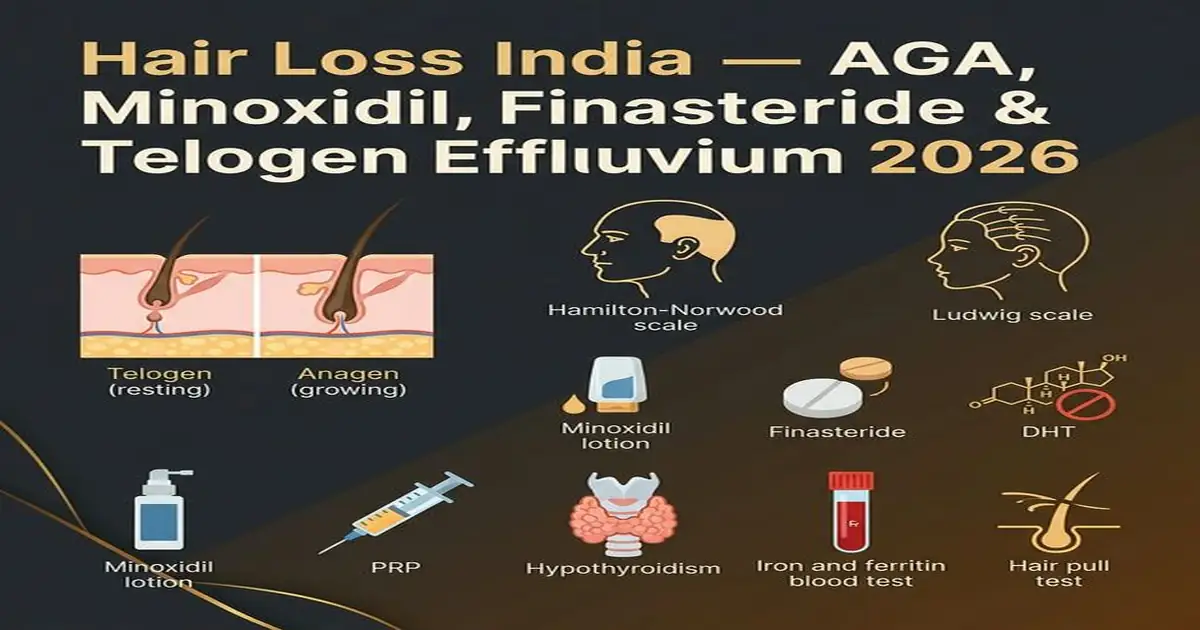
Hair Loss Types — Diagnosis and Treatment Overview
| Type | Pattern | Cause | Key Investigations | Treatment |
|---|---|---|---|---|
| Androgenetic Alopecia (AGA) — Male Pattern Baldness | Hamilton-Norwood scale I–VII; temple recession → crown thinning → confluence; the classic M-shaped recession; always spare occipital band | Genetic sensitivity of follicles to DHT (dihydrotestosterone — 5α-reductase converts testosterone → DHT → miniaturises androgen-sensitive follicles → progressive shortening of anagen phase → vellus hair replacement); autosomal polygenic inheritance (maternal AND paternal genes) — myth busted: baldness does NOT only come from mother’s side | Clinical + trichoscopy (dermoscopy of scalp): miniaturised hairs, perifollicular pigmentation, hair diameter diversity >20%; scalp biopsy (rarely needed — diagnostic if uncertain) | Minoxidil 5% topical solution/foam 1mL twice daily (men); finasteride 1mg oral once daily (men — 5α-reductase inhibitor — reduces DHT 70%; MEN ONLY — teratogenic; do NOT use in women of reproductive age); dutasteride 0.5mg oral (more potent — inhibits both 5α-R1 and 5α-R2; superior to finasteride at equivalent doses; off-label for AGA but widely used India); low-level laser therapy (LLLT) devices; hair transplant (FUE — follicular unit extraction) |
| Androgenetic Alopecia (AGA) — Female Pattern Hair Loss (FPHL) | Ludwig scale I–III; diffuse crown thinning preserving frontal hairline (distinguishes from male pattern); widening of central part; rarely complete baldness | Same genetic basis as male AGA; androgens less dominant driver (many women have FPHL with normal androgen levels — follicle sensitivity); PCOS, post-menopausal (oestrogen decline unmasks androgen effect), hypothyroidism, iron deficiency all contribute and worsen FPHL | Hormonal screen (testosterone, DHEAS, LH:FSH) if PCOS features; serum ferritin (<30 µg/L worsens FPHL — iron supplementation helps even at “normal” ferritin if low-normal); thyroid function (TSH); trichoscopy | Minoxidil 2% or 5% topical (women — 5% as effective as in men; 5% foam widely used); no significant systemic absorption at scalp application; oral minoxidil 0.25–1mg/day (very low dose — increasingly used for FPHL in women — dramatically more effective than topical; side effect: facial hypertrichosis at higher doses — start 0.25mg; well-tolerated at ultra-low dose); spironolactone 50–100mg (anti-androgen; particularly PCOS-related FPHL); COCP (Diane-35) for PCOS-driven FPHL; finasteride 2.5–5mg/day in post-menopausal women (not premenopausal — teratogenic) |
| Telogen Effluvium (TE) | Diffuse generalised hair shedding; ≥100–150 hairs/day (normal: <100); positive hair pull test (≥3 hairs per pull); no specific pattern; scalp appears relatively normal between hairs | Physiological shift of anagen (growing) follicles → telogen (resting) phase in response to metabolic stress; shedding occurs 2–4 months AFTER trigger; India triggers: post-COVID-19 (most common 2021–2023 — approximately 30% of COVID-19 patients develop TE at 1–3 months post-infection); post-partum (almost universal — oestrogen plummets postpartum → telogen shift; peaks at 3–4 months post-delivery; self-limiting); crash dieting (caloric restriction, low protein — common in Indian women); iron deficiency anaemia; thyroid disease; major illness/surgery; stress (chronic emotional stress — genuine trigger for TE); medications (carbimazole, heparin, lithium, anticonvulsants) | Full blood count; serum ferritin; TSH, T4; Zn, vitamin B12 (deficiency contributes); ANA (exclude SLE); scalp trichoscopy; hair pull test positive (≥3 hairs/pull from multiple scalp areas) | Identify and treat underlying cause FIRST — TE is almost always self-limiting once trigger addressed (typically 6–12 months); post-COVID TE: reassurance — resolves spontaneously; optimise nutrition (protein 1.2–1.5g/kg/day; iron supplementation if ferritin <40; zinc; biotin NOTE: biotin causes spurious lab results — use only if deficient); minoxidil may accelerate recovery; trichoscopy to distinguish from AGA (important — TE can unmask underlying AGA in genetically predisposed) |
| Alopecia Areata (AA) | Well-defined circular/oval patches of complete hair loss; smooth scalp within patch; exclamation mark hairs at patch margin (pathognomonic); may progress: alopecia totalis (entire scalp), universalis (entire body) | Autoimmune — CD8+ T-cells attack hair follicles (immune privilege of follicle collapses); associated with other autoimmune diseases (thyroid — Hashimoto’s, vitiligo, type 1 diabetes — screen for these); 20% family history; significant psychological impact; nail involvement (pitting, trachyonychia) in 10–20% | Clinical diagnosis (characteristic patches + exclamation mark hairs); trichoscopy: yellow dots, black dots, dystrophic hairs; thyroid antibodies, TSH; rule out tinea capitis (fungal — must exclude in children) | Limited (<50% scalp loss): potent topical TCS (clobetasol propionate 0.05% foam or solution); intralesional triamcinolone acetonide 5–10mg/mL (injections every 4–6 weeks — effective for small patches); topical immunotherapy (DPCP — diphencyprone); Extensive/refractory: Baricitinib (Jakafi — JAK inhibitor): FDA approved 2022 — first systemic treatment approved for severe AA; BRAVE-AA1/2 trials: 38–40% scalp hair coverage vs <3% placebo; India: increasingly available; ₹15,000–25,000/month; ritlecitinib (second JAK inhibitor): approved 2023 for AA ≥12 years; oral prednisolone pulse: monthly pulse (300mg IV methylprednisolone × 3 months) — used extensively India for extensive AA; variable response; baricitinib superior for sustained response |
| Traction / Scarring Alopecia | Traction: frontoparietal and temporal recession (along hair parting/bun areas); chronic — can become permanent; Scarring: follicular destruction → shiny, smooth scalp — no follicles visible; various subtypes (lichen planopilaris, frontal fibrosing, discoid lupus) | Traction: chronic mechanical tension on hair (tight braids, ponytails, extensions, heavy oiling practices — popular in India — coconut oil massaged vigorously causes follicular damage if excessive tension combined); Scarring: autoimmune/inflammatory destruction of follicle (LPP, FFA — lichen planopilaris subtypes; discoid lupus; DLE) | Traction: clinical history + pattern; Scarring: scalp biopsy essential — confirm type; DIF (direct immunofluorescence) for lupus; ANA, anti-dsDNA for SLE | Traction: stop causative hairstyle immediately; early stages: reversible; late stages: permanent (FUE hair transplant only option); Scarring LPP/FFA: hydroxychloroquine (first-line; reduces progression); topical TCS; oral retinoids (acitretin); intralesional steroids; dupilumab emerging (LPP variants); TREAT EARLY — once scarring established, transplant is only option |
Frequently Asked Questions
Does minoxidil actually work — and how should it be used in India?
Minoxidil is the only topical FDA/DCGI-approved treatment for both male and female pattern hair loss — and one of the most evidence-based hair loss treatments available at remarkably affordable India prices: How minoxidil works: Originally an antihypertensive (reduced BP by vasodilation); hypertrichosis (excess hair growth) was noted as a side effect → led to development as topical hair loss treatment; mechanism: extends anagen (growth) phase of hair cycle; increases follicular size; improves scalp blood flow; direct potassium channel opening in follicle; wakes up miniaturised follicles — does NOT fully reverse DHT-mediated miniaturisation (unlike finasteride); topical vs oral: topical is first-choice at standard doses; oral minoxidil at ultra-low dose (0.25–1mg/day) is showing dramatic efficacy superiority over topical in recent studies. Minoxidil clinical evidence: AGA men: 5% minoxidil twice daily vs placebo: 45% increase in terminal hair count at 48 weeks; both topical solution and foam effective; women: 2% or 5% similar to men (5% more effective); oral minoxidil (2.5–5mg/day men; 0.25–1mg/day women): DOSE STUDY and multiple cohort trials show substantially superior efficacy vs topical for many patients; side-effect profile at ultra-low dose remarkably favourable. How to use minoxidil correctly — India instructions: Apply 1mL (20 drops — included dropper) of 5% solution to DRY scalp (not wet hair) in affected area; massage gently; do NOT rinse for 4 hours; twice daily application (once nightly also acceptable — compliance better); use daily for minimum 6 months before assessing response; critical warning: SHEDDING IN FIRST 4–8 WEEKS IS NORMAL AND EXPECTED (synchronisation of follicles → increased telogen shedding before regrowth); many Indian patients stop at this stage thinking minoxidil is “causing more hair loss” — this is the fatal compliance error; if minoxidil stopped, all gained hair is lost within 3–6 months (treatment maintains hair — not cure); India cost: topical minoxidil 5% (60mL = 1 month supply): ₹200–400 (Mintop, Morr, Tugain — all equivalent); oral minoxidil 2.5mg tablet (off-label crushing for low-dose): ₹5–10/tablet × 0.25mg = ₹0.50–1/day (extremely affordable). What minoxidil cannot do: Cannot regrow hair on completely bald areas (follicle must be present — vellus hairs respond, but long-term bald areas with no follicles do not respond); does not address underlying androgen cause (requires finasteride combination in AGA for best results); maintenance therapy lifelong required.
Is post-COVID and post-partum hair loss permanent in India?
Two of the most common hair loss presentations in Indian dermatology clinics since 2021 are post-COVID telogen effluvium and post-partum/post-delivery hair loss — both cause extreme distress, both are self-limiting: Post-COVID-19 telogen effluvium: Mechanism: COVID-19 illness (the febrile illness, the metabolic stress, the hypoxia, the inflammation) acts as a powerful TE trigger — shifts anagen follicles to telogen → shedding 2–4 months after illness; Indian data: approximately 25–35% of hospitalised COVID-19 patients and 20% of mild COVID-19 develop post-COVID TE; disproportionate media coverage created enormous anxiety among Indian patients; shedding peak: typically 3–4 months post-COVID infection; duration of shedding: 2–3 months of maximum shedding; recovery: spontaneous and complete in 95%+ of cases within 6–12 months without treatment; residual permanent hair loss: uncommon but possible if COVID-19 unmasked underlying AGA; practical management: comprehensive reassurance (patients need to know this is temporary and expected); optimise nutrition (protein, iron, zinc); minoxidil prescribed if patient requests active treatment (not mandatory — hair recovers without it); trichoscopy confirms TE (no miniaturisation — distinguishes from AGA). Post-partum hair loss (chronic telogen effluvium of pregnancy): Mechanism: during pregnancy, high oestrogen prolongs anagen → hair appears thicker and lusher than usual; after delivery, oestrogen plummets → synchronised conversion to telogen → massive shedding starting 2–4 months post-delivery; affects the majority of Indian postpartum women — typically 30–50% of scalp hair can be shed at peak shedding; peak: 3–4 months post-delivery; self-limiting: 95%+ recover fully within 9–12 months post-delivery; India counselling challenge: new mothers are already exhausted; hair loss causes significant psychological distress on top of postpartum challenges; many are advised by family to apply copious oil and avoid washing hair (reducing friction helps minimally; this is not evidence-based treatment); management: reassurance + nutritional support (iron — postpartum anaemia very common in India; protein); minoxidil safe in breastfeeding? controversy — low topical absorption; most guidelines advise avoiding during breastfeeding if possible; if severe distress, discuss risk-benefit with prescriber. When post-COVID/post-partum TE is NOT self-limiting: If hair loss continues beyond 12 months without recovery — consider: underlying AGA unmasked by TE trigger (trichoscopy essential); iron deficiency anaemia (serum ferritin <30 µg/L — common India); thyroid disease (10% post-partum hypothyroidism — screen with TSH at 3 months post-delivery); chronic TE from ongoing nutritional deficiency (protein malnutrition — common in Indian vegetarian women with inadequate protein intake).
Does PRP (Platelet Rich Plasma) work for hair loss in India?
PRP therapy for hair loss has become one of the most heavily promoted and commercially driven treatments in Indian trichology — marketed aggressively by hair clinics. Understanding the evidence helps patients make informed decisions: What is PRP? Blood sample drawn from patient → centrifuged → platelet-rich fraction isolated → injected into scalp (multiple injections, typically 30–50 injection points per session); platelets release growth factors (PDGF, TGF-β, VEGF, EGF, IGF-1) → theoretically stimulate hair follicle proliferation and anagen extension. The evidence for PRP in hair loss: Positive evidence: multiple small RCTs and systematic reviews show PRP improves hair density, thickness, and regrowth in AGA (both male and female pattern); meta-analysis (2021, JAAD): PRP significantly superior to placebo for hair count, hair thickness, and patient satisfaction scores; limitations: studies are small, heterogeneous (protocols vary enormously — centrifugation speed, platelet concentration, number of sessions); no standardised PRP kit protocol; minimal long-term data beyond 12 months; not as well-evidenced as minoxidil + finasteride combination; PRP is adjunct therapy — not replacement for medical treatment. PRP in clinical practice India: AAHS (AGA) and AA (alopecia areata): moderate evidence supports benefit; Telogen effluvium: weaker evidence; Scarring alopecia: PRP not indicated (scarred follicle cannot regenerate). Typical protocol: 3–4 sessions monthly → then maintenance every 3–6 months; India cost: ₹3,000–8,000/session in most cities; ₹10,000–20,000 in premium hair clinics; multiple sessions = ₹30,000–80,000/year. Honest assessment for Indian patients: PRP is safe (autologous blood — own blood used), well-tolerated (local anaesthetic used), has evidence of modest benefit as add-on to minoxidil, but: is NOT a cure; cannot replace finasteride/dutasteride for DHT blockade in AGA; should be combined with topical/oral minoxidil and finasteride for best results in AGA; marketed commercial claims (100% hair regrowth in 3 sessions — common in Indian hair clinic advertising) are not supported by evidence; realistic expectation: 10–30% improvement in hair density when combined with medical treatment; not useful as sole treatment; hair transplant (FUE) remains the gold-standard for advanced AGA (Hamilton IV–VII) when medical treatment has provided insufficient response.
What to Read Next
- PCOS — PCOS-Driven Female Pattern Hair Loss: Treat Hyperandrogenism with COCP/Spironolactone + Minoxidil
- Thyroid — Hypothyroidism Causes Diffuse Hair Loss and Dry Scalp; Restore TSH to Normal Range to Recover Hair
- Iron Deficiency — Serum Ferritin <30 µg/L Worsens All Types of Hair Loss; Treat Iron Deficiency Even at Low-Normal Levels
- Atopic Dermatitis — Scalp Eczema and Seborrhoeic Dermatitis Cause Secondary Hair Loss from Inflammation; Treat Skin to Recover Hair
- Lupus SLE — Scarring Discoid Lupus Causes Permanent Hair Loss; ANA + DLE Biopsy + Hydroxychloroquine Essential
There is an enormous amount of money spent on hair loss treatment in India — on Ayurvedic tonics, onion juice, coconut oil massages, unproven serums, and aggressive PRP marketing — by patients who genuinely suffer. Almost none of it has robust evidence. Meanwhile, two drugs with decades of evidence and extraordinary cost-effectiveness sit in plain sight: minoxidil (₹300/month) and finasteride (₹200/month) — a ₹500/month combination with trial-proven efficacy. The tragedy of hair loss management in India is not the absence of effective treatments. It is the overwhelming noise drowning out the signal.
About This Guide: Written by the StudyHub Health Editorial Team (studyhub.net.in) based on IADVL Hair Disorders Guidelines 2022, American Academy of Dermatology AGA Guidelines 2023, and Trichological Society of India recommendations. Last updated: March 2026.
💊 Minoxidil Shedding = Good Sign: Increased hair shedding in the first 4–8 weeks of minoxidil use is NORMAL — it means the drug is working (follicle synchronisation). Do not stop minoxidil at this stage. Continue using for minimum 6 months. Stopping loses all gained hair within 3–6 months. Commit to long-term use.
⚕️ Post-COVID Hair Loss: Post-COVID telogen effluvium affects 25–35% of COVID survivors. It is TEMPORARY and SELF-LIMITING — 95%+ recover completely within 6–12 months without any treatment. Optimise nutrition (protein, iron, zinc). Reassurance is the most important intervention. Check ferritin and TSH if shedding continues beyond 12 months.
⚕️ Medical Disclaimer: This article provides general educational information about hair loss. Diagnosis of alopecia type, trichoscopy, and treatment decisions (especially for scarring alopecias, AA with baricitinib, or oral minoxidil/finasteride) require qualified dermatologist/trichologist assessment.