Last Updated: March 2026 | Reading Time: 8 minutes | ~2,000 words
Malaria remains one of India’s most significant infectious disease burdens — India accounts for approximately 6% of global malaria cases and 2% of global malaria deaths, with the WHO reporting approximately 5–6 million confirmed malaria cases annually in India (though actual burden is estimated 2–4× higher due to under-reporting). India has made extraordinary progress — malaria cases fell from 6.4 million in 2000 to approximately 5.5 million in 2023, and deaths have reduced by over 70% in two decades — but elimination by 2030 (India’s National Framework for Malaria Elimination — NFME 2016–2030) remains ambitious. India’s malaria burden is driven by two species: Plasmodium falciparum (approximately 50–60% of cases — causes severe/cerebral malaria, responsible for the vast majority of deaths) and Plasmodium vivax (40–50% — previously considered “benign” but can cause severe disease, and hypnozoite liver-stage requires primaquine for radical cure). High-risk states: Odisha (historically 40–50% of India’s malaria burden), Jharkhand, Chhattisgarh, Madhya Pradesh, Meghalaya, Tripura, Arunachal Pradesh — all high-transmission forested tribal areas. Urban malaria (Delhi, Mumbai, Bengaluru — construction-site water accumulation, drainage) is a separate growing challenge.
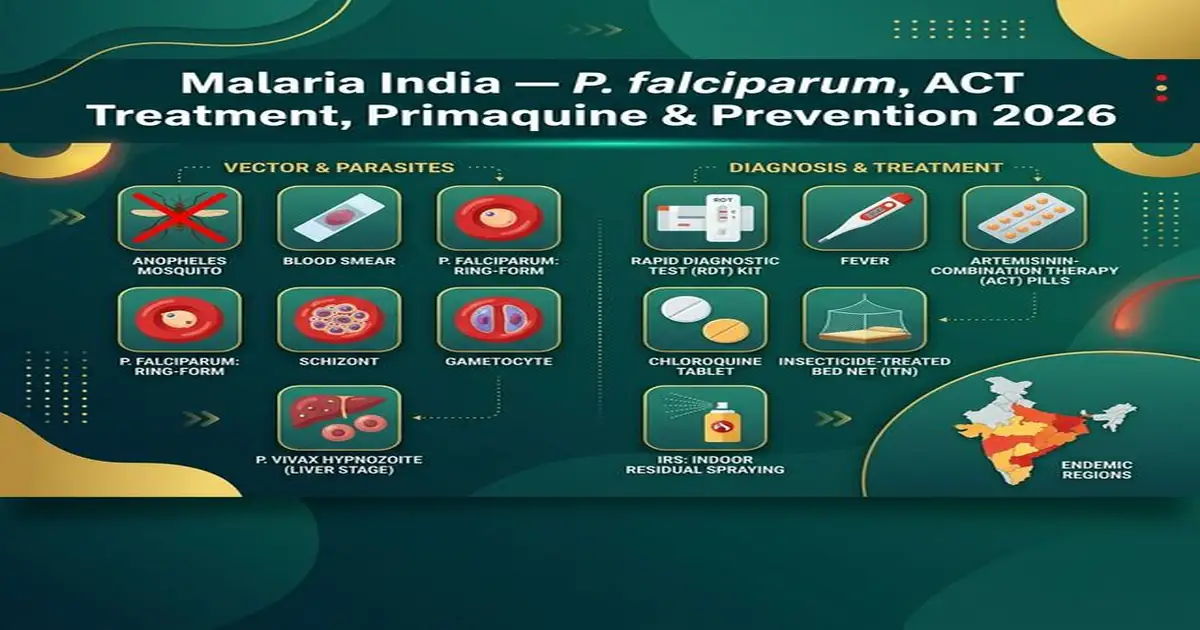
Malaria Diagnosis and Treatment — Species-Specific Protocol
| Species / Severity | Diagnosis | Treatment (NVBDCP / WHO India) | India Notes |
|---|---|---|---|
| P. falciparum — Uncomplicated | RDT (HRP2-based; sensitivity >95%); blood smear microscopy (Giemsa thick + thin — gold standard for speciation + parasite count); PCR (reference labs — mixed infections, low parasitaemia) | ACT: Artemether-Lumefantrine (AL) 6-dose × 3 days — NVBDCP first-line; OR Artesunate + Sulfadoxine-Pyrimethamine (AS+SP) — NVBDCP standard; OR ASAQ/AS-mefloquine (resistance areas); Primaquine 0.75mg/kg single dose (gametocidal — G6PD test mandatory before) | NVBDCP provides free ACT at PHCs in endemic states; artemisinin partial resistance emerging in NE India (Arunachal, Manipur — via Myanmar corridor); monitor day-3 parasite clearance; Kelch13 mutation surveillance; NEVER give CQ for falciparum — pan-India resistance since 1970s |
| P. falciparum — Severe / Complicated | WHO severe malaria criteria: hyperparasitaemia (>5% RBCs); cerebral malaria (GCS ≤11); severe anaemia (Hb <7); AKI; pulmonary oedema; hypoglycaemia; shock; jaundice; bleeding | IV Artesunate (AQUAMAT/SEAQUAMAT: 30–35% mortality reduction vs IV quinine): 2.4mg/kg at 0h, 12h, 24h then once daily → switch to oral ACT when tolerating; IV Quinine if artesunate unavailable; supportive ICU care: anti-seizure (cerebral malaria), renal support (AKI), blood transfusion (severe anaemia) | IV artesunate available at district malaria clinics and government hospitals in endemic states; private hospitals in non-endemic cities may still use quinine; cerebral malaria predominantly affects children from Odisha/Jharkhand/Chhattisgarh; post-malaria neurological syndrome (PMNS) needs rehab; pregnancy: artesunate 2nd/3rd trimester; quinine+clindamycin 1st trimester |
| P. vivax — Uncomplicated | RDT (pan-pLDH or vivax-specific pLDH); blood smear: Schüffner’s dots (pathognomonic), ameboid rings, enlarged RBC | Chloroquine 25mg/kg × 3 days (CQ still effective most India) PLUS Primaquine 0.25mg/kg/day × 14 days (radical cure — kills liver hypnozoites to prevent relapse); G6PD testing MANDATORY before primaquine (G6PD deficiency causes life-threatening haemolysis; prevalence India 7–15%); G6PD deficient: tafenoquine 300mg single dose OR weekly primaquine 0.75mg/kg × 8 weeks | Many PHCs lack POC G6PD testing — major implementation gap; vivax relapse without primaquine: 30–50% within 3 months; CQ-resistant vivax emerging (Andaman & Nicobar, south India) — use ACT for refractory relapsing cases; NVBDCP scaling G6PD POC kit deployment |
| Mixed Infection (P. falciparum + P. vivax) | Common in India (5–15% cases); HRP2-only RDT misses vivax; use pan-pLDH combo RDT OR blood smear; PCR gold-standard | Treat as falciparum (ACT) + 14-day primaquine for vivax component; G6PD screen mandatory | NVBDCP recommends pan-pLDH combo RDT in high-vivax regions (NE India, AP, Odisha); microscopy essential for speciation in mixed-endemic zones |
| Prevention — Vector Control & Vaccine | Not applicable | LLINs (long-lasting insecticide-treated nets — deltamethrin/permethrin): universal distribution (GoI + Global Fund); IRS (indoor residual spraying — malathion, synthetic pyrethroids before/after monsoon); larval source management (temephos, Bti); R21/Matrix-M malaria vaccine (WHO prequalified 2023 — 75% efficacy): Serum Institute India manufacture — NTAGI rollout in hyperendemic states (Odisha, Jharkhand) under consideration 2025–2026 | LLIN coverage 60–70% high-endemic areas; Urban malaria: Anopheles stephensi (invasive — breeds in overhead tanks, rooftops, construction water) now in Delhi, Hyderabad, Bengaluru, Surat — previously only Arabian Peninsula; tank cleaning + anti-larval operations essential in urban areas; R21 = 200M doses/yr capacity at SII Pune — potential elimination game-changer |
Frequently Asked Questions
Why must G6PD be tested before giving primaquine — and what happens if it is skipped?
Primaquine — the only widely available drug that eliminates P. vivax liver-stage hypnozoites to prevent relapse, and the only gametocidal drug for P. falciparum to reduce transmission — carries a potentially life-threatening interaction with G6PD (glucose-6-phosphate dehydrogenase) deficiency that makes pre-treatment testing mandatory: What is G6PD deficiency? G6PD is an enzyme that protects red blood cells from oxidative stress; G6PD deficiency is the most common enzyme deficiency in humans — affecting approximately 400 million people globally; X-linked recessive (predominantly affects males; females are carriers but can be affected if homozygous or with unfavourable lyonisation); India prevalence: 7–15% overall — higher in tribal populations (Odisha, Jharkhand tribal communities 15–20%); variants common in India: G6PD Mediterranean (most severe — very low G6PD activity), G6PD Kerala-Kalyan, G6PD Orissa — varying severity of RBC lysis risk. What primaquine does to G6PD-deficient patients: Primaquine (and other 8-aminoquinolines) generate reactive oxygen species in red blood cells → G6PD-deficient RBCs cannot neutralise oxidative stress → haemolysis → acute haemolytic anaemia; haemolysis severity correlates with G6PD activity level and primaquine dose; with standard 14-day 0.25mg/kg/day primaquine in severe G6PD deficiency: can cause severe haemolysis within 24–72 hours of first dose — dramatic drop in haemoglobin, haemoglobinuria (dark tea-coloured urine — classic sign), acute AKI from haemoglobin nephrotoxicity, potentially fatal; less severe G6PD deficiency: milder self-limiting haemolysis; WHO G6PD deficiency classification (4 classes based on residual activity). How to test G6PD before primaquine — India practical approach: Fluorescent spot test (FST): qualitative — positive/negative; cheap, rapid POC test; available at many district hospitals; limitation: misses intermediate deficiency (some female carriers classified normal); G6PD RUCAS (RBC Glutathione Stability) test: ₹100–200; alternative qualitative; G6PD quantitative enzyme assay: gold standard — measures exact enzyme activity (normal: 7–10 IU/gHb; deficient <5 IU/gHb); ₹300–600; required for dosing decisions with newer 8-aminoquinolines (tafenoquine); Rapid G6PD POC test (CareStart Biosensor — SD Biosensor): quantitative POC test — developing; NVBDCP scaling; critical limitation: G6PD tests may incorrectly estimate activity during acute haemolysis or in recently transfused patients (measurement interference). What to do if G6PD deficient and vivax treatment needed: Omit standard 14-day primaquine; use safer alternatives: tafenoquine single 300mg dose (RBC lysis risk lower than standard primaquine — but still requires G6PD >70% normal activity); OR weekly primaquine 0.75mg/kg × 8 weeks (lower single-dose oxidative stress → safer despite lower efficacy vs daily 14-day); OR — for now — close surveillance for relapse without radical cure (accept higher relapse risk to avoid haemolysis); India policy: NVBDCP recommends G6PD testing before primaquine; reality: many PHCs in high-endemic states lack testing → primaquine either routinely given without testing (unsafe in G6PD-deficient) or omitted entirely (→ vivax relapse epidemic in India). Closing this gap is a national malaria programme priority.
Is the R21 malaria vaccine coming to India — and will it help eliminate malaria?
The R21/Matrix-M malaria vaccine — developed by the University of Oxford in partnership with the Serum Institute of India — represents one of the most significant advances in malaria prevention in decades, with India’s own vaccine manufacturer at the centre of production: What R21 is and how it works: R21: recombinant protein vaccine targeting the circumsporozoite protein (CSP) of P. falciparum sporozoite stage (the stage injected during mosquito bite) → induces high-titre anti-CSP antibodies → blocks sporozoite entry into hepatocytes → prevents liver-stage infection before blood-stage malaria develops; Matrix-M (Novavax adjuvant): enhances immune response dramatically; anti-CSP titres induced by R21/Matrix-M are 4–5× higher than RTS,S/AS01B (the first licensed malaria vaccine — GSK/PATH Malaria Vaccine Initiative); Schedule: 3 doses primary + 1 booster at 12 months; recommended for children 5–36 months in sub-Saharan Africa (highest malaria burden). R21 trial efficacy data: Phase 2b (Burkina Faso — high seasonal transmission): vaccine efficacy 77% against clinical malaria in first year; Phase 3 (5 countries — Burkina Faso, Mali, Kenya, Tanzania, Ghana — 4,800 children): 75% efficacy against clinical malaria at 12 months (LANCET 2024) in high-transmission settings; WHO prequalification: October 2023 — first new malaria vaccine prequalified after RTS,S; waning: efficacy decreases to approximately 55–65% without booster → annual booster may be required. India relevance and R21 rollout prospect: Serum Institute of India (SII) Pune: manufacturing R21 at scale — 100–200 million doses/year target; India is both the producer AND a potential recipient market; R21 targets P. falciparum specifically — highly relevant for India’s falciparum-endemic states (Odisha — 47% falciparum, Jharkhand, Chhattisgarh, NE states); India’s P. vivax component (40–50% of burden) will NOT be addressed by R21 — separate vivax vaccine in development (not yet licensed); NTAGI (National Technical Advisory Group on Immunisation) deliberating on: rollout strategy for high-endemic areas; integration into Universal Immunisation Programme or targeted supplemental campaign; India’s legal/regulatory framework: DCGI licensure required; phase of India-specific immunogenicity data; pilot studies in Odisha and Jharkhand under discussion; potential timeline: India pilot rollout 2025–2027 in hyperendemic tribal districts if NTAGI approval obtained; global malaria modelling estimates R21 mass vaccination could prevent 50,000–100,000 deaths annually in sub-Saharan Africa; India impact modelling: significant reduction in falciparum malaria burden in hyperendemic states if combined with LLIN + IRS + ACT treatment.
What to Read Next
- Dengue Fever — Aedes aegypti Mosquito; No Specific Treatment (Supportive); Platelet Monitoring; NS1 Antigen RDT vs Malaria RDT Distinction
- Iron Deficiency Anaemia — Malaria Causes Haemolytic Anaemia; Primaquine-Induced Haemolysis in G6PD Deficiency; Treat Both Infections and IDA
- Kidney Stones — AKI from Severe Falciparum Malaria (Haemoglobinuric Nephropathy — Blackwater Fever); Emergency Dialysis; IV Artesunate Reduces AKI Risk
- Child Malnutrition — Malnutrition + Malaria = Synergistic Mortality in Tribal India Children; Treat Both Simultaneously with RUTF + ACT
- High-Risk Pregnancy — Malaria in Pregnancy Causes Maternal Anaemia, Low Birth Weight, Stillbirth; Artesunate Safe 2nd/3rd Trimester; ITN Mandatory in Endemic Areas
A 7-year-old child in a tribal village in Odisha develops fever, convulsions, and unconsciousness in October — peak transmission season. His village health worker has an RDT kit. The test is positive for P. falciparum. She has the protocol: refer immediately to district hospital for IV artesunate. The child arrives at the district hospital 4 hours later, receives IV artesunate, recovers in 72 hours, and goes home. Ten years ago, that district hospital had only IV quinine. The case fatality rate for cerebral malaria with quinine was 15–25%. With IV artesunate it is 8–12%. That child in Odisha is alive because India switched to IV artesunate in district hospitals. The algorithm works. The drugs work. The system is the challenge.
About This Guide: Written by the StudyHub Health Editorial Team (studyhub.net.in) based on WHO Guidelines for the Treatment of Malaria (3rd edition, updated 2022), India NVBDCP National Drug Policy for Malaria 2023, and LANCET R21/Matrix-M Phase 3 data 2024. Last updated: March 2026.
🦟 Free ACT at Government Hospitals — Use It: If you are in a malaria-endemic area and have fever, get an RDT test immediately. Government PHCs and district hospitals in Odisha, Jharkhand, Chhattisgarh, and NE India provide free malaria RDT testing AND free ACT treatment. Do not treat malaria home with chloroquine alone — falciparum needs ACT. Do not delay if fever doesn’t break in 24 hours.
🧬 G6PD Test Before Primaquine — Always: If you are prescribed primaquine for vivax malaria, insist on a G6PD test before taking it. Signs of haemolysis: dark tea/cola-coloured urine in 1–3 days after starting primaquine = STOP IMMEDIATELY and go to hospital. G6PD deficiency affects 7–15% of Indians — particularly common in tribal communities in malaria-endemic states.
⚕️ Medical Disclaimer: This article provides general educational information about malaria prevention and treatment. Malaria species identification, severity assessment, and treatment decisions (especially IV artesunate for severe malaria and primaquine dosing in G6PD deficiency) require qualified healthcare provider assessment and government protocol adherence.