Last Updated: March 2026 | Reading Time: 9 minutes | ~2,100 words
Lung cancer is the leading cause of cancer death in Indian men and the second overall — with approximately 72,000–80,000 new cases and 66,000–72,000 deaths annually in India. India’s lung cancer epidemiology has unique features that distinguish it from Western patterns: bidi smoking (bidis — hand-rolled tobacco in tendu leaf — 7–8× higher tar and 3× higher nicotine content than cigarettes) is responsible for a large proportion of tobacco-related lung cancers; indoor air pollution from biomass fuel combustion (chulha/woodfire cooking — 500+ million Indian households) is the leading cause of lung cancer in India’s non-smoking women (adenocarcinoma of the lung in never-smokers — increasingly recognised); EGFR-mutated lung adenocarcinoma is disproportionately prevalent in Indian patients (30–40% of Indian adenocarcinoma vs 15% in Western populations) — this has profound therapeutic implications, as EGFR-mutated disease is highly responsive to targeted therapy (osimertinib); and outdoor air pollution (Delhi AQI regularly >300 during winter — PM2.5 levels 10–20× WHO limits) contributes significantly to never-smoker lung cancer rising incidence. The therapeutic landscape of lung cancer has been revolutionised over the past decade — molecular testing (EGFR, ALK, ROS1, KRAS G12C, BRAF, MET exon 14, RET, NTRK, PD-L1) now guides individualised treatment, and India’s increasing generic access to targeted therapies has dramatically improved survival outcomes for mutation-positive patients.
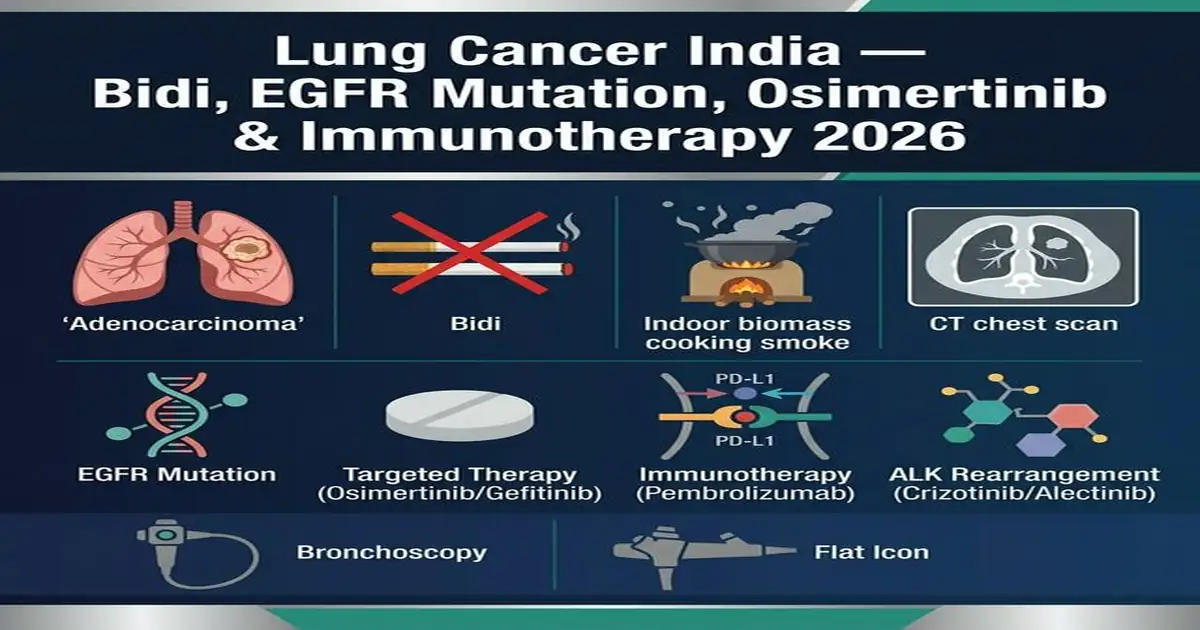
Lung Cancer — Molecular Subtypes and Staged Treatment Framework
| Molecular Subtype / Stage | Prevalence India | First-Line Treatment | India Access & Cost |
|---|---|---|---|
| EGFR-mutated NSCLC (Exon 19 del / Exon 21 L858R — most common; Exon 20 ins — osimertinib-resistant) | 30–40% of Indian lung adenocarcinomas; higher in never-smokers, women, non-bidi-smokers; most common actionable mutation in India | Osimertinib (Tagrisso — AstraZeneca) 80mg once daily: FLAURA trial (3rd-gen EGFR-TKI): OS 38.6 vs 31.8 months vs erlotinib/gefitinib; superior CNS penetration; prevents T790M resistance; current standard of care EGFR-mutated NSCLC worldwide; LAURA trial (2024): osimertinib after definitive CRT for unresectable Stage III EGFR+ NSCLC: PFS 39.1 vs 5.6 months — practice-changing; ADAURA trial: adjuvant osimertinib after resection Stage IB–IIIA: DFS 65.8 vs 26.0 months; Older EGFR-TKIs (erlotinib, gefitinib, afatinib): no longer preferred 1L if osimertinib available | Osimertinib branded (Tagrisso): ₹2,00,000–2,50,000/month; generic osimertinib (Osimert, Tagrix — generic India brands via compulsory licensing/voluntary licensing): ₹15,000–35,000/month — transformative affordability; generic erlotinib: ₹3,000–8,000/month; generic gefitinib: ₹3,000–6,000/month; osimertinib generic widely used at Tata Memorial, AIIMS, regional cancer centres; Astrazeneca Patient Assistance Program for branded Tagrisso also exists |
| ALK-rearranged NSCLC (EML4-ALK fusion) | 3–5% of Indian lung adenocarcinomas; younger patients; non-smokers; excellent targeted therapy responses; sensitive to ALK-TKIs | Alectinib (Alecensa) 600mg twice daily: ALEX trial: PFS 34.8 vs 10.9 months vs crizotinib; superior CNS penetration (critical — ALK+ brain mets common); current standard of care 1L ALK+; brigatinib (Alunbrig): ALTA-1L: superior to crizotinib, broad CNS coverage; lorlatinib (Lorbrena): 3rd-gen ALK-TKI: PFS superior to alectinib (CROWN trial 2023); CNS response rate >90%; crizotinib: older — not 1L preferred; used in resource-limited settings | Alectinib generic (Alcenta, Alectib — India brands): ₹30,000–60,000/month vs branded ₹2,00,000/month; lorlatinib: ₹1,50,000–2,00,000/month branded; limited generic availability; crizotinib generic: ₹25,000–40,000/month; ALK testing: FISH or IHC (D5F3 — highly sensitive for ALK) — IHC at ₹3,000–5,000 |
| PD-L1 high (≥50%) / KRAS G12C — no actionable driver mutation | 30–35% of NSCLC have PD-L1 ≥50%; KRAS G12C: 10–15% (predominantly smokers — lower India prevalence); MSI-H: rare in lung (<1%) | PD-L1 ≥50%, no EGFR/ALK: pembrolizumab 200mg 3-weekly (KEYNOTE-024: OS 26.3 vs 13.4 months vs chemo) — first-line pembrolizumab monotherapy; PD-L1 ≥1%, no driver: pembrolizumab + carboplatin/paclitaxel or pemetrexed (non-squamous: KEYNOTE-189; squamous: KEYNOTE-407); KRAS G12C: sotorasib (CODEBREAK-100: KRAS G12C inhibitor 2L; adagrasib); AMG510/sotorasib India: limited access; docetaxel + ramucirumab or nintedanib: 2L non-squamous after chemo progression | Pembrolizumab (Keytruda): ₹1,50,000–2,00,000/dose; biosimilar pembrolizumab entering India (Intas, Cipla, Biocon — Phase III data 2024–2025); PD-L1 IHC testing: 22C3 assay ₹4,000–8,000; carboplatin generic: ₹500–1,000/vial; paclitaxel generic: ₹500–1,500/vial; pemetrexed generic: ₹5,000–10,000/dose — affordable |
| Small Cell Lung Cancer (SCLC) | 15–20% of Indian lung cancers; strongly tobacco-associated (bidi/cigarette); extremely rare in never-smokers; rapid doubling time; early metastatic spread; two stages: limited (LS) and extensive (ES) | Limited stage (LS-SCLC): concurrent chemoradiotherapy (carboplatin + etoposide × 4–6 cycles + concurrent thoracic RT 45Gy/30fr BID or 66Gy/33fr); prophylactic cranial irradiation (PCI) if complete response (reduces brain mets 54%); 5-year survival: 15–25%; Extensive stage (ES-SCLC): carboplatin/etoposide + atezolizumab (IMpower133) or durvalumab (CASPIAN) — OS improved to 12–13 months vs 10 months with chemo alone; SCLC is initially highly chemo-responsive but rapid relapse almost universal; lurbinectedin (2L): FDA approved | Atezolizumab (Tecentriq): ₹1,00,000–1,50,000/dose; durvalumab: ₹1,50,000/dose; carboplatin + etoposide generic: ₹10,000–20,000/cycle — highly affordable backbone; limited OS benefit from adding IO in SCLC but now standard; AIIMS, TMH, Rajiv Gandhi Cancer Institute (RGCI) Delhi experienced in SCLC management; PCI: requires radiation planning expertise |
| Early Stage NSCLC (Stage I–IIA — surgical) | Only 15–20% of Indian lung cancers present at surgical stage; most are incidental findings on CT done for other reasons; smoking history + LDCT screening (low-dose CT — NLST, NELSON trials) can detect early | Lobectomy (preferred over wedge for Stage I): VATS (video-assisted thoracoscopic surgery) or robotic lobectomy — minimally invasive preferred; wedge resection if poor lung function; adjuvant osimertinib (ADAURA — EGFR+: DFS 65 vs 26 months) — now standard if EGFR+ resected Stage IB–IIIA; adjuvant atezolizumab (IMpower010 — PD-L1 ≥1%: DFS benefit Stage II–IIIA); adjuvant pembrolizumab (KEYNOTE-091): DFS improvement; perioperative nivolumab + chemotherapy (CheckMate 816) for Stage IB–IIIA | VATS lobectomy: major centres India (AIIMS, Apollo, Fortis, Manipal — Bengaluru); thoracic surgical expertise required; LDCT lung cancer screening: not national programme India; recommended for high-risk (age 50–80, ≥20 pack-years, current/former smoker quit ≤15yr) — not routinely offered; private LDCT ₹5,000–8,000; government hospital: ₹1,000–2,000 |
Frequently Asked Questions
Why do non-smoking Indian women get lung cancer — and why is EGFR testing essential?
One of the most misunderstood aspects of lung cancer in India is the rising incidence of lung adenocarcinoma in never-smoking Indian women — a phenomenon that undermines the cultural assumption that “only smokers get lung cancer”: Causes of lung cancer in Indian never-smokers: Indoor biomass fuel combustion (primary cause in Indian non-smoking women): 500+ million Indian households still cook on solid biomass (wood, cow dung, agricultural residuals — chulha/angithi); biomass combustion generates PM2.5, PAHs (polycyclic aromatic hydrocarbons), benzene, formaldehyde, acrolein — all IARC Group 1 carcinogens; Indian women spend 4–7 hours per day cooking → chronic carcinogen inhalation → lung adenocarcinoma particularly at upper lobe; rural India kitchen ventilation often inadequate; outdoor air pollution (Delhi PM2.5 — 50–100 µg/m³ average vs WHO limit 5 µg/m³ annual): IARC Group 1 carcinogen; particularly PM2.5 (ultra-fine particles penetrating deep alveolar tissue); HPV (human papillomavirus): emerging evidence for HPV in lung cancer in some never-smokers (HPV DNA found in 30–60% of lung SCC biopsy in some Indian studies — controversial but plausible given high HPV prevalence); radon (geological — higher in granite-rich states — Kerala, Karnataka): natural radioactive gas; accumulates in poorly ventilated ground-floor/basement areas; IARC Group 1; second-hand smoke: passive exposure remains significant in India where indoor smoking by male household members is common; genetic predisposition: EGFR germline variants — familial NSCLC tendency. Why EGFR mutation prevalence is so high in Indian patients: Indian lung adenocarcinoma patients have 30–40% EGFR mutation rate (exon 19 deletion + exon 21 L858R are most common); compared to 15% in Europeans and 40–50% in East Asians; Indian never-smokers with adenocarcinoma have EGFR mutation in 50–60% of cases; mechanism: non-tobacco carcinogens (biomass smoke, radon, air pollution) may cause EGFR-activating mutations through different mutagenic pathways than tobacco (which predominantly causes KRAS mutations and TP53 — driver mutations for squamous cell SCC); EGFR mutation = highly druggable target: osimertinib achieves 38-month median OS in EGFR+ advanced NSCLC (vs 12–14 months historically with chemotherapy). Why EGFR/ALK/molecular testing is mandatory in every Indian NSCLC patient: Any Indian patient diagnosed with NSCLC (non-small cell lung cancer) at any stage must have EGFR/ALK/ROS1/KRAS/BRAF molecular testing before treatment — not optional; reflex testing: request NGS (next-generation sequencing) panel or at minimum PCR-based EGFR mutation testing; tissue: CT-guided biopsy (bronchoscopy or percutaneous); liquid biopsy (circulating tumour DNA — ctDNA): cell-free DNA from plasma — increasingly available India for patients without adequate tissue; without molecular testing, a 40-year-old Indian woman with EGFR+ adenocarcinoma might receive empirical carboplatin + paclitaxel chemotherapy (OS 12–14 months) rather than osimertinib (OS 38+ months) — a catastrophic difference driven by test omission; cost of NGS panel: ₹20,000–50,000 (private); ₹5,000–15,000 (government centres); PIK3CA, STK11, KEAP1 co-mutations reduce EGFR-TKI efficacy — increasingly identified on comprehensive NGS.
How does bidi smoking compare to cigarettes — and what is the impact of Delhi air pollution on lung cancer risk?
Two uniquely Indian exposures — bidi smoking and urban outdoor air pollution — contribute substantially to India’s lung cancer burden in ways that differ from Western patterns: Bidi vs cigarette — the tobacco comparison: Bidi: hand-rolled sun-dried tobacco wrapped in tendu (Diospyros melanoxylon) leaf; approximately 2/3 of Indian tobacco use is bidi (estimated 720 billion bidis smoked annually vs 340 billion cigarettes — India is the world’s largest bidi producer); bidis deliver: 7–8× higher amounts of tar and nicotine than filtered cigarettes (no filter); 3× higher carbon monoxide; dramatically higher levels of TSNA (tobacco-specific nitrosamines — GNK, NNN); bidi smokers must draw more intensely (incomplete combustion, tendu leaf wrapper) → deeper inhalation → greater carcinogen deposition; lung cancer OR for bidi smoking: 2.4–8.3× (compared to non-smokers) — comparable to cigarette smoking in studies; bidi is price-accessible (₹10 per bundle of 10–20 vs ₹300/pack cigarettes) → predominant tobacco form in India’s poor and rural populations; workplace bidi rolling (cottage industry — predominantly women and children — exposed to raw tobacco dust → additional TSNA inhalation); pictorial warnings on bidi packs: required under COTPA 2003 regulations. Delhi and urban air pollution — PM2.5 and lung cancer risk: PM2.5 (fine particulate matter <2.5 µm): penetrates bronchioles → deposited in alveoli → oxidative stress, DNA damage → EGFR/KRAS mutations; Delhi annual average PM2.5: 60–110 µg/m³ (2020–2025 data); WHO guideline: 5µg/m³ annual mean (Delhi = 12–22× WHO limit); IARC classified outdoor air pollution (Group 1 carcinogen) in 2013 — PM2.5 specifically drives lung adenocarcinoma in never-smokers; estimated attributable fraction: India outdoor air pollution → 10–15% of all Indian lung cancers in urban areas; Non-smoking Indian women in Delhi face a biomass (kitchen smoke) + outdoor PM2.5 dual exposure — synergistic carcinogen burden; biomass transition: India’s Ujjwala Yojana LPG scheme (₹200 refill subsidy) → LPG displacement of biomass fuel in rural India; health modelling suggests complete biomass elimination could prevent 15,000–20,000 Indian lung cancer deaths annually; PM2.5 reduction measures: Graded Response Action Plan (GRAP) in Delhi — restricts construction dust, bans firecrackers, controls vehicles; stubble burning ban (Punjab/Haryana → Delhi winter AQI spikes); long-term interventions include FAME electric vehicle transition and industrial emission controls.
What to Read Next
- COPD — Bidi/Cigarette Smoking Causes Both Lung Cancer AND COPD; Spirometry Distinguishes Airflow Obstruction; Smoking Cessation Prevents Both
- TB — Pulmonary TB Mimics Lung Cancer (Mass + Cavitation + Lymph Nodes); NAAT/GeneXpert + CT Biopsy Distinguishes; Both Prevalent India
- Oral Cancer — Tobacco Drives Both Oral SCC and Lung Cancer; Quit Tobacco Simultaneously Reduces Both; NRT ₹150–400 Basic Addiction Support
- Depression — Lung Cancer Diagnosis Causes Major Depression in 30–40%; Integrate Oncology Psychiatry from Diagnosis; Evidence-Based Interventions
- Asthma — PM2.5 Worsens Asthma AND Increases Lung Cancer Risk; Air Quality Index Monitoring + N95 Mask Use in High-AQI Days India
A 42-year-old woman from a village in UP has never smoked. She has cooked on a wood-burning chulha for 20 years in a kitchen with one small window. She presents with a cough for 3 months and 4kg weight loss. CT chest: a 3cm right upper lobe mass. Biopsy: lung adenocarcinoma. EGFR testing: exon 19 deletion positive. She is given osimertinib (generic — ₹20,000/month from a government cancer hospital). She is in her third year of treatment. Her tumour has shrunk by 70%. She goes to her daughter’s wedding. She celebrates a grandchild’s birth. If her EGFR testing had been omitted and she had received only carboplatin + paclitaxel, she would likely have died before that wedding. NGS testing and generic osimertinib have given her years. This is precision oncology at work — and it is increasingly accessible in India.
About This Guide: Written by the StudyHub Health Editorial Team (studyhub.net.in) based on ESMO NSCLC Guidelines 2023, NCCN Lung Cancer Guidelines 2024, IARC Air Pollution classification, and Indian Cooperative Oncology Network (ICON) lung cancer recommendations. Last updated: March 2026.
🧬 EGFR/Molecular Testing is Mandatory — Do Not Accept Chemotherapy Without It: Every non-small cell lung cancer (NSCLC) patient in India should have EGFR/ALK/ROS1 molecular testing before treatment. If positive for EGFR mutation: generic osimertinib (₹15,000–35,000/month) gives 38+ months survival vs 12 months with chemotherapy. Demand molecular testing. If your doctor doesn’t offer it, ask specifically for “EGFR PCR or NGS panel.” Cost: ₹5,000–50,000 — the most important test you can have.
🍳 Indoor Air Matters — Switch from Chulha to LPG: Biomass cooking smoke is the leading cause of lung cancer in non-smoking Indian women. India’s Ujjwala Yojana provides LPG connections to BPL households at subsidised rates. If you still cook on wood/dung fuel — apply for LPG connection (pmuy.gov.in). Keep kitchen ventilated. Use exhaust fans. This is not just about cooking — it is about protecting your lungs from daily carcinogen exposure.
⚕️ Medical Disclaimer: This article provides general educational information about lung cancer. Diagnosis requires tissue biopsy with molecular testing. All treatment decisions (targeted therapy, immunotherapy, chemotherapy, surgery, radiotherapy) require multidisciplinary oncology team assessment including thoracic oncology, medical oncology, radiation oncology, and pathology.