Last Updated: March 2026 | Reading Time: 8 minutes | ~1,900 words
Urinary tract infections (UTIs) are the most common bacterial infection encountered in clinical practice worldwide — and in India, they represent a particularly significant public health challenge driven by a convergence of factors: intense heat and dehydration (reducing urinary flush and concentrating bacteria), poor access to clean water and sanitation (WASH deficits in rural India), widespread antimicrobial resistance (AMR) — with India having among the highest resistance rates globally for common uropathogens — and the catastrophic over-the-counter availability of antibiotics without prescription, which has both selected for resistant organisms and led to systematic undertreatment with wrong agents at wrong doses. An estimated 150 million UTIs occur globally per year, and India contributes a disproportionately large share: women are 50× more likely to develop UTI than men (short urethra anatomy + periurethral E. coli colonisation); approximately 50% of women will have at least one UTI in their lifetime; recurrent UTI (≥2 episodes in 6 months or ≥3 in 1 year) affects 25–30% of women with a first UTI; UTI in pregnancy (asymptomatic bacteriuria if untreated → pyelonephritis → preterm birth) affects 5–10% of pregnancies in India and is mandatorially screened at first ANC; and complicated UTI (structural or functional abnormality, indwelling catheter, diabetes, pregnancy, immunosuppression, renal failure) carries significant risk of urosepsis if undertreated. The AMR dimension is critical: India’s ESKAPE pathogens data (ICMR-AMR Sentinel Network 2022) shows E. coli resistance to fluoroquinolones (ciprofloxacin) approaching 60–80% in community UTIs — meaning the antibiotic most commonly prescribed for UTI in India (ciprofloxacin) fails in the majority of cases. This article provides the 2026 evidence-based guide to UTI diagnosis, antibiotic choice, and recurrence prevention — calibrated to India’s AMR landscape.
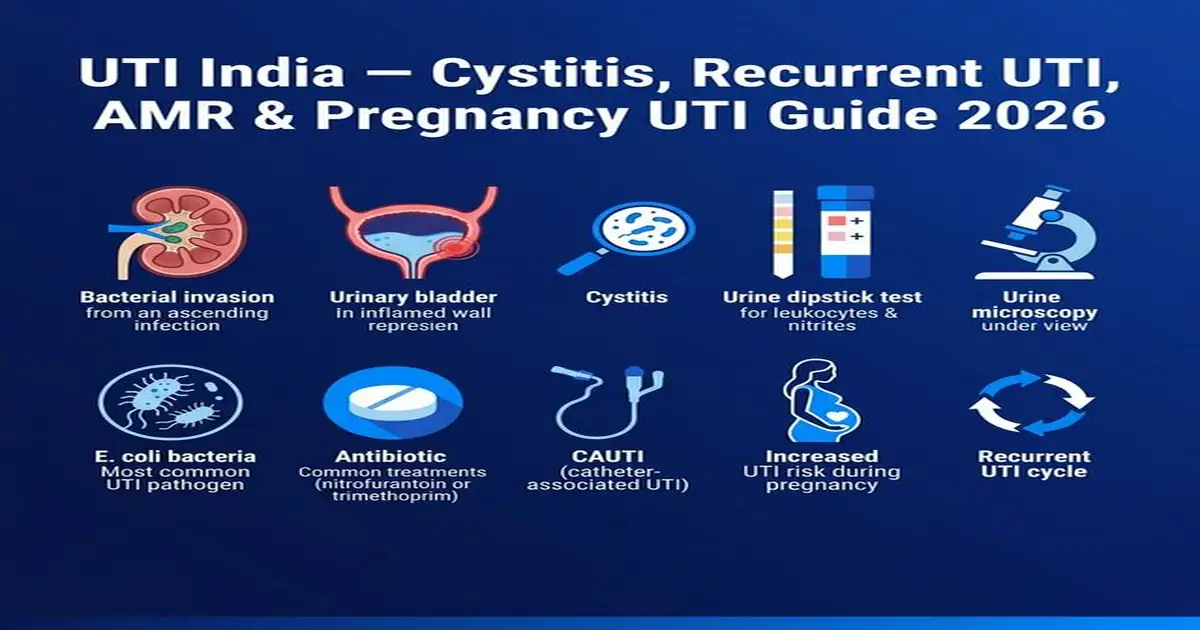
UTI India — Diagnosis, Antibiotics, AMR & Recurrence Prevention Guide 2026
| Domain | Evidence-Based Details | India Context |
|---|---|---|
| UTI Classification — Uncomplicated vs Complicated & Uropathogens India | Classification: Uncomplicated UTI: occurs in anatomically and functionally normal urinary tract; non-pregnant, non-diabetic, immunocompetent adult; community-acquired; Lower UTI (cystitis): bladder infection; Upper UTI (pyelonephritis): kidney infection; Complicated UTI: any UTI with increased risk of treatment failure or serious outcome: structural abnormality (vesicoureteral reflux — VUR, renal calculi, urethral stricture, BPH); functional abnormality (neurogenic bladder — DM neuropathy, SCI, MS); catheter-associated (CAUTI); pregnancy (always complicated); diabetes mellitus; immunosuppression (HIV, steroids, transplant); renal impairment; male UTI (nearly always complicated — must investigate for structural cause); hospital-acquired (nosocomial); Important UTI syndromes: Acute uncomplicated cystitis (AUC): most common; dysuria, frequency, urgency, suprapubic discomfort; no fever/flank pain; Acute pyelonephritis: fever (≥38°C), rigors, loin pain, CVA tenderness; nausea/vomiting; with or without lower UTI symptoms; bacteraemia in 30–50% → risk urosepsis; Recurrent UTI (rUTI): ≥2 UTIs in 6 months OR ≥3 UTIs in 12 months; subtypes: Relapse (same organism within 2 weeks, incompletely treated) vs Reinfection (different organism or same organism after >2-week symptom-free interval — 80% of rUTI); Asymptomatic bacteriuria (ASB): ≥10⁵ CFU/mL of a single uropathogen on two consecutive MSU specimens, without symptoms; TREAT only if: pregnancy + prior to urological procedure; do NOT treat ASB in: elderly (no benefit; ↑ AMR, adverse effects, clostridioides difficile risk); diabetics; catheterised patients; premenopausal non-pregnant women; Catheter-associated UTI (CAUTI): most common nosocomial infection globally; diagnosis: ≥10³ CFU/mL on catheter specimen + symptoms; prevention: avoid unnecessary catheterisation; aseptic insertion; closed drainage; early removal; CAUTI bundle; Uropathogens India: E. coli: 70–80% (most common all UTIs); Klebsiella pneumoniae: 10–15% (↑ in India — carbapenem-resistant Klebsiella — CRKP — increasingly detected); Proteus mirabilis: 5%; Enterococcus faecalis: 5% (particularly in elderly, post-urological); Pseudomonas aeruginosa: 3–5% (complicated, nosocomial); Staphylococcus saprophyticus: young sexually active women; Candida spp.: catheterised, immunocompromised, ICU patients | India AMR uropathogens — crisis data: ICMR-AMR Sentinel Surveillance Network 2022 (34 tertiary hospitals): E. coli resistance rates: Ciprofloxacin: 65–82% (community UTI India) — CRITICAL: ciprofloxacin is most prescribed India UTI antibiotic yet fails in 2/3rds of cases; Ampicillin: 70–85%; Co-trimoxazole (TMP-SMX): 45–65%; Cefuroxime: 32–48%; Nitrofurantoin: 8–15% resistance (LOWEST — most sensitive India) → should be first-line uncomplicated cystitis; Fosfomycin: <5% resistance (excellent for multidrug-resistant E. coli cystitis); Amikacin: 15–20%; Imipenem/meropenem: 10–25% (carbapenem resistance — CRKP + CRPA — alarming India); Drivers of AMR in India UTIs: over-the-counter fluoroquinolone (ciprofloxacin) sale without prescription → empirical self-treatment → selection pressure → resistance; short antibiotic courses (patient stops when symptoms improve at 2–3 days); wrong antibiotic choice (ciprofloxacin for E. coli cystitis = majority treatment failure); ICMR AMR India plan: antibiotic stewardship programme (ASP) at tertiary hospitals; Jan Aushadhi stores: restricted to OTC sales; CDSCO: restrictions on OTC antibiotic sale updating; but street-level OTC sale remains widespread |
| Diagnosis — Symptoms, Dipstick, Urine Microscopy & Culture | Clinical diagnosis: Classic triad (dysuria + frequency + urgency without vaginal discharge): 80–90% positive predictive value for cystitis in pre-menopausal women → treat empirically without culture in uncomplicated AUC; Atypical presentations requiring investigation: elderly (often asymptomatic or non-specific — confusion, falls — without classical UTI symptoms → risk of overtreating ASB in elderly); children (fever without source — mandatory urine culture before antibiotics); males (febrile UTI always complicated → urine culture + USS kidneys); Dipstick urinalysis: Leukocyte esterase (LE): sensitivity 75–96% for pyuria; Nitrite: sensitivity 50–70% (requires nitrate-reducing organism — principally gram-negative Enterobacteriaceae; Enterococcus and Staph do NOT produce nitrites → false-negative; also false-negative if urine too dilute or voided within 4h of last void — insufficient contact time); Both LE + nitrite positive: PPV >90% for UTI in symptomatic patient; Both LE + nitrite negative: 95% NPV for rule-out (high quality); Blood (haematuria): present in 40–60% of cystitis (bladder inflammation → mucosal bleeding → haematuria); Protein: non-specific; Urine microscopy: Pyuria: ≥10 WBC/hpf (high-power field) on uncentrifuged urine; bacteriuria: bacteria on Gram stain — gram-negative rods (E. coli, Klebsiella); Midstream Urine (MSU) culture: indications: pyelonephritis (always); complicated UTI; failure of first-line treatment; recurrent UTI; pregnancy (screen at first ANC + treat ASB); males; children; hospital-acquired UTI; NOT needed: uncomplicated AUC in young healthy women (start empiric treatment); Result interpretation: significant bacteriuria: ≥10⁵ CFU/mL single organism in MSU (from bladder) OR ≥10³ CFU/mL in catheter specimen; mixed growth (≥2 organisms): usually contamination → repeat; Sensitivity testing report: use for selecting antibiotic therapy particularly in AMR context; Blood cultures: for pyelonephritis with systemic features (temperature ≥38.5°C, rigors, hypotension) → bacteraemia in 30–50% → guide IV antibiotic de-escalation; Imaging: USS kidneys + bladder: first-line imaging for: all males with UTI; children after first febrile UTI; recurrent UTI (structural abnormality); pyelonephritis unresponsive at 72h (perinephric abscess, obstruction); CT KUB/IVP: for suspected renal calculi, obstruction, emphysematous pyelonephritis (diabetics); DMSA scan: for children post-pyelonephritis → detect renal scarring | India UTI testing: dipstick: widely available — all PHCs, nursing homes, pathology labs; cost: ₹50–150; urine culture + sensitivity (C&S): NABL labs in towns; cost: ₹200–500; results: 48–72 hours; CRITICAL India practice: urine C&S before starting antibiotics whenever possible (collect sample → send→ start empiric treatment; adjust at 48h on sensitivity); POINT-OF-CARE: Pelvic Examination India: vaginal discharge differentiates STI from UTI — mandatory in sexually active women with dysuria but no frequency (suggests urethritis/cervicitis, not cystitis → different management); India overtesting problem: elderly women admitted with “UTI” diagnosis on basis of dipstick alone → treated even for ASB → creates resistant organisms → true subsequent UTI harder to treat; India undertesting problem: male UTIs sent home with ciprofloxacin without culture → misses CRKP requiring IV carbapenems; children with fever treated presumptively without urine culture → VUR missed; USS kidneys: available at most district hospitals; ₹400–800; MCUG (micturating cystourethrogram): for VUR in children — selective use (after febrile UTI with renal scarring on USS → referral for MCUG) |
| Antibiotic Treatment — India AMR-Calibrated Protocols 2026 | Uncomplicated acute cystitis — 2026 India-adapted first-line: Nitrofurantoin (macrocrystalline): 100mg MR twice daily × 5 days; PREFERRED first-line for uncomplicated cystitis India (lowest resistance rate 8–15%); mechanism: multiple bactericidal effects on DNA, protein, cell wall synthesis simultaneously — resistance development is slow; contraindications: eGFR <30 mL/min (toxic accumulation); pregnancy at term (neonatal haemolytic anaemia risk); pulmonary/hepatic disease (long-term use); NOT for pyelonephritis (inadequate tissue levels); Fosfomycin trometamol: 3g sachet SINGLE DOSE oral; excellent for MDR E. coli cystitis; low resistance India; growing availability; effective even for ESBL-producing E. coli; Pivmecillinam (amoxicillin-pivaloate): 400mg BD × 3–5 days; not widely available India; Second-line (sensitivity-directed): TMP-SMX (trimethoprim-sulfamethoxazole/cotrimoxazole): only use if sensitivity confirmed (45–65% resistant India — do NOT use empirically); Oral cephalosporins (cefalexin 500mg QID × 5 days): moderate E. coli activity; better than ciprofloxacin in current India AMR landscape; AVOID empirically: Ciprofloxacin/levofloxacin: 65–82% E. coli resistance India → inappropriate empirical first-line for uncomplicated cystitis (contradicts current India AMR data); reserve for culture-proven sensitivity; Ampicillin/amoxicillin: 70–85% resistance; avoid without culture sensitivity; Acute pyelonephritis — outpatient (mild-moderate): IV/IM ceftriaxone 1g OD as extended single dose × 1 day → switch to oral cefuroxime 500mg BD × 10–14 days when afebrile (stepdown); OR: oral cefuroxime 500mg BD × 10–14 days (if truly mild, no systemic features); NOT: ciprofloxacin (local resistance 65%+); Pyelonephritis inpatient (moderate-severe, sepsis features): IV ceftriaxone 1–2g OD or IV piperacillin-tazobactam 4.5g TDS (if ESBL suspected); culture-directed de-escalation at 48h; duration: 10–14 days total (IV + oral); Complicated UTI/CAUTI: treat per culture sensitivity; review need for catheter/instrumentation removal — “source control”; ESBL-producing E. coli: oral nitrofurantoin (cystitis only); fosfomycin; parenteral carbapenems for pyelonephritis (ertapenem 1g OD IM/IV — outpatient option); Asymptomatic bacteriuria: treat ONLY in pregnancy (amoxicillin-clavulanate or cefalexin × 7 days; use sensitivity results; avoid nitrofurantoin at term; avoid TMP in 1st trimester); pre-urological procedure; Male UTI: treat for 7–14 days (risk of prostatitis); after culture; investigate underlying cause | India prescribing reality: most common UTI prescription India (primary care): ciprofloxacin 500mg BD × 3–5 days — now INAPPROPRIATE as first-line empirical treatment given 65%+ resistance; switch protocol needed urgently at primary care level; nitrofurantoin availability India: widely available; Macrobid/Macrodantin (macrocrystalline): ₹50–80 for 10-tablet course; generic nitrofurantoin: ₹3–5 per tablet; Furedan, Furadantin, Nitrofur brands; fosfomycin India: Fosfocin sachet (3g); ₹200–350 per sachet; limited availability — major cities; excellent for ESBL cystitis; CRKP (carbapenem-resistant Klebsiella — NDM-1): increasingly detected India; treatment options: polymyxin B (colistin) + meropenem combination; ceftazidime-avibactam; aztreonam-avibactam; extremely limited availability + high cost; NDM-1 (New Delhi Metallo-β-lactamase) — first described India 2010 from water samples + clinical isolates — now global spread; India AMSP: antibiotic stewardship: hospital formulary restriction; pre-authorisation for carbapenems; microbiology review; AMR reporting to ICMR Sentinel Network; OTC antibiotic awareness campaigns: “Antibiotics are NOT for viral infections / self-medication” — Swastha Bharat Jan Andolan (SBJA); misuse of antibiotics in UTI: tinidazole, ofloxacin OTC self-purchase → wrong drug → treatment failure → pyelonephritis → hospitalisation |
| UTI in Pregnancy — Mandatory Screening & Safe Antibiotics | Importance: asymptomatic bacteriuria (ASB) in pregnancy: 5–10% prevalence; if untreated → 25–40% progress to acute pyelonephritis (vs 1–2% non-pregnant); pyelonephritis in pregnancy → increased risk: preterm labour, low birth weight, maternal urosepsis; ALL pregnant women: SCREEN for ASB with MSU culture at FIRST antenatal visit (≤16 weeks ideally); repeat culture if clinical UTI symptoms develop; treat ALL ASB in pregnancy (including Enterococcus, GBS — Group B Streptococcus — if isolated; GBS also screened separately at 35–37 weeks for intrapartum prophylaxis); Antibiotic safety in pregnancy: First trimester: cefalexin 500mg QDS × 7 days (SAFE throughout); amoxicillin (if sensitive — high resistance — check culture); Nitrofurantoin: SAFE in 1st + 2nd trimester; AVOID in 3rd trimester (after 36 weeks) → neonatal haemolytic anaemia risk (immature red cell G6PD); AVOID TMP-SMX: 1st trimester (folate antagonist → neural tube defects); 3rd trimester (kernicterus risk via bilirubin displacement); fluoroquinolones: AVOID all trimesters (cartilage damage — teratogenic concern; FDA category C; AVOID); Pyelonephritis in pregnancy: hospitalise; IV ceftriaxone 1g OD (or IV cefuroxime 750mg TDS) + IV fluids; switch to oral (cefalexin or cefuroxime) when afebrile 48h; total 14 days; repeat urine culture 1 week post-treatment; suppressive therapy for rUTI in pregnancy: cefalexin 125–250mg nocte (low-dose nightly) for remainder of pregnancy if ≥2 UTIs; GBS bacteriuria in pregnancy: ANY GBS on urine culture → treat AND note for intrapartum prophylaxis (IV penicillin in labour → GBS neonatal sepsis prevention) | India ANC UTI protocols: JSSK (Janani Suraksha Shishu Karyakram): free ANC including urine examination at first visit; however, full MSU CULTURE free at government facilities is variable (urine R&M/urinalysis routine; culture: not always available at CHC/PHC → send to district lab); RNTCP/NHHM integration: nutrition + infection screening protocols include urinalysis at ANC; private ANC: urine C&S ₹200–400 → recommended at 12–14 weeks; common India error: treating pregnant women with ciprofloxacin for UTI (WRONG — teratogenic risk; AND high resistance); correct: cefalexin if sensitive; nitrofurantoin (not third trimester); India pyelonephritis in pregnancy: under-recognised as cause of preterm labour; presenting with “back pain + fever in pregnancy” → do not miss pyelonephritis → urine C&S + IV antibiotics; GBS bacteriuria India: increasingly recognised; all positive GBS MSU → treat + flag for intrapartum penicillin; GBS neonatal sepsis is a preventable cause of neonatal mortality in India (national GBS screening protocol not yet formalised — individual hospital protocols) |
| Recurrent UTI — Prevention, Prophylaxis & Lifestyle Strategies | Recurrent UTI definition: ≥2 episodes in 6 months OR ≥3 in 12 months; affects 25–30% of women with first UTI; risk factors: sexual activity (most important in premenopausal women — post-coital UTI); spermicide use (alters vaginal flora — disrupts Lactobacillus dominance → E. coli colonisation); post-menopausal oestrogen deficiency (GSM → vaginal atrophy → loss of Lactobacillus → alkaline pH → E. coli colonisation); anatomical (shorter urethra, VUR, cystocele); diabetes (glycosuria → bacterial growth medium); incomplete bladder emptying (voiding dysfunction, BPH, neurogenic bladder); catheterisation; Behavioural / non-antibiotic prevention: Hydration: adequate fluid intake (2+ litres/day) → urinary dilution + flush (reduces bacterial concentration + contact time with bladder epithelium); Post-coital voiding: void immediately after intercourse (flushes urethrally-introduced bacteria); Direction of wiping: front-to-back always (prevents anal E. coli → urethral transfer); avoid: spermicide-containing contraceptives (diaphragm + spermicide, spermicide-lubricated condoms); acidic diet + vitamin C (modest evidence — acidifies urine → inhibits bacterial growth); Cranberry: D-mannose and A-type proanthocyanidins → inhibit E. coli p-fimbriae adhesion to uroepithelium; meta-analysis (Cochrane 2023): cranberry supplementation reduces UTI recurrence by 30–50% in women with rUTI — modest but real effect; dose: cranberry capsule 240–400mg PAC (proanthocyanidin) daily OR unsweetened cranberry juice 240mL BD; NOT cranberry cocktail (yoghurt/high-sugar — no benefit); D-mannose: 2g/day — equal to nitrofurantoin prophylaxis in one RCT (Altarac 2014); safe; Probiotics (Lactobacillus crispatus): restore vaginal Lactobacillus dominance → reduce E. coli colonisation; promising but not yet standard-of-care; Antibiotic prophylaxis options: Post-coital prophylaxis (sexually active women, post-coital temporal relationship): single-dose antibiotic within 2h of intercourse: nitrofurantoin 100mg stat OR TMP-SMX 160/800mg stat OR cefalexin 500mg stat (choose per sensitivity); Continuous low-dose prophylaxis (≥3 UTIs/year with no clear trigger): nitrofurantoin 50–100mg nocte; TMP-SMX 40/200mg nocte; cefalexin 125mg nocte; duration: 6–12 months; 95% efficacy; re-assess on stopping; Local oestrogen therapy (post-menopausal rUTI): vaginal oestrogen cream (Ovestin — estriol 0.1%) restores Lactobacillus-dominant vaginal flora → dramatically reduces rUTI (equivalent to antibiotic prophylaxis — Cochrane evidence); evidence-based, safe, significantly underused; Immunostimulation: OM-89 (Uro-Vaxom — oral E. coli extract immunostimulant): EU guideline-recommended for rUTI prevention; not yet widely available India | India rUTI management: Indian women → diagnosed with chronic/recurrent UTI often treated with repeated quinolone courses → selecting for resistant organisms → treatment-failure spiral; prevention message India: hydration critical (India climate → dehydration → concentrated urine → bacterial growth → higher infection risk — particularly heat months May–July); post-coital voiding message: simple, free, highly effective — not widely communicated at primary care; cranberry India: cranberry supplements available at health stores (Himalaya, Capro Labs — cranberry extract capsules; ₹300–600/month); D-mannose: NOW Foods, Real Nutrients brands available India (Amazon, HealthKart) — ₹800–1,500/month; vaginal oestrogen India (Ovestin cream): ₹200–500/tube; highly effective for post-menopausal rUTI; drastically underused; ASHA/ANM education needed: menopause + recurrent UTI link + local oestrogen safety messaging; antibiotic prophylaxis India: prefer nitrofurantoin (lowest India resistance); avoid fluoroquinolone prophylaxis (rapid resistance selection with chronic use); Voiding dysfunction India: many women void infrequently (cultural — reluctance to use public toilets — particularly schoolgirls + working women) → bladder overdistension → impaired mucosal immunity → rUTI risk; bladder diary + voiding retraining valuable adjunct |
Frequently Asked Questions
Why does ciprofloxacin keep failing my UTI — and what should I take instead?
Ciprofloxacin is the most commonly prescribed antibiotic for UTI in India — and it is increasingly the wrong choice. Here is why it is failing, and what the evidence says about better alternatives for Indian patients: The science of ciprofloxacin resistance in India: Ciprofloxacin (and levofloxacin/ofloxacin — all fluoroquinolones) work by inhibiting bacterial DNA gyrase (topoisomerase II/IV). E. coli develops resistance via point mutations in the gyrA and parC genes — these mutations arise readily under antibiotic selection pressure. In India, several factors have driven ciprofloxacin resistance in E. coli to 65–82% in community UTI samples (ICMR 2022): (1) over-the-counter availability — ciprofloxacin has been freely available without prescription at most Indian pharmacies for decades; (2) widespread use in agriculture + poultry (fluoroquinolones used in India poultry farming → water/food contamination → horizontal resistance gene transfer to human-infective E. coli); (3) use in diarrhoeal illness (ciprofloxacin the treatment of choice for severe gastroenteritis/travellers’ diarrhoea — heavy usage driving resistance in gut flora which are the primary source of uropathogenic E. coli); (4) inappropriate UTI treatment at inadequate doses/durations; What this means for your UTI treatment: If you have taken ciprofloxacin for a UTI and symptoms persist at 48–72 hours — the most likely explanation is resistance, not inadequate dose; re-treat with nitrofurantoin or fosfomycin while awaiting culture result; do NOT increase ciprofloxacin dose (does not overcome point mutations); First-choice alternatives — India 2026: Nitrofurantoin (macrocrystalline) 100mg MR twice daily × 5 days: resistance only 8–15% in India community E. coli; works specifically in the urinary tract (concentrated in urine via renal tubular secretion → 200× higher urine concentration than serum); bactericidal through multiple simultaneous mechanisms — resistance development extremely slow; mild GI side effects (nausea — take with food); turns urine dark yellow-brown (harmless); should not be used for pyelonephritis (insufficient tissue penetration beyond bladder); brands India: Macrobid, Furadantin, Nitrofur, Furedan, Urizone — generic nitrofurantoin widely available, ₹3–5/tablet; complete 5-day course even if symptoms resolve by day 2; Fosfomycin 3g sachet (single dose): one sachet dissolved in water, taken once; excellent activity against ESBL-producing E. coli (the most problematic resistant strain); very low resistance India; particularly useful when culture shows MDR E. coli or ESBL phenotype; brands: Fosfocin (Indian brand) — ₹250–350; availability improving; When ciprofloxacin IS appropriate: Only when urine culture sensitivity report confirms E. coli sensitivity to ciprofloxacin; as empirical first-line: no longer appropriate for uncomplicated cystitis in India (ICMR AMR guidelines 2022); for pyelonephritis: use only if culture-confirmed sensitive and patient can be followed closely; for Pseudomonas UTI: still active in 60–70% — but always culture-directed; Key message: The India UTI management shift needed: STOP empirical ciprofloxacin for uncomplicated cystitis → START nitrofurantoin; take urine culture BEFORE starting antibiotics → use sensitivity result to guide treatment (this one practice change prevents the most AMR progression).
How can I stop getting UTIs repeatedly — practical India prevention guide?
Recurrent UTIs are one of the most frustrating conditions in women’s medicine — and the good news is that evidence-based prevention strategies can reduce the frequency of episodes by 50–95%. Here is the complete, practical, India-adapted guide: Step 1 — Identify the pattern and triggers: UTI diary: record each episode (date, preceding activities, antibiotic used, culture results if done) for 6 months; post-coital pattern: UTI starts within 24–48h of intercourse → post-coital prophylaxis strategy (single-dose antibiotic taken within 2h of intercourse: nitrofurantoin 100mg stat or cefalexin 500mg stat) — highly effective (95% reduction); seasonal pattern: more UTIs in hot months (May–August) → dehydration the driver → increase fluid intake specifically in hot months; new voiding habits: reduced frequency from work/school → bladder overdistension → rUTI → void every 3–4 hours even without urge; Step 2 — Non-antibiotic daily prevention (cheap, safe, effective): Hydration — THE most important intervention: target 2–2.5 litres fluid/day (water/dilute lemon water/coconut water); track urine colour (pale straw = adequate; dark yellow = dehydrated — drink more); drink a full glass of water BEFORE and AFTER intercourse; India-specific: in hot months + during exercise → 3+ litres/day; sweating significantly reduces urine output → concentrated urine → bacterial growth medium → UTI; Postcoital void: urinate immediately after intercourse (within 15 minutes — not 2 hours later); this is the single most impactful behavioural intervention for post-coital rUTI; requires explanation and partner understanding; Wiping technique: ALWAYS front-to-back after defecation; never introduce anal bacteria toward urethra; Underwear: breathable cotton underwear (polyester/nylon → heat + moisture retention → promotes periurethral E. coli colonisation); Avoid: tight synthetic sportswear for prolonged periods; bath products with antiseptics/foaming agents in perineal area (disrupts Lactobacillus flora); spermicide-containing contraceptives (diaphragm + spermicide is strongest risk factor for UTI); Cranberry supplementation: cranberry extract capsule 240–400mg/day (standardised to proanthocyanidin content); real evidence for 30–50% UTI reduction; buy capsules not cranberry juice cocktail (high sugar → no benefit); brands India: Himalaya Cranberry, HealthKart Cranberry Extract (₹300–600/month); D-mannose powder: 2g/day — non-antibiotic alternative; blocks E. coli p-fimbriae adhesion to bladder epithelium; evidence from a 2014 RCT: equal to nitrofurantoin prophylaxis; safe; available on Amazon India (₹800–1500/month); Probiotics: Lactobacillus reuteri/rhamnosus vaginal or oral probiotics — restore vaginal flora; preliminary evidence for UTI prevention; Step 3 — For post-menopausal women specifically: Local vaginal oestrogen (Ovestin cream or estriol pessary): THIS IS THE MOST EVIDENCE-BASED INTERVENTION for post-menopausal rUTI — yet massively underused in India; estriol vaginal cream (0.5mg) applied twice weekly → restores vaginal pH, Lactobacillus dominance, urethral mucosal integrity → 50–70% reduction in UTI episodes; evidence level: A (Cochrane systematic review); safe — minimal systemic absorption — can be used even if systemic HRT contraindicated (breast cancer survivors — check with oncologist); ₹200–400/tube; prescription needed; ask your gynaecologist; Step 4 — If prevention fails — antibiotic prophylaxis: Continuous low-dose antibiotic prophylaxis: nitrofurantoin 50mg nocte (every night at bedtime) × 6–12 months: 95% effective at suppressing recurrences; re-evaluate after stopping; may need long-term for some women; OR: nitrofurantoin macrocrystal 100mg alternate-night; patient preference matters; India: patient-initiated therapy (self-start with 3-day course upon symptom onset + urine C&S) — acceptable alternative for motivated patients with documented UTIs; prescribe 5-day nitrofurantoin course supply to keep at home for early self-initiation; avoid fluoroquinolone prophylaxis (extremely rapid resistance selection with chronic use).
What to Read Next
- CKD India — Recurrent Pyelonephritis → Renal Scarring → CKD; VUR in Children; eGFR Monitoring; PMJAY Dialysis Coverage 2026
- Diabetes & UTI — T2DM → Glycosuria → Bacterial Growth Medium → Higher UTI Risk; Emphysematous Pyelonephritis (DM Emergency); Urine C&S Annually in DM
- Menopause & Recurrent UTI — GSM → Vaginal Atrophy → rUTI; Local Vaginal Oestrogen (Ovestin) = Most Effective Non-Antibiotic Prevention; Safe Even Post-Breast Cancer
- Pregnancy & UTI — ASB Screen at 1st ANC; Treat ALL ASB in Pregnancy; Avoid Ciprofloxacin; Pyelonephritis = Hospitalise; GBS Bacteriuria = Intrapartum Penicillin
- Kidney Stones & UTI — Struvite Stones from Proteus UTI; Stone = Nidus for Persistent Infection; Remove Stone = Cure Infection; PCNL + Antibiotics
A 34-year-old woman from Pune — 6 UTIs in the past 12 months. Each time: ciprofloxacin prescribed by GP. Each time: symptoms improved by day 3. Each time: recurrence within 6 weeks. She keeps a box of ciprofloxacin at home “just in case.” Urine culture sent for the first time at UTI clinic: E. coli — ciprofloxacin RESISTANT (minimum inhibitory concentration: >4 mg/L); nitrofurantoin: SENSITIVE (MIC <16 mg/L). She has been self-treating with an antibiotic that has been failing her for a year. New plan: nitrofurantoin 100mg MR nocte prophylaxis × 6 months; post-coital single-dose nitrofurantoin; cranberry extract 400mg/day; D-mannose 2g/day; hydration 2.5L/day. 6-month follow-up: ZERO UTIs. “No one told me ciprofloxacin was resistance-prone. I just thought I was prone to UTIs. I was resistant to the wrong antibiotic.”
About This Guide: Written by the StudyHub Health Editorial Team (studyhub.net.in) based on ICMR-AMR Sentinel Surveillance Network Report 2022, EAU Guidelines Urological Infections 2023, IDSA/ESCMID UTI Guidelines 2022, Cochrane Review Cranberry for UTI Prevention 2023, and India ANC UTI screening protocols. Last updated: March 2026.
💧 UTI Prevention — The India Essentials: (1) Drink 2–2.5 litres water daily (more in hot months). (2) Void within 15 minutes of intercourse. (3) Front-to-back wiping always. (4) Cranberry extract 400mg/day if recurrent. (5) Post-menopausal with rUTI: ask doctor for vaginal Ovestin cream (₹200–400 — highly effective). Free: all government hospitals can send urine culture. ASK for culture before antibiotics — saves you from wrong treatment.
⚠️ Ciprofloxacin Resistance India — Critical: 65-82% of E. coli causing UTIs in India are now resistant to ciprofloxacin. If your UTI symptoms persist at 48-72 hours on ciprofloxacin — likely resistant. Correct first-line 2026: Nitrofurantoin 100mg MR × 5 days (8–15% resistance). Always get urine culture before starting antibiotics. Never self-buy ciprofloxacin OTC for UTI. Ask your doctor for nitrofurantoin instead.
⚕️ Medical Disclaimer: This article provides general educational information about urinary tract infections. Antibiotic selection, dosing, duration, and management of complicated UTI, pyelonephritis, or recurrent UTI requires qualified physician or urologist assessment. Always obtain urine culture sensitivity before choosing antibiotics where possible. Pregnancy UTI requires immediate medical management.