Last Updated: March 2026 | Reading Time: 8 minutes | ~1,900 words
Low back pain (LBP) is the leading cause of disability globally (Global Burden of Disease 2019) — and India is no exception. Approximately 60–80% of Indians will experience significant low back pain at some point in their lifetime; it is the most common musculoskeletal complaint presenting to orthopaedic, neurosurgery, and physiotherapy outpatient departments in India. The economic burden is enormous: LBP is the most common cause of work absenteeism in India’s IT sector, construction industry, and among agricultural labourers who perform repetitive forward-bending and load-carrying. India’s back pain burden is shaped by distinct occupational patterns: floor-based sitting culture (crossed-leg sitting, supine on hard floor — ironically protective for disc loading compared to prolonged office chair sitting); agricultural postures (prolonged forward flexion — paddy planting — L4/L5/S1 disc loading); domestic work postures (sweeping/mopping, low-to-ground cooking — repetitive lumbar flexion); and increasingly, sedentary techie culture (12–14h/day screen time → hip flexor tightening → lumbar hyperlordosis → facet overload). The most important clinical skill in back pain management is distinguishing specific from non-specific LBP: approximately 85% of acute LBP has no identifiable structural cause (non-specific LBP — best prognosis — 90% resolve spontaneously within 6–12 weeks with activity and NSAIDs); only 15% has a specific cause requiring targeted investigation: disc herniation with radiculopathy (sciatica), spinal stenosis, spondylolisthesis, vertebral fracture, infection (TB spondylitis — Pott’s spine — critically important in India where TB prevalence remains high), or malignancy (metastatic spine disease). The 10 “Red Flags” of back pain — warranting immediate investigation — must be known by every Indian patient and clinician. Crucially, imaging (X-ray, MRI) for acute uncomplicated LBP is not indicated and often counterproductive — incidentally detected disc bulges in asymptomatic individuals (present in 40% of 40-year-olds on MRI) lead to unnecessary surgery and chronicity through catastrophisation.
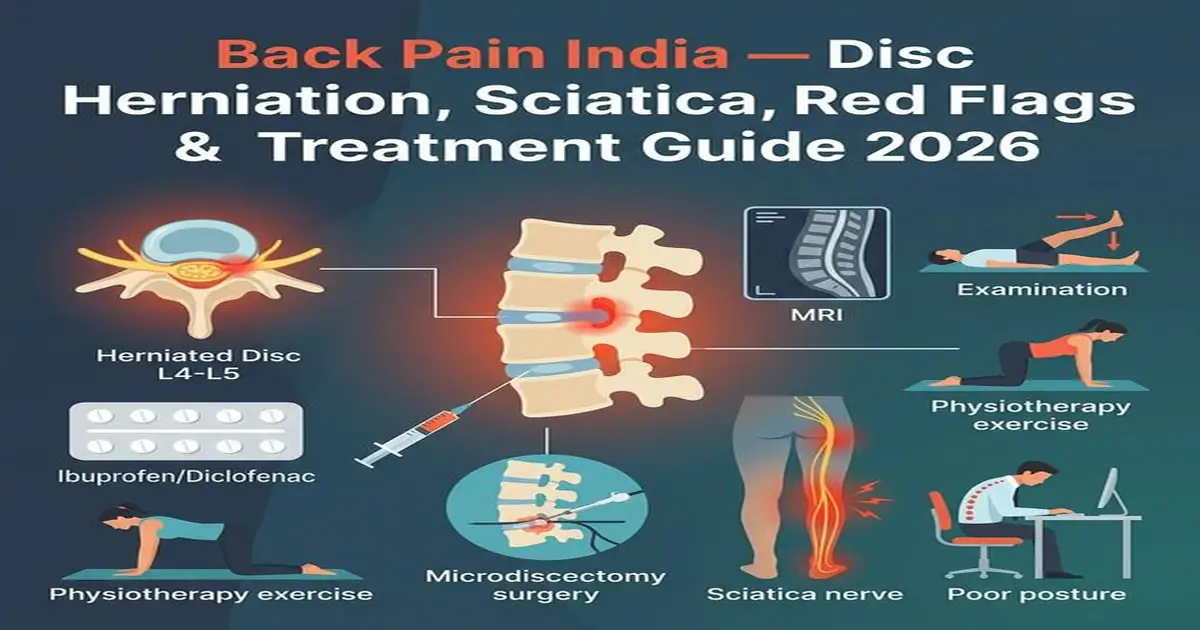
Back Pain India — Disc Herniation, Sciatica, Red Flags & Treatment Guide 2026
| Domain | Evidence-Based Details | India Context |
|---|---|---|
| Classification — Non-Specific vs Specific LBP & Red Flags | Classification framework: Non-specific LBP (85%): no identifiable structural cause; prognosis: 90% recover within 6 weeks; treatment: activity maintenance + NSAIDs + physiotherapy; imaging NOT indicated in acute non-specific LBP (<6 weeks without red flags); Specific LBP (15%) — requires investigation: Disc herniation with radiculopathy (sciatica): nucleus pulposus extrudes through annulus fibrosus → compresses nerve root → unilateral leg pain (dermatomal) + neurological deficit; spinal stenosis: narrowing of spinal canal → bilateral leg pain worsening with walking (neurogenic claudication — relieved by sitting/forward flexion); Spondylolisthesis: vertebral slip (L4/L5 common) → may compress multiple nerve roots; Vertebral fracture: osteoporotic crush (elderly), trauma, metastatic pathological fracture; Infection: TB spondylitis (Pott’s spine — India endemic), pyogenic osteomyelitis, discitis; Malignancy: primary (rare) or metastatic (prostate, lung, breast, renal — “spine-loving” cancers); Inflammatory: ankylosing spondylitis (AS) — young males, morning stiffness >30 min, sacroiliac pain, relieved by exercise; Cauda equina syndrome (CES): surgical emergency — massive central disc protrusion → bilateral leg weakness, saddle anaesthesia, urinary/bowel retention or incontinence; RED FLAGS — immediate investigation (MRI ± bloods): Age >50 with new back pain; History of cancer (current or past); Unexplained weight loss; Fever, rigors, recent infection; Night pain (waking from sleep); Immunosuppression (HIV, steroids, DM with poor control); IV drug use; Bladder/bowel dysfunction (urinary retention, incontinence — cauda equina emergency); Saddle anaesthesia (numbness around anus/perineum/inner thighs); Progressive neurological deficit (worsening weakness, sensory loss); Osteoporosis + minor trauma; Thoracic pain (uncommon — red flag for tumour, aortic pathology, vertebral fracture) | India-specific causes: TB spondylitis (Pott’s spine): India: 2.8 million TB cases annually; spinal TB: 1–3% of all TB cases; most common site: thoracolumbar junction (T10–L2); classic: chronic back pain (months) + gibbus deformity (kyphosis from vertebral collapse) + psoas abscess (fluctuant loin swelling); diagnosis: MRI spine (vertebral body destruction, paravertebral abscess, disc preservation — unlike pyogenic which destroys disc early); CBNAAT PCR of aspirated material (90% sensitivity); treatment: ATT (rifampicin + isoniazid + pyrazinamide + ethambutol × 2 months → rifampicin + isoniazid × 10 months total for spine); anti-gravity vest/brace; surgery if spinal instability or cord compromise; crucial India message: ANY persistent back pain (weeks-months) + constitutional symptoms (fever, sweats, weight loss) + not resolving with usual NSAIDs → TB spondylitis until proven otherwise; Ankylosing spondylitis India: young Indian males (15–40 years); HLA-B27 positive (90%); sacroiliac joint erosion on MRI; morning stiffness; night pain improving with exercise; management: NSAIDs (naproxen, diclofenac) first-line; physiotherapy spinal extension exercise programme; if non-responsive: anti-TNF biologics (adalimumab, etanercept — PMJAY covers under reimbursement if criteria met); Osteoporotic fractures: India: very high prevalence of Vitamin D deficiency + calcium-poor diet + early menopause → osteoporotic vertebral compression fractures common in women >55; acute onset back pain after minor activity → VCF (vertebral compression fracture); MRI T2 STIR: bright signal = acute/sub-acute fracture; treatment: brace + Vitamin D + antiosteoporotic treatment; vertebroplasty/kyphoplasty if severe pain |
| Disc Herniation & Sciatica — Anatomy, Types, Diagnosis | Intervertebral disc anatomy: nucleus pulposus (gelatinous centre — 70–80% water in young adults → progressively desiccates with age — disc degeneration) surrounded by annulus fibrosus (concentric collagen lamellae — outer 1/3rd has nociceptive innervation — source of discogenic pain); disc protrusion types: Bulge: diffuse circumferential extension beyond disc space — common incidental finding (40% of asymptomatic 40-year-olds); Protrusion: nucleus herniates through incomplete tear of annulus; Extrusion: nucleus herniates through complete annular tear (herniated disc proper); Sequestration: extruded fragment loses contact with parent disc (free fragment — most likely to cause acute severe radiculopathy; paradoxically often resolves spontaneously); Level patterns: L4/L5 (most common in India/globally): L5 nerve root → weakness: extensor hallucis longus (big toe extension), tibialis anterior (foot dorsiflexion); sensory: dorsum of foot/big toe; reflex: minimal (L5 has no reliable reflex); SLR positive; L5/S1 (2nd most common): S1 nerve root → weakness: gastrocnemius/soleus (plantarflexion), peronei; sensory: lateral foot, heel, little toe; reflex: ankle jerk (S1) ABSENT or reduced — key clinical sign; SLR positive; L3/L4: L4 nerve root → weakness: quadriceps; sensory: medial leg; reflex: knee jerk (L3/L4) reduced; femoral stretch test positive (instead of SLR); central stenosis: bilateral leg symptoms + neurogenic claudication; Sciatica definition: unilateral leg pain (in sciatic nerve distribution — posterior thigh → knee → calf/foot) +/- back pain; caused by: nerve root compression (disc herniation most common; rarely piriformis syndrome, sacral pathology); diagnosis — clinical: SLR (Straight Leg Raise) test: patient supine; examiner raises affected leg; positive: radicular pain reproduced at <70° (not just hamstring tightness or back pain); sensitivity 80%, specificity 40% for disc herniation; Bragard’s test: SLR + dorsiflexion of foot at angle of reproduction → pain worsens (highly specific for nerve root tension); Crossed SLR: raising the UNAFFECTED leg reproduces pain in AFFECTED leg → highly specific for large disc extrusion; Neurological examination: dermatomal sensory testing; motor testing (foot dorsiflexion, plantarflexion, big toe extension); reflexes (ankle jerk, knee jerk); Imaging strategy: Acute LBP without red flags (<6 weeks): NO imaging; Symptoms persisting >4–6 weeks despite conservative treatment: MRI lumbar spine (no contrast — show discs, nerve roots, cord, vertebrae, paravertebral soft tissues); X-ray: poor for soft tissue — cannot show disc herniation; useful for: spondylolisthesis (lateral X-ray — slip), fracture, bony metastasis (late finding), Pott’s spine (vertebral destruction); CT KUB: for bony detail if MRI contraindicated; Electrodiagnostics: NCS (nerve conduction studies) + EMG: useful if radiculopathy diagnosis unclear or to exclude peripheral neuropathy mimicking sciatica | Imaging overuse India: MRI lumbar spine India: widely available (₹3,000–8,000 at NABL diagnostic centres; ₹800–1500 at government hospitals; ₹500–1000 Ayushman Bharat PMJAY empanelled); MRI in India requested far too early and liberally: patients with 1-week acute LBP requesting MRI → incidental disc bulges found → catastrophisation → unnecessary surgery → worse outcomes; NICE (UK) + ICMR India guidelines: MRI for acute LBP only after 6 weeks of failed conservative treatment OR clinical red flags; neurosurgeon referral India: should not be for all disc bulges — only: significant progressive neurological deficit (foot drop worsening), cauda equina syndrome, failed conservative treatment >6–8 weeks with disabling symptoms; Pott’s spine India: CRITICAL — many districts have high TB prevalence; chronic back pain + low-grade fever + night sweats + ≥4 weeks duration → MANDATORY TB investigation (CBNAAT, ESR, CRP, CXR, MRI spine) before diagnosing “mechanical LBP”; delayed diagnosis of Pott’s spine → paraplegia (Pott’s paraplegia) from spinal cord compression — preventable with early ATT |
| Non-Surgical Treatment — NSAIDs, Physiotherapy & Lifestyle | Treating acute non-specific LBP: First-line (evidence grade A): Advice: stay ACTIVE (bed rest harmful — prolongs recovery by 20%; activity maintenance + normal daily activities → faster recovery); NSAIDs: ibuprofen 400–600mg TDS with food (1st choice — most cost-effective; superior to paracetamol for LBP — Cochrane); diclofenac 50mg BD; naproxen 500mg BD; COX-2 (etoricoxib 60–90mg OD — reduced GI risk; esomeprazole gastroprotection if high GI risk or age>60); duration: limit to 1–2 weeks (GI/cardiovascular risk with prolonged use); caution: renal impairment, peptic ulcer history, cardiovascular disease; Muscle relaxants: short-course (3–7 days): methocarbamol, diazepam 5mg nocte (AVOID long-term — dependency), tizanidine 4mg TDS, chlorzoxazone; Paracetamol (acetaminophen — 1g QID): widely used but Cochrane 2016 meta-analysis: no benefit over placebo for LBP (inferior to NSAIDs); Topical NSAIDs: diclofenac gel 1% applied TDS to lumbosacral area: evidence supports for both acute and chronic LBP; good GI safety; Second-line: Physiotherapy: structured exercise programme > non-specific exercise: McKenzie method (extension exercises for posterolateral disc herniations — directional preference assessment → specific exercises); Core stabilisation exercises (multifidus + transversus abdominis activation → spinal stability); Manual therapy (spinal manipulation/mobilisation — physiotherapist or chiropractor): short-term benefit for acute LBP; not for red flags; Heat therapy: local heat (hot water bottle, heat pad): evidence-based for muscle spasm + acute LBP → effective short-term adjunct; TENS (transcutaneous electrical nerve stimulation): modest evidence; Sciatica-specific: NSAIDs + activity; physiotherapy (nerve mobilisation — neural glides/sciatic nerve flossing); epidural corticosteroid injection (ECI): if not responding to 4–6 weeks conservative treatment; evidence: short-term (6 weeks) leg pain relief (NNT 3–4); no effect on long-term surgical rates; radicular pain > back pain for ECI; Pregabalin/gabapentin: for neuropathic (radiating) pain component of sciatica that has not responded to NSAIDs; evidence for nerve pain — but NOT for mechanical LBP; amitriptyline 10–25mg nocte: for chronic neuropathic component; antidepressants (duloxetine 60mg OD): NICE recommended for chronic LBP with central sensitisation; Chronic LBP (≥12 weeks): cognitive behavioural therapy (CBT — pain catastrophisation, fear-avoidance behaviour — strong evidence); multidisciplinary biopsychosocial pain programme (best long-term outcomes for disabling chronic LBP); exercise: any form sustained long-term; yoga (evidence base: multiple RCTs show yoga equivalent to physiotherapy for chronic LBP) | India physiotherapy access: PMJAY does not cover outpatient physiotherapy at most empanelled hospitals; private physiotherapy: ₹300–800 per session; widely available in towns; CGHS rates: ₹100–200; government hospitals: physiotherapy OPD free at AIIMS, PGI, district hospitals — but long queues; online physiotherapy: COVID-19 accelerated — many affordable online physiotherapy platforms (PhysioMitra, BeatO, Practo — ₹300–500/session via video); Yoga India: extraordinary evidence base for LBP — multiple RCTs (Tilbrook 2011, Sherman 2011, Cramer 2013): yoga superior or equivalent to physiotherapy for chronic LBP, at lower cost; India advantage: yoga widely practised, free resources (youtube.com: Yoga with Adriene — Back Pain Series free; Art of Living; Isha Foundation Yoga); specific poses: Cat-Cow (spine mobilisation), Child’s Pose (lumbar stretching), Cobra (extension for posterolateral disc), Bridge pose (gluteus/core activation), Seated forward bend — CAUTION if disc herniation → avoid sustained flexion; NSAIDs India: ibuprofen 400mg: ₹1–2/tablet (most cost-effective); diclofenac: widely available; etoricoxib (Arcoxia, Etova): ₹15–20/tablet; gastroprotection (omeprazole 20mg): ₹2–5/tablet — always co-prescribe if NSAID >7 days or age >60; India overuse of muscle relaxants: combination NSAID + muscle relaxant tablets widely marketed in India (e.g., Ibugesic Plus: ibuprofen + chlorzoxazone; Diclonac MR: diclofenac + chlorzoxazone) — short-course useful; avoid chronic use → dependency/sedation; opioids for LBP India: tramadol 50–100mg (Schedule H1): prescribed for severe acute disc pain in India; short-term use acceptable under supervision; avoid for chronic non-specific LBP (addiction risk + reduces activity which worsens long-term) |
| Surgical Treatment — Microdiscectomy, MISS & Spine Surgery India | Indications for surgery in disc herniation: Absolute (emergency): Cauda equina syndrome (CES): massive disc herniation compressing cauda equina → bilateral leg weakness + saddle anaesthesia + bladder/bowel dysfunction → EMERGENCY microdiscectomy within 24–48 hours (delay → permanent incontinence); Progressive neurological deficit: worsening foot drop (L4/L5) or progressive weakness despite conservative treatment; Relative (elective): Severe disabling radicular pain (sciatica) not responding to ≥6–8 weeks of conservative treatment (NSAIDs + physiotherapy ± epidural injection); patient preference for faster return to function; NOTE: evidence shows: surgery → faster short-term pain relief (NNT 2 at 6 months: leg pain); conservative treatment → equivalent long-term outcomes at 1–2 years; therefore: non-emergency disc surgery is not necessary if symptoms tolerable and improving; Surgical options: Microdiscectomy: gold-standard for L4/L5 and L5/S1 disc herniations with radiculopathy; small posterior incision (3–4cm), operating microscope, partial laminotomy/flavectomy → herniated disc fragment removed; 90% good to excellent outcomes for leg pain (back pain outcomes less predictable); same-day or 1-night admission; return to sedentary work: 2–4 weeks; return to heavy labour: 6–12 weeks; MISS (Minimally Invasive Spine Surgery): tubular microdiscectomy, endoscopic discectomy; less tissue trauma, faster recovery; available in private sector India; Percutaneous endoscopic lumbar discectomy (PELD): full-endoscopic (uniportal); local analgesia + sedation; excellent outcomes published in Indian data; Laminectomy: for spinal stenosis (decompression of multiple levels); Spinal fusion (PLIF/TLIF): for spondylolisthesis, instability; significant morbidity; not for disc herniation alone; Vertebroplasty/Kyphoplasty: for osteoporotic vertebral compression fractures (VCF) with persistent severe pain; cement injection into collapsed vertebra; good short-term pain relief evidence; Red flags for surgery: NOT indicated: incidental disc bulge without symptoms; mild-moderate sciatica improving on conservative treatment; non-specific LBP without structural cause; chronic LBP without surgical target (most common surgical failure in India) | Spine surgery India: AIIMS Delhi, NIMHANS Bangalore, CMC Vellore, Apollo, Fortis, Max: major spine surgery centres; microdiscectomy cost: government AIIMS/PGIMER: ₹15,000–30,000 (PMJAY covered); private (Apollo/Fortis): ₹1,50,000–3,50,000; PMJAY (Ayushman Bharat): microdiscectomy + laminectomy listed packages → covered at empanelled hospitals; check eligibility; endoscopic spine surgery India: rapidly growing — several centres now offering PELD (Percutaneous Endoscopic Lumbar Discectomy) at ₹80,000–2,00,000; faster recovery; Indian spine journal (Spine-India, J Spinal Surg): active research — Indian-origin surgeons among world leaders in minimally invasive spine techniques; India chiropractic: unregulated — no statutory registration body; physiotherapy better regulated (IAP/IPA — Indian Physiotherapy Association); stick to qualified physiotherapists (BPT/MPT degree holder); Overdiagnosis-driven surgery India: significant problem: incidental disc bulges → unnecessary surgery → failed back surgery syndrome (FBSS); back pain surgery rate India rising despite evidence of equivalence to conservative management at 2 years; key message: “If the disc bulge on my MRI was there when I had no pain — it is probably not the cause of my current pain.” |
| Prevention — Exercise, Posture, Ergonomics & Lifestyle India | Primary prevention (preventing first episode): Exercise: MOST EVIDENCE-BASED PREVENTION: moderate aerobic exercise + specifically core strengthening (multifidus, transversus abdominis, gluteus medius): reduces first and recurrent LBP episodes by 33–45% (Cochrane 2016 — exercise alone; exercise + education: 45%); Posture + ergonomics (significant but OVER-emphasised as single cause): key: variation > perfect posture (no single posture causes LBP — prolonged STATIC posture of any kind → cumulative disc loading → LBP); ergonomic workstation: monitor at eye level; chair height: feet flat on floor; lumbar support; 90° elbows; micro-breaks every 30 min (stand, stretch, walk 2 minutes); avoid prolonged sitting >20–30 minutes without movement; Lifting technique: bend knees, keep back straight, load close to body, avoid twisting while lifting — reduces acute disc injury; but evidence: these manoeuvres reduce injury risk in heavy lifters — less evidence for general population; Weight: obesity + BMI >30: ↑ LBP (increased spinal loading), but NOT major modifiable risk factor — weight loss helps but modestly; Smoking: increases disc degeneration (nicotine → disc nucleus vascularity ↓ → nutrition impaired → early degeneration); independent risk for LBP — smoking cessation reduces LBP progression; Psychosocial (Yellow Flags — important risk factors for chronicity): catastrophisation (“this pain means permanent damage”), fear-avoidance behaviour (avoiding activity for fear of pain — paradoxically causes more pain via deconditioning + sensitisation), low job satisfaction, previous depression/anxiety — these are STRONGER predictors of chronic LBP than imaging findings; address with CBT + graded activity + reassurance; Secondary prevention (preventing recurrence): regular back-strengthening exercise programme (3×/week ongoing — yoga, Pilates, swimming, gymball exercises, deadlifts with correct form); ergonomic awareness; avoid prolonged static postures; India-specific exercise: Sur Namaskar (sun salutation): 12 poses including Cat-Cow, Cobra, Downward Dog, Forward Bend → evidence-based for both prevention and treatment of chronic LBP; Kati Basti (Ayurvedic hot oil back treatment): limited evidence; provides short-term muscle relaxation — acceptable adjunct; NOT curative for structural disc herniation | India back pain workplace context: IT sector Mumbai/Bengaluru/Hyderabad: LBP most common occupational complaint; 12–14h/day screen time, poor workstation ergonomics (laptop on bed/lap, sofa), car commuting + sitting → cumulative disc loading → chronic LBP epidemic in 25–45 age group; agricultural workers: paddy planting, weeding, transplanting paddy seedlings (forward bent posture 6–8h/day) → highest rates of chronic LBP in India farm communities; construction: heavy lifting + twisting → acute disc injuries; India solutions: Stand-up desk: increasingly available ₹8,000–25,000 (in corporate India); or DIY: stack books to raise monitor; ergonomics assessment: free self-assessment tools (Health & Safety Institute India — HSII); government occupational health: ESIS (Employees State Insurance Scheme): covers physiotherapy and orthopaedic consultation for work-related LBP for ESIS-eligible employees (formal sector workers <₹21,000/month); informal economy workers: little occupational health protection; Bhartiya Kamgar Sanstha (trade unions) advocating for occupational LBP compensation; core exercise India free resources: YouTube (Anabolic Aliens, Yoga with Adriene, Jal-Keel — Hindi back pain exercises); Physiotherapy India apps: PhysiApp, Clinfield; Pilates India: growing in urban areas — ₹500–1,500/class; reformer Pilates: ₹1,500–3,000/class (Mumbai, Delhi, Bangalore boutique studios); mat Pilates equally effective for LBP — free online equivalents available |
Frequently Asked Questions
My MRI shows a disc bulge — do I need surgery?
This is one of the most important — and most misunderstood — questions in spine medicine. The short answer for the vast majority of patients is: No, you almost certainly do not need surgery for a disc bulge. Here is why, and what the evidence actually says: The fundamental misunderstanding — MRI findings vs symptoms: One of the most consistent findings across all spine imaging research is that disc bulges are extraordinarily common in people with NO BACK PAIN WHATSOEVER: in asymptomatic (pain-free) individuals aged 40, approximately 40% have disc bulges on MRI; aged 50: 60%; aged 60: 70–80% (Brinjikji 2015 — systematic review of 33 studies). This means a disc bulge found on MRI is often an incidental finding — present before the current episode of pain and unrelated to it. The pain you are experiencing may be from: muscle spasm + posterior joint (facet) irritation (most common cause of acute LBP); a different level than the one shown on MRI; psychosocial factors (stress, fear, catastrophisation) amplifying a normal disc finding; Therefore: “I have a disc bulge on my MRI” does NOT automatically explain your pain; When does surgery make sense? Surgery is indicated when: (1) the bulge is an extrusion/sequestration (not merely a bulge) AND compressing a specific nerve root AND causing: confirmed progressive neurological deficit (worsening foot-drop or hand weakness that is failing to recover despite 6–8 weeks of rest); OR severe disabling leg pain (sciatica — leg pain worse than back pain, dermatomal) unresponsive to ≥6 weeks of conservative treatment (physio + NSAIDs ± epidural injection); OR cauda equina syndrome (emergency — saddle anaesthesia + bladder/bowel dysfunction → operate within 24h); (2) Clinician-confirmed structural instability (spondylolisthesis with slip progression + neurological compromise); The evidence for conservative vs surgical treatment: The landmark SPORT (Spine Patient Outcomes Research Trial) studies (2006–2008, USA) — the largest surgical vs conservative LBP trials: for disc herniation: surgery → faster short-term (3-month) leg pain relief; at 1 year and 2 years: NO significant difference between surgery and conservative treatment in pain or disability outcomes for most patients; 40–50% of patients randomised to conservative treatment had full recovery without surgery; for spinal stenosis: similar results — surgery faster symptom relief; long-term equivalent; Indian data mirrors this: excellent case series from AIIMS, Bombay Hospital, Christian Medical College Vellore showing: 70% of acute disc herniations with sciatica resolve within 6–12 weeks with conservative management; What to do instead of rushing to surgery: Wait and mobilise: keep active; walking even 20–30 minutes daily despite discomfort speeds recovery (discomfort ≠ damage — the Mosely pain education paradigm); NSAIDs: ibuprofen/diclofenac taken regularly (not just when unbearable) for 2 weeks at full dose; physiotherapy: McKenzie exercises for posterolateral disc: extension exercises (cobra pose equivalent) — self-directed; neural glides (sciatic nerve flossing): gently restores nerve mobility through compressed area; if not improving at 6 weeks: repeat clinical assessment; consider epidural steroid injection (short-term sciatica relief, NNT 3); neurosurgical consultation (not for decision to operate — for expert assessment); Red flags that change the calculation — go NOW: Saddle anaesthesia (numbness around anus, genitals, inner thighs); any loss of bladder control (retention or incontinence); bowel loss of control; rapidly worsening leg weakness (can’t lift foot at all — foot drop); bilateral leg pain; → These indicate potential cauda equina syndrome → EMERGENCY → go to accident and emergency immediately.
What are the best exercises for back pain — and which should I avoid?
Exercise is the single most evidence-based long-term treatment for both acute and chronic low back pain — yet most Indian patients are told to “rest” after an acute episode. This advice is not only wrong — it actively prolongs recovery. Here is the complete guide: Why exercise works for back pain: Disc nutrition: intervertebral discs are avascular (no blood supply after age 20) — they receive nutrients purely through diffusion during movement (alternating compression and decompression — the “pumping” action of movement drives fluid and nutrients into the disc). Bed rest → static loading → disc dehydration → worse disc health; Core muscles as natural spinal brace: the deep stabilisers (multifidus — runs between every vertebral segment; transversus abdominis — the “corset muscle”) provide spinal stability. In chronic LBP, multifidus atrophies within 2 weeks of onset (MRI evidence) and does NOT spontaneously recover even after pain resolves — requiring specific retraining; Pain neurophysiology: movement reduces central sensitisation; fear-avoidance reduces it less effectively than graded return to movement; Best exercises for back pain — India-compatible guide: Phase 1 (Acute — Days 1–7): Goal: reduce muscle spasm + restore basic movement; Cat-Cow stretch: on hands and knees; inhale — arch back up (cat); exhale — let back sag (cow); 10 repetitions × 3 sets; gentle spinal mobilisation → immediate spasm relief; Child’s pose: sit back toward heels, arms extended forward on floor; hold 30 seconds; gentle lumbar stretch; Knee-to-chest stretch (single): lying on back (or cot), bring one knee gently to chest, hold 30 seconds; alternating sides; for posterolateral disc: Cobra pose (McKenzie extension): lie face-down (prone), hands under shoulders, push gently up to extend lower back; start with forearms (Sphinx pose) → progress to full Cobra; 10 reps; particularly effective for posterolateral disc herniations (most common type — extension centralises pain toward centre/back, away from leg); Phase 2 (Subacute — Weeks 2–6): Add core stabilisation: Dead bug exercise (supine): lower back pressed into floor; extend opposite arm and leg simultaneously without arching back; excellent multifidus + TA activation; Bird dog (quadruped): from hands and knees, extend opposite arm and leg; hold 5 seconds; 10 reps each side; glute bridges: lying supine, knees bent, feet flat; raise hips; hold 3 seconds; 15 reps; activates gluteus maximus → posterior chain → reduces lumbar load; partial crunches: hands behind head, feet flat; raise only shoulders (not full sit-up — which increases disc pressure significantly); 15 reps; Phase 3 (Chronic prevention — ongoing): Yoga Sun Salutation (Surya Namaskar): 12-pose sequence; flowing between flexion and extension → spinal mobility in all planes; minimum 3 rounds/day; Swimming/water exercises: best low-impact back exercise (buoyancy eliminates axial loading); backstroke + freestyle preferred over breaststroke (lumbar extension position); Walking: 30 min brisk walk daily — proven to reduce LBP episodes by 33% in RCT (Pocovi 2024); free, simple, requires no equipment; Deadlift (hip hinge with back straight): controversial but excellent for back strength when technique is correct — low back injuries from deadlifts in research are less common than assumed when form is good; begin with lighter weights → coach guidance; What to AVOID: Prolonged bed rest beyond 1–2 days (harmful); Sit-ups/crunches with full range (high disc pressure); Russian twists with weight (rotational loading on compromised disc); Standing toe-touch with straight legs in acute phase (disc pressure maximum in full lumbar flexion while loaded); Heavy overhead pressing without core engagement; Slouched forward flexion postures sustained for hours (most harmful for posterolateral disc — common sitting posture); Bouncing/ballistic stretches of lumbar spine; For sciatica specifically: Sciatic nerve flossing (neural glides): lying on back, alternately: straighten knee (dorsiflex foot at same time) → relax (plantar flex foot); pumping motion × 10; gently restores nerve mobility through compressed area; reduces radicular symptoms (evidence: moderate); Piriformis stretch: for piriformis syndrome (mimics sciatica): cross ankle over opposite knee → pull knee toward chest; 30 second hold; walking despite some sciatica is productive (not crippling leg weakness); complete immobilisation worsens outcome.
What to Read Next
- Arthritis India — Osteoarthritis vs RA vs Ankylosing Spondylitis; HLA-B27 + Sacroiliitis; Anti-TNF Biologics; MTX; Back Pain + Morning Stiffness = AS Until Proven Otherwise
- Osteoporosis India — Vertebral Compression Fractures Most Common Osteoporotic Fracture; DEXA T-Score; Alendronate; Vitamin D Mandatory Co-Treatment
- Vitamin D India — Proximal Muscle Weakness + Back Pain; Osteomalacia Mimics Disc Disease; 25(OH)D Test ₹500; Calcirol 60K/week x8 Weeks Cures Osteomalacia Pain
- TB India — Pott’s Spine: Chronic Back Pain + Weight Loss + Fever = Spinal TB Until Proven Otherwise; MRI Spine + CBNAAT; 12-Month ATT Regimen; Prevent Paraplegia
- Obesity & Back Pain — BMI >30 Increases Spinal Loading; Back Pain Improves with Weight Loss; Core Exercise + Swim + Walk = Best Low-Impact Back Exercise for Obese
A 38-year-old software engineer from Bengaluru — 3 months of low back pain with radiation to right leg. MRI: “L4/L5 disc extrusion with right L5 nerve root compression.” Referred to a private neurosurgeon. Quote: “You must operate soon — the disc will damage the nerve permanently.” He agreed to surgery. Pre-operative review by a second spine surgeon at a public hospital: “Your foot power is normal. Your reflexes are normal. SLR is mildly positive. You have 6-week sciatica that is improving.” Recommendation: physiotherapy + NSAIDs × 6 more weeks. Follow-up 6 weeks: complete resolution. No surgery. MRI at 4 months: disc extrusion largely resorbed (spontaneous regression — sequestered fragments have the highest rate of spontaneous resorption — nearly 70%). “I was told I would be permanently damaged if I didn’t operate. My MRI now barely shows the disc. My body healed it.” The body has remarkable capacity for disc self-repair — if given time, activity, and the right treatment.
About This Guide: Written by the StudyHub Health Editorial Team (studyhub.net.in) based on NICE Clinical Guideline NG59 (Low Back Pain 2016), SPORT Trial data (NEJM 2006–2008), Cochrane Reviews (Exercise for LBP 2021; Bed Rest 2010), ICMR India Spine Guidelines, Brinjikji 2015 asymptomatic disc bulge meta-analysis, and India TB Spondylitis RNTCP protocols. Last updated: March 2026.
🦴 Disc Bulge on MRI ≠ Need for Surgery: 40% of pain-free 40-year-olds have disc bulges on MRI. Most disc herniations (even extrusions) resolve spontaneously within 6–12 weeks. First treatment: stay active + ibuprofen/diclofenac + McKenzie extension exercises (Cobra pose). Red flag → surgery emergency: saddle anaesthesia + bladder/bowel loss → go to A&E immediately. Otherwise: 6 weeks conservative treatment first.
⚠️ Chronic Back Pain + Fever + Weight Loss = Rule Out TB Spine: In India, TB spondylitis (Pott’s spine) is common and frequently missed. Any back pain lasting >4 weeks with fever, night sweats, or weight loss → get ESR, CRP, CXR, and MRI spine before accepting “mechanical” diagnosis. Delayed diagnosis → Pott’s paraplegia (preventable). CBNAAT of biopsy material 90% sensitive. ATT 12 months → dramatic recovery.
⚕️ Medical Disclaimer: This article provides general educational information about back pain and disc herniation. Any new back pain with neurological symptoms (leg weakness, bladder/bowel change, saddle numbness), fever, weight loss, or history of cancer requires urgent qualified physician or spine specialist assessment. Cauda equina syndrome is a surgical emergency. Do not delay medical care.