Last Updated: March 2026 | Reading Time: 9 minutes | ~2,100 words
Gastric (stomach) cancer is the fourth most common cancer and the third leading cause of cancer death in India — approximately 57,000–60,000 new cases diagnosed annually, with significantly higher incidence in South India (Kerala, Tamil Nadu, Karnataka), North-East India (Mizoram — one of the highest gastric cancer incidence rates in the world at 35–40 per 100,000 men), and Jammu & Kashmir. India’s gastric cancer burden is driven by the world-highest prevalence of Helicobacter pylori (H. pylori) infection — over 80% of Indian adults harbour H. pylori, the IARC Group 1 definite carcinogen responsible for 89% of non-cardia gastric cancers globally. Despite this, India lacks a population-level gastric cancer screening programme, and the overwhelming majority of Indian gastric cancers — 70–80% — are diagnosed at Stage III–IV (regionally advanced or metastatic), where curative surgery is rarely possible. The 5-year overall survival for gastric cancer in India is approximately 15–25% — reflecting both late diagnosis and the biologically aggressive nature of the disease in Indian patients (higher prevalence of signet ring cell and diffuse-type histology, which is intrinsically less chemo-responsive and carries worse prognosis than intestinal-type gastric cancer).
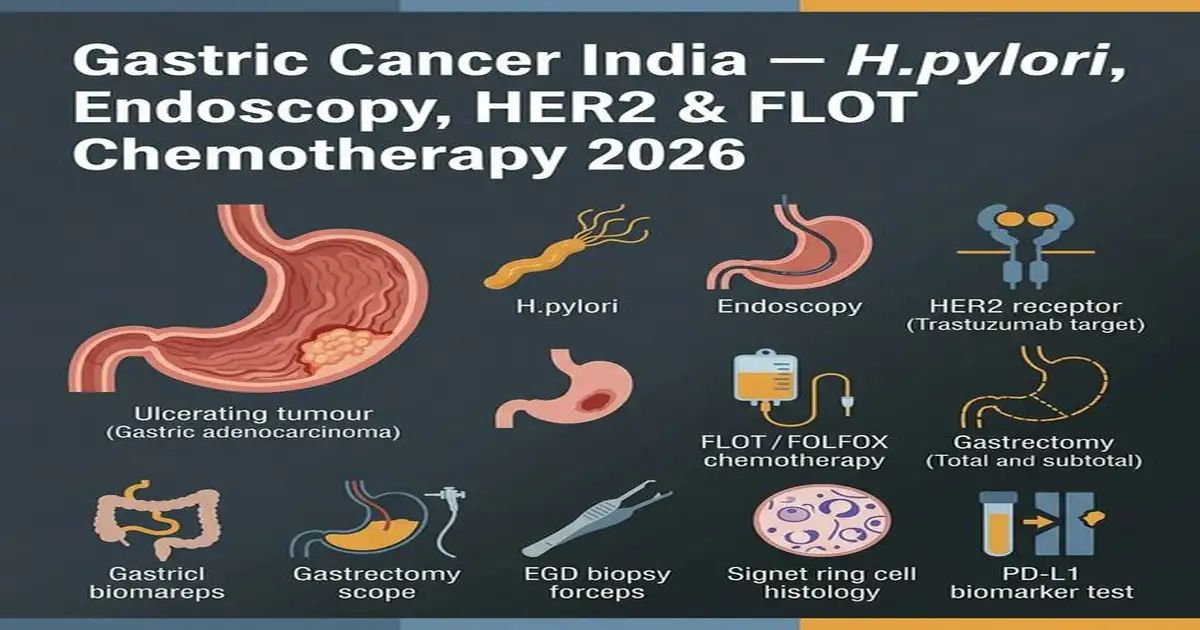
Gastric Cancer — Classification, Staging and Treatment Framework
| Stage / Treatment Phase | Definition / Setting | Preferred Treatment | India-Specific Notes |
|---|---|---|---|
| H. pylori Eradication (Prevention) | H. pylori-positive adults (particularly first-degree relatives of gastric cancer patients, atrophic gastritis, intestinal metaplasia patients) | Triple therapy: PPI (omeprazole 20mg) + clarithromycin 500mg + amoxicillin 1g — twice daily × 14 days (14-day superior to 7-day in India); Bismuth quadruple therapy (PPI + bismuth + metronidazole + tetracycline × 14 days): preferred if clarithromycin resistance likely (India resistance rising); Confirm eradication: urea breath test (UBT) or stool H. pylori antigen at ≥4 weeks after completion; second-line: levofloxacin triple or bismuth quadruple if first-line fails | H. pylori prevalence India 50–80%; eradication reduces gastric cancer risk 35–40% in H. pylori-positive individuals (meta-analysis); first-degree relatives of gastric cancer patients should be tested and treated; India: H. pylori clarithromycin resistance 35–40% → high bismuth quadruple use recommended; UBT (carbon-13 labelled urea breath test) available at major centres; stool antigen cheaper and widely available |
| Early Gastric Cancer (EGC) — Endoscopic Treatment | T1 (mucosa/submucosa, no lymph node invasion); ideal candidates for endoscopic resection; confined to mucosa (T1a): ESD curative; selected T1b submucosa: ESD under strict criteria | Endoscopic submucosal dissection (ESD): highest-quality endoscopic resection; en-bloc removal of early gastric lesion with clear lateral and deep margins; curative in 85–95% of ideal candidates; endoscopic mucosal resection (EMR): less preferred than ESD (higher recurrence); laparoscopic gastrectomy if ESD criteria not met | ESD requires dedicated gastric endoscopy expertise — not widely available India; available at CMC Vellore, AIIMS New Delhi, Tata Memorial Mumbai, Asian Institute Gastroenterology Hyderabad; EGC rarely diagnosed India (low screening) — most “early” diagnoses are incidental findings during endoscopy for dyspepsia; Japan’s organised gastric cancer screening (annual endoscopy from 50) achieves 60–70% EGC diagnosis vs India’s 5–10% |
| Resectable — Localised / Locally Advanced (Stage I–III) | cT1–T4a N0–N3 M0; potentially resectable; may require neoadjuvant to downstage; majority should receive perioperative chemotherapy | Perioperative chemotherapy (before + after surgery): FLOT (docetaxel + oxaliplatin + leucovorin + 5-FU) — 4 cycles pre-op + surgery + 4 cycles post-op; FLOT4 trial: FLOT vs ECF/ECX: OS 50 months vs 35 months; R0 resection rate 85% vs 78%; FLOT is current standard for fit patients globally; alternative: CAPOX (capecitabine + oxaliplatin perioperative); older ECF/ECX (epirubicin + cisplatin + FU/capecitabine) still used if FLOT not tolerated; Surgery: D2 gastrectomy (standard — must remove ≥15 nodes; specialist centre required); total vs subtotal gastrectomy depending on location; splenectomy not routinely recommended; adjuvant S-1 (tegafur — Japan data — ACTS-GC): useful post-Asian resection | FLOT India: docetaxel + oxaliplatin + 5-FU — generic availability makes FLOT affordable; FLOT cycle cost in India (generic drugs): ₹30,000–60,000/cycle × 8 cycles; D2 gastrectomy: specialist centres — Tata Memorial Mumbai, AIIMS, Apollo Chennai, CMC Vellore; high-volume surgery essential (D2 gastrectomy morbidity significant — pancreatic fistula, anastomotic leak — in inexperienced hands); post-op nutritional support critical |
| Metastatic — First-Line (HER2-positive) | HER2 amplification/overexpression (IHC 3+ or FISH positive — 10–15% of gastric adenocarcinomas); PD-L1 CPS ≥1 (most metastatic gastric cancers) | HER2-positive: trastuzumab + chemotherapy (TOGA trial — OS 13.8 vs 11.1 months; first targeted therapy for gastric cancer); KEYNOTE-811 update 2023: pembrolizumab + trastuzumab + chemotherapy (FP or CAPOX) — superior to trastuzumab + chemo in PD-L1 CPS ≥1 HER2+ mGC (OS benefit confirmed HER2+/PD-L1+); standard: pembrolizumab + trastuzumab + CAPOX/FP: now first-line HER2+/PD-L1+ mGC; trastuzumab deruxtecan (T-DXd — DESTINY-Gastric01/02): HER2-positive 2nd line — 40% ORR vs 14% physician choice; approve and expanding in India | HER2 testing: must be done on all metastatic gastric cancer biopsies in India (IHC then FISH if IHC 2+); trastuzumab (Herceptin): ₹70,000–90,000/vial (branded); generic trastuzumab (Herclon, Hertraz — Mylan/Biocon): ₹15,000–25,000/vial — dramatically reduced cost; pembrolizumab: ₹1,50,000–2,00,000/dose; T-DXd: limited India availability currently |
| Metastatic — First-Line (HER2-negative) | HER2-negative (majority); assess PD-L1 CPS; FGFR2b overexpression (bemarituzumab target — 30% of GC); MSI-H status | PD-L1 CPS ≥5: nivolumab + chemotherapy (CHECKMATE-649 — OS 14.4 vs 11.1 months; nivolumab + CAPOX or FOLFOX); PD-L1 CPS ≥1: add nivolumab benefit (smaller); MSI-H: pembrolizumab or nivolumab (remarkable responses — MSI-H GC best responders to CPI); PD-L1 CPS <1 HER2-neg MSS: FOLFOX or CAPOX chemotherapy alone; FLOT/CAPOX/FOLFOX standard; Second-line: ramucirumab + paclitaxel (REGARD/RAINBOW); irinotecan; trifluridine/tipiracil (TAS-102) | Nivolumab (Opdivo): ₹1,00,000–1,50,000/dose; some biosimilar nivolumab entering India market; CAPOX (capecitabine oral + oxaliplatin IV): highly accessible — generic capecitabine ₹2,000–5,000/cycle; PD-L1 testing (CPS score) now standard before starting 1L; MSI testing by IHC (MLH1/MSH2/MSH6/PMS2) or PCR — essential; FGFR2b IHC testing limited availability India |
Frequently Asked Questions
Does H. pylori always cause stomach cancer — and who should be tested in India?
H. pylori infects over 80% of Indian adults — but only approximately 1–3% of infected individuals will ultimately develop gastric cancer. Understanding who is at heightened risk within this vast infected population is essential for targeted prevention: Correa cascade — the pathway from H. pylori to cancer: Normal gastric mucosa → H. pylori infection → chronic active gastritis → multifocal atrophic gastritis (MAG) → intestinal metaplasia (IM) → dysplasia → adenocarcinoma; the journey from H. pylori infection to gastric cancer takes 20–40 years; most H. pylori-infected individuals are arrested at the gastritis stage and never progress; key steps that increase progression risk: atrophic gastritis + intestinal metaplasia = highest pre-malignant risk; endoscopy + biopsy (Updated Sydney Protocol: 5 biopsies — antrum + incisura + body) to stage gastritis accurately (OLGA/OLGIM staging — high-stage = intensive surveillance). High-risk groups for gastric cancer in India — who warrants endoscopic surveillance: First-degree relatives of gastric cancer patients: RR 2–3× — H. pylori test and treat; endoscopy at 40–45 years if positive family history; Intestinal metaplasia on endoscopy: OLGIM Stage III–IV → endoscopy every 1–3 years; H. pylori-positive + antral atrophic gastritis: treat H. pylori; endoscopy at 3 years post-eradication; Mizoram, J&K residents: highest-incidence Indian regions — may justify lower-threshold endoscopy; Heavy smokers + H. pylori: synergistic risk; high-salt diet (preserved fish, pickled vegetables — north-east India): synergistic with H. pylori in gastric carcinogenesis. Dietary risk factors for gastric cancer India: High-salt diet: sodium directly damages gastric mucosa, facilitates H. pylori colonisation; salted/smoked/pickled foods (particularly North-East India — smoked pork, fermented fish — “anishi,” “nakham” — high gastric cancer in Naga, Mizo communities); smoked/charcoal-grilled meats: polycyclic aromatic hydrocarbons (PAH); red and processed meat; low consumption of fresh fruit and vegetables (antioxidant-poor diet — common in deficiency states India); protective: fresh fruits and vegetables (vitamin C, beta-carotene, folate); green tea (Japan data). Why H. pylori eradication as prevention works: IARC and WHO endorse H. pylori eradication as the most effective intervention for primary prevention of gastric cancer in high-incidence regions; HUNT (Norway) + Lin and Uemura Japan studies: 35–40% gastric cancer mortality reduction with H. pylori eradication vs no treatment; eradication benefit is greatest before intestinal metaplasia develops (pre-metaplastic stage — reversible); after IM established, eradication reduces but does not eliminate cancer risk; Japan mass eradication programmes have contributed to declining gastric cancer incidence.
What are the symptoms of stomach cancer — and why is it diagnosed so late in India?
Gastric cancer is one of the most insidious cancers — early disease is almost always asymptomatic, and by the time symptoms become distressing enough to prompt medical consultation, disease is usually advanced. Understanding why this happens in India enables targeted intervention: Symptom progression in gastric cancer: Early gastric cancer (EGC — T1–T2): usually asymptomatic or causes non-specific dyspepsia; indistinguishable clinically from extremely common benign H. pylori gastritis or GERD; anaemia (iron deficiency from occult bleeding — most EGC bleeds imperceptibly); early satiety (proximal tumours — fundus/cardia); weight loss (subtle); Locally advanced (T3–T4): epigastric pain — often described as “burning” or “discomfort” similar to peptic ulcer; significant weight loss; dysphagia (cardia/GEJ tumours — oesophagogastric junction); vomiting (pyloric tumours — outlet obstruction); Metastatic (M1): new-onset ascites (peritoneal CarCinomatosis — extremely common Indian presentation, peritoneal seedling is prevalent in India’s diffuse-type SRC); palpable left supraclavicular node (Virchow’s node — pathognomonic); hepatomegaly (liver mets); Sister Mary Joseph nodule (umbilical metastasis — peritoneal spread); bone pain. Why India’s diagnosis is so late — systemic barriers: Symptom normalisation: dyspepsia, epigastric discomfort, and weight loss are extremely common in India (attributed to “gas,” “acidity,” food habits, seasonal illness); patients and families normalise symptoms for 6–18 months before seeking care; Self-medication: antacids, H2 blockers, PPIs widely available OTC in India → symptom suppression without investigation; PPI prescribed by non-specialists for “acidity” without endoscopy — masking early gastric cancer for 1–2 years; Access to endoscopy: rural India has minimal endoscopy access; ASHA workers not screening for upper GI symptoms; endoscopy concentrated at urban private/tertiary centres; Cost: “unnecessary” endoscopy avoided in cost-conscious patients; diagnostic endoscopy in India: ₹2,000–5,000 (private); ₹300–500 (government hospital); Biological aggressiveness: India’s higher signet ring cell (SRC) / diffuse-type prevalence (Lauren classification diffuse) — rapid growth, early peritoneal spread, presents at metastatic stage even when interval from symptoms to diagnosis is short. The “test and treat” vs “scope and treat” debate in India: Young (<45 years) dyspepsia without alarm features: H. pylori test-and-treat (non-invasive) before endoscopy — this is NICE/ACG guideline recommendation; Alarm features mandating urgent endoscopy (any age): unintentional weight loss; dysphagia; persistent vomiting; anaemia (iron deficiency); epigastric mass; haematemesis/melaena; age ≥45 with new-onset dyspepsia; family history of gastric cancer; India: alarm feature threshold should be lower than Western guidelines — ≥40 years rather than ≥55 — given high H. pylori prevalence and moderate gastric cancer incidence.
What to Read Next
- GERD — Gastric Cancer at GEJ Often Misdiagnosed as Reflux; Alarm Features Mandate Endoscopy Over Empirical PPI; Barrett’s Oesophagus Surveillance
- Fatty Liver — H. pylori Independently Associated with NAFLD Progression; Co-treat Both in Metabolic Patients with Upper GI Symptoms
- Iron Deficiency Anaemia — Occult GI Blood Loss from Gastric Cancer is a Leading Cause of IDA in Adults Over 40; Endoscopy Mandatory
- Colorectal Cancer — Upper GI (Gastric) vs Lower GI (CRC) Cancer: Distinct Pathways; Biomarker Panels Now Available for Both in India
- Liver Cirrhosis — Portal Hypertension + Gastric Varices Mimics Gastric Cancer Bleeding; Endoscopy Distinguishes; Banding vs Surgery
Mizoram has one of the highest gastric cancer incidences in the world. 35–40 cases per 100,000 men per year. The main dietary culprit: smoked and preserved pork products and fermented fish — traditional foods consumed daily for generations. And H. pylori prevalence likely exceeds 85%. This combination — carcinogenic diet, near-universal H. pylori, no screening programme — produces a cancer epidemic that disproportionately kills north-eastern Indians in their most productive years. The biology is understood. The prevention tools exist (H. pylori eradication, dietary modification). What is missing is the political and public health will to implement them at scale.
About This Guide: Written by the StudyHub Health Editorial Team (studyhub.net.in) based on ESMO Gastric Cancer Guidelines 2022, NCCN Gastric Cancer Guidelines 2024, ICMR National Cancer Registry Programme data, and Indian Society of Gastroenterology gastric cancer recommendations. Last updated: March 2026.
🔬 H. pylori — Test and Treat in High-Risk Groups: If you have a first-degree relative with gastric cancer, or if you are from Mizoram, J&K, or any high-incidence region — ask your doctor for H. pylori testing (stool antigen ₹500 or urea breath test ₹1,000). If positive, complete 14-day eradication therapy and confirm cure at 4 weeks. H. pylori eradication reduces gastric cancer risk by 35–40%. This is one of the most evidence-based cancer prevention interventions available.
🚨 New Dyspepsia + These Symptoms = Urgent Endoscopy: Weight loss + epigastric discomfort; OR iron deficiency anaemia + dyspepsia; OR dysphagia; OR age ≥40 with new dyspepsia — DO NOT just take antacids. Demand an endoscopy. These are alarm symptoms for upper GI cancer. Early gastric cancer = potentially curable. Late = palliative. Don’t let “it’s just acidity” explanations delay a life-saving investigation.
⚕️ Medical Disclaimer: This article provides general educational information about gastric cancer. Diagnosis requires endoscopy with biopsy and staging CT scan. Perioperative chemotherapy (FLOT), HER2 testing, PD-L1 testing, and treatment decisions require multidisciplinary oncology team assessment including surgical oncology, medical oncology, and radiation oncology.