Last Updated: March 2026 | Reading Time: 9 minutes | ~2,100 words
Oral cancer — predominantly oral squamous cell carcinoma (OSCC) — is one of India’s most devastating public health crises: India accounts for one-third of the world’s oral cancer burden, with approximately 135,000–150,000 new cases and 80,000–90,000 deaths annually. The reason is stark: India’s uniquely high prevalence of smokeless tobacco use — gutka, paan masala, khaini, mawa, zarda, and betel nut (areca nut) chewing — creates a chronic oral carcinogen exposure in hundreds of millions of Indians. Unlike many cancers where risk factors are abstract, oral cancer in India is almost entirely preventable: oral SCC is a disease of tobacco and betel nut use in the overwhelming majority of cases, and cessation of these habits — especially if accompanied by cessation of alcohol (a potent co-carcinogen with synergistic risk) — dramatically reduces oral cancer risk. The tragedy is compounded by late diagnosis: despite being one of the most clinically accessible cancers (visible in the mouth, detectable by examination), 60–70% of Indian oral cancers are diagnosed at Stage III–IV, by which point surgery requires extensive disfiguring resection, survival is significantly compromised, and quality of life is devastated. Early detection through awareness of pre-malignant lesions (leukoplakia, erythroplakia, oral submucous fibrosis — OSMF) and prompt biopsy of suspicious lesions is the single most impactful intervention.
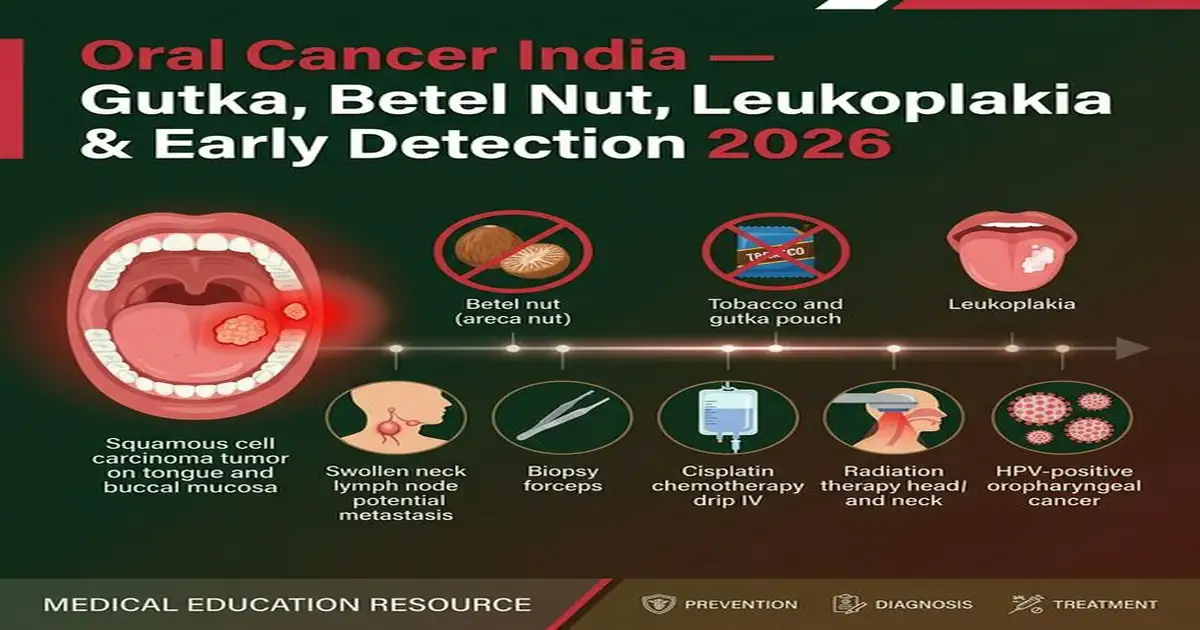
Oral Cancer — Pre-malignant Lesions, Staging and Treatment
| Condition / Stage | Description | India Significance | Action / Treatment |
|---|---|---|---|
| Leukoplakia (pre-malignant) | White patch on oral mucosa (buccal, tongue, floor of mouth, gingiva) that cannot be rubbed off and cannot be attributed to any other diagnosable disease; 2–18% risk of malignant transformation over 10 years; high-risk features: non-homogeneous (speckled, nodular, verrucous), erythroleukoplakia (red + white areas), large size (>2cm), floor of mouth or ventral tongue site, dysplasia on biopsy (mild/moderate/severe) | Extremely common in gutka/paan masala/khaini users; often dismissed as “normal white patch” by patient and primary care; India: community surveys show 5–10% of tobacco users have leukoplakia; the single most important teachable lesion India | Biopsy (mandatory — cannot distinguish from early cancer clinically); if dysplastic: excision (CO2 laser preferred) ± close surveillance; cessation of tobacco/areca nut (some lesions regress on cessation); vitamin A analogues (retinoids) — some regression; antioxidants (lycopene, beta-carotene): modest benefit India studies; regular 3–6 monthly surveillance |
| Oral Submucous Fibrosis (OSMF — pre-malignant) | Progressive fibrosis of oral submucosa → trismus (restricted mouth opening), stiffness and burning, blanching and stiffening of mucosa; caused predominantly by areca nut (betel nut/supari) alkaloids → collagen downregulation of fibrinolysis; 7–13% malignant transformation rate (higher than leukoplakia); OSMF grades: I (burning, no trismus); II (trismus ≥35mm); III (trismus ≤25mm — severe; may require surgical release) | OSMF is almost exclusively an Indian (and South and Southeast Asian) disease — driven by areca nut chewing habit; gutka = areca nut + tobacco + lime → maximum risk; estimated 5 million Indians with OSMF; predominantly young adults (15–35 years) — youngest oral cancer risk group; alarming cultural normalisation of gutka use among adolescents and university students | Cessation of areca nut (essential — OSMF may stop progressing; does not fully reverse); intralesional steroids (triamcinolone acetonide injections into buccal mucosa) — reduce fibrosis; pentoxifylline (anti-fibrotic agent); hyaluronidase; physiotherapy (mouth opening exercises); surgical release (fibrotomy) for Grade III — only if cessation guaranteed; regular biopsy surveillance for malignant transformation; lycopene supplementation (tomato-based — evidence from India RCT) |
| Erythroplakia (pre-malignant) | Velvety red patch on oral mucosa; frank dysplasia/carcinoma in situ in 80–90% (much higher malignant potential than leukoplakia); urgent biopsy essential; relatively rare vs leukoplakia but more sinister | Any red velvety patch in a tobacco/areca nut user’s mouth = urgent biopsy referral; erythroplakia on floor of mouth or lateral tongue = very high risk; should not be dismissed as “mucosal irritation” or “denture trauma” | Biopsy immediately; surgical excision if dysplasia confirmed; close surveillance; cessation |
| Oral SCC — Stage I–II (early) | Tumour ≤4cm; no regional lymph node involvement; no distant metastasis; T1–T2 N0 M0; 5-year survival: 70–90% | Only 30–40% of Indian oral cancers present at this stage; early Stage I–II = potentially curable with single-modality treatment; small T1 tumours of tongue/buccal mucosa: surgery alone or RT alone can achieve >80% 5-year survival | Surgery: wide local excision with clear margins (1cm margin minimum); selective neck dissection (ipsilateral Level I–III) for T2 (occult node mets 15–20% risk); RT alone: equivalent for very small selected T1 lesions; adjuvant RT if close/positive margins or pT2; no adjuvant chemotherapy for N0 |
| Oral SCC — Stage III–IV (advanced — majority of India) | T3–T4 tumour (>4cm or bone/muscle invasion) and/or regional lymph node metastasis (N1–N3); no distant mets; 5-year survival: 20–50% (Stage III) and <20% (Stage IVA/B) | The Indian epidemic: most oral SCC diagnosed here; requires multimodality treatment; surgery leaves extensive disfigurement (hemi-glossectomy, mandibulectomy, neck dissection ± free flap reconstruction); quality of life profoundly impact regarding eating, speaking, swallowing; radical RT ± cisplatin for unresectable/surgically unfit | Surgery: radical resection (composite resection of jaw + soft tissue) + pedicled/free flap reconstruction (pectoralis major, radial forearm free flap, ALT — anterolateral thigh free flap); post-op RT (60–66 Gy, 30–33 fractions); concurrent cisplatin (100mg/m² 3-weekly or 40mg/m² weekly) if extranodal extension or positive margins; IMRT (head and neck RT) to minimise xerostomia, parotid sparing; palliative: cisplatin + 5-FU + cetuximab (EXTREME protocol); nivolumab (pembrolizumab) for recurrent/metastatic: CHECKMATE 141 / KEYNOTE-048 |
| HPV-associated oropharyngeal cancer | Distinct from oral cavity SCC; site: tonsil, base of tongue, posterior pharynx; HPV-16 positive (p16 immunostaining); younger patients, non-smokers; better prognosis than HPV-negative oropharyngeal SCC | India: HPV oropharyngeal cancer far less common than tobacco-driven oral SCC (unlike USA/Europe where HPV drives most oropharyngeal SCC); India HPV vaccination (Cervavac — bivalent; Gardasil-9 — nine-valent) coverage expanding → may reduce HPV oropharyngeal cancer over coming decades; NATCO Pharma/Serum Institute HPV vaccines in national programme from 2023 | Surgery (TORS — transoral robotic surgery) or definitive chemoradiotherapy; de-escalation trials for low-risk HPV-positive disease |
Frequently Asked Questions
How dangerous are gutka, paan masala and khaini — what is the actual cancer risk?
The relationship between India’s smokeless tobacco/areca nut products and oral cancer is one of the most clearly established carcinogen-cancer relationships in oncology — yet public awareness remains inadequate and usage rates remain alarmingly high: The carcinogens in gutka and areca nut: Gutka = areca nut (betel nut/supari) + tobacco dust + slaked lime + catechu + flavouring agents; Each ingredient contributes distinct carcinogens: Tobacco: nitrosamines (TSNA — tobacco-specific N-nitrosamines: NNN, NNK) — IARC Group 1 carcinogens; directly alkylate DNA causing TP53 mutations (most common mutation in oral SCC); Areca nut: arecoline (main alkaloid) — IARC Group 1 human carcinogen; causes OSMF (submucous fibrosis — see above); drives epigenetic silencing and chromosomal instability in oral mucosa; upregulates TGF-β → fibrosis; Slaked lime (calcium hydroxide): raises pH → increases absorption of arecoline through oral mucosa; accelerates mucosal damage; Betel leaf (paan): eugenol, safrole — additional mucosal irritants; reactive oxygen species generating. Quantitative risk: Gutka use (combined tobacco + areca nut): OR for oral cancer 7–20× compared to non-users; daily gutka users: RR 10–25× for developing OSCC; areca nut alone (without tobacco): OR 3–5× for oral SCC (IARC Group 1 confirmed); years of use and daily frequency both increase risk; bidi smoking: OR 3–7× (IARC Group 1); cigarette smoking: OR 3–5× for oral cancer; alcohol (≥4 drinks/day): OR 3–9×; alcohol + tobacco: synergistic (multiplicative) risk increase = OR 30–100×; oral sex + HPV-16: predominantly oropharyngeal (tonsil/base of tongue) not oral cavity. India-specific staggering statistics: 275 million Indians use smokeless tobacco (every Indian knows multiple smokeless tobacco users); 200,000+ paan/gutka/mawa outlets nationwide; gutka banned under Food Safety Act in many states (Maharashtra, Delhi, Karnataka) but enforcement minimal and product smuggling rampant; ₹5 per pouch — highly accessible to all socioeconomic groups; nicotine addiction (tobacco in gutka) + areca nut addiction (arecoline — CNS stimulant, mild euphoria, appetite suppressant — explains betel nut use in non-tobacco containing products) → dual addiction barrier to cessation. Risk reduction with cessation: Even after years of gutka/tobacco use, cessation significantly reduces new cancer risk; OSMF stabilises and may partially improve after areca nut cessation; existing leukoplakia may partially regress; absolute cessation of areca nut (even betel leaf without tobacco) essential for OSMF risk reduction; nicotine replacement therapy (NRT — patches, gum, lozenge — available India: Nicotex gum ₹150–200/pack; Nicotine patch ₹300–500/week) addresses nicotine component; no pharmacological treatment targets areca nut addiction specifically — must be addressed through counselling and will.
What are the warning signs of oral cancer that Indians must know?
The majority of oral cancers in India are preceded by visible pre-malignant lesions for months to years before frank malignancy develops — making oral cancer uniquely amenable to early detection if people know what to look for: Warning signs that require immediate oral/maxillofacial surgery or ENT referral (do not wait >2 weeks): Any white patch (leukoplakia) or red patch (erythroplakia) in the mouth that does not resolve in 3 weeks; non-healing ulcer in the mouth (persistent ulcer >3 weeks = mandatory biopsy — do not treat symptomatically without histology); progressive difficulty/pain opening the mouth (trismus — OSMF or advanced cancer); lump or thickening in cheek, tongue, floor of mouth, lip; painless lump in neck (lymph node metastasis — painless neck node in a tobacco user = cancer until proven otherwise); numbness of the tongue or lower lip (inferior alveolar nerve involvement — advanced floor of mouth/mandible cancer); progressive difficulty swallowing (dysphagia — oropharyngeal/hypopharyngeal extension); unexplained tooth loosening without gum disease (mandibular bone invasion); hoarseness >3 weeks in a smoker (laryngeal cancer — related tobacco-related cancer). Critical India message — do NOT delay with home remedies or “it will go away”: The most common presentation pathway in India: gutka/khaini user notices white patch or ulcer → applies clove oil/turmeric locally (traditional remedies) → waits 3–6 months → lesion grows → progressively worsens → eventually seeks dental/ENT care → diagnosed Stage III or IV → major surgery + chemoradiotherapy → potentially preventable disfigurement; Early Stage I oral SCC = cure rates 80–90%; Late Stage IV = cure rates <20%; the difference between early and late presentation is 12–18 months of delay that costs cure. Self-examination for oral cancer awareness: India’s National Cancer Awareness Programme (awareness camps in states like Odisha, Bihar, UP, MP): visual examination of oral cavity by CHW (community health worker) with torch — can identify obvious leukoplakia/erythroplakia/ulcers; ASHA workers trained to conduct basic oral cancer visual inspections during home visits; Oral Potentially Malignant Disorder (OPMD) — refers to all pre-malignant conditions: leukoplakia, erythroplakia, OSMF, palatal changes in reverse smokers (chutta smokers), lichen planus (small malignant transformation risk), actinic cheilitis (lower lip — sun exposure).
What to Read Next
- Lung Cancer — Tobacco Smoking: OSCC + Lung Cancer + COPD Often Cluster in Bidi/Cigarette Smokers; Quit Now — Smoking Cessation Links
- Cancer Awareness India — OSCC, Cervical, Breast: Three Cancers Where Early Detection Changes Outcome — India’s Prevention Opportunity
- Cervical Cancer — Like OSCC, Cervical Cancer is a Preventable Cancer with Pre-Malignant Stage; HPV Vaccine + Colposcopy + Pap Smear
- Depression — Head and Neck Cancer Surgery Causes Profound Psychological Trauma (Disfigurement, Dysphagia, Communication Impairment); Integrate Psychological Support
- TB — TB Lymphadenopathy Commonly Confused with Neck Nodal Metastasis in India; Biopsy + Culture + FNAC Essential Distinction
A 35-year-old man in Varanasi has been chewing gutka since he was 19. At 32 he noticed difficulty opening his mouth. At 33 a dentist noted a white patch on his cheek. “Nothing to worry about,” he was told. At 34 he developed a painful ulcer. At 35, after another 6-month delay, he is diagnosed with stage IVA oral squamous cell carcinoma of the buccal mucosa with mandibular bone invasion and ipsilateral neck nodes. He will require a composite resection — removal of part of his jaw, cheek, and neck contents — followed by reconstruction, radiotherapy, and chemotherapy. He will never look the same. He may lose the ability to eat normally. He might not survive 5 years. He is 35 years old. His white patch at 33 was OSMF and early SCC. A biopsy and cessation at 33 might have saved his face and his life. The gutka pouch. ₹5. The destruction it causes is incalculable.
About This Guide: Written by the StudyHub Health Editorial Team (studyhub.net.in) based on NCCN Head and Neck Cancer Guidelines 2024, ESMO Head and Neck Cancer Guidelines 2021, Indian Journal of Cancer/ICMR data, and Oral Cancer Foundation of India recommendations. Last updated: March 2026.
🚨 Any Mouth Ulcer or White Patch Not Gone in 3 Weeks = See a Doctor Now: A mouth ulcer that doesn’t heal within 3 weeks in any person who uses tobacco, gutka, khaini, paan masala, or betel nut MUST be assessed by a dental surgeon or oral medicine specialist and a biopsy taken. Do not apply clove oil and wait. Every month of delay in Stage I can become Stage II. Every month in Stage II can become Stage III. Biopsy is the only way to diagnose oral cancer.
✅ Quitting Gutka/Tobacco Reduces Your Risk: Stopping gutka, paan masala, khaini, and betel nut — even after years of use — significantly reduces oral cancer risk. OSMF stabilises. Leukoplakia may regress. Use nicotine replacement therapy (Nicotex gum ₹150, nicotine patch ₹400/week) for the tobacco addiction. Call the NCoCP helpline: 1800-11-6666 (FREE quit tobacco counselling).
⚕️ Medical Disclaimer: This article provides general educational information about oral cancer. Diagnosis of oral pre-malignant lesions and oral SCC requires biopsy by qualified dental surgeon, oral/maxillofacial surgeon, or ENT specialist. Treatment of oral SCC requires multidisciplinary oncology team (surgical oncology, radiation oncology, medical oncology).