Last Updated: March 2026 | Reading Time: 8 minutes | ~1,900 words
Rabies remains one of the most terrifying and entirely preventable causes of death in India — a disease that is 100% fatal once symptoms develop, yet almost entirely preventable with correct post-exposure prophylaxis (PEP). India bears the world’s largest rabies burden: approximately 18,000–20,000 rabies deaths annually — representing nearly 36% of the global rabies death toll — despite the disease being entirely vaccine-preventable. Over 90% of India’s rabies deaths are caused by dog bites (Canis lupus familiaris — domestic dog), with the country estimated to have approximately 35 million stray dogs. India records approximately 17.4 million animal bite incidents per year, of which 96% are dog bites, and yet an estimated only 40–50% of bite victims complete the full PEP course, either due to lack of awareness, inaccessibility of PEP, or misconceptions (e.g., belief that a dog that is still alive after 10 days cannot have transmitted rabies — partly true but incomplete). The National Rabies Control Programme (NRCP) under NCDC/MoHFW has set a target of zero rabies deaths in India by 2030 (aligned with WHO Zero by 30 initiative), focusing on mass dog vaccination, improved PEP access, and community education. The critical public health message remains stark: every rabies death in India is preventable — it represents a failure of PEP access or completion.
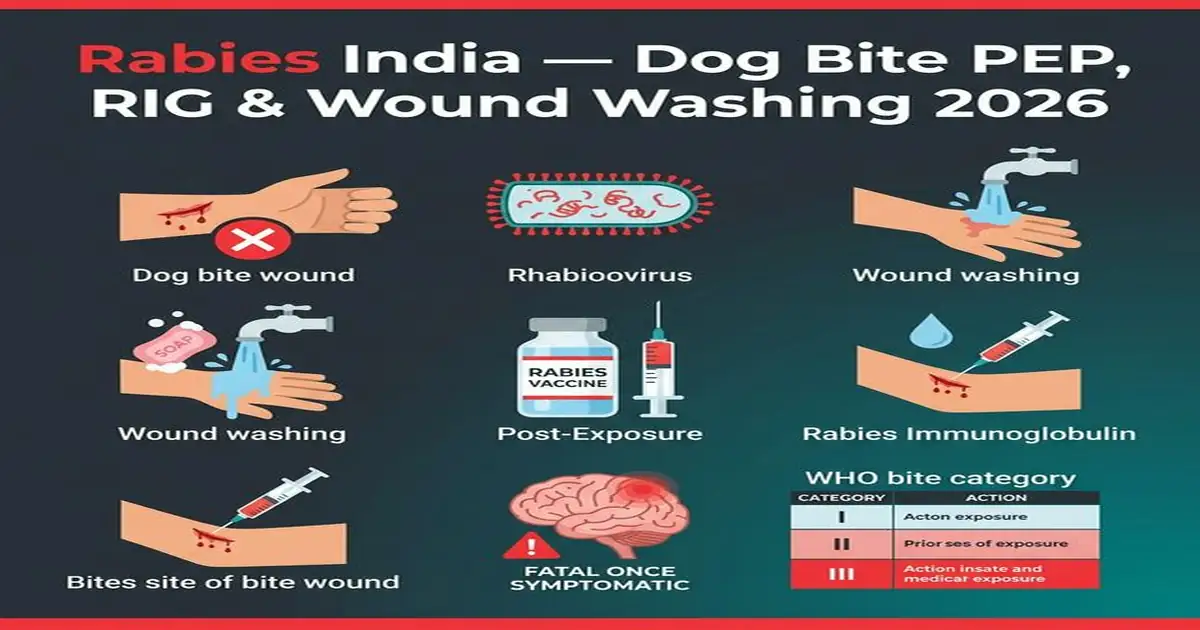
Rabies — WHO Bite Category, PEP Protocol and Management
| WHO Bite Category | Description | PEP Required? | Treatment Protocol India | India Notes |
|---|---|---|---|---|
| Category I — Touching / Feeding | Touching or feeding a rabid animal; licks on intact skin; animal bites through thick clothing without skin contact; no skin broken; no salivary contact with mucous membrane | NO PEP required; wash hands with soap and water if animal saliva contact on intact skin; observe animal if available | Wound wash with soap and water (even Cat I — precautionary); no vaccine; no RIG; reassure patient | Category I most commonly mismanaged in India — patients demand vaccine for lick on intact skin; conversely, Cat III wounds sometimes dismissed as “only a scratch” — the reverse error kills; physician must categorise correctly; intact skin is an absolute barrier to rabies virus |
| Category II — Minor Scratch / Superficial Bite | Nibbling of uncovered skin; minor scratches or abrasions without bleeding; licks on broken skin; single superficial scratch (no bleeding); superficial bite (skin broken but no visible bleeding) | YES — PEP vaccine required; RIG NOT required (Cat II) | Immediate wound management: wash wound with soap and water under running tap for minimum 15 minutes; apply povidone-iodine or 70% alcohol; DO NOT suture/close wound immediately (delays rabies virus local treatment); Rabies vaccine (PEP): Essen regimen (intramuscular — IM): 5 doses on days 0, 3, 7, 14, 28 (WHO standard); OR Updated Thai Red Cross Intradermal (TRC-ID) regimen: 2 sites × 0.1mL on days 0, 3, 7, 28 (more economical — same immunogenicity — NRCP India recommended); ABHL regimen: 2-2-2-0-1-1 or 2-site ID — increasingly adopted India (fewer clinic visits — 4 visits vs 5); vaccine types approved India: PCECV (purified chick embryo cell vaccine — Rabipur), PVRV (purified Vero cell rabies vaccine — Verorab, Abhayrab), HDCV (human diploid cell vaccine — expensive — rarely used); Animal observation: 10-day observation of offending dog (if alive and well at 10 days — reassuring but complete vaccine course anyway) | Category II patients most commonly under-treated in India: “it’s just a scratch” → no PEP → patient develops rabies; PEP vaccine India: free at government anti-rabies clinics (ARCs) at district hospitals; intradermal (ID) regimen much more economical than IM (uses ¼ dose per site) → reduces India cost significantly (₹1,000–1,500 vs ₹5,000–7,000 privately IM); ID regimen requires trained staff → government clinic preferred; all animal bites: vaccinate first, categorise exactly later |
| Category III — Severe Bite / Mucosal Exposure | Single or multiple transdermal bites or scratches (skin broken with bleeding); contamination of mucous membrane (eye, nose, mouth) with saliva; ANY bite on head, face, neck (highest risk — closest to brain); ANY bite on fingers/hands (high nerve density → fast CNS access); licks on broken skin; bat exposure (even without visible bite — aerosol exposure possible in confined spaces) | YES — PEP vaccine + RIG BOTH required (Cat III) | Wound management (same as Cat II — immediate intensive wash × 15 min + povidone-iodine); Rabies Immunoglobulin (RIG): Human RIG (HRIG — Berirab, Imogam Rabies): 20 IU/kg body weight; OR Equine RIG (ERIG — Abhayrig, Equirab): 40 IU/kg (horse-derived — cheaper but anaphylaxis risk →test dose first); ALL RIG must be infiltrated INTO and around the wound site (as much anatomically feasible) to provide immediate passive immunity; remaining RIG (if any — not infiltrated) given at distant IM site; RIG given ONLY on Day 0 of PEP (never give RIG after Day 7 — counterproductive — suppresses active immune response); Vaccine regimen: same as Cat II (5-dose IM or ID regimen); NO RIG if previously vaccinated (pre-exposure or completed PEP previously — 2-dose booster days 0+3 only); skin test for ERIG: ID 0.02mL, observe 30 min for wheal >10mm = positive → use HRIG or desensitise; if anaphylaxis to ERIG: adrenaline, antihistamine, ICU; bat exposure: always Cat III regardless of visible bite (asymptomatic bat contact) | RIG access: major India problem — HRIG extremely expensive (₹10,000–25,000/dose at private pharmacies — limits use); ERIG cheaper (₹2,000–5,000) but anaphylaxis risk and cold-chain requirements; NRCP: free ERIG at government hospitals but stock-outs common; HRIG increasingly available at medical college hospitals; India data: only 20–30% of Cat III wound patients receive correct RIG in addition to vaccine (78% receive vaccine but only 22% receive RIG at government facilities — NCDC survey); wound on face/neck = brain proximity = MUST get RIG + vaccine without delay → refer to ARC immediately if local clinic lacks RIG; rabies-purified monoclonal antibody (RabMAbs): newer alternative to RIG (Twinrab — Indian-manufactured by Bharat Biotech, cheaper, no anaphylaxis risk) — approved India 2023, increasingly available |
| Pre-Exposure Prophylaxis (PrEP) for Rabies | For high-risk individuals: veterinarians, animal handlers, wildlife workers, cave explorers, rabies laboratory workers, travellers to endemic areas for extended periods; 3-dose schedule: IM or ID on Days 0, 7, 21 or 28; check titre at 1–2 years: if <0.5 IU/mL → booster; offers partial protection — still requires vaccine booster (2 doses days 0+3) and wound management after exposure but NO RIG needed (simplifies Cat III to 2 doses + wound care) | PrEP reduces PEP complexity but does not eliminate need for wound management and vaccine booster after exposure | Pre-exposure: PCECV or PVRV 3-dose ID or IM; cheaper ID: 3 × 2-site ID; affordable at ₹1,500–2,500 per 3-dose course; booster after confirmed exposure: days 0 + 3 (vaccine only — 2 doses); no RIG required (prior primed immune system responds rapidly) | India PrEP: recommended for all veterinarians, animal control workers, rabies lab staff; rarely done in India outside professional context; India-specific: people who handle street dogs in rescue/TNVR programmes → should receive PrEP; pilgrims to Pashupatinath (Nepal), Varanasi ghats (stray dog-dense) — consider PrEP for extended visits |
| Clinical Rabies — Diagnosis and (Invariably Fatal) Management | Incubation: highly variable — 20 days to >1 year (average 1–3 months — depends on bite site distance to brain and viral load); shorter incubation: face/neck bites, finger bites in children; longer: leg bites, low-inoculum; Prodrome (2–10 days): fever, headache, malaise, paraesthesia/pain at bite site (pathognomonic — 50–80% patients develop local paraesthesia at healed bite site = rabies until proven otherwise); Encephalitic (furious) rabies (80%): hydrophobia (fear of water/swallowing — laryngeal/pharyngeal spasm on sight/sound of water — PATHOGNOMONIC); aerophobia (fear of air movement); agitation, hallucinations, autonomic dysfunction, hypersalivation; paralytic (dumb) rabies (20%): ascending flaccid paralysis (Landry’s ascending paralysis type); less dramatic; often misdiagnosed as GBS; Diagnosis (ante-mortem): saliva RT-PCR; nuchal skin biopsy RT-PCR (nape of neck — hair follicle nerve endings); CSF RT-PCR; DFA (direct fluorescent antibody staining of corneal impression or skin biopsy — requires live patient); Post-mortem: brain impression DFA (gold standard — 100% sensitive/specific); Negri bodies on histopathology (classic — eosinophilic intracytoplasmic inclusions in Purkinje cells/hippocampus) | Clinical rabies: 100% fatal (with rare exceptions — Milwaukee Protocol survivors); no proven treatment; supportive care (sedation, mechanical ventilation — prolongs survival by days/weeks but does not save life); Milwaukee Protocol (ketamine + antiviral cocktail + induced coma + barrier nursing): >40 attempts worldwide; 3 confirmed survivors; NOT recommended routinely (suffering prolonged with negligible cure chance); India management: palliative/comfort care; do NOT mechanically ventilate in terminal rabies (prolongs agony; no benefit); HRIG retrograde injection into established encephalitis: no benefit | India: approximately 20,000 rabies deaths per year — each preventable with PEP; cases most common in children (play with stray dogs); UP Bihar MP Rajasthan Tamil Nadu highest India burden; Children: shorter incubation, higher-risk bite sites, often underestimate wound severity/hide bite from parents → PARENTS must know: any dog bite in child = category immediately → wash + PEP + hospital; Hydrophobia: if any patient presents with hydrophobia/aerophobia + prior dog bite history → rabies encephalitis → PEP not indicated (futile); focus on comfort/palliative care notification to IDSP |
Frequently Asked Questions
What is the 10-day dog observation rule — and does it mean I don’t need PEP?
The 10-day dog observation rule is one of the most misunderstood and dangerously misapplied concepts in rabies management in India — causing many patients to delay or forego PEP with fatal consequences: What the 10-day rule actually means: A dog (or cat) that has bitten and is capable of transmitting rabies through its saliva can only be infectious (rabies virus present in saliva) during the final 10 days of its own life before it dies of rabies; this means: if the dog is alive and appearing well 10 days after the bite that it inflicted, it was NOT shedding rabies virus at the time of the bite → exposure likely non-infectious; if the dog dies during the 10-day observation period or shows signs of rabies (behaviour change, paralysis, aggression) → assume was infectious at time of bite → continue/complete PEP urgently. Critical misconceptions to correct in India: Misconception 1: “The dog is alive — I don’t need the vaccine” — WRONG: you must START PEP immediately on ANY Cat II/III bite; do not wait for the 10-day observation to start PEP; start PEP Day 0 and observe dog simultaneously; Misconception 2: “The dog bit 15 people and none of them got rabies — so this dog is fine” — WRONG: rabies virus is NOT present in saliva continuously — only in the terminal 10 days; an infected dog can bite non-infectiously many times before becoming infectious near death; Misconception 3: “The dog was vaccinated against rabies — so I don’t need PEP” — PARTIALLY WRONG: if dog is correctly and currently vaccinated (documented) → risk very low, but NOT zero; WHO still recommends PEP for Cat III bites even if animal vaccinated (India recommendation: always give PEP for Cat II/III regardless of animal vaccination status unless verified vaccination certificate from veterinarian within 1 year); Misconception 4: “It’s been 3 months — too late to give PEP” — WRONG: there is NO absolute contraindication to giving PEP at any time after exposure (even months later if no symptoms yet); PEP is still immunologically effective before symptoms develop, regardless of time elapsed; once clinical signs of rabies appear → PEP is futile; start PEP immediately on presentation regardless of time since bite. When to stop PEP (10-day rule application): If the biting animal (dog/cat): is alive and healthy 10 days after the bite → PEP can be discontinued after 3 doses (stopping after day 7 if all else satisfactory); was securely confined and observed by a qualified veterinarian for 10 days → same; is killed and brain sent to rabies lab → DFA negative → PEP can be stopped (though completing full course is preferred); died within 10 days or shows signs consistent with rabies → complete full PEP course + ensure RIG given; Practical India advice: Start PEP Day 0 (always); observe dog; if dog alive at day 10 → you can safely stop (after 3 doses minimum and clinical reassurance); if dog disappeared or dead → complete full course.
What first aid should be given immediately after a dog bite — and why is wound washing so critical?
The most important intervention after any animal bite — more important even than getting to a hospital — is immediate wound washing at the site of the bite. This is the one step that can be performed by anyone, anywhere, before any healthcare professional is accessed: Why wound washing is so critical — the virology: Rabies virus is a neurotropic virus that travels centripetally along peripheral nerve axons to the brain; it does NOT enter the bloodstream; once the virus has bound to nerve receptors (acetylcholine receptors at neuromuscular junctions, neuronal cell adhesion molecules) and begun axonal transport → PEP cannot neutralise it (it is sequestered within neurons — outside reach of antibodies); however: in the first minutes to hours after inoculation, the virus is still in the wound tissue, not yet bound to nerve receptors → physical removal of virus by washing in this window can prevent inoculation → can prevent rabies; every minute of wound washing = virus removed from wound before nerve receptor binding; this is why wound washing is simultaneously the simplest and most critical first aid action. Correct wound washing technique (mandatory India first-aid education): Step 1 (within minutes of bite): wash wound immediately under running water for at least 15 minutes; use soap (any soap — hand/dish/laundry) if available; soap denatures rabies virus lipid envelope → immediate virucidal; vigorous scrubbing with soap removes bound/unbound virus from wound surface; if soap unavailable: water alone — still effective at mechanical removal; Step 2: apply virucidal agent: povidone-iodine 5–10% (Betadine): most effective — directly inactivates virus; 70% ethyl/isopropyl alcohol: also effective; dilute iodine tincture; quaternary ammonium compounds (cetrimide — Savlon); do NOT apply: chilli, turmeric, oil, kerosene, traditional poultice — completely ineffective and may prevent effective wound assessment; Step 3: do NOT suture/close wound immediately: suturing concentrates virus at wound edges and prevents drainage; if closure essential (cosmetic/anatomical — face) delay 72 hours and give RIG first; Step 4: transport to anti-rabies clinic (ARC) immediately for PEP assessment; take note of: dog owner name/contact if domesticated; description of dog (colour, collar, aggression trigger); whether dog provoked; Step 5 (ARC): WHO bite categorisation → PEP decision → vaccine ± RIG → wound assessment + tetanus toxoid; What NOT to do — dangerous India traditional practices: Do NOT apply chilli/red pepper to wound (irritates, no virucidal effect); do NOT apply mustard oil, neem, garlic, herbal paste (no evidence; delays wound cleaning); do NOT cauterise wound with fire/hot iron (severe additional tissue injury; does not kill virus in nerves); do NOT consult faith healer or “dog bite specialist” before washing and PEP; do NOT rely on “mantra” or traditional treatment for rabies prevention — 100% fatal if untreated; do NOT wait to see if symptoms develop before getting PEP — by then it is too late.
What to Read Next
- Snakebite — Another India Zoonotic Emergency: No Traditional Treatment; Go to Hospital; ASV Not Tourniquets; 58K Deaths/Yr Preventable
- Leptospirosis — Rat (Not Dog) as Zoonotic Vector: Weil-Felix + IgM ELISA vs Rabies (Clinical); Both Preventable by Avoiding Animal Contact
- Child Health — Indian Children Most Vulnerable to Rabies: Face/Head Bites; Short Incubation; Parents Must Know Cat II/III Protocol Immediately
- Mental Health — Rabies Survivors (Milwaukee Protocol): PTSD + Neurological Sequelae; Caregiver Grief After Preventable Child Rabies Death
- Diabetes — Diabetic Patients Post-Dog Bite: Wound Infection Higher Risk; Oral Flora Pasteurella multocida → IV Amoxicillin-Clavulanate; PEP Same Protocol
A 7-year-old girl in a village in Bihar is bitten on the face by a stray dog while playing. Her family applies turmeric and chilli to the wound. The elder says: “Wait and see if the dog lives for 10 days.” The dog disappears on day 4. On day 21 she develops fever and headache. On day 25 she develops hydrophobia — screaming at the sight of water. She is brought to the district hospital. The physician recognises it immediately: rabies encephalitis. She dies on day 28. The dog bite → rabies virus → death: all in 28 days. The vaccine was free at the government ARC, 12km away. The wound wash with soap would have taken 15 minutes. Both steps were skipped. Twenty thousand times a year, this story repeats in India. Every single death is preventable.
About This Guide: Written by the StudyHub Health Editorial Team (studyhub.net.in) based on WHO Rabies Prevention Guidelines 2018, India National Rabies Control Programme (NRCP) 2020, NCDC India Rabies Annual Report 2023, and WHO Zero by 30 technical documents 2023. Last updated: March 2026.
🐕 Dog Bite? Act in This Exact Order: (1) WASH wound immediately with soap + running water for 15 FULL minutes. (2) Apply Betadine/iodine. (3) Go to nearest government Anti-Rabies Clinic (ARC) — free vaccine + RIG. (4) Do NOT wait to see if the dog lives. Do NOT apply traditional remedies. Do NOT consult a faith healer. Category II/III bites = PEP vaccine same day. Face/neck/hand bites + Cat III = PEP + RIG urgently. Rabies is 100% fatal once symptomatic. It is 100% preventable with PEP.
⚕️ Medical Disclaimer: This article provides general educational information about rabies post-exposure prophylaxis. All bite category assessment, RIG dosing, vaccine regimen selection, and management of clinical rabies require qualified healthcare provider assessment at an Anti-Rabies Clinic or government hospital. Call emergency services immediately for any suspected rabies encephalitis (hydrophobia/aerophobia).