Last Updated: March 2026 | Reading Time: 8 minutes | ~1,900 words
Attention Deficit Hyperactivity Disorder (ADHD) is the most common neurodevelopmental disorder in children — a biologically-based condition of executive function and self-regulation characterised by persistent, developmentally inappropriate levels of inattention, hyperactivity, and impulsivity that cause significant impairment across multiple settings (home, school, social). In India, ADHD prevalence is estimated at 5–11% of school-age children (6–18 years) — with an estimated 15–25 million children with ADHD in India, making it the most common reason for child psychiatry referral in urban India. Despite this, ADHD remains dramatically under-diagnosed and under-treated in India: many children are labelled “lazy,” “naughty,” “disruptive,” or “dull” by teachers and families rather than receiving appropriate evaluation and support. ADHD is NOT caused by poor parenting, too much screen time, or dietary sugar — it is a neurodevelopmental condition with strong genetic basis (heritability 70–80%) involving dopaminergic and noradrenergic dysregulation in the prefrontal cortex, anterior cingulate cortex, and basal ganglia. India’s challenges include: insufficient child psychiatrists (500 for 450 million children); significant teacher and parental stigma; lack of awareness that ADHD persists into adulthood (50–60% of childhood ADHD continues as adult ADHD — estimated 3–5% adult prevalence India); and the complexity of comorbidities (50–70% ADHD + another condition — ASD, learning disability, anxiety, conduct disorder). The RPWD Act 2016 includes “Specific Learning Disabilities” (which includes ADHD in its broad framing) — providing educational accommodations rights.
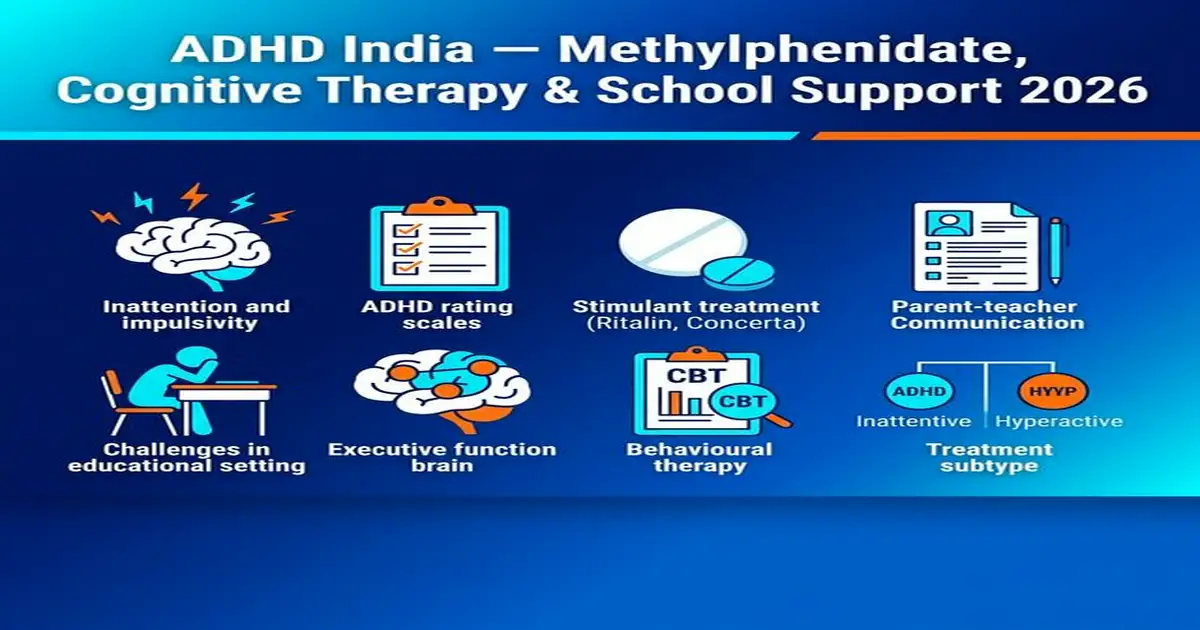
ADHD India — Types, Diagnosis, Medication and Behavioural Therapy
| Domain | Details | India Context |
|---|---|---|
| ADHD Subtypes & Core Symptoms (DSM-5-TR) | Three presentations (DSM-5-TR — replaces “subtypes”): ADHD — Predominantly Inattentive (ADHD-I): ≥6 inattention symptoms (≥5 in adults ≥17): overlooking details/careless mistakes; difficulty sustaining attention (tasks, play); seems not to listen when spoken to directly; doesn’t follow through on instructions; difficulty organising tasks; avoids tasks requiring sustained mental effort; loses things; easily distracted by extraneous stimuli; forgetful in daily activities; ADHD — Predominantly Hyperactive-Impulsive (ADHD-H): ≥6 hyperactivity-impulsivity symptoms: fidgets/squirms; leaves seat when expected to stay; runs/climbs in inappropriate situations; unable to play quietly; “on the go” as if driven by motor; talks excessively; blurts out answers before question completed; difficulty waiting turn; interrupts/intrudes on others; ADHD — Combined Presentation (ADHD-C): both ≥6 inattention + ≥6 hyperactive-impulsive symptoms; most common in young children; Additional criteria: symptoms in two+ settings (home AND school); onset before age 12; present ≥6 months; clinically significant impairment; not better explained by ASD, anxiety, mood disorder, substance use, other medical condition; Age-related presentation: hyperactivity diminishes with age in many adolescents (ADHD-I becomes more prominent in teens/adults); executive function deficits (working memory, planning, time management, emotional regulation) persist lifelong | India recognition gap: ADHD-H (hyperactive boys) more likely to be recognised (disruptive behaviour → teacher complaint); ADHD-I (inattentive girls — “daydreamers”) vastly under-recognised in India — girls with ADHD-I are quiet, not disruptive, sitting in last rows with failing grades, assumed “not intelligent enough”; India schools: teachers rarely distinguish ADHD from “laziness” or “mischief”; traditional Indian education system (rote learning, silent classrooms, long homework periods) particularly mismatched with ADHD brain — amplifies difficulties; “Class topper one year → poor grades suddenly” → ADHD should be considered when academic decline begins around class 5–6 (increased demand for sustained independent work); Adult ADHD India: extremely underdiagnosed — adults with undiagnosed ADHD present with: chronic job instability, relationship difficulties, financial mismanagement, road traffic accidents (ADHD 4× higher accident risk), substance abuse |
| Diagnosis of ADHD — Assessment Process | Clinical assessment (no single test diagnoses ADHD): history from parent + child + teacher (multimodal, multi-informant approach essential); Rating scales — parent: Conners’ Parent Rating Scale (CPRS-R); SNAP-IV (Swanson, Nolan and Pelham — validated India); Vanderbilt ADHD Rating Scale (free, widely used India); Rating scales — teacher: Conners’ Teacher Rating Scale (CTRS-R); SNAP-IV Teacher version; clinical interview: developmental history, family history (ADHD highly heritable — 70–80% heritability; parent with ADHD = 25–50% risk in child); school report (actual grade/marks trajectory + specific teacher observations essential); psychological testing (optional but helpful): cognitive assessment (IQ — WISC-5 India norms); continuous performance test (CPT — measures sustained attention/impulsivity objectively); academic achievement tests (detect learning disabilities); Exclusion of mimics: lead poisoning (serum lead — endemic in areas with leaded paint/utensils/industrial exposure — causes ADHD-like symptoms); thyroid disease (hyperthyroidism → irritability + inattention); sleep disorders (OSA — especially in obese children → daytime inattention); absence epilepsy (staring spells — EEG); anxiety disorder (restlessness + inattention); mood disorders (bipolar mania in adolescents — important to distinguish); ASD (ADHD + ASD co-occur 50–70%) | India diagnostic process: formal ADHD assessment available at: NIMHANS Bangalore (child psychiatry — free/subsidised); AIIMS Delhi child psychiatry; SCARF Chennai; LH Hiranandani mental health unit; Child psychiatrists in tier-2 cities (limited but growing); cost: government — virtually free; private child psychiatry consultation: ₹2,000–5,000/session; SNAP-IV India validated Hindi version: freely downloadable; India challenge: no neuropsychological testing labs in most cities — WISC-5 available at clinical psychology departments of medical colleges; school reports: Indian teachers often unwilling to complete rating scales (extra work); parent-teacher meeting critical — must involve both; lead testing: serum lead levels in urban children (living near paintings, toys, utensils — India specific) should be checked in any ADHD evaluation particularly if IQ concerns (lead ≥5 µg/dL = elevated — aggressive chelation debate) |
| Pharmacological Treatment — Stimulants & Non-Stimulants | First-line: Methylphenidate (MPH): most evidence-based ADHD medication worldwide; mechanism: dopamine + norepinephrine reuptake inhibitor → increases synaptic DA/NE in prefrontal cortex; immediate-release (IR): Ritalin, Inspiral — 4–6 hour duration → 2–3 doses/day (morning + lunch); extended-release (ER/LA): Concerta, Metadate CD, Ritalin LA — 8–12 hours → once daily morning dose (better adherence, no school-dose stigma); dose: 0.3–1.0 mg/kg/day titrated; typical: 5mg BD initially → titrate to response (max 60mg/day child, 80mg/day adult); efficacy: large meta-analytical effect size (ES 0.9–1.1) for core ADHD symptoms; 70–80% response rate; monitoring: appetite suppression (weigh monthly — if growth faltering → drug holiday), insomnia (give no later than 3pm for IR), heart rate + BP (monthly initially); Non-stimulants: Atomoxetine (ATX): NE reuptake inhibitor; 2nd line (lower efficacy than MPH but no abuse potential — preferred if substance abuse risk/tic disorder/anxiety prominent); 1.2 mg/kg/day; 4–6 week onset; Clonidine/Guanfacine: alpha-2 agonists; for ADHD + tic, ADHD + aggression, sleep; Drug holidays: summer school break drug holiday reduces appetite suppression + growth catch-up; not necessary for all but helpful when growth faltering; NOT appropriate during exam periods | India methylphenidate status: Schedule X controlled substance (psychotropic under NDPS Act 1985) — requires special Schedule X prescription; prescription pad with serial number; restrictions: 30-day supply maximum per prescription; cannot be purchased without valid Schedule X prescription; significant over-regulation in India → many child psychiatrists reluctant to prescribe → ADHD pharmacotherapy severely under-utilised; India availability: generic methylphenidate: Inspiral IR (Intas Pharma), Ritalin IR (Novartis) — 10mg tabs ₹30–60/tab; Concerta ER: ₹120–200/tab (once daily — most practical for school-age); Atomoxetine generic (Attentrol — Sun Pharma, Strattera — Lilly): 10–80mg capsules ₹50–150/cap; daily cost: ₹100–300 for methylphenidate; parental concerns India: “my child will become addicted” → educate: stimulant ADHD treatment REDUCES substance abuse risk by 45% (Wilens 2003 meta-analysis) — unmedicated ADHD higher risk; “it will change his personality” → correct dose = improved function, not flat affect; correct dosing is liberating, not suppressive |
| Behavioural Therapy, Parent Training & School Accommodations | Behavioural therapy (evidence-based — ESPECIALLY for ages <6 and adjunct to medication at all ages): Parent Management Training (PMT): evidence-based — teaches parents to use positive reinforcement, clear limit-setting, consistent consequences; reduces ADHD symptoms + oppositional behaviour; Incredible Years Programme; Triple P (Positive Parenting Programme); Cognitive Behavioural Therapy (CBT): for adolescent/adult ADHD — executive function coaching, time management, organisational skills, emotional regulation; Neurofeedback (EEG biofeedback): some evidence for ADHD — trains children to produce beta brainwaves; 30–40 sessions; evidence weaker than medication + PMT; Mindfulness-based interventions: growing evidence for attentional regulation; Teacher-based interventions (school accommodations): preferential seating (front row, near teacher); reduced distraction environment; frequent movement breaks (5 min every 30 min); chunked assignments (not 20 problems at once — 5+5+5+5); extended time on tests (25–50% more); oral testing option; no penalty for messy handwriting (motor control issue in ADHD); regular positive feedback (not just corrective); daily report card (home-school behaviour chart) | India parent training availability: NIMHANS Bangalore: PMT groups (free — Hindi, Kannada); SCARF Chennai: parent groups; Ummeed Mumbai: ADHD workshops; most tier-2 cities: no structured parent training — individual CBT/supportive counselling; school accommodations India: government schools: Samagra Shiksha provides resource teachers — but ADHD specifically under-recognised vs physical disability; private schools: CBSE accommodations available with disability certificate — but most families unaware; IIT-JEE/NEET ADHD accommodations: available with medical certificate — time extension (40 min per 3-hour exam); separate room with fewer distractions; this requires documented disability certificate + medical letter from psychiatrist; many high-achieving ADHD students miss this accommodation → significantly disadvantaged in competitive exams; ADHD coaching: emerging field in India — executive function coaches helping college/adult ADHD; available in Mumbai, Bangalore, Delhi |
| Adult ADHD India — The Hidden Epidemic | Adult ADHD: ~50–60% of childhood ADHD persists into adulthood; adult presentation evolves: hyperactivity → inner restlessness (less overt running/climbing); inattention + executive dysfunction persist and worsen as life demands increase; adult ADHD impacts: academic failure (college dropout — inability to complete long assignments, time-bind); occupational: job-hopping, frequent firings, difficulty meeting deadlines, procrastination, impulsive career decisions; financial: overspending, impulse purchases, difficulty managing bills on time; relationship: forgetting partner’s important events, emotional dysregulation (ADHD anger — “ADHD rage” — quick to frustrate, quick to forget); road safety: ADHD → 4× higher motor vehicle accident rate (inattentive driving, impulsive lane changes, distracted by phone); substance abuse: 2–3× higher alcohol/drug use in undiagnosed adult ADHD (self-medicating executive dysfunction); sleep: ADHD-associated delayed sleep phase (nights owl — cannot fall asleep early → late mornings → chronic tardiness); Diagnosis in adults: Conners’ Adult ADHD Rating Scale (CAARS); DIVA interview (Diagnostic Interview for ADHD in Adults); retrospective childhood symptom confirmation (from parent or old school records if available | India adult ADHD: virtually entirely unrecognised; no adult ADHD clinics outside NIMHANS, AIIMS; most psychiatrists in India have limited adult ADHD training; adult ADHD patients commonly misdiagnosed as: bipolar disorder (emotional lability confused with mood cycling); anxiety disorder (ADHD hyperarousal + worry); depression (low motivation, academic failure consequences); personality disorder (impulsivity + relationships); treatment for adult ADHD India: methylphenidate ER (Concerta 18–54mg once daily) — same Schedule X prescription hurdles; atomoxetine (Attentrol 40–80mg) — easier to prescribe (Schedule H — NOT Schedule X like methylphenidate — important India difference); CBT for adults: very effective for time management, EF coaching; online resources: Understood.org India section; Rehabcounsel India; CHADD equivalent India: not yet established — advocacy gap |
Frequently Asked Questions
Does methylphenidate (Ritalin) cause addiction — and is it safe for my child?
The fear that methylphenidate will cause addiction is the single most common reason Indian parents resist ADHD pharmacotherapy — and it is based on a profound misunderstanding of both ADHD neuroscience and the pharmacology of stimulant medications: The neuroscience of ADHD and why stimulants help: ADHD involves hypofunctioning of the prefrontal cortex — the brain’s “CEO” — due to insufficient dopamine and norepinephrine signalling; methylphenidate blocks dopamine and norepinephrine reuptake transporters → increases synaptic DA/NE → normalises PFC function → improves sustained attention, working memory, impulse control; the effect is targeted — methylphenidate improves ADHD symptoms at doses that produce minimal euphoria (unlike recreational stimulant abuse which uses 10–100× clinical doses intranasally/IV); the ADHD brain responds to methylphenidate therapeutically — the non-ADHD brain responds euphorigenic ally at higher doses; this is the key distinction. What the evidence on addiction risk actually shows: Wilens 2003 meta-analysis (4 RCTs, 674 ADHD patients): stimulant-treated ADHD patients had 1.9× LOWER lifetime risk of substance use disorder compared to untreated ADHD; explanation: unmedicated ADHD → impulsivity + risk-taking + poor decision-making → self-medication with alcohol, cannabis, nicotine; medicated ADHD → improved self-regulation → better decision-making → LESS substance experimentation; diversion risk: methylphenidate misuse by non-ADHD individuals does occur (stimulant misuse documented in Indian medical/engineering colleges for “study drugs”) — this is a public health problem, but it is unrelated to appropriate therapeutic use in an ADHD-diagnosed child; physical dependence: methylphenidate does NOT cause physical dependence at therapeutic doses — stopping does not cause withdrawal syndrome; psychological habituation: rare at therapeutic doses; Schedule X status India — rationale: prevents non-medical diversion and abuse; does NOT mean the drug is dangerous for children with ADHD when prescribed by a qualified child psychiatrist. Safety monitoring for methylphenidate in children — India practical: Appetite: most common side effect — reduced appetite, particularly at lunch; usually improves after first 4–6 weeks; child should eat substantial breakfast before morning dose; growth monitoring: height/weight monthly; if growth velocity <5th percentile → consider drug holiday in summer, dose reduction, or switch to atomoxetine; Cardiovascular: stimulants increase heart rate (average +5 bpm) and BP (average +2–4 mmHg) — clinically insignificant in healthy children; contraindicated with structural heart disease, cardiomyopathy, arrhythmia, family history sudden cardiac death (ECG + cardiology review before starting if any concern); Sleep: insomnia if given too late in the day (IR: give before 3pm; ER: give before noon); Tics: methylphenidate can unmask/worsen tics in predisposed individuals → switch to atomoxetine if tics appear; Mood: some children develop irritability/weeping as dose wears off (rebound effect) → switch to ER formulation; WHEN TO STOP: if child has BOTH ASD + ADHD + severe aggression → risperidone preferred over MPH; if growth severely impaired → drug holiday; WHEN NOT TO STOP: exam period, important academic year (class 10, 12) — this is worst time for drug holidays.
How should parents and teachers in India approach a child with ADHD at home and in school?
ADHD management in India lives or dies on the home and school environment — medication alone without environmental modifications produces significantly inferior outcomes compared to combined treatment: At home — parent-child strategies: Routine and structure: ADHD brains underperform in unpredictable environments; create a consistent daily schedule (visual schedule on whiteboard — morning checklist, homework time, dinner, screen time, bed); consistency across ALL caregivers critical (domestic help, grandparents, parents must all follow same rules); rewards and consequences: immediate (10-minute) small rewards rather than end-of-week big rewards (ADHD time blindness → delayed rewards not motivating); specific, concrete, achievable targets (“Sit at desk and complete 5 maths problems” not “Do your homework”); sticker chart for young children; screen time management: ADHD + screens = high addiction vulnerability (dopamine-seeking behaviour + short-reward-cycle of games/apps); strict screen limits (not as punishment but as neurobiological need); homework: break into 20-minute sessions with 5-minute movement breaks (Pomodoro technique); sit facing away from window (reduce distractions); use fidget tool if helps focus; do NOT withhold sports/physical activity as punishment for homework non-completion — exercise IS ADHD treatment (30 min aerobic exercise → +5 IQ points in ADHD children, multiple RCTs); Communication: use child’s name before any instruction (“Raju — I need you to put your shoes on”); give ONE instruction at a time; visual instructions preferred over verbal lists; emotional regulation: ADHD children have MORE emotional reactivity (frustration → rage faster than peers) — this is neurological NOT deliberate; calm, matter-of-fact response from parent (avoid shouting → ADHD child’s stress axis is already dysregulated → shouting → freeze/shutdown/flight); At school — teacher strategies: Classroom placement: front row, away from window and door; near teacher for proximity prompts; near peers who model good behaviour; task modifications: reduce volume (10 problems not 30) with same content; allow movement (stand at desk, answer orally if needed); paired with a “study buddy” for class assignments; assessment accommodation: extra time consistently (!); oral exam option for children who know material but struggle to produce it in writing; no marks deduction for messy handwriting (dysgraphia frequent comorbid); What NOT to do — India schools: do NOT shame ADHD child publicly (“You are so stupid,” “Always disturbing,” “Go stand outside” — profoundly harmful); do NOT take away recess as punishment (movement essential); do NOT sit in last row (perceived as problem child — isolation worsens outcomes); do NOT call child “dull/slow” — ADHD children often have ABOVE-AVERAGE intelligence with specific executive function weakness; parent-teacher communication: monthly meeting review; teacher completes Vanderbilt teacher form to monitor treatment response; teacher email/app updates on homework completion; India resource: ADHD Society of India (adhdindia.org) — parent and teacher workshops, resources in Hindi/regional languages.
What to Read Next
- Autism — ADHD + ASD Co-occur 50-70%; Both Need Separate Assessment; ABA Therapy for ASD + Methylphenidate for ADHD Comorbidity; M-CHAT-R for ASD Screening
- Anxiety — ADHD + Anxiety Comorbidity: Methylphenidate Can Worsen Anxiety; Atomoxetine + SSRI Combination; CBT Addresses Both
- Depression — Adult Undiagnosed ADHD + Depression: Chronic Failure + Shame → Secondary Depression; Stimulant Treatment Resolves ADHD-Driven Depression
- Sleep — ADHD Delayed Sleep Phase: Melatonin 0.5-3mg 2h Before Sleep; No Screens 1h Bed; ER Stimulant Given Too Late = Insomnia; Clonidine for ADHD Sleep
- Obesity — ADHD + Obesity Link: Impulsive Eating + Reward-Seeking + Screen Sedentary Behaviour; Stimulant Reduces Appetite Short-Term; Exercise Dual-Action
A 10-year-old boy from Pune — top-5 in class through class 4 — is now failing class 6. His teacher calls him lazy. His father assumes he is too distracted by phone. His mother says: “Even as a toddler he never sat still, never waited his turn.” His paediatrician administers Vanderbilt scales: parent score 18/27; teacher score 21/27. Child psychiatry referral: confirmed ADHD Combined (with co-morbid reading difficulty). Methylphenidate ER 18mg started. Teacher notified. Front-row seat given. Extended exam time arranged. At 3-month review: grades improved from 42% to 67%. Father: “This is not the same child — or rather, this IS the child I knew in class 3. He got himself back.” The child: “I can finally hear what the teacher is saying without my mind going somewhere else.” ADHD is not a character flaw. It is a brain that needs the right environment and, sometimes, the right medication.
About This Guide: Written by the StudyHub Health Editorial Team (studyhub.net.in) based on DSM-5-TR (APA 2022), NICE ADHD Guidelines UK (2023), NIMHANS Clinical Guidelines ADHD India (2019), AAP ADHD Practice Guidelines (2019), and Indian Psychiatric Society position papers on ADHD. Last updated: March 2026.
📋 Think Your Child Has ADHD? Do These Steps: (1) Ask your paediatrician to use the Vanderbilt or SNAP-IV rating scale. (2) Get teacher input — ask school to complete teacher rating form. (3) Referral to child psychiatrist for formal assessment (free at NIMHANS, AIIMS, DEIC). (4) After diagnosis: discuss combined treatment (medication + parent training + school accommodations). (5) Request CBSE disability accommodation if Class 10/12 with certified diagnosis — extended time in exams. Early diagnosis = early support = better outcomes.
💊 Methylphenidate Does NOT Cause Addiction: Stimulant treatment of ADHD REDUCES substance abuse risk by 50% (Wilens 2003). Methylphenidate at therapeutic doses does not produce euphoria or physical dependence. Schedule X status is to prevent non-medical diversion — not because the drug is unsafe for ADHD patients under medical supervision. When prescribed correctly by a child psychiatrist, methylphenidate is one of the most effective and safest medicines in child psychiatry.
⚕️ Medical Disclaimer: This article provides general educational information about ADHD. All diagnosis, medication prescribing (methylphenidate Schedule X), and behavioural therapy planning require qualified child psychiatrist or developmental paediatrician assessment. ADHD management is individualised — dosing and monitoring must be supervised by a specialist.