Last Updated: March 2026 | Reading Time: 9 minutes | ~2,000 words
Autism Spectrum Disorder (ASD) is a complex, lifelong neurodevelopmental condition characterised by two core domains of difference: (1) persistent difficulties in social communication and social interaction, and (2) restricted, repetitive patterns of behaviour, interests, or activities — present from early developmental period, causing significant functional impact across settings. The term “spectrum” reflects the enormous heterogeneity in ASD — from highly verbal, intellectually gifted individuals to those with significant intellectual disability and limited verbal communication — all sharing the same neurodevelopmental profile. In India, the estimated prevalence of ASD is approximately 1 in 100 children (1%) — with an estimated 10–18 million individuals with ASD in India (though diagnosis rates are dramatically lower — <1 million currently diagnosed). India faces a three-layered ASD crisis: (1) awareness: most parents and primary care physicians do not recognise early ASD signs; (2) access: child psychiatrists and developmental paediatricians are catastrophically undersupplied (approximately 500 child psychiatrists for 450 million children); (3) acceptance: significant stigma — particularly in rural India — prevents families from seeking or accepting the diagnosis. The Persons with Disabilities (Rights) Act 2016 (RPWD Act) includes ASD as a listed disability — guaranteeing rights to education, employment, and welfare support. The National Mental Health Policy 2014 and the National Action Plan for Autism (NAPA) have identified early identification and intervention as the primary national priority. The critical evidence is clear: early intervention (before age 3–4) dramatically improves long-term outcomes — every month of access to appropriate therapy in early childhood translates to measurable gains in communication, adaptive behaviour, and quality of life.
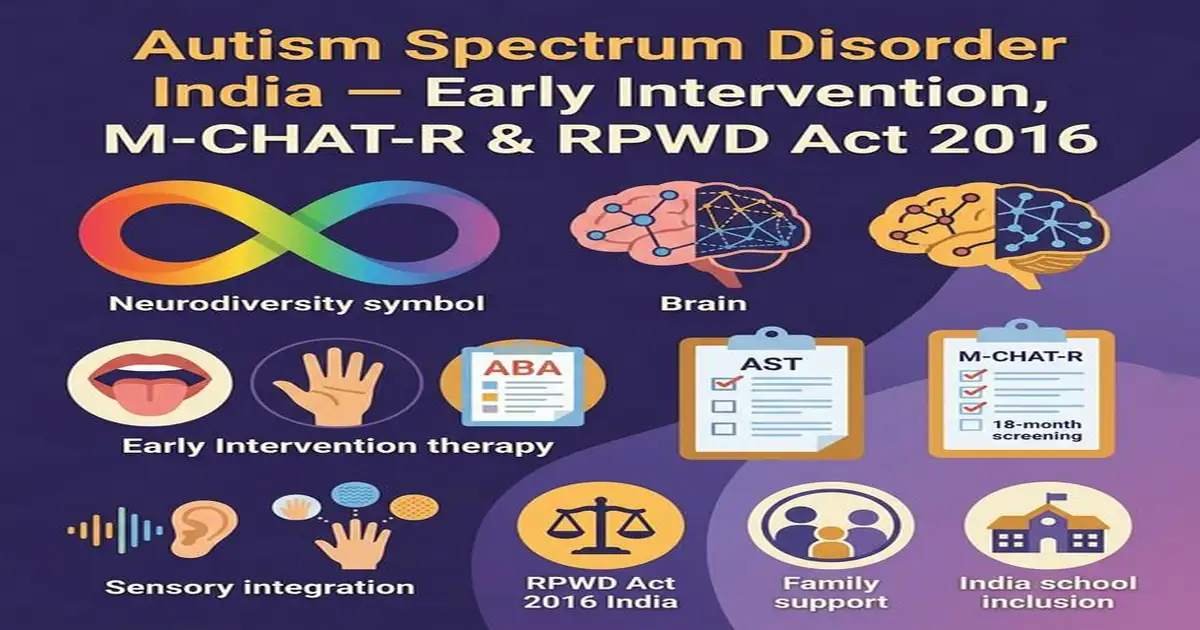
ASD India — Signs, Screening, Diagnosis and Intervention
| Domain | Details | India Context |
|---|---|---|
| Early Signs of ASD — Red Flags (6–24 Months) | Social communication red flags (any age): No social smile by 2 months; no babbling by 12 months; no single words by 16 months; no two-word phrases by 24 months; ANY loss of previously acquired language or social skills at any age (regression — most alarming sign); Specific early ASD signs (6–18 months): not responding to own name when called (consistently); reduced eye contact (not making eye contact with caregiver during play/interaction); not pointing to share interest (proto-declarative pointing — e.g., pointing at aeroplane to share attention — typically develops 12–14 months); not waving bye-bye; reduced imitation (not copying clapping, peekaboo, facial expressions); reduced joint attention (not following caregiver’s gaze/point); preference for objects over people; lining up toys/objects repeatedly; unusual hand/finger movements; 18–36 months red flags: echolalia (repeating words/phrases without communicative intent — “scripting”); pronoun reversal (“you want water” instead of “I want water”); limited pretend play; intense interests in specific topics (e.g., fans, wheels, trains — specific objects); hyperreactivity to sensory input (covering ears to ordinary sounds, distress at certain textures/foods, unusual pain threshold — sometimes very high — child may not cry after an injury); hypo-reactivity to sensory input (seeking sensory stimulation — body spinning, hand flapping, seeking deep pressure) | India red flag recognition: most Indian parents and grandparents interpret speech delay as “he’s a boy — boys talk late” or “grandfather also talked late” — delaying help-seeking by 1–3 years; critical India message: speech delay in a child WHO ALSO does not respond to name, does not point, does not make eye contact = autism red flag; this combination is NOT normal “late talking” — it requires immediate evaluation; language regression at any age (child who was saying 20 words then stopped by 18 months) = EMERGENCY referral to developmental paediatrician or child psychiatrist; cultural barrier India: eye contact norms vary — some Indian families consider constant eye contact disrespectful — distinguish culturally appropriate eye contact reduction from ASD-associated eye contact avoidance (ASD: reduced even with parents, not primarily with strangers/authority) |
| Screening Tools — M-CHAT-R/F | Modified Checklist for Autism in Toddlers, Revised with Follow-Up (M-CHAT-R/F): gold-standard ASD screening tool for 16–30 month old children; validated in India (Tamil Nadu, Maharashtra studies); 20 yes/no questions answered by parent (takes 5 minutes); administered by paediatrician/family physician at 18-month and 24-month well-child visits; M-CHAT-R scoring: Low risk (0–2): routine surveillance; Medium risk (3–7): conduct follow-up interview (F) — 9 critical items — if still medium/high risk → refer; High risk (8–20): immediate referral to developmental paediatrician / child psychiatrist; M-CHAT-R India: available in Hindi, Tamil, Telugu, Marathi, Kannada, Bengali, Gujarati (validated translations); free download from M-CHAT website (mchatscreen.com); Indian Academy of Paediatrics (IAP) recommends M-CHAT-R at every well-child visit 18–30 months; INDT-ASD (Indian Scale for Assessment of Autism): Indian-developed tool; ISAA (Indian Scale for Assessment of Autism) — also used for severity classification; Other screening: CARS-2 (Childhood Autism Rating Scale — 2nd edition); ADOS-2 (Autism Diagnostic Observation Schedule — gold standard for formal diagnosis — available at NIMHANS, AIIMS, major centres) | India screening gap: M-CHAT-R is NOT routinely administered at most Indian well-child visits (vs USA: mandatory at 18+24 months per AAP since 2006); most Indian paediatricians rely on clinical impression rather than validated screening tools; solution: IAP has strongly recommended M-CHAT-R implementation in all paediatric practices since 2022 — compliance gradually improving in urban areas; rural India: ASHA worker-administered developmental surveillance (RBSK — Rashtriya Bal Swasthya Karyakram): all children 0–18 years screened for 4D defects (defects at birth, diseases, deficiencies, developmental delays) — ASD flagging via simple 19-item tool at Anganwadi → referral to District Early Intervention Centre (DEIC); DEICs: established at every district hospital under RBSK — provide free developmental evaluation, early intervention |
| Formal ASD Diagnosis | Diagnosis is clinical — based on DSM-5-TR (2022) or ICD-11 (2019) criteria; no blood test / brain scan / genetic test diagnoses ASD (though genetic testing may identify aetiology in some cases); DSM-5-TR criteria: Domain A (social communication/interaction — all 3 required): deficits in social-emotional reciprocity; deficits in nonverbal communicative behaviours; deficits in developing, maintaining relationships; Domain B (restricted/repetitive behaviours — ≥2 of 4): stereotyped motor/speech mannerisms; insistence on sameness, routines, rituals; highly restricted, fixated interests; hyper/hyporeactivity to sensory input; symptoms present from early developmental period (may be masked in later childhood); cause clinically significant impairment; not better explained by intellectual disability or global developmental delay alone; Severity levels (DSM-5): Level 1 (requiring support); Level 2 (requiring substantial support); Level 3 (requiring very substantial support); Assessment at diagnostic centre: ADOS-2 (gold standard observational assessment); ADI-R (Autism Diagnostic Interview-Revised — parent interview); cognitive assessment (IQ — WISC-V, Bayley-4 for younger); adaptive behaviour (Vineland-3, VABS); speech-language evaluation; occupational therapy sensory assessment; Associated conditions (comorbidities — very common): intellectual disability (30–50% of ASD); ADHD (50–70% overlap); epilepsy (20–30%); anxiety disorders; GI problems (constipation, diarrhoea — GI-brain axis); sleep disorders (insomnia — 60–80%); genetic syndromes (Fragile X, Rett syndrome, 16p11.2 deletion, PTEN mutation — genetic testing with chromosomal microarray + clinical exome in complex cases) | India diagnosis gap: most families wait 3 years between first parental concern and formal diagnosis; average age of ASD diagnosis in India: 3.5–5 years (vs 2–3 years in developed countries); contributing factors: fewer child psychiatrists (1 per 900,000 children vs 1 per 80,000 USA); stigma prevents families from seeking diagnosis; misdiagnosis common (“speech delay only,” “hearing problem,” “slow learner — will catch up”); genetic testing: chromosomal microarray (CMA) — recommended for all ASD patients — identifies causative genetic abnormality in 10–20% of ASD; CMA available at AIIMS, CMC Vellore, 4basecare Bangalore (~₹15,000–25,000); whole exome sequencing (WES): for complex ASD with multiple anomalies — ₹25,000–50,000; India ADOS-2 trained professionals: limited — NIMHANS Bangalore, AIIMS Delhi, TISS Mumbai, CMR-NIAM Hyderabad |
| Intervention — Early, Intensive & Evidence-Based | Early intensive behavioural intervention (EIBI) / ABA (Applied Behaviour Analysis): most evidence-based intervention (25+ years RCT data); Lovaas method: 40 hours/week intensive ABA (age 2–5); EIBI meta-analyses: significant gains in IQ, language, adaptive behaviour; modern ABA: naturalistic developmental behavioural interventions (NDBIs) — PRT (Pivotal Response Treatment), JASPER, ESDM (Early Start Denver Model — from age 12 months); ESDM: play-based joint activity routines; delivered by parents (parent-mediated) + therapist; particularly suited for low-resource settings; pivotal targets: joint attention, social motivation, imitation; Speech and Language Therapy (SLT): core — addresses verbal language, AAC (Augmentative and Alternative Communication — PECS, speech-generating devices, sign language) for non-verbal ASD; Occupational Therapy (OT) + Sensory Integration: addresses sensory processing differences, fine motor skills, daily living; TEACCH (Treatment and Education of Autistic and related Communication Handicapped Children): structured teaching using physical and visual structure; very effective in school-age ASD; Social skills training: for Level 1 ASD with insight; peer-mediated interventions; Medications: NO medication treats core ASD features; medications for comorbidities only: Risperidone (0.5–3 mg/day) — FDA-approved for ASD-associated irritability, self-injurious behaviour, aggression; Aripiprazole — same; Melatonin (1–5mg at bedtime) — for sleep disorder (very common in India); SSRIs (fluoxetine, sertraline) for co-occurring OCD/anxiety in older ASD; Methylphenidate/atomoxetine for co-occurring ADHD; AVOID: secretin injections, chelation therapy, hyperbaric oxygen — NO evidence, potential harm | India intervention access crisis: structured ABA therapy centres: concentrated in urban metro (Mumbai, Delhi, Bangalore, Chennai, Hyderabad — 300+ ABA centres in these cities); rural India: virtually zero ABA-trained therapists; government intervention: DEIC at district hospitals — provides free speech therapy, OT, special education; quality varies widely; parent-mediated intervention (PMI): most scalable India solution — train parents to deliver ESDM/PRT techniques at home with therapist supervision (fortnightly/monthly); NIMHANS Bangalore: NIMHANS training centre for ASD — trains therapists across India; Tamana: NGO in Delhi delivering ABA for low-income families; govt special schools (under RPWD Act): every district to have at least one special residential school for ASD/intellectual disability children; implementation patchy; cost of private therapy India: ABA therapy ₹3,000–8,000/month (group sessions); private one-to-one: ₹10,000–30,000/month; speech therapy: ₹500–1,500/session |
| RPWD Act 2016 — Rights, Entitlements & Certification | Persons with Disabilities (Rights) Act 2016: landmark legislation replacing outdated PWD Act 1995; lists ASD as one of 21 recognised disabilities; Rights guaranteed: free education in inclusive setting or special school up to age 18; ≥4% reservation in government jobs (total across all disabilities — ASD eligible); ≥5% reservation in government housing schemes; disability certificate: mandatory for accessing benefits (issued by Chief Medical Officer / District Medical Board based on ISAA score — gives % disability); ≥40% disability certificate: eligible for concession railway travel, priority government services, income tax deduction (Section 80DD for family caring for disabled relative — up to ₹1.25 lakh deduction), social security pension (NSAP — National Social Assistance Programme); UDID card: Unique Disability ID card — digital disability certificate (issued by district CMO → upload at UDID portal); National Trust Act 1999 (amended 2016): specifically for autism, cerebral palsy, intellectual disability, multiple disability — legal guardianship for adults with ASD (NIDHI — National Trust Income and Development for Persons with Autism); Niramaya: free health insurance scheme (₹1 lakh/year) for ASD/CP/ID/MD persons registered under National Trust — covers hospitalisation, surgery, therapy | India benefit utilisation: abysmally low — most ASD families unaware of RPWD Act entitlements; disability certificate: requires ISAA assessment by trained psychiatrist/psychologist at CMO office — many families don’t know this exists; UDID portal (svabhav.gov.in): online application for UDID card — can apply with ISAA assessment report; Niramaya insurance: extremely underutilised — free ₹1 lakh/year health cover — register at National Trust website (thenationaltrust.gov.in); Section 80DD tax deduction: completely unknown to most families — file ITR with certificate to claim; Sarva Shiksha Abhiyan (SSA) Samagra Shiksha: provides IE (Inclusive Education) support — resource teacher + assistive devices + transport — for children with disabilities including ASD in government schools; private school RTE 25% seats: children with ASD from low-income families eligible for free RTE seats in private schools (Supreme Court 2015 judgment) |
Frequently Asked Questions
What causes autism — and did vaccines cause my child’s ASD?
The question of what causes autism is one of the most important — and most widely misunderstood — questions in all of medicine, particularly in India where vaccine hesitancy driven by the discredited autism-vaccine hypothesis has caused measles outbreaks and preventable child deaths: What we know about the causes of ASD: ASD is a strongly genetic condition: heritability (twin studies): monozygotic (identical) twins — concordance 60–90%; dizygotic (fraternal) twins — 20–40%; sibling recurrence risk: 10–20% (vs 1% population prevalence); underlying genetics: highly heterogeneous — no single “autism gene”; hundreds of rare genetic variants implicated (CNVs, de novo mutations); most common identified genetic cause: Fragile X syndrome (FMR1 gene — approximately 2–5% of ASD); 16p11.2 microdeletion; SHANK3, CNTNAP2, SYNGAP1 mutations (synaptopathies — synaptic protein dysfunction → atypical neural circuit formation); common variants: GWAS studies — hundreds of common variants each with tiny individual effect; no prenatal environmental cause proven to directly cause autism (though some modifiers identified: advanced paternal age, valproate in pregnancy, extreme prematurity, air pollution exposure — minor risk increases); what we DO NOT know: the precise neurodevelopmental mechanism in most cases (heterogeneous aetiology); “cause” in a specific child (genetic testing identifies causative variant in only 10–20%); The vaccine-autism myth — DEFINITIVELY debunked: Origin: Andrew Wakefield’s 1998 Lancet paper claiming MMR vaccine causes autism; Lancet retracted the paper in 2010 (found to be fraudulent — manipulated data; Wakefield lost medical licence); 10+ large-scale studies since (Denmark study: 650,000 children; Taylor 1999; DeStefano 2004 CDC; Honda Japan 2005; Taylor 2002; Madsen 2002 — ALL: NO association between MMR and autism); MMR + thimerosal (mercury preservative in some childhood vaccines): thimerosal-free vaccines have been available since 2001 — autism rates continued to rise → no causal link; what the Indian evidence shows: Goenka 2020 (AIIMS): no causal link MMR + ASD India; India ASD prevalence rising despite increasing vaccination → cannot possibly be causal; Indian childhood vaccines: hepatitis B, polio, DPT, MMR, measles — all critical; measles kills: 134,000+ children globally per year still (7,000+ India in low-vaccination areas); withholding MMR = trading negligible-risk of theoretical autism link (debunked) for real, measurable risk of measles death; Specific question: “My child had MMR vaccine and then lost speech at 18 months — was it the vaccine?”: This timeline (vaccine at 12–15 months, regression at 18 months) is the source of the myth; however: autism typically becomes apparent between 12–24 months NOT because of any vaccine but because the social brain demands that develop at exactly this developmental stage (joint attention, social referencing, language comprehension) are the ones most affected by ASD — they emerge and fail simultaneously — coinciding with routine vaccine schedule; language regression in ASD is an intrinsic feature of the neuro-developmental trajectory — occurring at this age regardless of vaccination; the concurrence is temporal coincidence, not causation; what to do: if child loses speech/social skills at 18 months → refer immediately to child psychiatrist (regression → ASD evaluation urgently); DO NOT delay vaccination of siblings/other children based on ASD in one child (siblings already at 15–20× higher genetic risk of ASD regardless of vaccination).
What school and therapy options are available in India for a child with ASD?
Navigating the Indian educational and therapy landscape for a child with ASD requires understanding both the legal entitlements (which few families know) and the practical options (which vary enormously by geography): Legal entitlements under RPWD Act 2016 for ASD in schools: Inclusive education right: every child with ASD has the right to attend a neighbourhood government school with “reasonable accommodation” and a special educator support; school cannot refuse admission solely on grounds of ASD; Resource teacher: Samagra Shiksha provides one special/resource educator per block cluster of schools — assists ASD/disability students in inclusive classrooms; IEP (Individualised Education Plan): legally mandated for children with ASD in government schools — tailored learning goals, accommodations (more time in exams, oral assessment option, scribe if needed); CBSE disability accommodations (for Class 10/12 board exams): 1 hour extra per paper for certified disability; scribe; exemption from specific subjects/components (as per certificate); these are severely underutilised — most families with ASD children don’t know to apply. Types of schools in India for ASD children: Inclusive schools (mainstream): suited for Level 1 ASD with adequate verbal communication + IQ ≥70 + some social skills; requires: school cooperation, dedicated resource teacher, sensory-friendly accommodations; Special schools (autism-specific or multi-disability): suited for Level 2/3 ASD, ID co-morbid, non-verbal; focus on functional communication + daily living skills + vocational skills; run by NGOs, trusts, government (RPWD mandates one per district — implementation patchy); examples: Action for Autism (Delhi), Sethu (Bangalore), Ummeed (Mumbai), AADI (Delhi), Tamana (Delhi), Fireflies (Bangalore); Home-Based therapy + school combination: for young children (2–5 years): split day — morning ABA/speech/OT at therapy centre; afternoon regular inclusive preschool. Therapy options by budget and location in India: Government (free): DEIC (District Early Intervention Centre) at district hospital — free speech therapy, OT, special education, physiotherapy; CAPD (NIMHANS): outpatient free assessment; AIIMS Delhi child psychiatry OPD: free/subsidised assessment; NGO-subsidised: Ummeed (Mumbai), Action for Autism (Delhi), AADI (Delhi): sliding-scale fees based on income (some fully free for BPL families); Govt welfare schemes: Niramaya (National Trust): ₹1 lakh/yr health insurance for National Trust registered ASD persons — covers therapy, hospitalisation; State disability pensions: ₹500–2,500/month (state-dependent) for BPL families with disability certificate; Assistive technology: AAC devices (iPad + Proloquo2Go or LetMeTalk apps) — ₹30,000–80,000; ADIP scheme (Ministry Social Empowerment): free assistive devices for BPL disabled including AAC; Private: ABA therapy centres: ₹5,000–20,000/month (varies enormously); TEACCH-based schools: ₹1,500–5,000/month (NGOs); ₹8,000–30,000 (private); Parent training: DiALog-type programmes (NIMHANS), ESDM parent workshops — most cost-effective investment for Indian families.
What to Read Next
- ADHD — High Overlap with ASD (50-70%); Methylphenidate First-Line ADHD; Behavioural Therapy Complements Medication; School Accommodations India
- Mental Health — Autistic Burnout: Chronic Mental Exhaustion from Social Masking; Anxiety in ASD Adults Underdiagnosed India; SSRI for ASD Anxiety
- Epilepsy — ASD + Epilepsy Comorbidity (20-30%): Valproate (Teratogenic — Pregnancy Contraindicated); Levetiracetam + ASD; EEG + MRI for ASD-Epilepsy
- Child Nutrition — ASD Food Selectivity: Sensory-Based Restricted Eating; Vitamin D + Omega-3 for ASD (Limited Evidence); Nutritional Assessment
- Sleep — ASD Insomnia (60-80%): Melatonin 1-5mg; Sleep Hygiene for ASD; Night Wandering Safety; Weighted Blankets (Sensory Regulation)
A mother in Nagpur notices at 18 months: her son does not respond when she calls his name. He never waves. He lines up toy cars precisely. He is building a vocabulary — but only repeats phrases from Peppa Pig, not communicating. Her neighbour says: “Boys are slow. My son also talked late. Wait till 2.5 years.” Her paediatrician does M-CHAT-R: score 12 (high risk). Within 2 weeks: child psychiatry appointment (DEIC Nagpur). Diagnosis: ASD Level 2. Within 1 month: ASHA-trained speech therapist + parent ESDM training begins. By age 3: he has 50 functional words, eye contact, and attends a DEIC-linked preschool. By age 5: inclusive school with resource teacher. His mother: “The two months I spent waiting to see if he would catch up — I wish I had those back.” Every month of early intervention matters. In India, the system is building. But parents must know it exists to use it.
About This Guide: Written by the StudyHub Health Editorial Team (studyhub.net.in) based on DSM-5-TR (APA 2022), NIMHANS Clinical Practice Guidelines for ASD 2019, IAP ASD Practice Guidelines 2020, RPWD Act 2016, and National Trust India resources. Last updated: March 2026.
🧩 Concerned Your Child May Have ASD? Do These Steps: (1) Ask your paediatrician to administer M-CHAT-R screening (16–30 months) — free, takes 5 minutes. (2) If score ≥3: referral to child psychiatrist or developmental paediatrician at DEIC (District Early Intervention Centre — free at every district hospital). (3) After diagnosis: DEIC provides free speech therapy, OT, and special education. (4) Register under National Trust → free Niramaya health insurance (₹1 lakh/yr). (5) Apply for RPWD disability certificate → school accommodations + 80DD tax deduction. Early intervention before age 4 makes the greatest difference.
💉 Vaccines Do NOT Cause Autism: The 1998 Wakefield paper was retracted for fraud. 10+ large studies including 650,000+ children have found zero link between MMR vaccine and autism. Withholding vaccines risks measles deaths and outbreaks. Children with a sibling with ASD still need all vaccines on schedule — their genetic autism risk is inherited, not vaccine-caused. Vaccinate your child.
⚕️ Medical Disclaimer: This article provides general educational information about ASD. All developmental assessment, formal ASD diagnosis, medication prescribing, and therapy planning require qualified child psychiatrist, developmental paediatrician, or clinical psychologist evaluation. ASD is a spectrum — no two children are alike. Treatment must be individualised.