On the morning of 26 December 2004, a magnitude 9.1–9.3 undersea megathrust earthquake off the coast of Sumatra triggered one of the deadliest disasters in recorded history — a series of massive ocean waves that struck 14 countries across the Indian Ocean, killing over 2,27,000 people. This catastrophe changed how the world prepares for tsunamis. For students of geography, geology, and competitive exams like UPSC and SSC, understanding what a tsunami is, how it forms, and how warning systems work is essential knowledge.
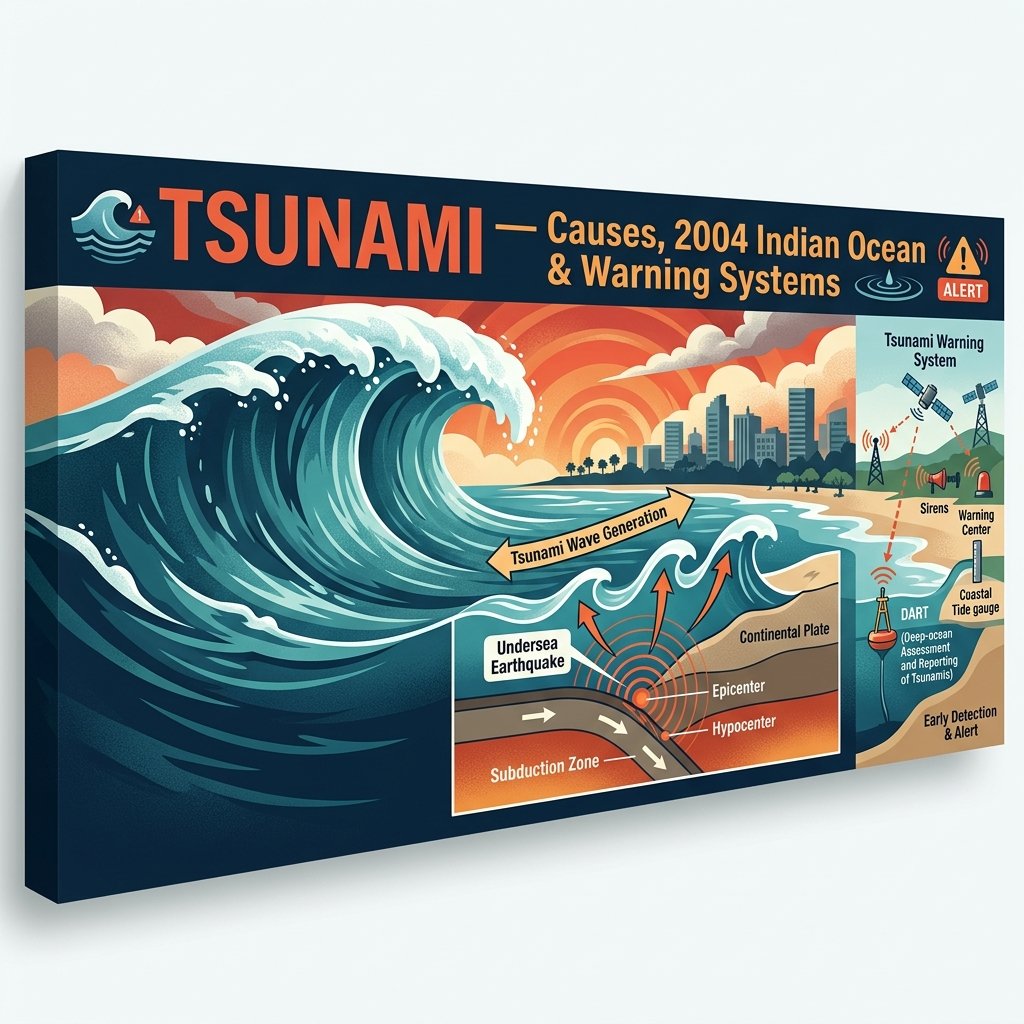
What is a Tsunami? — Definition
The word tsunami (pronounced “tsoo-NAH-mee”) comes from the Japanese words tsu (harbour) and nami (wave). A tsunami is a series of extremely long ocean waves caused by a large displacement of water, typically triggered by an underwater earthquake, volcanic eruption, submarine landslide, or meteor impact.
🌊 Key Definition: A tsunami is NOT a single wave — it is a series of waves (wave train) arriving at intervals of 10–60 minutes. The first wave is often NOT the largest. This is why the “all-clear” after a first wave can be deadly.
Tsunamis are often mistakenly called “tidal waves,” but they have no connection to tidal forces caused by the Moon. In the deep ocean, a tsunami wave may be less than 1 metre tall but stretches hundreds of kilometres in length. As it approaches shallow coastal water, it slows down and dramatically increases in height — a process called shoaling.
How Does a Tsunami Form? — Step-by-Step Process
- Trigger Event: An undersea earthquake (most common), submarine landslide, volcanic eruption, or impact displaces a massive volume of water.
- Energy Transfer: The displacement pushes an enormous column of ocean water upward or downward, transferring seismic energy into wave energy.
- Deep Ocean Travel: Waves spread outward from the source in all directions at high speed (up to 800–900 km/h — as fast as a jet aircraft). In deep water, height is small (< 1 m) but wavelength is immense (100–500 km).
- Shoaling (Approaching Coast): As the tsunami enters shallower water, it slows down (wave speed ∝ √depth). As speed decreases, wave height dramatically increases — sometimes reaching 30–40 metres.
- Drawback: Often, the sea withdraws (recedes) dramatically before tsunami impact — a telltale warning sign. Fish and seabed may become exposed. This lasts 5–10 minutes before the wave hits.
- Impact: Wave crashes ashore with enormous destructive power — not a crashing breaking wave but a fast-rising flood that penetrates kilometres inland.
- Multiple Waves: Additional waves follow, often more destructive than the first, arriving every 10–60 minutes.
Causes of Tsunamis
| Cause | Frequency | Description | Example |
|---|---|---|---|
| Undersea Earthquake | 80%+ of all tsunamis | Megathrust earthquakes at subduction zones vertically displace the seafloor | 2004 Indian Ocean (M 9.1) |
| Submarine Landslide | ~10% | Underwater slope collapses displace water suddenly | 1958 Lituya Bay, Alaska (524 m wave!) |
| Volcanic Eruption | ~5% | Caldera collapse or explosion into ocean displaces water | Krakatoa 1883; Hunga Tonga 2022 |
| Meteor/Asteroid Impact | Extremely rare | Bolide striking ocean displaces enormous water volume | Chicxulub impact, 66 Ma (prehistoric) |
Tsunami Physics — Key Numbers
| Property | Deep Ocean | Shallow Water (Coast) |
|---|---|---|
| Speed | 700–900 km/h | 35–50 km/h |
| Wave Height | < 1 metre | 10–40+ metres |
| Wavelength | 100–500 km | Compressed to a few km |
| Wave Period | 10–60 minutes | 10–60 minutes (unchanged) |
| Energy | Enormous (spread thin) | Concentrated — devastating |
The wave speed formula for a tsunami: v = √(g × d) where g = 9.8 m/s² and d = ocean depth. At 4,000 m depth, speed ≈ 720 km/h. At 10 m depth, speed ≈ 35 km/h — enough time to evacuate if warned.
The 2004 Indian Ocean Tsunami — Complete Account
The Earthquake
- 📅 Date & Time: 26 December 2004, 07:58:53 AM local time (Sumatra)
- 📍 Epicentre: 160 km off the west coast of Northern Sumatra, Indonesia
- 💥 Magnitude: M 9.1–9.3 — the 3rd largest earthquake in recorded history
- ⏱️ Duration: Fault rupture lasted 8–10 minutes — longest ever recorded
- 📏 Fault rupture length: ~1,300 km along the Sunda Trench (subduction zone)
- ⬆️ Seafloor displacement: Up to 15 metres horizontally; 4–5 metres vertically
- 💧 Energy released: Equivalent to 23,000 nuclear bombs
The Waves
- Waves radiated outward at 500–800 km/h across the Indian Ocean
- Andaman & Nicobar Islands (India) hit within 30 minutes
- Tamil Nadu and Kerala coasts hit within 2 hours
- Sri Lanka hit within 2 hours
- Maldives, India’s mainland coast, Myanmar hit within 3 hours
- East Africa (Somalia, Tanzania, Kenya) hit within 7–8 hours
Death Toll by Country
| Country | Deaths | Notes |
|---|---|---|
| Indonesia | 165,000+ | Aceh Province nearest to epicentre — most affected |
| Sri Lanka | 35,000+ | Southern coast devastated |
| India | ~10,749 | Tamil Nadu, Andaman & Nicobar, Kerala, Pondicherry |
| Thailand | 8,200+ | Phuket, Khao Lak tourist areas hit |
| Myanmar | 61 | Irrawaddy Delta buffered impact |
| Maldives | 108 | Islands almost entirely inundated |
| Somalia | 298 | 7,000+ km from epicentre — still deadly |
| Total (14 countries) | 2,27,000+ | Deadliest tsunami in recorded history |
Impact on India
- 📍 Tamil Nadu — worst hit Indian state; Nagapattinam district lost ~6,000 people
- 📍 Andaman & Nicobar Islands — Car Nicobar Air Force base destroyed; ~2,000 deaths
- 📍 Kerala, Andhra Pradesh, Pondicherry — coastal fishing villages washed away
- Over 600,000 people displaced in India
- Lakshadweep was notably less affected due to its shallow reef platform and atoll structure acting as a natural buffer
- India had NO early warning system at the time — all deaths were preventable with a warning
India’s Tsunami Early Warning System (ITEWS)
The 2004 disaster exposed India’s complete lack of a tsunami warning infrastructure. India responded by building one of the world’s most advanced warning systems:
- 🏛️ Established: 2007 — just 3 years after the 2004 disaster
- 🌐 Operated by: Indian National Centre for Ocean Information Services (INCOIS), Hyderabad
- ⚡ Alert time: Can issue warnings within 7–10 minutes of a major undersea earthquake
- 📡 Components:
- Real-time seismic network — 17+ seismograph stations around India
- Bottom Pressure Recorders (BPRs) — sensors on ocean floor detecting wave pressure
- Tide gauge network — 35+ gauges along Indian coastline
- GPS-based stations — measure crustal deformation
- DART (Deep-ocean Assessment and Reporting of Tsunamis) buoys
- 🌍 Regional role: INCOIS serves as a Tsunami Service Provider for the Indian Ocean region under UNESCO-IOC (Intergovernmental Oceanographic Commission)
India’s Tsunami-Prone Coastline
| Region | Risk Level | Reason |
|---|---|---|
| Andaman & Nicobar Islands | 🔴 Very High | Closest to Sunda Trench subduction zone; active volcanoes (Barren Island) |
| Tamil Nadu Coast | 🟠 High | Directly exposed to Bay of Bengal; no landmass between it and Sunda Trench |
| Andhra Pradesh Coast | 🟠 High | Exposed eastern coast; flat coastal plains amplify inundation |
| Kerala & Karnataka Coast | 🟡 Moderate | Western coast; less exposed to Indian Ocean tsunamis but vulnerable to local events |
| Odisha & West Bengal Coast | 🟡 Moderate | Bay of Bengal tsunamis; cyclone risk more prominent |
| Gujarat Coast (Arabian Sea) | 🟢 Lower | Fewer nearby subduction zones; primarily seismic (not tsunami) risk |
Other Major Historical Tsunamis
| Tsunami | Year | Cause | Deaths | Max Wave |
|---|---|---|---|---|
| Lisbon, Portugal | 1755 | M 8.5–9.0 earthquake | 40,000–60,000 | ~30 m |
| Krakatoa, Indonesia | 1883 | Volcanic eruption/collapse | 36,000+ | 30–40 m |
| Sanriku, Japan | 1896 | M 8.5 earthquake | 22,000+ | 38 m |
| Lituya Bay, Alaska | 1958 | Rockfall into bay | 5 | 524 m (record) |
| Indian Ocean Tsunami | 2004 | M 9.1 earthquake | 227,000+ | 34 m (Aceh) |
| Tohoku, Japan | 2011 | M 9.0 earthquake | 15,800+ | 40.5 m |
| Hunga Tonga | 2022 | Volcanic eruption | 3 | 15 m |
2011 Tōhoku Tsunami — Japan
- 📅 March 11, 2011 — M 9.0 earthquake off Pacific coast of Japan
- Waves reached 40.5 metres — tallest waves of 2011 earthquake
- Caused Fukushima Daichi Nuclear Disaster — reactors flooded, cooling system failed → Level 7 nuclear accident
- Japan had advanced warning systems — gave 10–15 minutes warning but some areas had insufficient evacuation time
- Despite warnings, 15,800+ deaths — underscores that warnings alone aren’t enough without community preparedness
Tsunami Warning Signs — How to Survive
- ⚠️ Strong earthquake near coast: Feel shaking that lasts 20+ seconds → move to high ground immediately
- ⚠️ Sea suddenly withdraws: Ocean receding dramatically exposing seafloor → RUN — this is the suction wave before the main wave
- ⚠️ Loud roaring sound: Like a train or jet aircraft approaching from the sea
- ⚠️ Official warnings via INCOIS/media
- ✅ Act immediately — do NOT wait for confirmation: Move at least 1 km inland or to 30+ metres elevation
- ✅ Stay away after first wave → more waves follow for hours
- ✅ Return only after official all-clear
Key Takeaways
| Topic | Key Fact |
|---|---|
| Meaning of Tsunami | Japanese: tsu (harbour) + nami (wave) |
| Main Cause | Undersea megathrust earthquake at subduction zones (80%+ cases) |
| Deep Ocean Speed | 700–900 km/h (as fast as a jet aircraft) |
| Deadliest Tsunami | 2004 Indian Ocean — 2,27,000+ deaths in 14 countries |
| India’s death toll (2004) | ~10,749 — mainly Tamil Nadu and Andaman & Nicobar |
| India’s Warning System | ITEWS — operated by INCOIS, Hyderabad; set up 2007 |
| Highest Tsunami Wave Ever | 524 m — Lituya Bay 1958 (rockfall, not earthquake) |
| Nuclear disaster link | 2011 Tohoku tsunami caused Fukushima nuclear meltdown |
| Warning sign | Sea suddenly withdrawing = run to high ground immediately |
Frequently Asked Questions (FAQs)
1. Is India at risk of another major tsunami?
Yes. The Andaman & Nicobar Islands are located on the Sunda subduction zone — the same fault that caused 2004. A major earthquake there (M 8.5+) could trigger a tsunami hitting India’s eastern coast within 2–3 hours. Tamil Nadu, Andhra Pradesh, and Andaman coasts are most vulnerable. India now has ITEWS (2007) which can issue warnings in 7–10 minutes.
2. Why did India have no tsunami warning in 2004?
In 2004, there was no Indian Ocean Tsunami Warning System. The Pacific Tsunami Warning Center (PTWC) in Hawaii detected the earthquake but had no protocol to issue warnings for the Indian Ocean region. India had no seismic monitoring specifically linked to tsunami alerting. After 2004, the Indian Ocean Tsunami Warning and Mitigation System (IOTWMS) was established under UNESCO, with INCOIS as India’s Tsunami Service Provider from 2007.
3. What’s the difference between a tsunami and a storm surge?
A storm surge is caused by low pressure and high winds from a cyclone pushing seawater onshore — it lasts hours and is predictable days in advance. A tsunami is caused by seafloor displacement — it involves multiple higher-speed waves, arrives within minutes to hours, has a longer inundation range, and is much more sudden. Both cause coastal flooding, but tsunamis penetrate much further inland with higher wave heights.
4. Can a tsunami happen in an inland lake or river?
Yes — these are called Seiches. Earthquakes can create large standing waves in lakes and reservoirs. The 1964 Alaska earthquake created seiches as far away as Texas. Landslides into reservoirs can also create localized “tsunamis” — the 1958 Lituya Bay event (524 m wave) was caused by a massive rockfall into the narrow bay.
5. Why is the Andaman & Nicobar archipelago most at risk in India?
The Andaman & Nicobar Islands sit directly on the Andaman Trench, which is part of the Sunda subduction zone — the same fault responsible for the 2004 megquake. The islands are only 150–300 km from the fault. Tsunamis generated here would hit the islands within 20–30 minutes — leaving almost no evacuation time. The archipelago also has India’s only active volcano (Barren Island) adding volcanic tsunami risk.
⭐ Important for Exams — Quick Revision
- 🔑 Tsunami meaning: Japanese (tsu = harbour, nami = wave) — series of waves NOT tidal waves
- 🔑 Main cause: Undersea megathrust earthquake at subduction zone (80%+)
- 🔑 Deep ocean speed: 700–900 km/h; shallow water: 35–50 km/h
- 🔑 Warning sign: Sea withdrawing/receding rapidly = run immediately to high ground
- 🔑 2004 epicentre: Off Sumatra coast, Sunda Trench, M 9.1 — 3rd largest earthquake ever
- 🔑 2004 deaths: 2,27,000+ in 14 countries; India = ~10,749 (Tamil Nadu + Andaman hardest hit)
- 🔑 India warning system: ITEWS — INCOIS, Hyderabad — operational since 2007
- 🔑 Highest tsunami wave: 524 m — Lituya Bay, Alaska, 1958 (rockfall)
- 🔑 Most dangerous zone India: Andaman & Nicobar Islands → Sunda Trench subduction
- 🔑 2011 Tohoku tsunami caused Fukushima Nuclear Disaster — Level 7 (same as Chernobyl)
- 🔑 IOTWMS: Indian Ocean Tsunami Warning & Mitigation System (UNESCO-IOC, post-2004)
- 🔑 Shoaling: Process by which deep ocean tsunami waves slow and gain height near coast
Related Geology Articles on StudyHub
- ➡️ Seismic Zones of India — Zone 1 to 5, Earthquake Risk States & BIS Map
- ➡️ What is an Earthquake? — Causes, Focus, Epicentre & Seismic Waves
- ➡️ Volcanoes — Types, Structure, Barren Island & Deccan Traps
- ➡️ Coastal Geomorphology India — Wave Action, Landforms & Beaches
- ➡️ What is Plate Tectonics? — Types of Boundaries & Plate Movement