Last Updated: March 2026 | Reading Time: 8 minutes | ~1,900 words
India has a Vitamin D deficiency epidemic that is simultaneously invisible and catastrophic. Despite being a tropical country with abundant sunshine year-round, an estimated 70–90% of Indians have insufficient or deficient Vitamin D levels (25-hydroxyvitamin D <20 ng/mL — deficiency; <30 ng/mL — insufficiency) — a paradox explained by a perfect storm of factors: dark skin (Fitzpatrick types IV–VI → melanin pigmentation requires 3–10× longer UV-B exposure to synthesise equivalent Vitamin D to lighter-skinned individuals); cultural practices of covering skin (particularly women — saree pallus, dupatta, purdah); increasingly indoor lifestyles (urbanisation, office work, air-conditioned environments); high melanin content in South Asian populations genetically reducing photosynthesis efficiency; high-carbohydrate, low-fat traditional diets (Vitamin D is fat-soluble — fat-malabsorption states and low dietary fat significantly reduce intestinal absorption); widespread vegetarianism (Vitamin D-rich foods — fatty fish, egg yolk, liver — avoided); and almost zero food fortification (unlike USA, UK, Canada where milk, cereals, orange juice are mandatorily fortified). The consequences are profound and extend far beyond the classic presentations of rickets in children and osteomalacia in adults: Vitamin D deficiency is now recognised as contributing to increased susceptibility to tuberculosis (Vitamin D is essential for macrophage bactericidal activity — cathelicidin synthesis); impaired insulin secretion and insulin resistance (T2DM risk); muscle weakness (proximal myopathy — cannot climb stairs or rise from floor — extremely common in Indian elderly); autoimmune disease risk (MS, RA, IBD — all inversely correlated with Vitamin D); adverse pregnancy outcomes (preeclampsia, GDM, low birth weight); and cognitive decline + depression in elderly. The ICMR recommends universal supplementation for at-risk groups in India — yet Vitamin D testing and supplementation remain poorly systematised even in tertiary care.
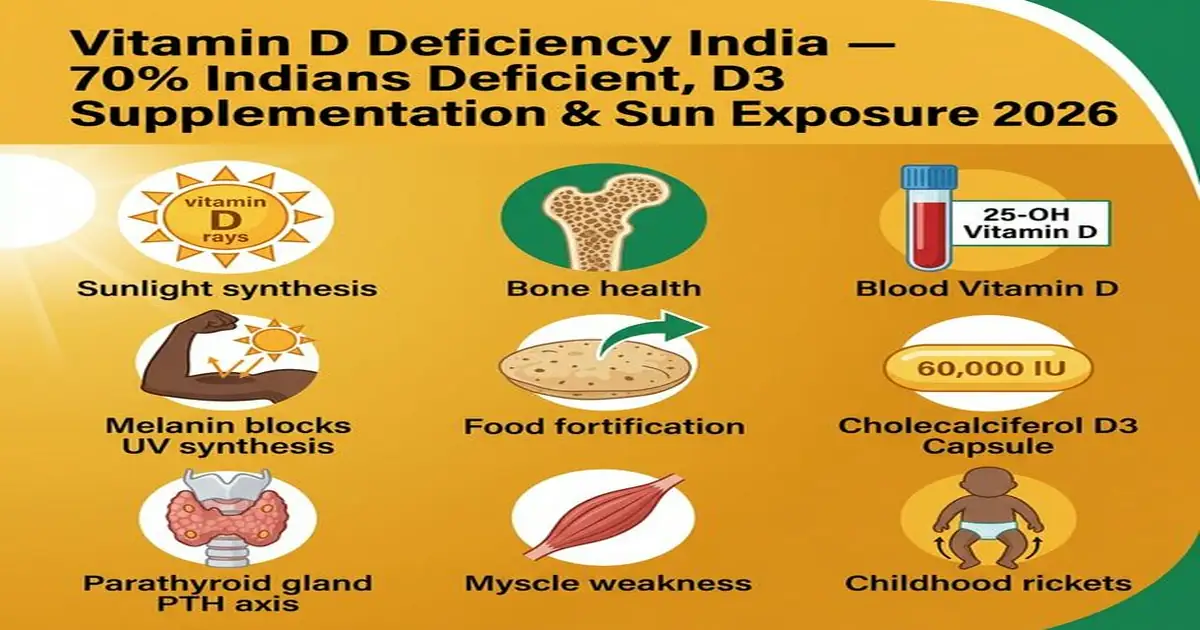
Vitamin D Deficiency India — Testing, Supplementation and Bone Health Guide 2026
| Domain | Evidence-Based Details | India Context |
|---|---|---|
| Vitamin D Physiology — Synthesis, Metabolism & Functions | Vitamin D = fat-soluble prohormone (not strictly a vitamin — synthesised endogenously); two forms: Vitamin D2 (ergocalciferol — plant-derived; less potent; found in mushrooms exposed to UV); Vitamin D3 (cholecalciferol — animal-derived + skin synthesis — 3–5× more potent at raising serum 25(OH)D); Synthesis pathway: UV-B radiation (290–315nm wavelength) → skin 7-dehydrocholesterol → pre-vitamin D3 → isomerisation to Vitamin D3 (cholecalciferol) → liver: 25-hydroxylation (CYP2R1) → 25(OH)D (calcidiol — the MEASURED form — serum half-life 2–3 weeks — diagnostic marker) → kidney: 1,25-dihydroxylation (CYP27B1 — 1α-hydroxylase — tightly regulated by PTH, FGF-23, calcium) → 1,25(OH)2D (calcitriol — the biologically ACTIVE form); Functions: Calcium + phosphate absorption (intestine — without adequate Vitamin D, only 10–15% of dietary calcium absorbed vs 30–40% with sufficiency); bone mineralisation (deficiency → rickets in children; osteomalacia in adults — unmineralised osteoid); PTH suppression (Vitamin D → reduces PTH → reduces bone resorption → preserves bone density); muscle function (VDR in muscle cells → calcium transport → contraction; deficiency → proximal myopathy); immune modulation (VDR on macrophages, dendritic cells, T-cells; calcitriol → cathelicidin → antimicrobial peptide against M. tuberculosis; SARS-CoV-2; reduces Th17 inflammatory response); insulin secretion (VDR in pancreatic beta cells → glucose-stimulated insulin secretion); cell proliferation + differentiation (anti-cancer hypothesis — ecological data shows latitude gradient in cancer incidence); Deficiency definitions (Endocrine Society / AIIMS): Deficient: 25(OH)D <20 ng/mL (<50 nmol/L); Insufficient: 20–29 ng/mL; Sufficient: 30–100 ng/mL (some experts prefer >40 ng/mL for optimal non-skeletal effects); Toxic: >150 ng/mL (clinical toxicity usually >200 ng/mL with high-dose supplementation) | India Vitamin D paradox: UV-B available year-round in India (unlike UK/Canada — winter UV-B insufficient above 50° latitude for Vitamin D synthesis); yet 70–90% Indians deficient; reasons: Melanin competition: melanin absorbs UV-B same wavelength as 7-DHC → type V–VI skin (most Indians) → same sun exposure as European type II produces 1/3rd to 1/10th the Vitamin D; Clothing coverage: North India (purdah, salwar-kameez full-length); South India (dupatta); work outdoors but face/hands only exposed (insufficient); Air pollution: particulate matter + smog in Delhi, Kolkata, Mumbai scatters UV-B → reduces UVB reaching skin 40–60% even in clear sky periods; Indoor urbanisation: IT workers, bank staff, call centres — 9–5 indoor entirely; glass blocks UV-B → sitting near window = zero Vitamin D synthesis; Latitude India: Mumbai (18°N) → good UV-B year-round; Delhi (28°N) → November–January UV-B insufficient for synthesis; Kolkata (22°N) → year-round adequate; Diet: ghee (minimal Vit D); milk (unfortified in India — unlike USA mandatory); zero fish in vegetarian diet (70% India population); egg yolk (Vit D-rich — but many avoid yolk for cholesterol fear); ICMR 2010 RDA: 400 IU/day (children); 600 IU/day (adults); new ICMR 2020 update: 600–800 IU/day adults; 800 IU/day elderly; these are maintenance doses — therapeutic for deficiency requires significantly higher amounts |
| Clinical Presentation — Rickets, Osteomalacia, Myopathy & Non-Skeletal Disease | Skeletal manifestations: Rickets (children, growing bone): inadequate mineralisation of cartilaginous growth plate → characteristic deformities: craniotabes (softening of skull — ping-pong ball feel); frontal bossing; rachitic rosary (beading at costochondral junctions); Harrison’s groove (horizontal groove along lower thorax — diaphragm pull); genu varum (bow legs — most classic — excessive loading unmineralised bone) or genu valgum (knock knees); delayed closure of fontanelles; delayed dentition; hypocalcaemia → tetany, seizures (neonatal rickets — exclusively breastfed without supplementation); Osteomalacia (adults — softening already formed bone): bone pain (diffuse — particularly spine, pelvis, long bones — worse on pressure); pathological fractures; proximal muscle weakness (waddling gait — difficulty climbing stairs, rising from floor = Gower’s sign equivalent in adult); Looser’s zones (pseudofractures — narrow bands of decalcification perpendicular to bone surface on X-ray — pathognomonic of osteomalacia — bilateral, symmetric — pubic rami, femoral necks, ribs); Proximal myopathy: muscle weakness — proximal (hip girdle + shoulder girdle); difficulty: rising from squatting (important function in India — floor sitting culture); climbing stairs; lifting arms above head; often diagnosed as “weakness” or “old age” without testing Vitamin D; Non-skeletal manifestations (evidence strength varies — consistent associations): Increased TB susceptibility: VDR polymorphisms + Vitamin D deficiency → impaired macrophage function → higher M. tuberculosis burden; multiple Indian studies confirm vitamin D-deficient TB patients → higher bacterial load; adjunctive Vitamin D in TB: SUCCINCT trial (UK): no mortality benefit overall but benefit in specific VDR genotypes; several India trials ongoing; Type 2 Diabetes: VDR in pancreatic beta-cells; Vitamin D deficiency → impaired insulin secretion + increased insulin resistance; D-HEALTH trial (2022): high-dose Vitamin D3 60,000 IU/month did not prevent T2DM in pre-DM (disappointing); however, Vitamin D deficiency correction in symptomatic deficiency clearly beneficial; Depression: VDR in hippocampus; deficiency associated with depression (observational); supplementation trials: modest effect; USPSTF 2021: insufficient evidence for Vit D for depression; Cancer: ecological data strong (latitude gradient); RCTs mixed; VITAL trial (2019, USA): Vitamin D3 2000 IU/day → no reduction in primary cancer incidence but ↓ cancer mortality; COVID-19: severe deficiency associated with worse outcomes; prophylactic supplementation to sufficiency recommended (not mega-dose); Cardiovascular: observational association; RCT evidence (VITAL trial) shows no CV outcome benefit despite 2000 IU/day | India rickets: prevalent — particularly: exclusively breastfed infants without Vitamin D supplementation (breast milk Vitamin D depends on maternal status — deficient mother → deficient milk → rickets by 6 months); maternal Vitamin D deficiency in pregnancy → congenital rickets at birth; IAP 2023 recommendation: Vitamin D3 400 IU/day for all infants from birth to 1 year (all breastfed, partially breastfed; formula-fed infants: formula provides 400 IU/day but check label); 600 IU/day age 1–18 years; supplementation compliance India: poor — syrups available (Oleovit, D-Vit, Calcirol drops — 400 IU/mL → 1 mL daily); once-weekly formulations for older children; IAP also recommends routine supplementation during pregnancy for all women (600–1000 IU/day); Osteomalacia India: common misdiagnosis — patients labelled “psychosomatic pain,” “rheumatoid arthritis,” “fibromyalgia” without checking 25(OH)D; proximal myopathy misdiagnosed as “old age weakness” without testing; India data: AIIMS studies show >80% patients presenting with musculoskeletal pain have Vitamin D deficiency — dramatic response to treatment (pain resolution within 3–6 months of correction); TB + Vitamin D India: India: highest TB burden globally (2.8 million new cases annually) × highest Vitamin D deficiency prevalence globally = significant overlap; ICMR-NTI (National TB Institute) studying Vitamin D adjunct in active TB; current NTEP guidelines do not mandate Vitamin D supplementation — not yet evidence-based at protocol level |
| Testing — 25(OH)D Assay, Interpretation & Who to Test | Diagnostic test: Serum 25-hydroxyvitamin D [25(OH)D]: measure of total body Vitamin D stores; NOT 1,25(OH)2D (calcitriol) — this is the active hormone, tightly regulated, does not reflect stores; is NORMAL or even elevated in deficiency (compensatory PTH ↑ → 1α-hydroxylase ↑ → more conversion); serum 1,25(OH)2D should only be measured in specific indications (chronic kidney disease, granulomatous disease, lymphoma); Method: chemiluminescent immunoassay (CLIA — automated — most labs India); RIA (reference method); LC-MS/MS (gold standard — most accurate — limited availability); variation between assay methods: up to 20–30% → use same lab for serial monitoring; Fasting: NOT required for 25(OH)D testing; Repeat testing timing: if supplementing: recheck 25(OH)D after 8–12 weeks (time for therapeutic response); once sufficient: annual check sufficient; Secondary tests: Serum calcium (may be low in severe deficiency); Phosphate (low-normal in deficiency; low in XLH/FGF-23-mediated disorders); ALP (alkaline phosphatase — elevated in active osteomalacia + rickets); PTH (elevated in secondary hyperparathyroidism from Vitamin D deficiency → suppresses on treatment); 24-hour urinary calcium (elevated if toxicity concern); Who to test — ICMR + Endocrine Society India: Indications: symptoms of deficiency (bone pain, muscle weakness, fracture history); osteoporosis (all patients before treatment); malabsorption (coeliac disease, IBD, post-gastric bypass, chronic pancreatitis); chronic kidney disease (all CKD stages — impaired 1α-hydroxylation); liver disease (impaired 25-hydroxylation); medications: anticonvulsants (phenytoin — induces CYP450 → accelerates Vitamin D catabolism), rifampicin, glucocorticoids (long-term); inflammatory bowel disease; elderly (>65 years — all); obesity (Vitamin D sequestered in adipose — apparent deficiency despite sufficient synthesis); dark skin in low-sun latitude (not relevant India — paradox as above); exclusively breastfed infants; pregnancy + planners; NOT recommended: universal population screening (insufficient cost-effectiveness evidence); WHO 2022: does not recommend routine testing — target supplementation at-risk groups empirically | India 25(OH)D testing: widely available — all NABL-accredited laboratories: cost: ₹500–1,500 per test (significant cost barrier for rural/BPL patients); CGHS/ESIC: covered; PMJAY: limited; private: ₹800–1,200 (Apollo, SRL, Dr Lal Pathlab, Thyrocare); at-home blood collection: Thyrocare, PharmEasy, Redcliffe Labs offer doorstep collection for ₹300–600; result interpretation pitfalls India: (1) labs using different reference ranges (some report 30–100 ng/mL as normal; others use 20–100 ng/mL — check lab’s reference range); (2) CLIA methods used by most India labs — some assays show up to 30% variation from true value; (3) false-normal from biotin supplementation (patients taking biotin >5mg/day — interferes with immunoassay → falsely elevated 25(OH)D — stop biotin 3 days before testing); (4) seasonal variation: test in winter if suspecting true deficiency (summer values may be relatively better); empirical supplementation India: ICMR + many India experts support empirical Vitamin D3 supplementation for all Indians without testing (given 70–90% deficiency prevalence + low cost of D3 supplementation + no meaningful harm at recommended doses) — particularly pregnant women, infants, elderly, TB patients, dark-skinned indoor workers |
| Treatment — D3 Dosing Protocols, Loading Dose & India Formulations | Treatment principle: correct deficiency with loading dose → maintain with daily/weekly supplementation + lifestyle modification; Vitamin D3 (cholecalciferol) preferred over D2 (ergocalciferol): D3 more potent, more bioavailable, raises 25(OH)D more effectively; Loading (therapeutic) protocols for deficiency (<20 ng/mL): Stoss therapy: 6,00,000 IU oral D3 as single dose or split over 1 week → rapid correction (used in severe deficiency — tetany, fracture); standard loading: 60,000 IU/week × 8–12 weeks (most common India protocol — “sachet” regimen — Calcirol, Uprise D3 sachet); OR: 60,000 IU/day × 10 days (1,00,000 IU total) → maintenance; AIIMS protocol: 60,000 IU/week × 8 weeks (loading) → 60,000 IU/month (maintenance); Correction rate: 25(OH)D rises approximately 0.5–1 ng/mL per 100 IU/day additional supplementation (i.e., 60,000 IU/week ≈ 8,571 IU/day → expected rise: 43–86 ng/mL over 8 weeks); Maintenance: once sufficient (≥30 ng/mL): 1,000–2,000 IU/day (adult) OR 60,000 IU/month; elderly: 2,000 IU/day or 60,000 IU/month; Pregnancy maintenance: 1000–2000 IU/day (ACOG + NIS India peri-natal guideline); Infants: 400 IU/day until 1 year; Administration: take with largest meal of day (fat-containing → improves absorption — fat-soluble vitamin); if malabsorption: IM Vitamin D3 injection available (arachitol injection — stosstherapy); Co-supplementation: calcium: if dietary calcium intake adequate (≥600 mg/day from diet) → D3 alone sufficient; if dietary calcium inadequate (common in India) → calcium carbonate 500mg + D3 together (Calcirol-G, Shelcal D); do NOT over-supplement calcium (increased cardiovascular risk — calcium supplementation beyond 1,000 mg/day from supplements: Bolland meta-analysis shows ↑ MI risk — calcium from food preferred; supplement only the gap); Toxicity (hypervitaminosis D): mechanism: supplementation-induced (sustained very high doses — typically >10,000 IU/day chronic); granulomatous disease (sarcoidosis, TB lymphadenitis — autonomous 1α-hydroxylation → hypercalcaemia even at normal 25(OH)D); symptoms: hypercalcaemia → polyuria, polydipsia, constipation, confusion, renal stones, band keratopathy; serum calcium elevated + 25(OH)D >150 ng/mL; treatment: stop D3 immediately; hydration; steroids for granulomatous disease; CANNOT occur from sun exposure (skin synthesis self-limits) | India D3 formulations: Calcirol sachets (Cadila): 60,000 IU cholecalciferol sachet — most widely prescribed India; ₹15–25 per sachet; Uprise-D3 sachet (Sun Pharma): 60,000 IU; ₹20–30 per sachet; Tayo 60K (Eris): 60,000 IU; D-Rise (USV): 60,000 IU; Arachitol Nano (Abbott): 60,000 IU/ml oral solution; NutrOVit drops (400 IU/mL): infant supplementation; Oleovit drops: 400 IU/mL; daily tablets: Shelcal-D (500mg calcium carbonate + 250 IU D3); Calcirol 1000 capsule; Calcium + D3 tablets widely used India — but clarify patient: supplement D3 tablets separately (1000–2000 IU/day) vs calcium; ICMR position 2020: recommends universal supplementation for pregnant/lactating women, infants, elderly — with Vitamin D3 400 IU/day → 1000 IU/day range; school programmes: some state NHM programmes now distribute D3 sachets quarterly to schoolchildren (Rajasthan, Delhi GNCT — scattered implementation); cost-effectiveness: India studies show universal infant + elderly supplementation cost-effective even without testing — given high deficiency prevalence; overtreatment concern India: some private practitioners prescribing 60,000 IU/day (not per week) — potentially toxic in long term — doses above 10,000 IU/day chronic should only be under specialist supervision with monitoring |
| Sunlight Exposure — Practical India Guide & Dietary Sources | UV-B synthesis: UV-B (290–315 nm): only UV-B produces Vitamin D in skin (UV-A does not); factors determining UV-B effectiveness: latitude (distance from equator → lower UV-B angle in winter); season (winter → sun lower in sky → UV-B filtered by more atmosphere); time of day: peak UV-B: 10am–3pm (shadow shorter than height → optimal); skin exposed: minimum effective: arms + legs (18–22% body surface area) uncovered for 15–30 minutes at peak time (type IV–V Indian skin); skin colour: dark skin → 3–5× longer exposure needed vs type II skin for equivalent synthesis; sunscreen SPF 15 → reduces Vitamin D synthesis by 99%; glass: blocks UV-B completely; UV-B does NOT penetrate glass → sitting near sunny window = zero synthesis; cloud cover: light cloud reduces UV-B 50%; heavy overcast 90%; Adequate exposure recommendation (India — approximate, highly variable): Type IV–V skin (most Indians): 30–45 minutes midday sun, arms + legs exposed: sufficient for most of year in most India locations; 45–60 minutes November–January in North India (Delhi, Lucknow): less effective UV-B angle; face exposure: NOT recommended as primary source — photoageing + skin cancer (though risk of skin cancer from sun low in dark-skinned populations); post-exposure: wait 30 minutes before washing exposed skin (allow D3 to absorb from subcutaneous layer); Dietary sources (limited — Vitamin D naturally rare): High: fatty fish: salmon (447 IU/85g), mackerel (360 IU/85g), sardines (170 IU/can), hilsa (500 IU/100g — excellent India source); fish liver oil (cod liver oil: 400–1360 IU/tsp); Moderate: egg yolk (40 IU/yolk — eat whole egg); beef liver; UV-exposed mushrooms (shiitake sun-dried upside-down: 400–1400 IU/100g — practical supplement for vegetarians); Low: milk (unfortified India: ~40 IU/cup vs USA fortified: 120 IU/cup); butter; cheese; Negligible: most plant foods, cereals (unless fortified); Fort ification India: FSSAI permits voluntary fortification: milk at 400–700 IU/litre; edible oil at 300–600 IU/litre; flour; branded products: Amul Taaza fortified milk; Fortune edible oil (Vitamin D fortified); limited adoption; UK model: statutory fortification of staple foods → lesson for India policy; Supplementation vs sunlight: supplementation more reliable in urban India (indoor lifestyle, pollution, clothing coverage) → D3 supplement preferred for consistent intake; sunlight remains important for overall health + circadian rhythm + mood — not only Vitamin D production | India sun exposure reality: cultural barriers to sun exposure: women particularly covered (saree, dupatta — body mostly covered; face covered in conservative communities); dark skin discourages sun exposure (ironically — “fair skin” beauty ideal drives umbrella/sunscreen use in India → reducing synthesis further); practical advice India: 15–30 min midday sun with bare arms + legs without sunscreen; mild sun (not harsh midday summer in Rajasthan/UP — heat precaution); morning sun (8–10am): UV-B angle insufficient in most India cities for meaningful Vitamin D — popular wellness advice “morning sun is best for Vitamin D” is INCORRECT — peak synthesis 10am–3pm; hilsa fish India: one of the best natural Vitamin D sources for Bengali population (East India + Bangladesh) — may partially explain lower deficiency rates in coastal/fish-eating communities; ghee: negligible Vitamin D despite popular belief; yolk: most practical daily source for non-vegetarian Indians (40 IU/yolk × 2 eggs = 80 IU/day — insufficient alone but contributes); food fortification India: FSSAI 2016 Food Safety Standards (Fortification) Regulations permit voluntary fortification — uptake limited; advocacy for mandatory fortification of staple milk + edible oil ongoing (GAIN India, TATA Trust nutrition advocacy); ASHA workers + ANM: being trained to counsel on infant Vitamin D supplementation and maternal supplementation — implementation variable by state |
Frequently Asked Questions
How much Vitamin D3 should I take — and do I need to test first?
This is the most practical question about Vitamin D in India — and the answer depends on your individual situation and whether you are treating confirmed deficiency or maintaining sufficiency: Do you need to test first? Testing before supplementation is ideal — it guides the dose and allows monitoring of response. However, given that 70–90% of Indians are deficient, many experts (including ICMR, AIIMS guidelines) support empirical supplementation without testing for most healthy Indians, particularly pregnant women, infants, and elderly — especially since the standard maintenance dose (1,000–2,000 IU/day or 60,000 IU/month) is safe without monitoring in most people. Test FIRST if: you have symptoms of severe deficiency (bone pain, muscle weakness, fractures); you have a condition affecting absorption (coeliac disease, Crohn’s, chronic pancreatitis, post-bariatric surgery); you have chronic kidney or liver disease (metabolism affected); you are planning very high doses (>4,000 IU/day); you have a history of kidney stones or granulomatous disease (sarcoidosis, TB lymphadenitis — risk of hypercalcaemia with supplementation); Dosing guide India — by situation: Confirmed deficiency (25(OH)D <20 ng/mL): Loading: Calcirol 60,000 IU sachet ONCE WEEKLY for 8 weeks (= 4,80,000 IU total over 8 weeks); then recheck 25(OH)D after 12 weeks; Maintenance after loading: 60,000 IU ONCE MONTHLY (not weekly — this is a critical safety distinction — many patients/prescribers continue weekly dose into maintenance → over-supplementation); Insufficiency (20–29 ng/mL): 60,000 IU fortnightly for 6–8 weeks → then 60,000 IU monthly; Routine maintenance (sufficient at baseline, preventing future deficiency): 1,000–2,000 IU/day daily tablet (more consistent than monthly sachets — better for adherence-prone patients); OR 60,000 IU once monthly sachet (excellent adherence — once monthly is very easy to remember); Infants: Vitamin D drops (400 IU = 1 mL Oleovit/NutrOVit/D-Vit): 1 mL daily from day 1 of life until 1 year (regardless of feeding method); Pregnancy: 1,000–2,000 IU/day throughout pregnancy (start from first trimester — or even planning); Elderly (>65 years): 2,000 IU/day (or 60,000 IU/month) — consistently, long-term; combined with calcium carbonate 500mg/day if dietary calcium <600 mg/day; Common dosing errors in India: “60,000 IU DAILY for 10 days” → sometimes prescribed for loading — total dose (6,00,000 IU) is within stoss therapy range but risks hypercalcaemia — should be supervised and followed by checking calcium before starting this regimen; “60,000 IU weekly ongoing indefinitely” after loading → over-supplementation if continued long-term without rechecking; safe maintenance = 60,000 IU monthly ONLY; “Calcirol once and done” → patient takes 1–2 sachets and stops → level rises briefly → falls back; remember: Vitamin D has a serum half-life of only 2–3 weeks — without ongoing supplementation, deficiency recurs in 6–8 weeks; supplements must be taken ONGOING — this is a lifestyle medicine, not a one-time treatment; Take with fat: Vitamin D is fat-soluble → take Calcirol sachet OR capsule WITH your largest meal of the day (ideally containing ghee, oil, or full-fat dairy); absorption on empty stomach or with low-fat food is significantly reduced; Safety ceiling: 4,000 IU/day is the Tolerable Upper Intake Level (UL) for adults (FNB-IOM); toxicity is rare below 10,000 IU/day in people without predisposing conditions; 60,000 IU/month ≈ 2,000 IU/day average = well within safe range.
Can I get enough Vitamin D from sunlight in India — or do I need supplements?
The answer for most urban Indians is: you need supplements — sunlight alone is not reliably sufficient in the modern Indian urban lifestyle. Here’s why — and the complete guide to maximising what you CAN get from sunlight: Why sunlight is theoretically sufficient but practically inadequate in India: The physics: India’s latitude (8–37°N) means UV-B is theoretically available year-round for Vitamin D synthesis — unlike the UK or Canada where winter UV-B is simply absent (impossible to synthesise Vitamin D in UK between October and March regardless of sun exposure). The biology: a fair-skinned person (type II) can synthesise 10,000–20,000 IU in 30 minutes of midday summer sun. For a dark-skinned Indian (type V): the same exposure produces 2,000–5,000 IU — still theoretically sufficient — but only IF: (1) 30% or more of skin is uncovered (arms + legs at minimum); (2) exposure occurs between 10am–3pm (UV-B peak); (3) no sunscreen; (4) not behind glass; (5) skin is not washed immediately after (wait 30 min — D3 migrates from skin surface to subcutaneous tissue over 20–30 minutes post-exposure; washing immediately removes it before absorption); In practice, most urban Indians: expose only face + hands (insufficient body surface area); use sunscreen; are indoors during peak UV-B hours; wash within minutes of any sun exposure; wear full-length clothing (particularly women). The “morning walk in the sun” myth: Morning sun (7–9am) in India: UV index <3; UV-B angle too low (sun at low horizon → UV-B travels through more atmosphere → filtered out → what reaches skin is predominantly UV-A — NO Vitamin D synthesis); Morning walks are excellent for cardiovascular health, circadian rhythm entrainment (blue light), mood (serotonin synthesis) — but NOT for Vitamin D synthesis; Optimal sunlight protocol for Indians who can access it: Time: 11am–1pm (absolute peak in most India locations); Duration: type V skin → 30–45 minutes; type VI skin → 45–60 minutes; Summer vs winter: summer (May–August): even 15–20 minutes sufficient in most India cities; winter North India (December–January): 45–60 minutes midday even less effective (UV-B angle compromised above 28°N — Delhi and north); Exposed area: at minimum bare arms + bare legs (ideally shorts + T-shirt or bare-chested — feasible for men using terrace/balcony/park); face: add sun protection (sunscreen + hat after 10–15 min — skin cancer + ageing risk); Post-exposure: wait 30 minutes before shower; Therefore — practical India recommendation: For most urban Indians: supplement with Vitamin D3 1,000–2,000 IU/day OR 60,000 IU monthly sachet (Calcirol) + get whatever sunlight is feasible as a bonus — don’t rely on sunlight alone; For rural Indians with outdoor occupation (farmers, construction workers — significant sun exposure daily to arms/legs/torso): may have adequate synthesis → test before supplementing; For exclusively indoor workers: supplement without question; remember: supplementation is extraordinarily inexpensive in India (60,000 IU Calcirol sachet: ₹20 = adequate for 1 month maintenance → ₹240/year for complete protection — one of the most cost-effective health interventions available).
What to Read Next
- Osteoporosis India — Vitamin D is the foundation of bone health; DEXA Scan, Alendronate, Calcium, FRAX Score; don’t treat osteoporosis without first correcting Vitamin D
- TB & Vitamin D — Rifampicin accelerates Vitamin D catabolism; all TB patients should be tested + supplemented; VDR polymorphisms predict susceptibility
- Diabetes & Vitamin D — VDR in beta-cells; deficiency impairs insulin secretion; correct deficiency in all T2DM patients; improves insulin sensitivity at the margin
- Depression & Vitamin D — VDR in hippocampus; low Vitamin D associated with depression; supplement as part of comprehensive mental health care; adjunct to antidepressants
- Pregnancy & Vitamin D — all pregnant women need 1000-2000 IU/day throughout; deficiency causes neonatal rickets, LBW, preeclampsia risk; supplement from first trimester
A 45-year-old schoolteacher from Delhi — 8 years of diffuse bone pain (“everywhere — back, hips, legs”); labelled as “psychosomatic” at three hospitals; treated with NSAIDs (causing gastric ulcers — no diagnosis). Finally referred to rheumatology: 25(OH)D: 6 ng/mL (severely deficient). ALP: 180 U/L. PTH: 89 pg/mL (elevated secondary hyperparathyroidism). Bone X-ray: bilateral Looser’s zones at femoral necks (pseudofractures — pathognomonic osteomalacia). Diagnosis: severe Vitamin D deficiency → osteomalacia. Treatment: Calcirol 60,000 IU weekly × 8 weeks + calcium carbonate 500mg BD. Six weeks later: “The bone pain is 80% reduced. I couldn’t believe it.” Eight years of “psychosomatic” pain = eight years of untreated <₹500 diagnosis and <₹200 treatment. She was not imagining the pain. She had a painful, treatable metabolic bone disease — invisible on standard blood panels unless you add one extra test.
About This Guide: Written by the StudyHub Health Editorial Team (studyhub.net.in) based on ICMR Dietary Guidelines 2020, Endocrine Society Vitamin D Guidelines 2011 (update 2024 pending), IAP Vitamin D Supplementation Guidelines 2023, AIIMS India Vitamin D Deficiency Clinical Protocol, and WHO Evidence Review Vitamin D Supplementation 2022. Last updated: March 2026.
☀️ Vitamin D for Every Indian — Start Today: Morning sun walk ≠ Vitamin D (UV-B insufficient at 7am — great for mood + exercise, not bone health). Supplement: Calcirol 60,000 IU sachet ONCE MONTHLY (₹20–25/month — cheapest effective supplement in India). Infants: 400 IU drops (Oleovit 1mL) from birth. Pregnant: 1000-2000 IU/day from trimester 1. Elderly: 2000 IU/day + calcium 500mg. Take with your largest meal (fat-containing). Ongoing — not once-off.
🦴 Bone Pain + Muscle Weakness? Get 25(OH)D Tested: Diffuse bone pain, proximal muscle weakness (can’t climb stairs, rise from floor), or pathological fractures → check serum 25(OH)D (₹500–1200). If <20 ng/mL: Calcirol 60,000 IU/week × 8 weeks loading → 60,000 IU/month maintenance. Most osteomalacia pain resolves within 6–12 weeks of treatment. Do not accept “psychosomatic” label without checking Vitamin D first.
⚕️ Medical Disclaimer: This article provides general educational information about Vitamin D deficiency. Testing, diagnosis, high-dose supplementation protocols, and management of toxicity or malabsorption require qualified physician or endocrinologist assessment. Do not self-prescribe very high dose Vitamin D (above 4,000 IU/day chronic) without supervision.