India has one of the richest river networks in the world — with major rivers draining into both the Bay of Bengal and the Arabian Sea. Indian rivers are broadly divided into two fundamental categories: Himalayan Rivers (perennial, sourced from glaciers and monsoon) and Peninsular Rivers (seasonal/rain-fed, sourced from the Deccan Plateau). Understanding the differences, major river basins, drainage patterns, and the importance of each river system is critical for UPSC, SSC, State PSC, and all competitive geography examinations.
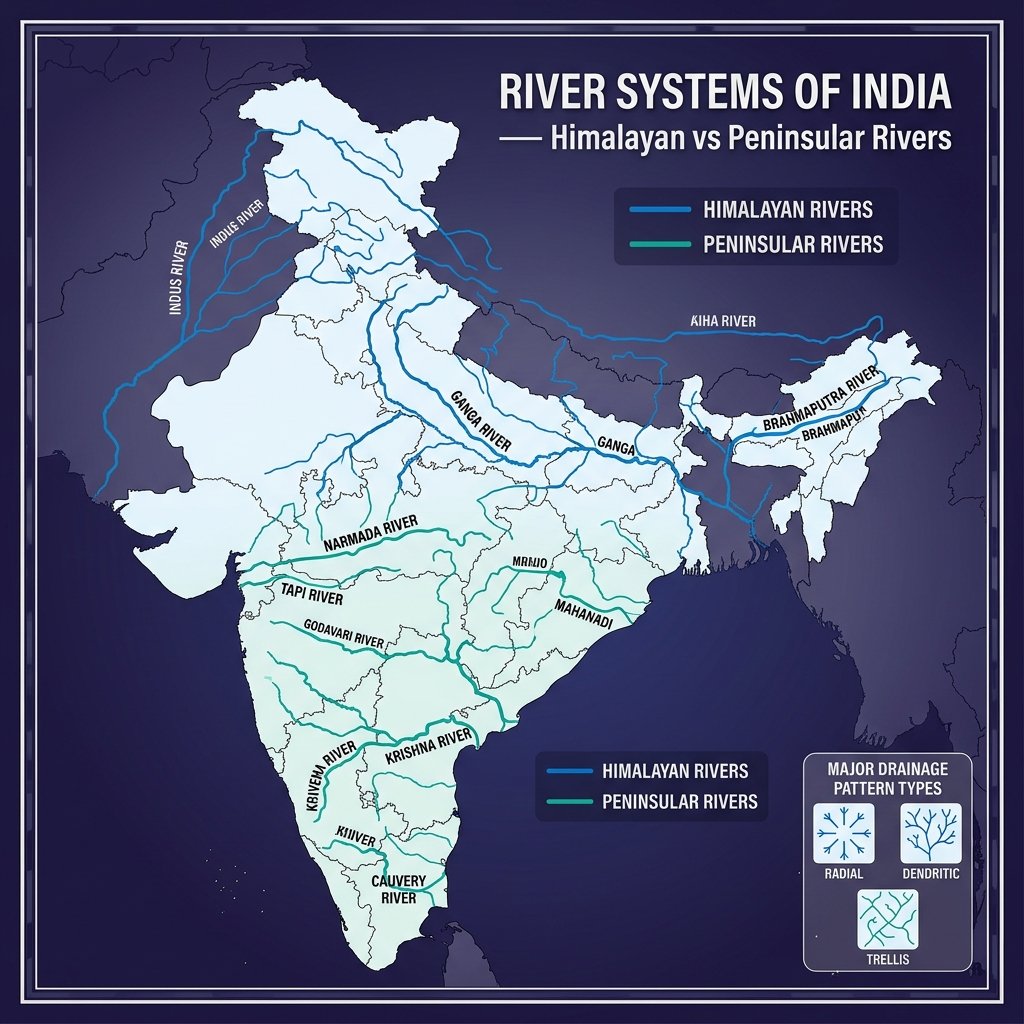
Himalayan Rivers vs Peninsular Rivers — Key Differences
| Feature | Himalayan Rivers | Peninsular Rivers |
|---|---|---|
| Source | Glaciers + Monsoon rain (Himalayas) | Monsoon rain only (Deccan Plateau, Western Ghats) |
| Flow type | Perennial (flow all year) | Seasonal/Ephemeral (dry in summer) |
| Water volume | Very large (fed by glacier melt + rain) | Smaller (rain-fed only) |
| Age | Antecedent rivers — older than Himalayas | Consequent rivers — formed with Deccan tilt |
| Course | Long, windingthrough plains; form large meanders | Relatively straight; controlled by hard rock structure |
| Valley type | Deep gorges in mountains; wide plains in lower course | Narrow valleys in hard Deccan rock; rapids common |
| Delta formation | Large fertile deltas (Ganga-Brahmaputra, Mahanadi) | Most form deltas (Krishna, Godavari, Cauvery); Narmada/Tapti form estuaries |
| Drainage to | Bay of Bengal (Ganga, Brahmaputra); Arabian Sea (Indus) | Bay of Bengal (Krishna, Godavari); Arabian Sea (Narmada, Tapti) |
| Navigation | Navigable in plains (Ganga, Brahmaputra) | Less navigable (rocky, seasonal, rapids) |
| Hydropower potential | High in mountain gorges | High in hard rock plateau gorges (Deccan rivers) |
The Three Great Himalayan River Systems
1. The Indus River System
- 📍 Origin: Mansarovar Lake / Kailash range (Tibet, China) — at 5,500 m altitude
- 📏 Total length: 3,180 km (one of the world’s longest rivers)
- 🌊 Drainage area: 11.65 lakh km² (mostly in Pakistan; ~3.2 lakh km² in India)
- ➡️ Flows through: Ladakh (India) → Pakistan → Arabian Sea
- ☁️ Antecedent river: The Indus was flowing before the Himalayas rose — it cut gorges as the mountains pushed up around it
Major Indus Tributaries in India
| Tributary | Side | Key Notes |
|---|---|---|
| Jhelum | Left (west) | Flows through Kashmir Valley; Wular Lake on it; enters Pakistan |
| Chenab | Left (west) | Largest tributary of Indus; flows through Himachal Pradesh and J&K |
| Ravi | Left (west) | Flows past Pathankot; Lahore (Pakistan) is on it |
| Beas | Left (west) | Entirely within India (Himachal Pradesh, Punjab); Pong Dam |
| Sutlej | Left (west) | Originates in Tibet (Rakshastal lake); Bhakra-Nangal Dam; flows from J&K via HP into Punjab |
| Zanskar | Right (east) | In Ladakh; famous frozen river trek in winter |
💧 Indus Waters Treaty (1960): India gets water of eastern rivers (Ravi, Beas, Sutlej), Pakistan gets western rivers (Indus, Jhelum, Chenab). Mediator: World Bank. Called one of the most successful international water treaties — held even during wars between India and Pakistan.
2. The Ganga River System
- 📍 Origin: Gangotri Glacier (Uttarakhand) — the main headstream is Bhagirathi; meets Alaknanda at Devprayag to become Ganga
- 📏 Total length: 2,525 km (entirely in India + Bangladesh)
- 🌊 Drainage area: 8.6 lakh km² — India’s largest river basin
- ➡️ Flows through: Uttarakhand → UP → Bihar → West Bengal → Bangladesh (as Padma) → Bay of Bengal
- 🏙️ Major cities on Ganga: Haridwar, Allahabad (Prayagraj), Varanasi, Patna, Bhagalpur, Kolkata
Major Ganga Tributaries
| Tributary | Side | Origin & Key Points |
|---|---|---|
| Yamuna | Right (south) | Largest tributary; Yamunotri Glacier → Delhi → Agra → meets Ganga at Prayagraj (Triveni Sangam) |
| Chambal | Right | Madhya Pradesh; Ravine badland (Chambal ravines); Rajasthan; joins Yamuna |
| Son | Right | Amarkantak Plateau (MP); joins Ganga near Patna |
| Ghaghra (Karnali) | Left (north) | Nepal Himalayas; largest left tributary; joins Ganga in Bihar |
| Gandak | Left | Nepal; enters Bihar; meets Ganga near Hajipur |
| Kosi | Left | Nepal (“Sorrow of Bihar”); heavily sediment-laden; frequent floods + river course shifting |
| Damodar | Right (south) | “Sorrow of Bengal”; Jharkhand coalfields; now Damodar Valley Corporation (DVC) |
Ganga Delta — World’s Largest Delta
- 🌿 Sundarbans — world’s largest mangrove delta; shared by India (West Bengal) and Bangladesh
- 📏 Delta area: ~59,000 km² (largest in the world)
- 🐯 UNESCO World Heritage Site; home to Bengal Tiger, Irrawaddy dolphin, Gangetic dolphin
- ⚠️ Highly vulnerable to sea level rise, cyclones, saline intrusion
3. The Brahmaputra River System
- 📍 Origin: Chemayungdung Glacier, Tibet (Kailash range) — called Tsangpo in Tibet
- 📏 Total length: 2,900 km (one of the world’s longest); in India ~916 km
- 🌊 Drainage area in India: 1.94 lakh km² (Assam, Arunachal Pradesh)
- 🌀 Remarkable feature: Makes a dramatic U-turn (Big Bend) around Namcha Barwa Peak (7,782 m) in Tibet — cutting the deepest gorge on Earth (5,300 m deep) before entering India as Dihang in Arunachal Pradesh
- 📍 Known as: Tsangpo (Tibet) → Dihang/Siang (Arunachal) → Brahmaputra (Assam) → Jamuna (Bangladesh)
- 🧬 Unique: One of the world’s largest rivers by discharge volume — greater than Nile and Ganga combined
- 🏝️ Majuli Island in Brahmaputra River, Assam — world’s largest river island
Major Peninsular River Systems
4. Narmada River
- 📍 Origin: Amarkantak Plateau (Madhya Pradesh) — Vindhya Range
- 📏 Length: 1,312 km
- ➡️ Flows: West — through a rift valley (graben) between Vindhya (north) and Satpura (south) ranges → Arabian Sea at Khambhat Gulf, Gujarat
- 🏗️ Sardar Sarovar Dam — largest dam on Narmada; controversial (Narmada Bachao Andolan − Medha Patkar)
- 💧 Estuary (not delta) — Arabian Sea tides prevent delta formation
- 💥 Why does Narmada flow WEST? — It flows through a geologically-formed graben (rift valley between two normal faults) that tilts westward — fault-controlled drainage
5. Tapti (Tapi) River
- 📍 Origin: Satpura Range (Multai, MP)
- 📏 Length: 724 km — flows parallel to and south of Narmada
- ➡️ Flows West: Also a graben river (rift valley); MP → Maharashtra → Gujarat → Arabian Sea near Surat
- 💧 Estuary (not delta); Surat city is on the Tapti
6. Godavari River
- 📍 Origin: Brahmagiri Hills, Trimbakeshwar, Nashik (Maharashtra) — just 80 km from Arabian Sea but flows east!
- 📏 Length: 1,465 km — longest peninsular river
- 🏅 Known as “Dakshin Ganga” (South Ganga) — sacred, large basin
- ➡️ States: Maharashtra → Telangana → Andhra Pradesh → Bay of Bengal
- 🌊 Forms a large fertile delta on the AP coast (Godavari Delta)
7. Krishna River
- 📍 Origin: Mahabaleswar (Western Ghats, Maharashtra)
- 📏 Length: 1,400 km — 2nd longest peninsular river
- ➡️ States: Maharashtra → Karnataka → Telangana → Andhra Pradesh → Bay of Bengal
- 🏗️ Major dams: Nagarjuna Sagar, Srisailam (Andhra Pradesh)
- 🌊 Krishna-Godavari Delta — major rice growing region
8. Cauvery (Kaveri) River
- 📍 Origin: Brahmagiri Hills, Talakaveri, Kodagu (Coorg), Karnataka
- 📏 Length: 800 km
- 🏅 Known as “Dakshin Ganga” in Tamil Nadu — sacred; the Cauvery water dispute between Karnataka and Tamil Nadu is one of India’s longest inter-state water disputes
- ➡️ States: Karnataka → Tamil Nadu → Bay of Bengal (Cauvery Delta near Thanjavur)
- 💧 Cauvery Delta = “Rice Bowl of South India”
Drainage Patterns of India
| Pattern | Shape | Control | India Example |
|---|---|---|---|
| Dendritic | Tree-like branches | Uniform rock; no structural control | Ganga plains, Indus plains |
| Trellis | Grid-like, rectangular | Alternating hard/soft rock bands (folded/faulted) | Himalayan rivers (Yamuna, Son tributaries) |
| Radial | Outward from a central high | Dome or hill; rivers flow away from summit | Amarkantak (Narmada, Mahanadi, Son originate) |
| Centripetal | Inward toward a basin | Basin/depression | Manipur Basin, Loktak Lake drainage |
| Parallel | Rivers run parallel to each other | Steep slopes; uniform regional tilt | Rivers off the Western Ghats (short, fast, parallel) |
India’s Major River Basins — Area Comparison
| River | Basin Area in India (km²) | Drainage to | Type |
|---|---|---|---|
| Ganga | 8,61,404 | Bay of Bengal | Himalayan |
| Indus | 3,21,290 | Arabian Sea | Himalayan |
| Godavari | 3,12,812 | Bay of Bengal | Peninsular |
| Krishna | 2,58,948 | Bay of Bengal | Peninsular |
| Brahmaputra | 1,94,413 | Bay of Bengal | Himalayan |
| Mahanadi | 1,41,589 | Bay of Bengal | Peninsular |
| Narmada | 98,796 | Arabian Sea | Peninsular (rift) |
| Cauvery | 81,155 | Bay of Bengal | Peninsular |
Key Takeaways
| Topic | Key Fact |
|---|---|
| Longest river in India | Ganga (2,525 km entirely in India/Bangladesh) |
| Largest river basin | Ganga basin — 8.6 lakh km² |
| Longest peninsular river | Godavari (1,465 km) — “Dakshin Ganga” |
| World’s largest delta | Ganga-Brahmaputra (Sundarbans) — ~59,000 km² |
| World’s largest river island | Majuli Island — Brahmaputra, Assam |
| Deepest river gorge | Brahmaputra (Big Bend/Namcha Barwa) — ~5,300 m deep |
| Rivers with estuaries (not deltas) | Narmada and Tapti — due to fault-controlled gorge (Arabian Sea tides) |
| “Sorrow of Bihar” | Kosi River (floods, course shifting) |
| “Sorrow of Bengal” | Damodar River (before DVC dams) |
| Indus Waters Treaty | 1960; India = Ravi+Beas+Sutlej; Pakistan = Indus+Jhelum+Chenab |
| Most sacred Himalayan river | Ganga — National River of India; Gangotri Glacier source |
| Cauvery dispute | Karnataka vs Tamil Nadu — one of India’s longest water disputes |
Frequently Asked Questions (FAQs)
1. Why do Narmada and Tapti flow westward while most peninsular rivers flow east?
Most peninsular rivers flow east because the Deccan Plateau tilts gently eastward — the Western Ghats form the watershed. However, Narmada and Tapti are fault-controlled rift valley rivers that flow through grabens (down-dropped blocks between parallel normal faults). The Narmada flows in a west-tilted graben between the Vindhya Range (north) and Satpura Range (south). Because the ancient fault-controlled graben tilts towards the Arabian Sea, both rivers flow west and discharge into the Arabian Sea — forming estuaries (not deltas) because the Khambhat Gulf’s tidal action prevents sediment accumulation.
2. Why is the Kosi called the “Sorrow of Bihar”?
The Kosi River originates in the Nepal Himalayas and carries an enormous sediment load — it has one of the highest sediment yields of any river in the world. As it enters the flat Bihar plains, it drops its sediment load rapidly, constantly building up its own bed and changing course (the Kosi has shifted its course westward by over 120 km over the past 250 years). This frequent course-shifting destroys farmland, villages, and infrastructure covering thousands of square kilometres. The 2008 Kosi flood broke a temporary embankment dam in Nepal and inundated 3.5 million people. This earned it the tragic nickname “Sorrow of Bihar.”
3. What makes the Brahmaputra unique among world rivers?
The Brahmaputra is remarkable for several reasons: (1) It is an antecedent river — older than the Himalayas, it has maintained its course by downward erosion as the mountains rose around it. (2) It makes a dramatic U-turn around Namcha Barwa peak (Tibet-Arunachal Pradesh), cutting the world’s deepest gorge (Yarlung Tsangpo Grand Canyon, ~5,300 m). (3) Despite originating from a relatively small glacier, it has enormous discharge — because of the extremely high rainfall in Assam (some areas receive 500+ cm/year). (4) The Brahmaputra is a braided river in Assam — very wide, shallow, islands (chars) constantly form and shift.
4. What is the difference between a delta and an estuary?
A delta forms when a river deposits its sediment load at its mouth, creating a fan-shaped land mass extending into the sea (requires calm sea, large sediment load, gradual gradient). Examples: Ganga-Brahmaputra delta (Sundarbans), Godavari, Krishna, Mahanadi deltas. An estuary forms when a river mouth is funnel-shaped, where tidal action is strong enough to carry away sediment before it can accumulate — the sea invades the river mouth. Examples: Narmada estuary (Khambhat Gulf) and Tapti estuary (near Surat) — both on the Arabian Sea where the Khambhat Gulf has high 12-metre tides that flush sediment away.
⭐ Important for Exams — Quick Revision
- 🔑 Himalayan rivers = perennial + antecedent + large sediment + fertile plains + large deltas
- 🔑 Peninsular rivers = seasonal/rain-fed + consequent + hard rock valleys + shorter + mostly Bay of Bengal
- 🔑 Ganga origin: Gangotri Glacier (Bhagirathi) + Alaknanda → meet at Devprayag
- 🔑 India’s largest basin: Ganga (8.6 lakh km²)
- 🔑 Longest peninsular river: Godavari (1,465 km) — “Dakshin Ganga”
- 🔑 Brahmaputra names: Tsangpo (Tibet) → Dihang (Arunachal) → Brahmaputra (Assam) → Jamuna (Bangladesh)
- 🔑 World’s largest river island: Majuli (Brahmaputra, Assam)
- 🔑 World’s largest delta: Ganga-Brahmaputra Sundarbans (~59,000 km²)
- 🔑 Narmada + Tapti flow WEST because they are in rift valley grabens — form estuaries NOT deltas
- 🔑 Kosi = “Sorrow of Bihar” (course-shifting, floods); Damodar = “Sorrow of Bengal”
- 🔑 Indus Waters Treaty 1960: India = Ravi + Beas + Sutlej; Pakistan = Indus + Jhelum + Chenab
- 🔑 Cauvery: “Dakshin Ganga” in TN; Karnataka vs TN water dispute; Thanjavur = “Rice Bowl of South India”
- 🔑 Dendritic pattern = Ganga plains (uniform rock); Radial = Amarkantak (Narmada, Mahanadi, Son diverge from same hill)
- 🔑 Prayagraj Triveni Sangam = Ganga + Yamuna + mythical Saraswati
Related Geology Articles on StudyHub
- ➡️ Soil Types of India — Alluvial (from rivers), Black, Red, Laterite
- ➡️ Types of Faults — Normal Faults & Why Narmada Flows West
- ➡️ Coastal Geomorphology — Deltas, Estuaries & Indian Coastline
- ➡️ Glaciers of India — Gangotri, Zemu & Glacial Landforms
- ➡️ Seismic Zones of India — River Plains & Earthquake Risk