Climate change is the defining environmental challenge of the 21st century. Earth’s average surface temperature has already risen by ~1.2°C above pre-industrial levels (since 1850), and the impacts — melting glaciers, rising sea levels, extreme weather events, shifting monsoon patterns, and ocean acidification — are accelerating. For India, climate change is not a future threat but a present reality: the Indian monsoon is becoming more erratic, Himalayan glaciers are retreating, heatwaves are intensifying, and coastal cities face rising sea levels. Understanding the greenhouse effect, carbon cycle, IPCC reports, and international climate agreements is essential for UPSC, SSC, and all environmental exams.
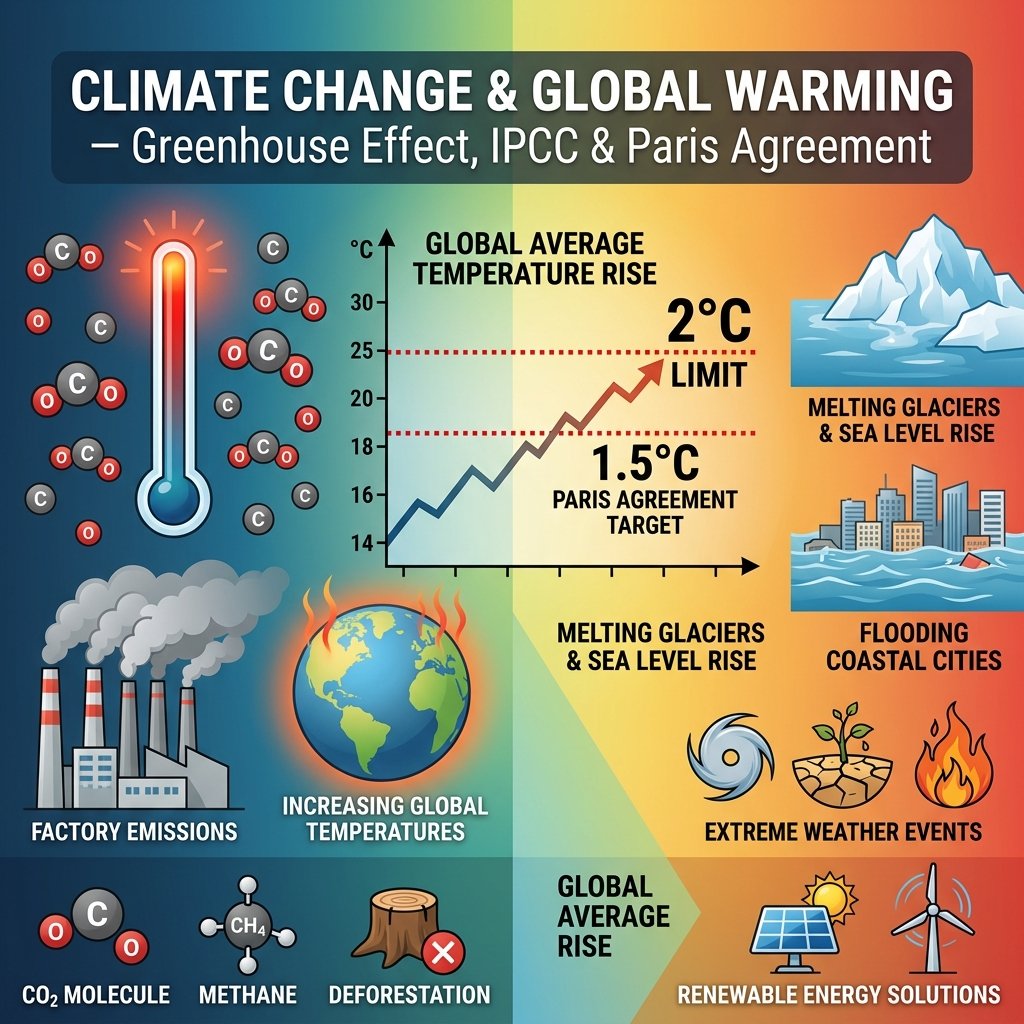
The Greenhouse Effect — How Earth Stays Warm
The Greenhouse Effect is a natural process — without it, Earth’s average temperature would be -18°C (instead of the habitable +15°C). It works like a glass greenhouse:
- ☀️ Solar radiation (mostly visible light/UV) passes through the atmosphere and warms Earth’s surface
- 🌍 Earth radiates this warmth back as infrared (long-wave) radiation
- 🔄 Greenhouse gases (GHGs) in the atmosphere absorb this infrared radiation and re-radiate it in all directions — including back toward Earth
- 🌡️ This trapping of heat raises Earth’s surface temperature — the natural greenhouse effect
The problem: human activities (burning fossil fuels, deforestation, agriculture, industry) are dramatically increasing GHG concentrations → enhanced greenhouse effect → Earth warms beyond the natural range → global warming.
Major Greenhouse Gases — Sources & Warming Potential
| Gas | Pre-industrial Level | Current Level (2024) | GWP (100yr) | Main Human Sources |
|---|---|---|---|---|
| Carbon Dioxide (CO₂) | 280 ppm | 424+ ppm | 1 (baseline) | Fossil fuel burning, cement, deforestation |
| Methane (CH₄) | 722 ppb | ~1,900 ppb | 84–86 (20yr) | Livestock (cattle), rice paddies, landfills, natural gas leaks |
| Nitrous Oxide (N₂O) | 270 ppb | ~336 ppb | 273 | Fertilisers (nitrogen), livestock manure, fossil fuels |
| Water Vapour (H₂O) | — | Variable | High | Natural; amplifies warming as a feedback (more warming → more evaporation → more water vapour → more warming) |
| Fluorinated Gases (HFCs, PFCs, SF₆) | Near zero | Rising | Up to 23,500 | Refrigerants, industrial processes, electronics |
| Ozone (Tropospheric) | — | Rising (urban/industrial) | — | NOT directly emitted; formed from NOx + VOCs in sunlight (smog) |
🌾 India & Methane: India is a major methane emitter — primarily from its massive livestock population (world’s largest cattle herd ~300 million), rice paddy cultivation (anaerobic decomposition), and landfills. Methane is 84× more powerful than CO₂ over 20 years, making India’s agricultural emissions a key focus of climate negotiations.
The Carbon Cycle — Earth’s Carbon Management System
The carbon cycle describes how carbon moves between the atmosphere, oceans, land, and living organisms. Understanding it is key to understanding why human CO₂ emissions cause lasting warming.
Major Carbon Reservoirs
| Reservoir | Carbon Stored | Key Process |
|---|---|---|
| Fossil Fuels (underground) | ~10,000 Gt C | Geologically trapped; humans release by burning |
| Oceans | ~38,000 Gt C | Dissolves CO₂ (ocean acidification occurs); deep ocean long-term storage |
| Terrestrial biosphere | ~2,000 Gt C | Plants absorb CO₂ (photosynthesis); forests are major sinks |
| Atmosphere | ~870 Gt C | Rising rapidly (~4 Gt C/year net); warming driver |
| Soil | ~1,500 Gt C | Organic matter; vulnerable to warming (permafrost melt releases stored carbon) |
How Human Activity Disrupts the Carbon Cycle
- ⛽ Burning fossil fuels releases ~37 billion tonnes of CO₂ per year (carbon that was stored underground for millions of years)
- 🌳 Deforestation removes carbon sinks AND releases stored carbon (India loses ~1.5 million ha of forest/year)
- 🌊 Ocean warming reduces ocean’s ability to absorb CO₂ (warmer water holds less CO₂)
- 🌡️ Permafrost thaw (Arctic/Tibetan Plateau) releases ancient methane and CO₂ — a dangerous tipping point
IPCC — Intergovernmental Panel on Climate Change
The IPCC (established 1988 by UNEP & WMO) is the UN’s scientific body for assessing climate change. It does NOT conduct original research — it reviews and synthesises thousands of peer-reviewed scientific papers. IPCC reports are the authoritative basis for all international climate negotiations.
Key IPCC Assessment Reports
| Report | Year | Key Conclusion |
|---|---|---|
| AR4 (4th Assessment) | 2007 | “Warming is unequivocal”; IPCC shared 2007 Nobel Peace Prize with Al Gore |
| AR5 (5th Assessment) | 2013–14 | 95% certainty humans are main cause; 1.5–4.8°C warming by 2100 (various scenarios) |
| SR1.5 (Special Report) | 2018 | 1.5°C vs 2°C consequences spelled out; 2030 emission cuts must be 45% below 2010 levels |
| AR6 (6th Assessment) | 2021–23 | “Code red for humanity”; 1.5°C likely crossed by 2030; some changes already irreversible |
International Climate Agreements
1. UNFCCC (1992) — The Foundation
- 🌐 United Nations Framework Convention on Climate Change — signed at Rio Earth Summit 1992
- 📊 197 parties (virtually all nations); India ratified 1993
- 🏛️ Annual meetings = COP (Conference of the Parties) — COP28 was Dubai 2023; COP29 = Baku, Azerbaijan 2024; COP30 = Belém, Brazil 2025
- 📋 Established key principle: Common But Differentiated Responsibilities (CBDR) — developed nations bear greater historical responsibility & must lead in emission reductions
2. Kyoto Protocol (1997) — First Binding Commitment
- 📜 First international treaty with legally binding emission reduction targets for developed countries (Annex I nations)
- 🔧 3 flexibility mechanisms: Emissions Trading, CDM (Clean Development Mechanism — developing nations get credits for clean projects), Joint Implementation
- ❌ USA never ratified; Canada withdrew 2012; developing nations (India, China) had NO binding targets
- 📅 Succeeded by Paris Agreement (2015)
3. Paris Agreement (2015) — COP21
The Paris Agreement (adopted December 2015, entered force November 2016) is the landmark global climate treaty that replaced the Kyoto Protocol. It is fundamentally different — instead of top-down binding targets, it uses nationally determined bottom-up pledges.
- 🌡️ Temperature goal: Limit global warming to well below 2°C above pre-industrial levels; pursue efforts to limit to 1.5°C
- 📋 NDCs (Nationally Determined Contributions): Each country sets its own emission reduction targets — must be updated every 5 years with increasing ambition (ratchet mechanism)
- 💰 Climate finance: Developed nations pledged $100 billion/year to developing nations by 2020 (missed target; COP29 2024 set new goal of $300 billion/year by 2035)
- ✅ USA rejoined (Biden 2021); Trump withdrew 2017 and again announced withdrawal 2025
- 🔍 Loss & Damage Fund — established at COP27 (Sharm el-Sheikh 2022); compensation from rich to vulnerable nations for unavoidable climate damage
India’s Climate Commitments (NDC 2022)
- ☀️ 500 GW non-fossil electricity capacity by 2030
- 🌱 50% electricity from non-fossil sources by 2030
- 🌳 Create/enhance carbon sink of 2.5–3 billion tonnes CO₂ equivalent through forest/tree cover by 2030
- ⬇️ Reduce emission intensity of GDP by 45% from 2005 levels by 2030
- 🔥 Net Zero by 2070 (India’s long-term target — later than most developed nations’ 2050 targets)
- ☀️ India launched International Solar Alliance (ISA) — India’s initiative to promote solar energy globally; headquarters in Gurugram
- 🌊 India launched CDRI (Coalition for Disaster Resilient Infrastructure) — building climate-resilient infrastructure globally
Climate Change Impacts on India
| Impact | Current Evidence | Future Risk |
|---|---|---|
| Monsoon disruption | More extreme rain events; longer dry spells within monsoon; erratic onset | Increased flood-drought cycles; agricultural unpredictability |
| Himalayan glacier retreat | 67% of Himalayan glaciers retreating; Gangotri retreating 22m/year | Reduced river flows (Ganga, Indus) affecting 500M people |
| Sea level rise | Indian Ocean rising ~3 mm/year; faster in Bay of Bengal | Mumbai, Kolkata, Chennai floodplain risk; Sundarbans threatened |
| Heatwaves | Frequency and intensity increasing; 2022 saw earliest ever heatwaves (March) | Wet-bulb temperature limits (beyond which humans can’t survive) may be breached in Indian plains |
| Ocean acidification | pH from 8.2 (pre-industrial) to 8.1 = 26% more acidic | Coral reef bleaching; fishery collapse; Andaman/Lakshadweep corals threatened |
| Agriculture | Wheat yields declining in Punjab/Haryana due to rising temperatures | 300M people in food insecurity risk if 2°C crossed |
Ozone Layer — Separate but Related Issue
- 🔵 Ozone layer (stratosphere, 15–35 km altitude) — absorbs harmful UV-B/UV-C radiation from the Sun; protects life from skin cancer, eye damage, ecosystem harm
- ❌ Ozone depletion — caused by CFCs (Chlorofluorocarbons) from refrigerants, aerosols; CFC molecules release chlorine in stratosphere → destroys ozone molecules (one Cl atom can destroy 100,000 ozone molecules)
- 🌍 Ozone hole — formed over Antarctica each spring (August–October); also observed over Arctic
- 📜 Montreal Protocol (1987) — most successful environmental treaty ever; phased out 99% of ozone-depleting substances (ODS); ozone layer recovering; expected to heal by 2060–2070
- ⚠️ Note for exams: Ozone depletion and climate change are SEPARATE problems with SEPARATE causes — though CFCs are ALSO greenhouse gases, so the Montreal Protocol also helped slow warming
⭐ Important for Exams — Quick Revision
- 🔑 Greenhouse Effect = natural warming by GHGs trapping infrared radiation; without it Earth = -18°C
- 🔑 CO₂ level: Pre-industrial = 280 ppm → Now = 424+ ppm (highest in 3 million years)
- 🔑 GWP: CH₄ = 84–86× CO₂ (20yr); N₂O = 273× CO₂; HFCs = up to 23,500×
- 🔑 India’s methane = livestock (largest cattle herd) + rice paddies + landfills
- 🔑 IPCC = established 1988; UNEP+WMO; AR6 (2021–23) = “Code red for humanity”
- 🔑 UNFCCC = 1992 (Rio); annual COP meetings; 197 parties; CBDR principle
- 🔑 Kyoto Protocol = 1997; binding targets for Annex I (developed) nations; CDM for developing nations; India/China = no targets; USA never ratified
- 🔑 Paris Agreement = 2015 (COP21); keep warming <2°C, pursue 1.5°C; NDCs every 5 years; Loss & Damage Fund (COP27)
- 🔑 India NDC: 500 GW non-fossil by 2030; 50% electricity from non-fossil 2030; Net Zero by 2070
- 🔑 ISA = International Solar Alliance; India initiative; HQ Gurugram; promotes solar globally
- 🔑 CDRI = Coalition for Disaster Resilient Infrastructure; India initiative; climate-proof infrastructure
- 🔑 Montreal Protocol (1987) = phased out CFCs; ozone layer recovering; healing by 2060–70; most successful treaty
- 🔑 Hippocampus: Ozone depletion (CFCs, Montreal Protocol) ≠ Climate change (CO₂, Paris Agreement) — separate issues!
- 🔑 India’s glaciers: Gangotri retreating 22m/year; 67% Himalayan glaciers retreating; water tower of Asia threatened
Frequently Asked Questions (FAQs)
1. Why is 1.5°C such a critical threshold in climate science?
The IPCC Special Report on 1.5°C (2018) showed that the difference between 1.5°C and 2°C of warming is not small — it is the difference between severe and catastrophic outcomes. At 1.5°C: coral reefs decline by 70–90%; 70 million more people face extreme heat annually; sea level rise of ~0.4 m. At 2°C: coral reefs virtually eliminated (99% loss); 2× as many people facing extreme heat; 0.56 m sea rise; 10% of Earth’s surface changes climate zone. For India specifically: at 1.5°C, ~72 million coastal residents face annual flood risk; at 2°C, this doubles. The Indian Ocean warms disproportionately faster, making India particularly vulnerable. Current policies globally put us on track for approximately 2.5–3°C by 2100 — making deeper cuts urgent.
2. What is “Loss and Damage” in climate negotiations and why does India support it?
Loss and Damage refers to the negative impacts of climate change that cannot be adapted to — permanent losses (island nations disappearing under rising seas, communities displaced by recurring extreme weather, cultures lost as ice-dependent peoples lose their traditional way of life). The concept recognises that developing nations that contributed little to historical emissions are suffering the most. Developed nations resisted this for decades (fearing unlimited liability). At COP27 (Sharm el-Sheikh, 2022), a global Loss and Damage Fund was finally established. India strongly supports this — it contributes <3% of historical global emissions but suffers disproportionately from climate impacts (glacial floods, monsoon disruption, cyclones, heatwaves, sea-level rise threatening its 7,516 km coastline).
3. What is the difference between climate change mitigation and adaptation?
Mitigation = actions to reduce/prevent greenhouse gas emissions or enhance carbon sinks — addressing the cause of climate change. Examples: switching to renewable energy, improving energy efficiency, protecting forests, electric vehicles. Adaptation = adjusting to the present and future effects of climate change that are already locked in — managing the consequences. Examples: heat-resistant crop varieties, cyclone shelters, coastal flood barriers, relocating vulnerable communities, drought-resistant water management. Both are essential: mitigation to limit long-term harm, adaptation to manage unavoidable impacts. India’s Climate Action Plan (NAPCC — National Action Plan on Climate Change, 2008) has 8 National Missions covering both: National Solar Mission, Water Mission, Green India Mission, Sustainable Himalayan Ecosystem Mission etc.
Related Geology Articles on StudyHub
- ➡️ Glaciers of India — Himalayan Ice Retreat & GLOF Risk
- ➡️ Indian Monsoon — How Climate Change Disrupts Rainfall
- ➡️ Natural Disasters — Climate Change’s Role in Intensifying Disasters
- ➡️ Energy Resources — India’s Renewable Transition & Net Zero Goal
- ➡️ Natural Vegetation — Forests as Carbon Sinks & Climate Buffers