The atmosphere is the thin blanket of gases surrounding Earth that makes life possible. It blocks harmful solar radiation, regulates temperature, drives weather systems, and provides the oxygen we breathe. Earth’s atmosphere extends from the surface to about 10,000 km above — but 99% of its mass is within the first 30 km. Understanding the atmosphere’s composition, its distinct layers with their unique properties, weather phenomena (pressure belts, wind systems, jet streams), and how all these connect to India’s climate is essential for UPSC, SSC, CDS, and all competitive geography examinations.
Composition of the Atmosphere
| Gas | % by Volume (Dry Air) | Significance |
|---|---|---|
| Nitrogen (N₂) | 78.09% | Dilutes oxygen; prevents rapid combustion; nitrogen cycle for plants |
| Oxygen (O₂) | 20.95% | Essential for respiration and combustion; ozone formed from O₂ |
| Argon (Ar) | 0.93% | Inert; no biological role; used in lighting |
| Carbon Dioxide (CO₂) | 0.04% (424+ ppm) | Greenhouse gas; essential for photosynthesis; rising due to human activity |
| Water Vapour (H₂O) | 0–4% (variable) | Most important weather gas; drives rainfall, humidity, cloud formation; powerful GHG |
| Ozone (O₃) | Trace (stratosphere) | Absorbs UV-B/C radiation; “good ozone” in stratosphere; “bad ozone” at ground (smog) |
| Other (Ne, He, CH₄, NO₂…) | Trace | Various roles; methane = powerful GHG |
💡 Key formula to memorise: N₂ (78%) + O₂ (21%) + Ar (1%) = 99.93% of dry air. Everything else — CO₂, ozone, methane — is just a trace, yet CO₂ and methane drive climate change, and ozone protects life from UV radiation. Small concentrations, outsized importance.
Layers of the Atmosphere
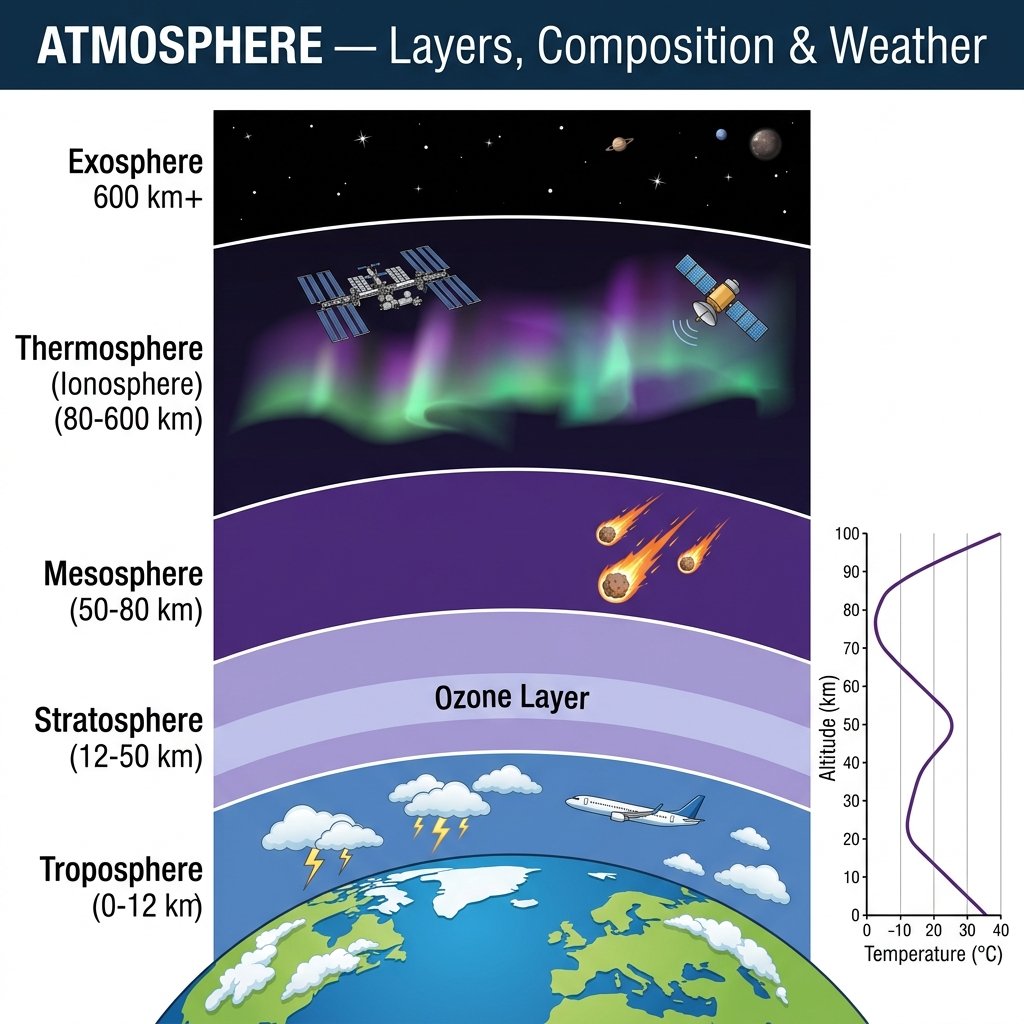
1. Troposphere — Weather Layer (0–12 km)
- 📏 Thickness: ~8 km at poles; ~16 km at equator (thicker where it’s hotter); average ~12 km
- 🌡️ Temperature: Decreases with altitude at ~6.5°C per km (Environmental Lapse Rate); top (tropopause) = −56°C
- ☁️ All weather occurs here — clouds, rain, wind, cyclones, monsoons, thunderstorms
- ✈️ Most commercial flights at 9–12 km (upper troposphere/tropopause) to avoid weather
- 🔑 Contains ~75–80% of total atmospheric mass and virtually all water vapour
- 📍 Tropopause = boundary between troposphere and stratosphere; temperature minimum; very stable
2. Stratosphere — Ozone Layer (12–50 km)
- 🌡️ Temperature: Increases with altitude (temperature inversion) — ozone absorbs UV radiation → heats the layer
- 🔵 Ozone layer (15–35 km) — absorbs 97–99% of harmful UV-B and UV-C radiation from the Sun
- ✈️ High-altitude aircraft (supersonic like Concorde) flew here; weather balloons reach here
- 🌪️ Very stable layer — minimal vertical mixing; no weather; very calm
- 📍 Stratopause = upper boundary (~50 km); temperature maximum (~0°C)
3. Mesosphere — Meteor Burning Layer (50–80 km)
- 🌡️ Temperature: Decreases again with altitude; coldest layer of atmosphere (−90°C at top)
- 🌠 Meteors burn up here due to friction with air — why we see “shooting stars”
- 🔬 Difficult to study — too high for aircraft/weather balloons, too low for satellites
- 📍 Mesopause = upper boundary (~80 km); coldest point in atmosphere (−90°C)
4. Thermosphere / Ionosphere (80–600 km)
- 🌡️ Temperature: Rises dramatically — can reach 1,500°C+ (but air is so thin it doesn’t “feel” hot)
- 📡 Ionosphere (part of thermosphere) — atoms ionised by solar radiation; reflects AM radio waves (long-distance radio communication)
- 🌌 Auroras (Northern/Southern Lights) occur here — solar wind particles interact with ionosphere
- 🛸 ISS (International Space Station) orbits in uppermost thermosphere at ~400 km
- 📡 GPS satellites, Iridium satellites in this zone
5. Exosphere (600 km+)
- 🌌 Outermost layer; molecules so sparse they travel great distances without colliding
- 🛰️ Weather satellites (geostationary at 36,000 km) orbit in/beyond exosphere
- “Space” begins — fades into interplanetary medium
| Layer | Altitude | Temperature Trend | Key Feature |
|---|---|---|---|
| Troposphere | 0–12 km | Decreases↓ | All weather; max mass; lapse rate 6.5°C/km |
| Stratosphere | 12–50 km | Increases↑ | Ozone layer (UV shield); stable; no weather |
| Mesosphere | 50–80 km | Decreases↓ | Coldest (−90°C); meteors burn here |
| Thermosphere | 80–600 km | Increases↑ | Auroras; ionosphere; ISS; very thin air |
| Exosphere | 600km+ | — | Fades to space; geostationary satellites |
Atmospheric Pressure Belts
Earth’s unequal heating creates alternating belts of high and low pressure around the globe — these pressure belts drive the planet’s major wind systems.
| Pressure Belt | Location | Cause | Weather |
|---|---|---|---|
| Equatorial Low (ITCZ) | 0°–5° N/S | Intense solar heating → rising air → low pressure | Heavy rainfall; doldrums (no wind); tropical rainforests |
| Sub-Tropical High (STH) | 25°–35° N/S | Descending air from Hadley cell top; adiabatic compression → warming → high pressure | Dry, clear; world’s deserts (Sahara, Thar, Arabian Desert) located here |
| Sub-Polar Low | 60°–65° N/S | Cold polar air meets warm westerlies → wedging → rising → low pressure | Cyclonic storms; frontal weather; stormy |
| Polar High | 90° N/S (Poles) | Extreme cold → dense, sinking air → high pressure | Extremely dry & cold; polar desert |
Global Wind Systems
| Wind | From → To | Direction | Significance for India |
|---|---|---|---|
| Trade Winds | Sub-tropical high → ITCZ (equator) | NE in N.hemisphere; SE in S.hemisphere | SE trades cross equator → deflect right (Coriolis) → become SW Monsoon over India! |
| Westerlies | Sub-tropical high → Sub-polar low | SW in N.hemisphere; NW in S.hemisphere | Bring winter western disturbances to North India (via Mediterranean/Caspian) |
| Polar Easterlies | Polar high → Sub-polar low | NE in N.hemisphere; SE in S.hemisphere | Limited direct impact on India |
| Monsoon Winds | Ocean → Land (SW) / Land → Ocean (NE) | Seasonal reversal | SW Monsoon (Jun–Sep) = India’s lifeline; NE Monsoon = Tamil Nadu’s winter rains |
Jet Streams — The Atmosphere’s “River of Wind”
Jet streams are narrow, fast-moving bands of wind in the upper troposphere/lower stratosphere at altitudes of 9–16 km. They blow from west to east at speeds of 120–400 km/h (sometimes faster in winter). They are critical for:
- ✈️ Air travel — flights from India to Europe/USA fly faster going east (with jet stream); slower going west (against it)
- 🌧️ Indian climate — jet streams directly influence the Indian monsoon and winters
Jet Streams & Indian Climate
- 🌬️ Sub-Tropical Westerly Jet (STWJ): Flows over northern India during winter (at ~25°N) — drives Western Disturbances (winter rains in northwest India, snowfall in Himalayas); essential for Rabi crops (wheat)
- 🌧️ Monsoon onset mechanism: In late May, the STWJ shifts north of the Himalayas (to ~35°N) due to differential heating. This removal of the jet stream from over India removes a cap on the atmosphere → the South-West Monsoon bursts over Kerala. This is why the jet stream’s northward shift is a direct trigger for monsoon onset.
- 🌬️ Tropical Easterly Jet (TEJ): Forms over southern India/Bay of Bengal in summer at high altitude; helps pump moisture northward; strengthens SW monsoon rainfall
The Coriolis Effect — Why Winds Curve
- 🌀 Earth’s rotation deflects moving objects (winds, ocean currents) to the right in the Northern Hemisphere and left in the Southern Hemisphere
- 🌪️ This is why: Cyclones rotate anticlockwise in the Northern Hemisphere (low pressure → air flows in → deflects right → anticlockwise spiral) and clockwise in the Southern Hemisphere
- 💨 SE Trade Winds crossing the equator get deflected right → become SW Monsoon winds hitting India
- ⚽ Ferrel’s Law (1856): Any freely moving object on Earth deflects right in NH, left in SH due to Coriolis
Insolation & Heat Budget of the Earth
- ☀️ Insolation = incoming solar radiation striking Earth’s atmosphere and surface
- 📊 Of 100 units of incoming solar radiation: 35 units reflected back to space (albedo — by clouds 25, surface 5, atmosphere 5); 14 units absorbed by atmosphere; 51 units absorbed by Earth’s surface
- 🌡️ Earth re-radiates 51 units as long-wave infrared radiation → greenhouse gases absorb and re-radiate → heat budget maintained in equilibrium (pre-human era)
- ❄️ Albedo: Fresh snow = 80–90% (reflects most sunlight); forests = 10–15%; oceans = 5–10%; deserts = 25–30%. Arctic ice loss from warming → less albedo → more warming → ice-albedo feedback loop
⭐ Important for Exams — Quick Revision
- 🔑 N₂ = 78%, O₂ = 21%, Ar = 1% — together = 99.93% of dry air
- 🔑 Troposphere = 0–12 km; all weather; temperature decreases @6.5°C/km; 75–80% of atmosphere mass
- 🔑 Stratosphere = 12–50 km; temperature INCREASES (ozone absorbs UV); ozone layer at 15–35 km
- 🔑 Mesosphere = 50–80 km; COLDEST layer (−90°C); meteors burn here → “shooting stars”
- 🔑 Thermosphere = 80–600 km; auroras; ionosphere (reflects AM radio); ISS at 400 km
- 🔑 Temperature trend: Troposphere↓ → Stratosphere↑ → Mesosphere↓ → Thermosphere↑
- 🔑 ITCZ = Intertropical Convergence Zone = equatorial low; heavy rain; doldrums (no wind for ships)
- 🔑 Sub-Tropical High (25–35°N/S) = descending dry air = world’s deserts (Thar, Sahara, Arabian)
- 🔑 Trade winds = from STH→equator; SE trades cross equator → Coriolis deflects right → SW Monsoon
- 🔑 Westerlies = STH→sub-polar low; bring Western Disturbances to North India in winter
- 🔑 Jet Streams = upper troposphere; west-to-east; 120–400 km/h
- 🔑 STWJ shifted north of Himalayas = direct trigger for SW Monsoon onset over Kerala (late May/June)
- 🔑 Coriolis Effect = right deflection in NH, left in SH; cyclones anticlockwise in NH, clockwise in SH
- 🔑 Lapse rate = 6.5°C/km (normal); if actual lapse rate < 6.5°C = stable; >6.5°C = unstable (convection/thunder)
Frequently Asked Questions (FAQs)
1. Why does temperature decrease in the troposphere but increase in the stratosphere?
In the troposphere, the primary heat source is Earth’s surface (which absorbs solar radiation and radiates long-wave heat upward). As you move away from this heat source, temperature logically decreases — at about 6.5°C per km. In the stratosphere, the heat source is completely different: the ozone layer directly absorbs high-energy UV radiation from the Sun, converting it to heat. This means the top of the stratosphere (where ozone absorption is greatest) is warmer than the bottom. This temperature inversion (warm on top, cool below) makes the stratosphere extremely stable — there’s no convection, no turbulence, no weather. This stability is actually what keeps the stratosphere “separate” from the troposphere and what makes it an ideal layer for long-distance aircraft like the Concorde. The stratopause (top of stratosphere) reaches ~0°C before cooling again in the mesosphere.
2. How do jet streams control the Indian monsoon onset and withdrawal?
The connection between jet streams and India’s monsoon is one of the most fascinating links in atmospheric science. During winter and spring, the Sub-Tropical Westerly Jet (STWJ) flows at roughly 25°N — directly over India and the southern flank of the Himalayas. This jet creates a region of upper-level convergence that suppresses convection (prevents rising air) over India. In May, as the land heats up dramatically, the Tibetan Plateau (the “third pole”) warms intensely. The STWJ is progressively pushed north of the Himalayan barrier. Once it crosses to ~35°N (north of the Himalayas), the suppression effect is removed from over India. Simultaneously, the Tropical Easterly Jet (TEJ) forms at upper levels over South India, pumping air outward. The result: moist ocean air rushes in at low levels — the Southwest Monsoon “bursts” at Kerala in late May/June. Monsoon withdrawal in September–October coincides with the STWJ returning southward, re-establishing its suppressing effect over northern India.
3. What are Western Disturbances and why are they critical for India’s wheat crop?
Western Disturbances (WDs) are extra-tropical cyclones that originate in the Mediterranean Sea, Caspian Sea, or Black Sea region and travel eastward along the Sub-Tropical Westerly Jet Stream, reaching northwestern India (Punjab, Haryana, UP, HP, J&K) during winter (December–March). They bring rainfall and snowfall to northwestern India — crucial for: (1) Winter Rabi crops — especially wheat (India’s staple food, grown in Punjab-Haryana “wheat belt”); wheat requires cool temperatures + moderate winter moisture for optimal yield. A weak WD winter → drought → wheat crop failure → food security concern. (2) Himalayan snowpack — WDs deposit snow on the Himalayas, which melts in summer to feed rivers (Indus, Ganga tributaries). Poor WD winters = less snowpack = less summer river flow. (3) Tourism: WD snowfall in Shimla, Manali, Gulmarg = tourism economy. WDs are becoming weaker and less frequent with climate change, threatening India’s winter agriculture.
Related Geology Articles on StudyHub
- ➡️ Indian Monsoon — How Jet Streams Trigger SW Monsoon Onset
- ➡️ Natural Disasters — Cyclone Formation in Atmosphere
- ➡️ Climate Change — Greenhouse Effect in the Troposphere
- ➡️ Climate of India — Pressure Belts Driving Indian Weather
- ➡️ Glaciers of India — Western Disturbances & Himalayan Snowpack