Sedimentary rocks cover approximately 75% of Earth’s land surface and contain virtually all known fossils, all known petroleum and natural gas deposits, and most of India’s coal reserves. They form at or near Earth’s surface through the accumulation, compaction, and cementation of sediments — fragments of pre-existing rocks, minerals, or organic material. Geologically they represent only about 8% of the crust by volume (most crust is igneous and metamorphic at depth), yet they disproportionately dominate surface geology because they blanket older rocks. From the red sandstone of Agra Fort to the limestone of Meghalaya’s caves, the coal of Jharkhand’s Gondwana fields, and the chalk of marine platforms — sedimentary rocks are Earth’s history books, recording environments, climates, and life through geological time. This complete guide covers classification, formation, key rock types, and their critical importance for India — essential for UPSC, SSC, Class 9–11 NCERT, and all geological examinations.
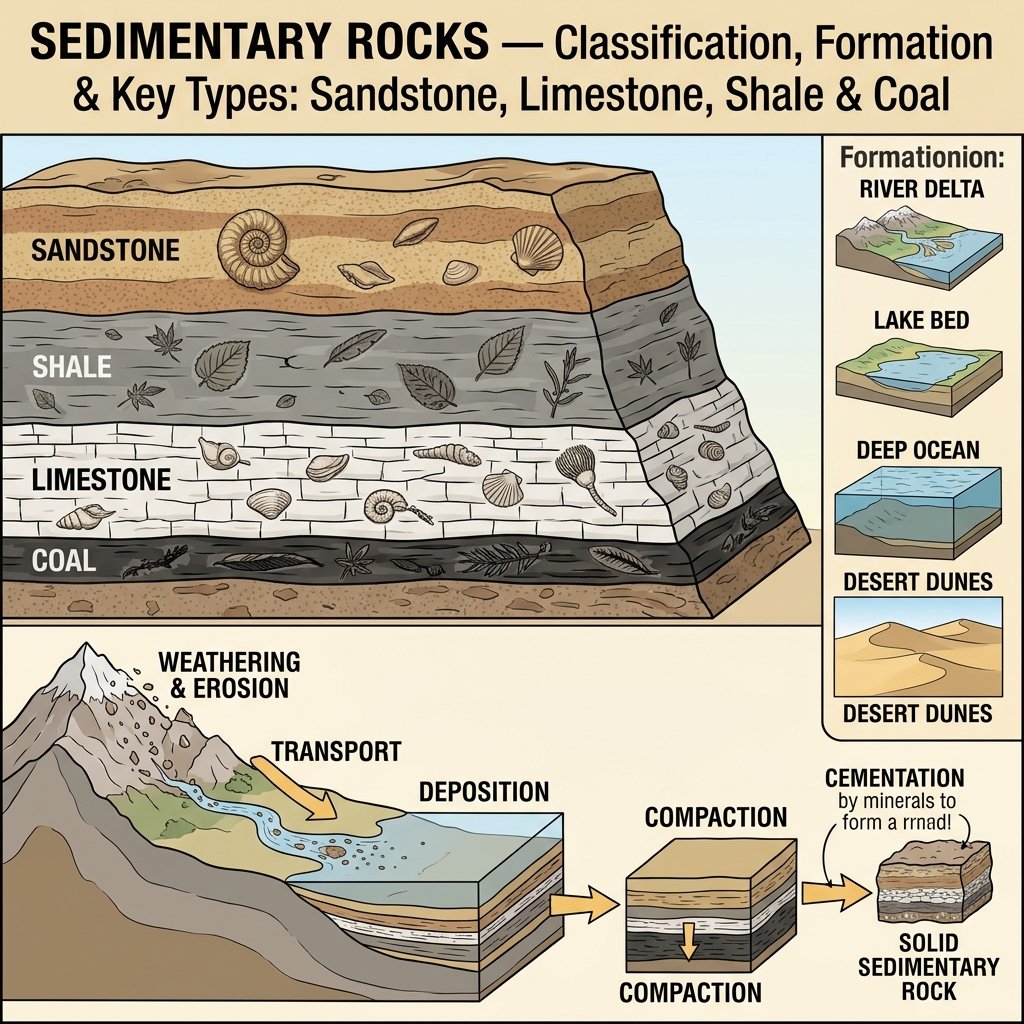
What Makes a Rock Sedimentary? — Key Characteristics
- 📄 Layering (Stratification) — characteristic horizontal layers called beds or strata, each representing a distinct depositional event; visible in river valley walls, road cuts, sea cliffs
- 🦴 Fossils — ONLY sedimentary rocks routinely contain fossils; they form at surface temperatures where organic material can be preserved before it fully decays
- 💧 Surface formation — deposited by water, wind, ice, or gravity; not formed underground by heat or pressure (unlike metamorphic) or by cooling magma (unlike igneous)
- 🔘 Rounded grains — clastic sedimentary rocks contain grains that were rounded during transport by water or wind (abrasion = edges worn smooth)
- 🧩 Cement visible — the “glue” holding grains together (calcite, silica, iron oxide) is often visible as coloured rims around grains
- 📊 Sorting — grains sorted by size (well-sorted = uniform grain size = cleaner depositional environment like a beach; poorly sorted = mixed sizes = turbulent or glacial environment)
Classification of Sedimentary Rocks
| Class | Origin | Sub-type / Grain Size | Key Examples |
|---|---|---|---|
| Clastic (Detrital) Broken fragments of pre-existing rocks | Mechanical weathering + transport + deposition | Rudite/Psephite (>2mm): gravel, pebble | Conglomerate (rounded clasts), Breccia (angular clasts) |
| Arenite/Psammite (0.0625–2mm): sand | Sandstone (most common clastic), Arkose (feldspar-rich sandstone) | ||
| Siltstone (0.004–0.0625mm): silt | Siltstone, Loess (wind-deposited silt) | ||
| Lutite/Pelite (<0.004mm): clay | Shale (most abundant sedimentary rock), Mudstone (unstratified shale), Claystone | ||
| Mixed sizes | Greywacke (poorly sorted, dark, turbidite), Tillite (glacial deposit, very poorly sorted) | ||
| Chemical Minerals precipitated from water solution | Evaporation of water bodies; chemical precipitation | Evaporites | Rock Salt/Halite (NaCl), Gypsum (CaSO4.2H2O), Anhydrite |
| Carbonates | Travertine (CaCO3 from hot springs/caves), Tufaceous limestone | ||
| Siliceous | Chert (microcrystalline silica), Flint (dark chert in chalk) | ||
| Biochemical / Organic Organic remains or biologically induced precipitation | Accumulation of biological material + burial | Carbonate bioclastic | Limestone (from shells/coral/algae), Chalk (coccolithophore shells), Coquina (whole shells cemented) |
| Siliceous biogenic | Diatomite/Diatomaceous earth (diatom shells), Radiolarite (radiolarian chert) | ||
| Carbon-rich organic | Coal (plant material), Oil shale (algal organic matter), Peat (earliest stage of coal) |
How Sedimentary Rocks Form — 5 Stages of Lithification
- 1️⃣ Weathering — existing rocks broken into fragments by mechanical (freeze-thaw, thermal expansion) and chemical (hydrolysis, oxidation, dissolution) processes; produces the raw material (sediment)
- 2️⃣ Erosion & Transport — fragments removed and moved by rivers, wind, glaciers, waves; grains become rounded and sorted during transport; finer particles travel farther
- 3️⃣ Deposition — sediments settle when transport energy decreases (river slows at delta, wind drops in a basin); deposited in characteristic environments (fluvial, marine, aeolian, glacial, lacustrine)
- 4️⃣ Compaction — burial by overlying sediment squeezes water out; grains pack closer together; pore space reduces from ~40–50% to ~10–20%; soft sediment becomes firmer
- 5️⃣ Cementation — groundwater percolating through sediment deposits minerals (calcite CaCO₃, silica SiO₂, iron oxide Fe₂O₃) in remaining pore spaces, permanently “gluing” grains together; produces the hardness and durability of the finished rock
Sedimentary Environments — Where Rocks Form
| Environment | Rock Types Produced | Indian Examples |
|---|---|---|
| River (Fluvial) | Sandstone, Conglomerate, Siltstone (fining upward sequences) | Ganga-Yamuna river sediments; Gondwana sandstones (Jharkhand, Odisha) |
| Delta | Interbedded sandstone, shale, coal; organic-rich | Ganga-Brahmaputra delta; Mahanadi delta sediments |
| Marine (Shallow shelf) | Limestone (coral reefs, shell beds), Sandstone, Shale | Andaman limestone; Gujarat shelf carbonates; Rajasthan ancient sea limestones |
| Marine (Deep ocean) | Shale, Chert, Radiolarian ooze, Limestone (abyssal) | Spiti Valley black shales (Himalayan Tethys Sea deposits) |
| Desert (Aeolian) | Well-sorted sandstone with cross-bedding (dune structures) | Thar Desert sandstones; Jodhpur Sandstone (Rajasthan) |
| Swamp/Peat Bog | Coal, Carbonaceous shale; organic-rich black sediments | Gondwana coal swamps (Jharkhand, Odisha, Chhattisgarh, WB) 300-250 Ma |
| Lake (Lacustrine) | Fine shale, siltstone, evaporites; varved (annual layer) sediments | Kashmir valley lake sediments; Rajasthan salt lake evaporites (Sambhar Lake) |
| Glacier (Glacial) | Tillite (unsorted, angular = diamictite); Varved clay (annual layers in glacial lakes) | Talchir Tillite (Gondwana base, India) = evidence India was near South Pole 300 Ma |
Key Sedimentary Rocks — Detailed Guide
Sandstone
- 🟡 Grain size: 0.0625–2mm (sand-sized); visible grains; feels gritty
- 🔧 Composition: Mostly quartz grains (most durable mineral, survives transport); cement = silica, calcite, or iron oxide (determines colour: red/brown = iron oxide; yellow = limonite; white = silica/calcite)
- 💧 Porosity: Good porosity between grains = excellent aquifer rock (stores groundwater) and petroleum reservoir rock — most oil and gas found in sandstone reservoirs
- 🏗️ Uses: Building stone (Agra Fort, Fatehpur Sikri, Connaught Place Delhi = red Bharatpur/Dholpur sandstone), glass-making sand, foundry sand, oil well proppant
- 🇮🇳 India: Rajasthan (Jodhpur blue-grey sandstone, Dholpur red sandstone, Bharatpur), Vindhyan Supergroup sandstones (MP-UP), Gondwana sandstones (East India); Rajasthan = India’s largest sandstone exporter
- 📚 Special: Arkose = feldspar-rich sandstone (indicates rapid erosion and deposition, limited chemical weathering); Greywacke = poorly sorted, dark, fine-grained; deposited by turbidity currents in deep ocean
Limestone
- ⬜ Composition: Calcium carbonate (CaCO₃) predominantly as calcite; may contain dolomite [CaMg(CO₃)₂], clay, or silica impurities
- 🐚 Origin: Mostly biochemical — accumulated shells, coral, algae, and other carbonate-secreting organisms on shallow marine platforms; less commonly chemical precipitation
- 🧪 Identification test: Fizzes (effervesces) vigorously when dilute HCl applied — CO₂ released as acid reacts with CaCO₃ = definitive test for carbonate rocks
- 🏔️ Karst features: Limestone dissolves in slightly acidic groundwater (carbonic acid from CO₂); over millions of years creates caves, sinkholes, stalactites, stalagmites, disappearing streams = karst topography
- 🏗️ Uses: Cement raw material (India = world’s 2nd largest cement producer; limestone is the key ingredient), steel-making flux, agriculture (soil pH neutralisation), construction, paper, pharmaceuticals, toothpaste
- 🇮🇳 India: Madhya Pradesh (largest reserves), Rajasthan, Andhra Pradesh/Telangana, Karnataka, Chhattisgarh; Meghalaya = India’s longest limestone cave (Krem Liat Prah = 31.1 km); Andaman-Nicobar coral limestone; Himalayan Tethys limestones
- 🌊 Types: Chalk (fine-grained, soft, white — from microscopic coccolithophore algae; tropical shallow seas); Coquina (coarse, shell fragments loosely cemented); Oolitic limestone (tiny spherical carbonate grains); Dolomite [CaMg(CO₃)₂] = limestone with Mg substituting Ca
Shale — Most Abundant Sedimentary Rock
- ⬛ Grain size: Clay-sized (<0.004mm); smooth feel; does not feel gritty
- 🔧 Composition: Clay minerals (kaolinite, illite, smectite) + fine quartz + organic matter; dark shales contain organic carbon
- 📄 Texture: Fissile — splits along parallel bedding planes into thin flat sheets (like pages of a book); distinctive property of shale
- 🌊 Formation environments: Very quiet, low-energy water — deep ocean floor, deep lake, lagoon, tidal flat; anywhere fine particles slowly settle
- ⛽ Economic importance: Source rock for oil and gas — organic matter in shale converted to oil/gas by heat+pressure over millions of years; shale gas/oil (fracking) = trapped gas remaining in shale pores rather than migrated to conventional reservoir; India has significant shale gas potential (Cambay basin, Krishna-Godavari basin, Assam)
- 🏗️ Uses: Brick-making (clay from shale), cement manufacture, road base material
- 🇮🇳 India: Widespread in Gondwana sequences; Spiti Valley black shales (Tethyan marine deposits with great trilobite+ammonite fossils); Vindhyan shales; Assam shales (oil-bearing)
Coal — Organic Sedimentary Rock
- ⬛ Composition: Carbon (C) — from land plant material buried and slowly converted by heat+pressure over millions of years; NOT a mineral (no fixed crystal structure)
- 📈 Rank/grades of coal (increasing carbon %, time, depth):
| Rank | Carbon % | Moisture % | Calorific Value | India Context |
|---|---|---|---|---|
| Peat | ~50–60% | Very high | Lowest | Not mined commercially; swamp material; precursor to coal |
| Lignite (Brown Coal) | 60–70% | High (~40%) | Low | Neyveli Lignite Mines (Tamil Nadu) = India’s largest; Rajasthan lignite; tertiary-age coal |
| Sub-bituminous | 70–76% | Moderate | Medium-low | Some Gondwana coalfields |
| Bituminous | 76–90% | Low | High | Most of India’s coal (Gondwana fields: Jharia, Raniganj, Korba, Talcher, Singrauli) |
| Anthracite | >90% | Very low | Highest | Very rare in India; some in J&K (Kalakot); requires extreme pressure+time |
- 🇮🇳 India’s coalfields: Gondwana coal (Permian age, ~300 Ma; best quality bituminous; East/Central India) = Jharia (Jharkhand, largest + only coking coal), Raniganj (WB, oldest mined), Talcher (Odisha), Korba (Chhattisgarh), Singrauli (MP/UP), Wardha Valley (Maharashtra). Tertiary coal (45–65 Ma; NE India + Rajasthan + TN) = Assam (Makum, Jaintia Hills), Meghalaya, Nagaland; Neyveli (Tamil Nadu), Barmer (Rajasthan)
- ⚠️ India coal statistics: 4th largest coal reserves globally; 2nd largest producer; 70%+ of total electricity from coal; India imports coking coal (needed for steel-making) from Australia as domestic coal has high ash content
Conglomerate & Breccia
- 🔵 Conglomerate = largest-grained clastic rock; pebbles and cobbles (>2mm) with rounded clasts cemented together; rounded = transported long distances + well-rounded by river/beach action; indicates high-energy depositional environments (fast rivers, beaches)
- 🔺 Breccia = similar to conglomerate but clasts are angular (not rounded); angular = short transport distance; formed near original rock source (fault breccia, scree slopes, cave breccia)
Rock Salt & Evaporites
- 🧂 Rock Salt (Halite) = NaCl; forms when enclosed sea or lake evaporates; layered with gypsum and anhydrite; mined at Khewra (Pakistan, world’s 2nd largest), Sambhar Lake (Rajasthan = India’s largest inland salt lake, natural salt); Gulf of Khambhat evaporite basin (Gujarat)
- 🏗️ Other evaporites: Gypsum (CaSO₄·2H₂O) = plaster of Paris raw material; Rajasthan gypsum = major Indian reserves; Anhydrite, Potash (fertiliser)
Sedimentary Structures — Reading Earth’s History
- 📐 Cross-bedding — inclined layers within a bed; formed by migrating sand dunes (aeolian) or underwater sand waves (fluvial/marine); indicates direction of ancient wind or water currents; common in Rajasthan sandstones
- 🌊 Ripple marks — wave-like undulations on bedding surfaces; formed by current or wave action; tells direction + strength of ancient water/wind; preserved on sandstone surfaces
- ☀️ Mud cracks (Desiccation cracks) — polygonal pattern of cracks formed when wet mud dries and shrinks; preserved in ancient sedimentary rocks = indicates periodic drying (tidal flat, lake margin, floodplain)
- 🦶 Graded bedding — coarse grains at base, fining upward to fine grains at top within a single bed; formed by turbidity currents (submarine sediment avalanches) or seasonal flooding events; common in deep-water turbidite sequences
- 🌀 Sole marks — tool marks and flute casts on bedding plane bases; formed when objects (shells, sticks) dragged along seafloor by turbidity currents
⭐ Important for Exams — Quick Revision
- 🔑 Sedimentary rocks = 75% of land surface; 8% of crust by volume; contain ALL fossils, ALL petroleum, most coal
- 🔑 3 classes: Clastic (broken fragments), Chemical (precipitated), Biochemical/Organic (from organisms)
- 🔑 Shale = most abundant sedimentary rock; clay-sized grains; fissile (splits in sheets); source rock for oil and gas; shale gas (fracking)
- 🔑 Sandstone = cemented sand grains; porous = stores oil, gas, groundwater; Agra Fort/Fatehpur Sikri = red sandstone; Rajasthan = India’s largest sandstone exporter
- 🔑 Limestone = CaCO₃; fizzes with HCl; from marine organisms; forms karst caves; used for cement; MP = India’s largest limestone reserves
- 🔑 Coal ranking: Peat → Lignite → Sub-bituminous → Bituminous → Anthracite (increasing carbon %, decreasing moisture)
- 🔑 Jharia coalfield (Jharkhand) = India’s largest + only coking coal field; Raniganj (WB) = oldest mined
- 🔑 Gondwana coal = Permian (~300 Ma); best quality bituminous; formed from swamp forests when India was in Southern Hemisphere
- 🔑 Neyveli (Tamil Nadu) = India’s largest lignite deposit; Tertiary-age coal
- 🔑 Conglomerate = rounded clasts (>2mm) = long transport; Breccia = angular clasts = short transport
- 🔑 Lithification = weathering → erosion → deposition → compaction → cementation
- 🔑 Talchir Tillite = Gondwana base; glacial deposit proving India was near South Pole ~300 Ma; evidence for Continental Drift (Wegener’s proof)
- 🔑 Sambhar Lake (Rajasthan) = India’s largest inland saltwater lake; natural salt (evaporite)
- 🔑 Cross-bedding = ancient dune/current direction; Ripple marks = wave/current action; Mud cracks = drying environment; Graded bedding = turbidity current/flood
Frequently Asked Questions (FAQs)
1. Why does India import coking coal despite having the world’s 4th largest coal reserves?
This apparent paradox reveals an important distinction within coal geology. India has enormous coal reserves — approximately 361 billion tonnes, 4th largest globally — predominantly bituminous Gondwana coal in Jharkhand, Odisha, MP, Chhattisgarh, and West Bengal. However, India’s coal has a critical problem: high ash content (30–45% ash in most Indian coal versus 5–15% international standard). High ash coal has lower calorific value per tonne and requires more coal to generate equivalent power. For steel-making, this becomes a severe problem. Steel manufacturing requires coking coal (also called metallurgical coal) — a specific type of coal that, when heated without oxygen, softens and fuses into coke (a porous, high-carbon fuel that acts as both fuel and reducing agent in blast furnaces). Only Jharia coalfield (Jharkhand) in India produces true coking coal — and even that has high ash content compared to Australian and Appalachian coking coal. India’s steel plants (Tata Steel, Sail, JSW) require very high quality, low-ash coking coal for efficient blast furnace operation. Rather than use inferior domestic coal and produce poor-quality coke and therefore poor-quality steel, India imports ~55–60 million tonnes of coking coal annually — primarily from Australia (Queensland) — at significant foreign exchange cost (~$10–12 billion/year). This is a structural vulnerability in India’s steel and metallurgical sector that coal washery technology can partially address but not eliminate given the geological quality of Indian coal.
2. How did Meghalaya’s limestone caves form, and why does India have so many there?
Meghalaya contains India’s longest and largest cave systems — Krem Liat Prah (31.1 km, longest in India and South Asia), Krem Um Im-Labit system (24 km), and hundreds more — all formed in Cretaceous-Eocene limestone (55–100 million years old) through a process called karstification. The Meghalaya Plateau (Shillong Plateau) is made of predominantly Precambrian basement gneisses, but its southern margins and river valleys expose thick limestone formations. These limestones are the product of ancient shallow tropical seas that covered this region when India was still drifting northward before the Himalayan collision. Three conditions converge perfectly in Meghalaya to create exceptional caves: (1) Limestone thickness — beds up to several hundred metres thick provide ample material to dissolve; (2) extremely high rainfall — Cherrapunji and Mawsynram (world’s highest annual rainfall records: 11,871mm and 11,871mm+ respectively) produce vast volumes of slightly acidic water saturated with CO₂ from organic-rich soils; (3) structural geology — joints, faults, and fractures in the limestone provide pathways for water. The result: water follows cracks into the limestone, dissolves calcium carbonate, gradually enlarging passages into caves over millions of years. The dissolved calcium is transported to rivers and ultimately to the ocean. Each year, Meghalaya’s rivers carry away millions of tonnes of dissolved limestone — slowly eating the plateau from within. The caves are also found in Andaman-Nicobar (coral limestone) and isolated outcrops in Kerala, Karnataka, and Madhya Pradesh, but none approach Meghalaya’s scale because of the unique combination of thick limestone + extreme rainfall.
3. What is the Gondwana Supergroup and why is it so important for India’s geology?
The Gondwana Supergroup is one of India’s most economically and geologically significant rock sequences. It comprises sedimentary rocks deposited between approximately 300 million years ago (late Carboniferous) to 66 million years ago (end of Cretaceous) in a series of intracontinental rift basins that formed when the ancient supercontinent Gondwana (of which India was a part) began breaking apart. These basins were initially filled by glacial deposits and later by river, swamp, lake, and floodplain sediments as India drifted northward toward its rendezvous with Asia. The Gondwana sequence has four main stages: Lower Gondwana = Talchir Formation (glacial tillite — the oldest, deposited when India was near South Pole; Damuda Group including coal-bearing beds with Glossopteris plant fossils — same fossils found in Antarctica, South Africa, Australia, South America proving these were once one continent); Middle Gondwana = Panchet Formation (freshwater beds, no coal); Upper Gondwana = Jabalpur Formation (river and floodplain deposits; famous Lameta Formation contains Titanosaurus dinosaur bones and eggs!); Deccan Intertrappean beds. The economic importance of the Gondwana Supergroup is immense: it contains approximately 98% of India’s total coal reserves in the Damodar Valley (Jharia, Raniganj, Bokaro, Dhanbad), Godavari Valley, Mahanadi Valley (Talcher, Ib), Wardha Valley, and Sone-Mahanadi coalfields. The Glossopteris fossil flora found throughout these rocks was Wegener’s key botanical evidence for Continental Drift — the same plant genus couldn’t have crossed thousands of kilometres of open ocean; the continents must have been joined.
Related Geology Articles on StudyHub
- ➡️ What is a Rock? — Three Rock Types Overview
- ➡️ Igneous Rocks — The Source of Weathered Sediment
- ➡️ Rock Cycle — How Sedimentary Rocks Fit In
- ➡️ Mineral Resources of India — Coal, Limestone & Industrial Minerals
- ➡️ Geological Time Scale — When Sedimentary Rocks Formed